A Royal Tour

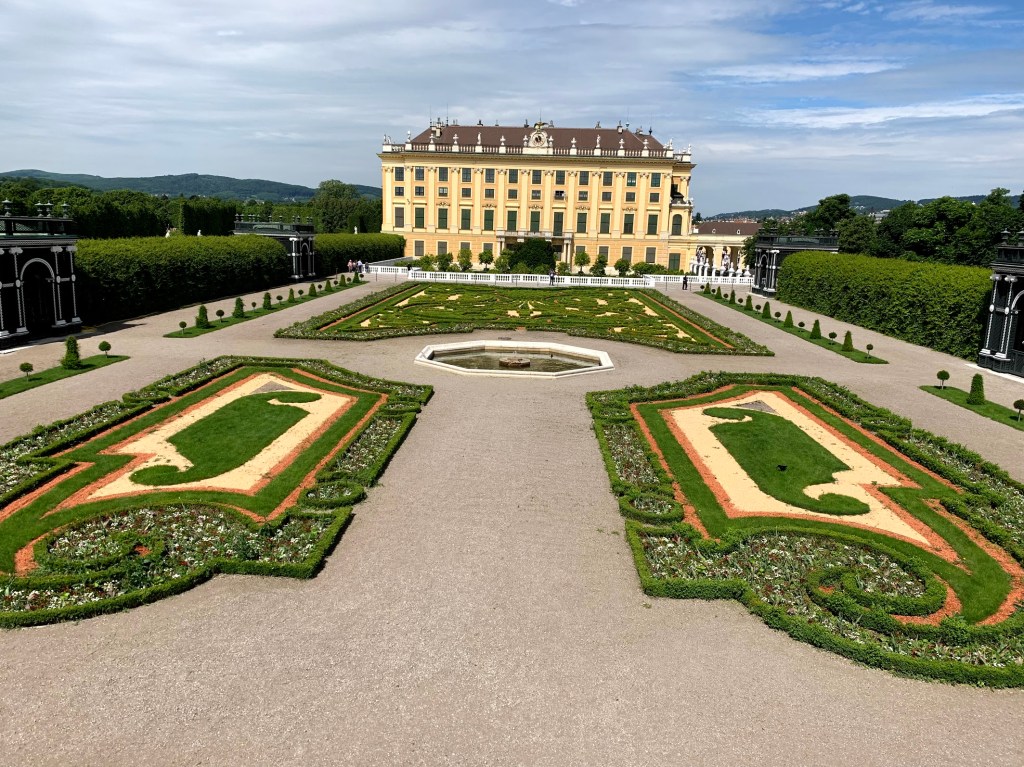
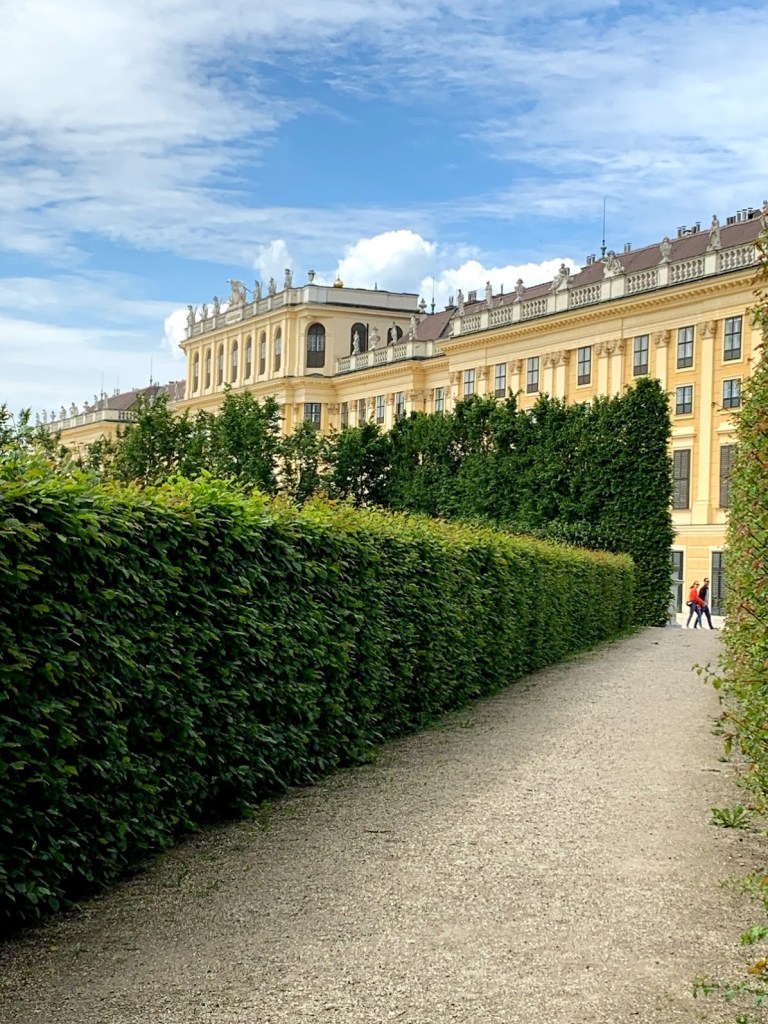
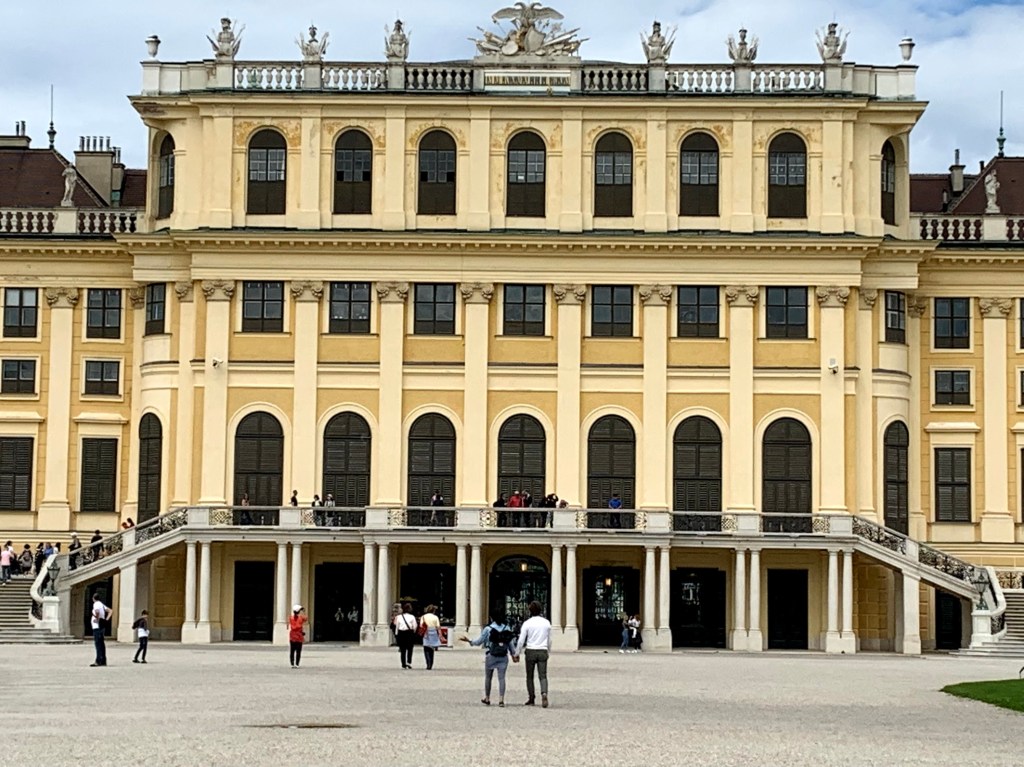
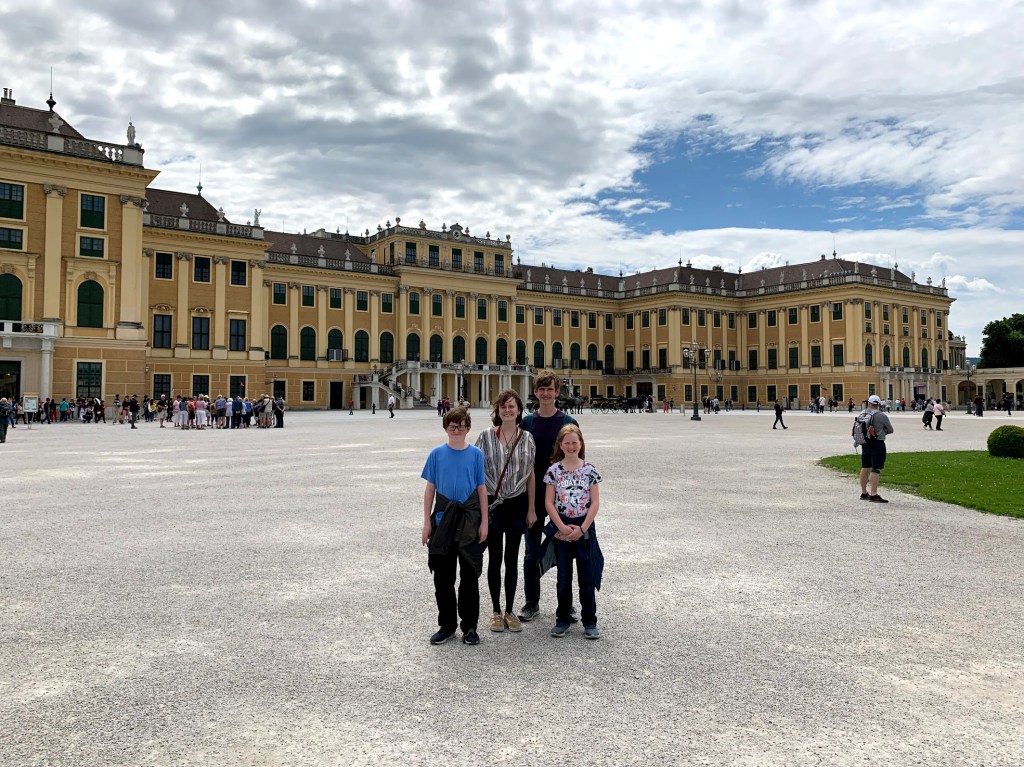
We woke up early because we had entry tickets to Schönbrunn Palace at 9:15 to see the Royal Apartments and Imperial Grand Rooms. Schönbrunn was the summer palace of the Hapsburgs, the reigning royal family of the Austro-Hungarian Empire. Built in the 17-18th century the stunning Ricoco yellow palace and its formal gardens was a visual feast. The reign of two different monarchs were depicted in the royal rooms; the mid 18th century reign of Empress Maria Theresia and the last great Hapsburg rulers of the late 19th century King Franz Josef and his wife Elizabeth (Sisi). Franz Josef actually reigned 68 years and died in 1916 during WWI. He was the longest ruling Hapsburg king in the dynasty’s 600+ year history. His nephew Karl, the last official Hapsburg king, was forced to absolve the monarchy in 1918.
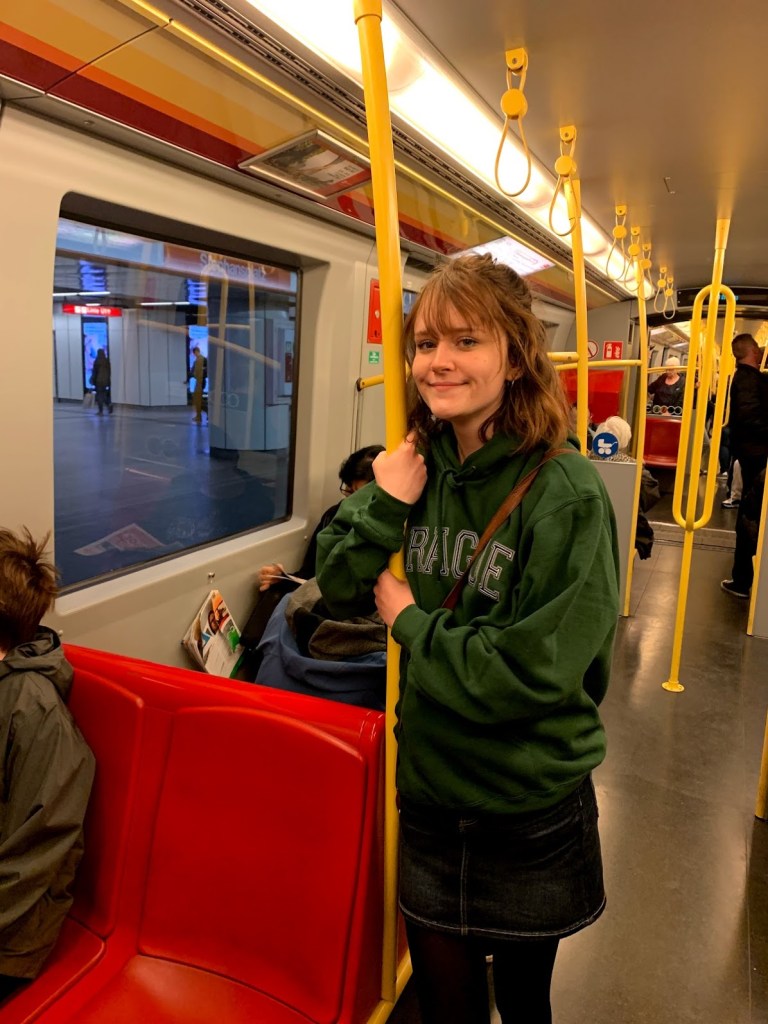
Turah’s first subway ride was in Vienna!
31 May 2019
Schonbrünn Palace in Vienna, Austria

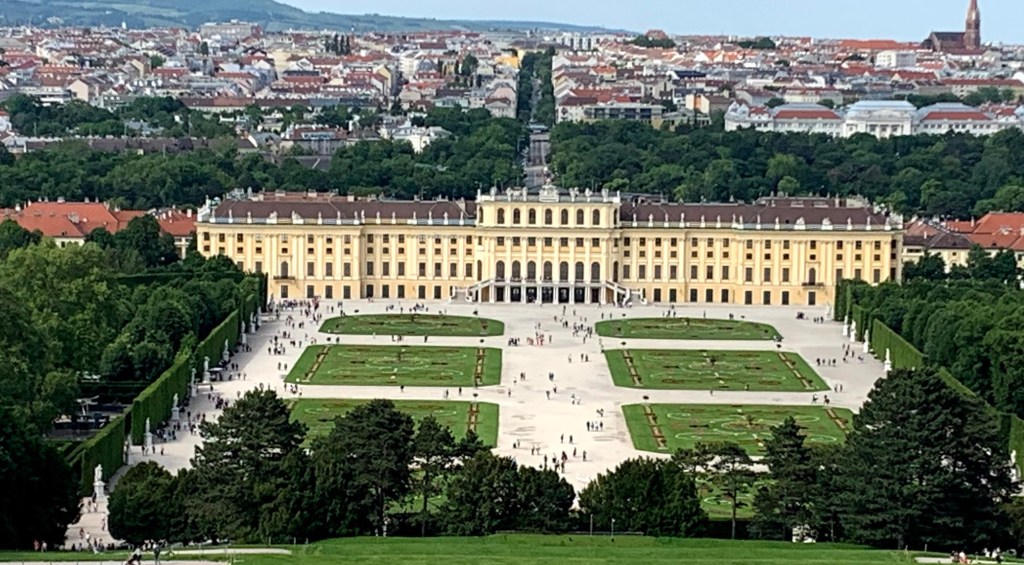
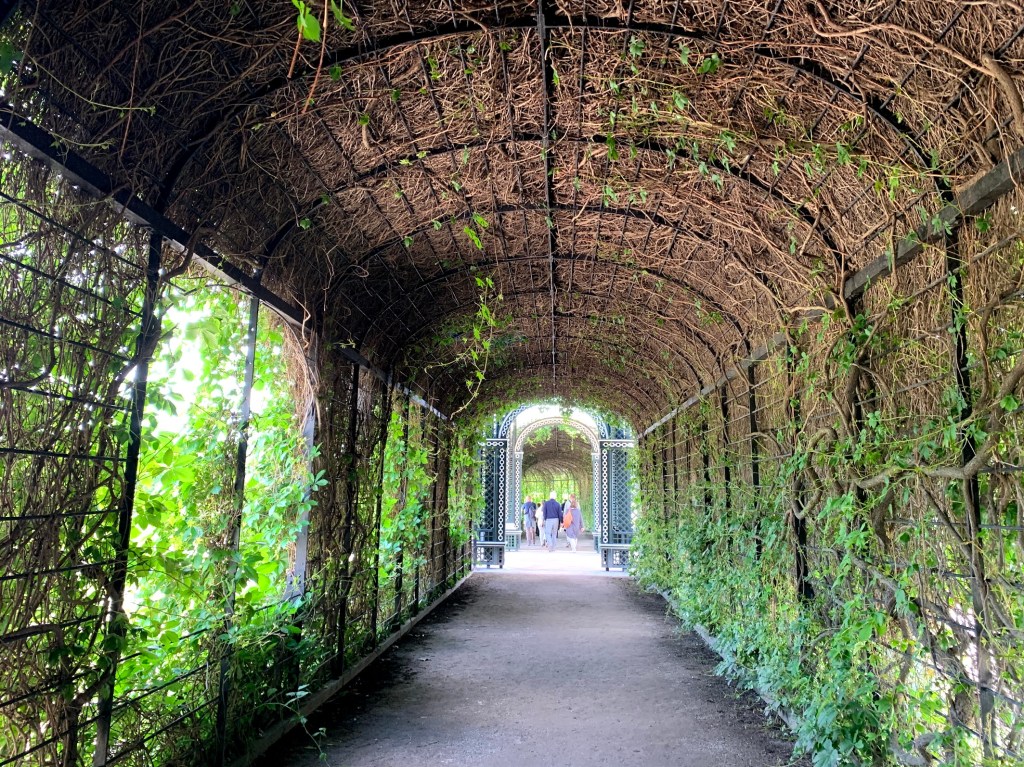
After viewing the ornate royal apartments and staterooms we entered the Privy Garden and strolled along the vine covered arbor paths. Climbing a set of stairs we found ourselves looking onto a magnificent view of the gardens and side of the palace.
At 11:00 we had lunch at the palace café and then temporarily left Schonbrünn Palace. It was a lovely spring day so we didn’t mind having to travel 20 minutes back to the innerstadt in order to make our 1:00 tour at the Vienna Musikverein. This famous music hall has personal significance for our family. Every year we have gathered on New Years Day and watched  “The Vienna Philharmonic: New Years Day Concert”. This annual concert, of Strauss Famous music and other famous Austrian composers, is held in the Golden Hall of the Musikverein.

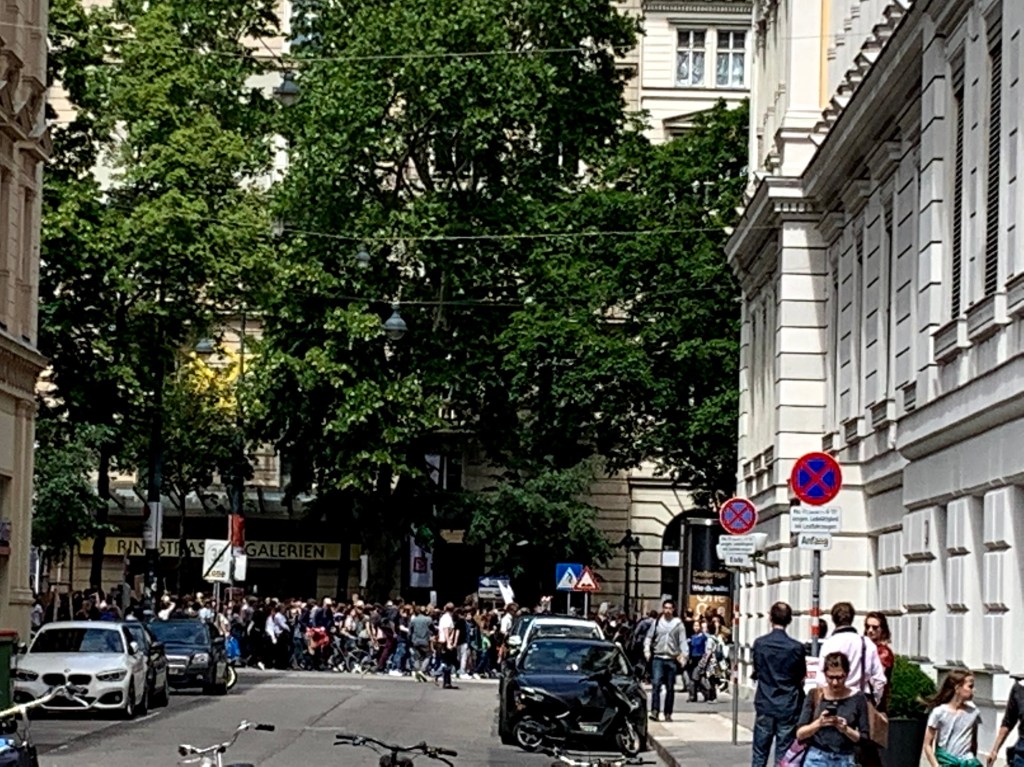
Two months ago we attended a concert at the Musikverein, but the tour really helped us understand in depth the history and architecture of the building. Our guide was informative and he told us not only about the famous Golden Hall, but also the Brahm’s Chamber Music Hall and the Rehearsal Rooms, which are 30 meters under the Platz (square) in front of the Musikverein. I was particularly impressed with the four full size rehearsal spaces.  Upon exiting the Musikverein we could hear and see a public demonstration against a political party currently under investigation in the Austrian Parliament. It was interesting to witness, a few blocks away, the people’s voices in action.
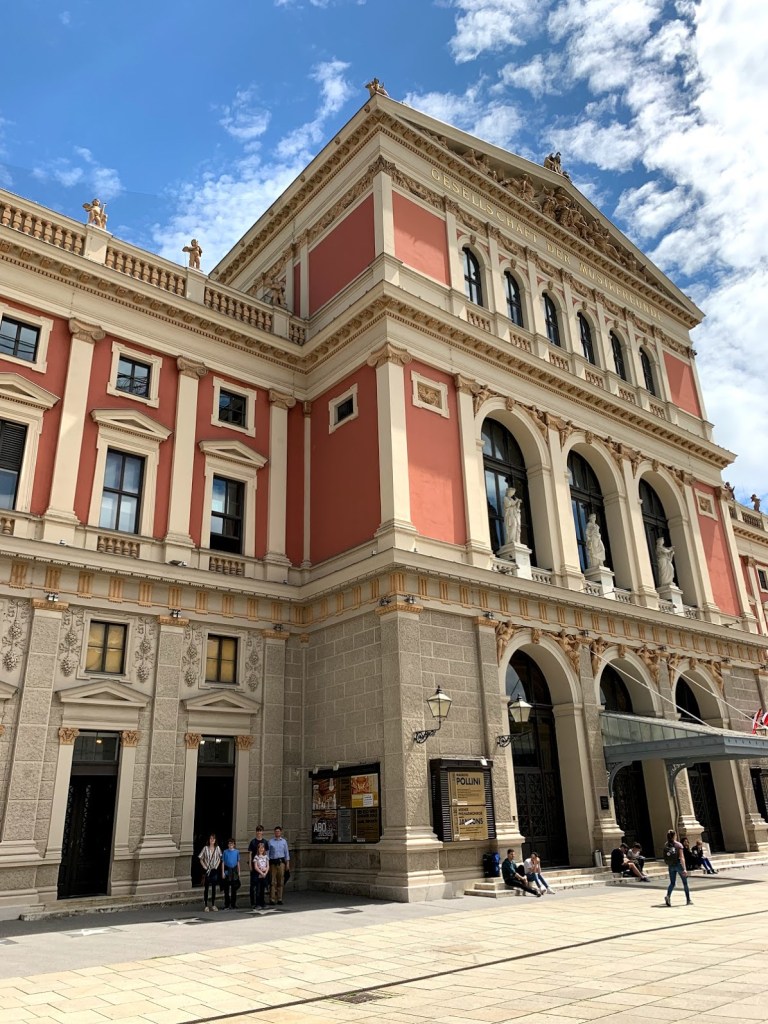
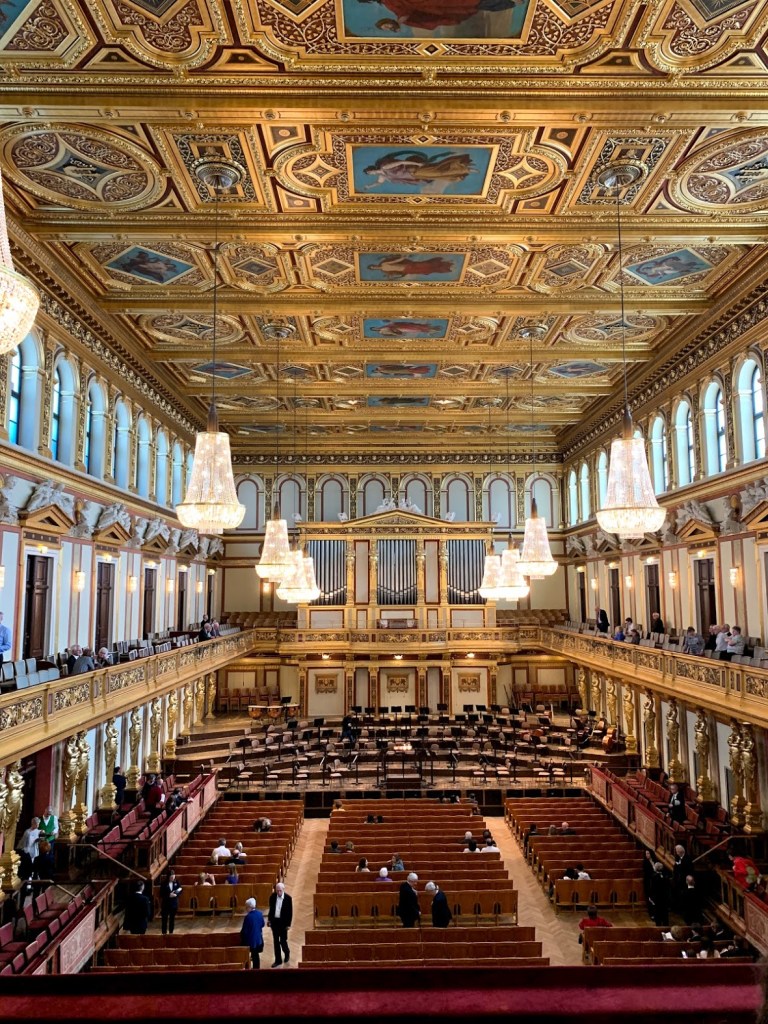
The Musikverein in Vienna

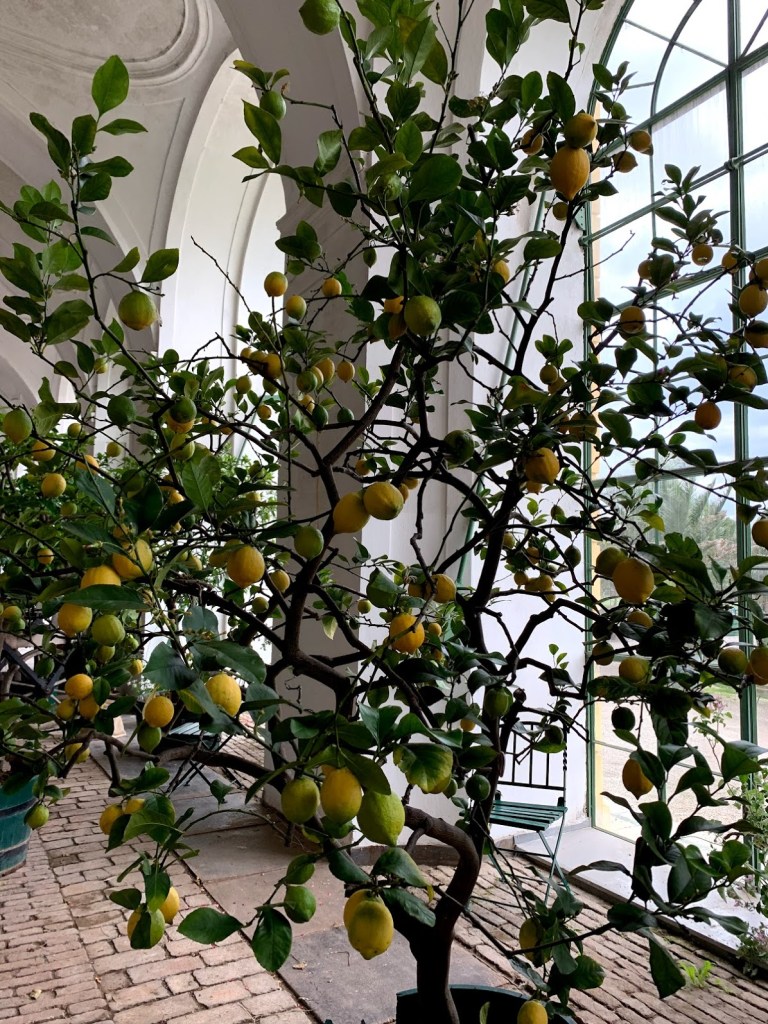
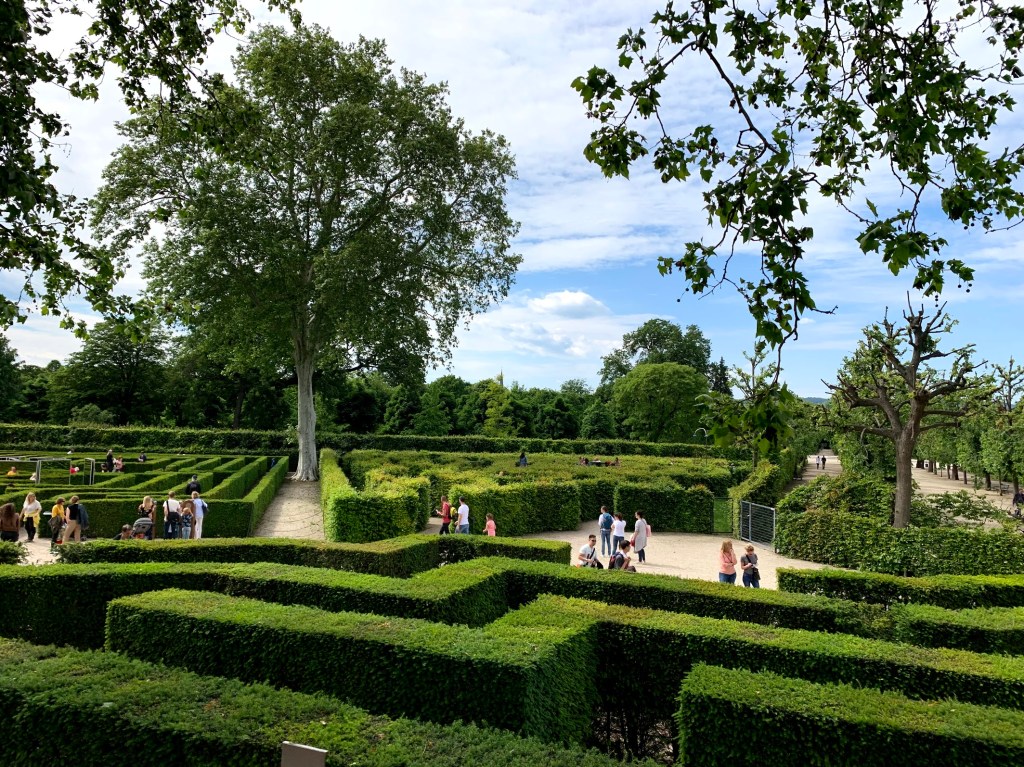
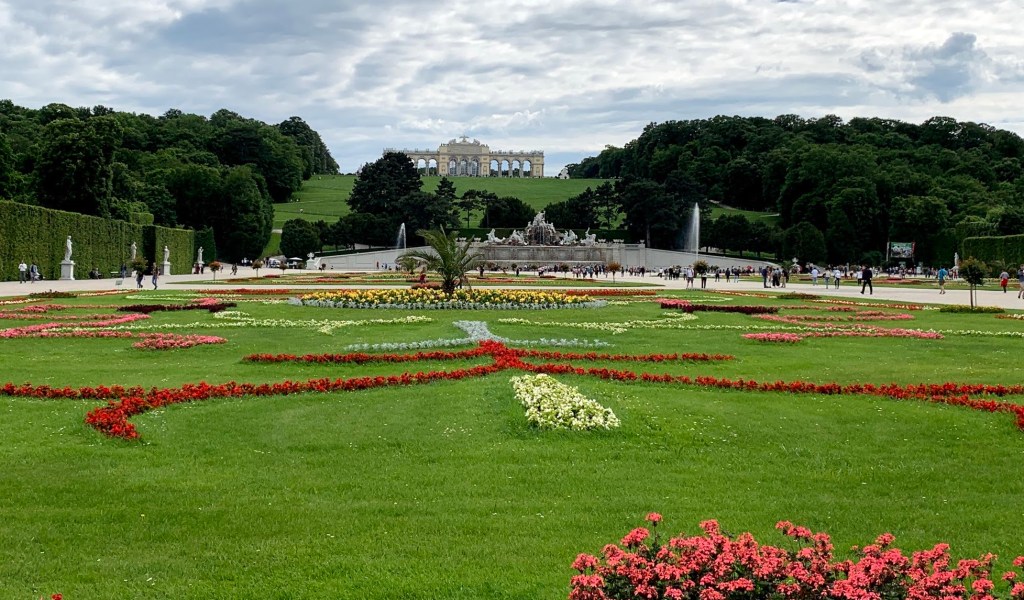
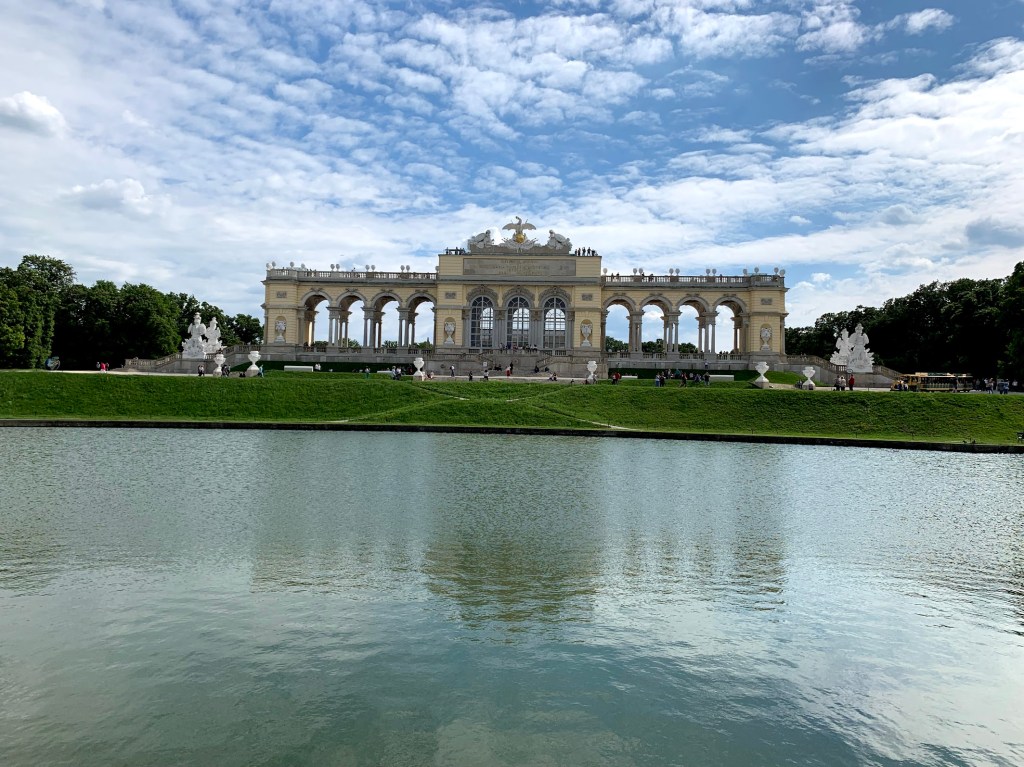
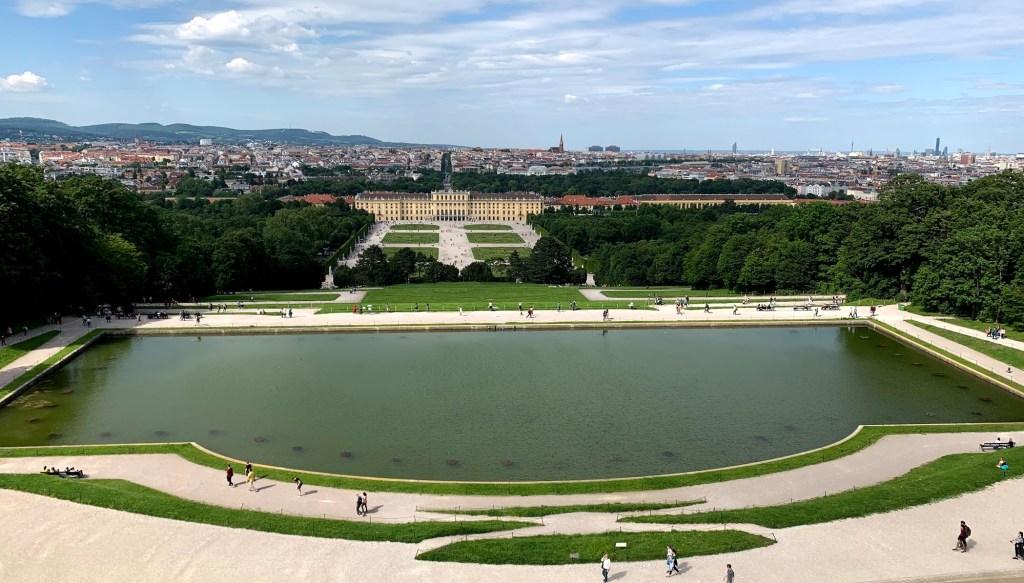
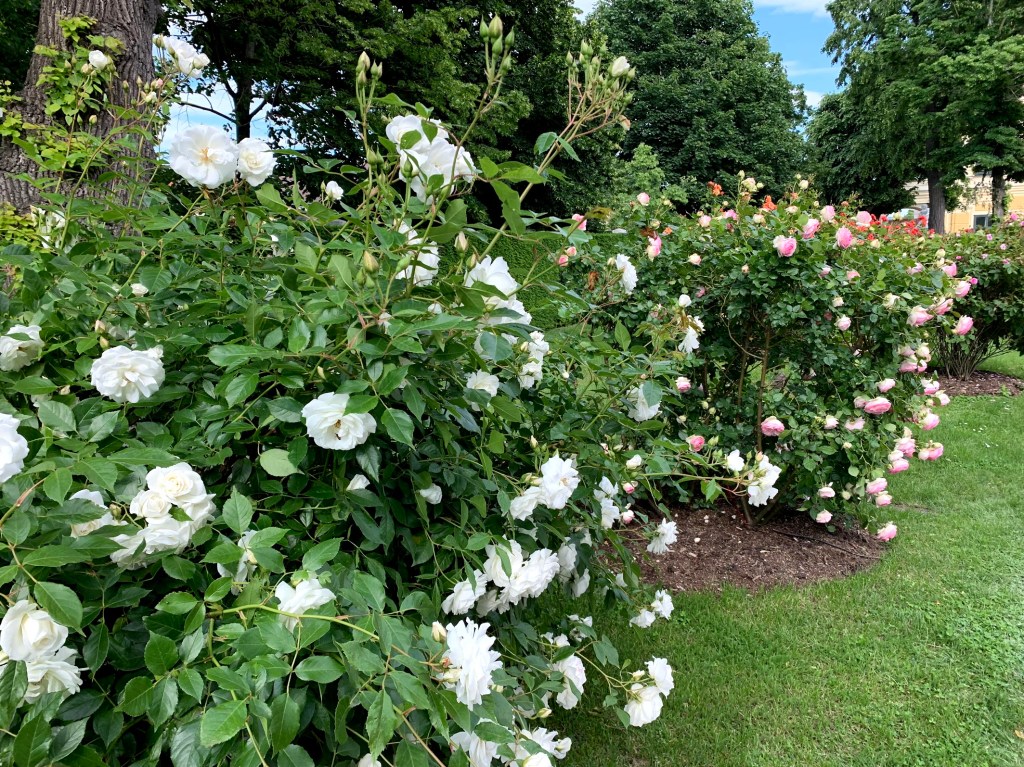
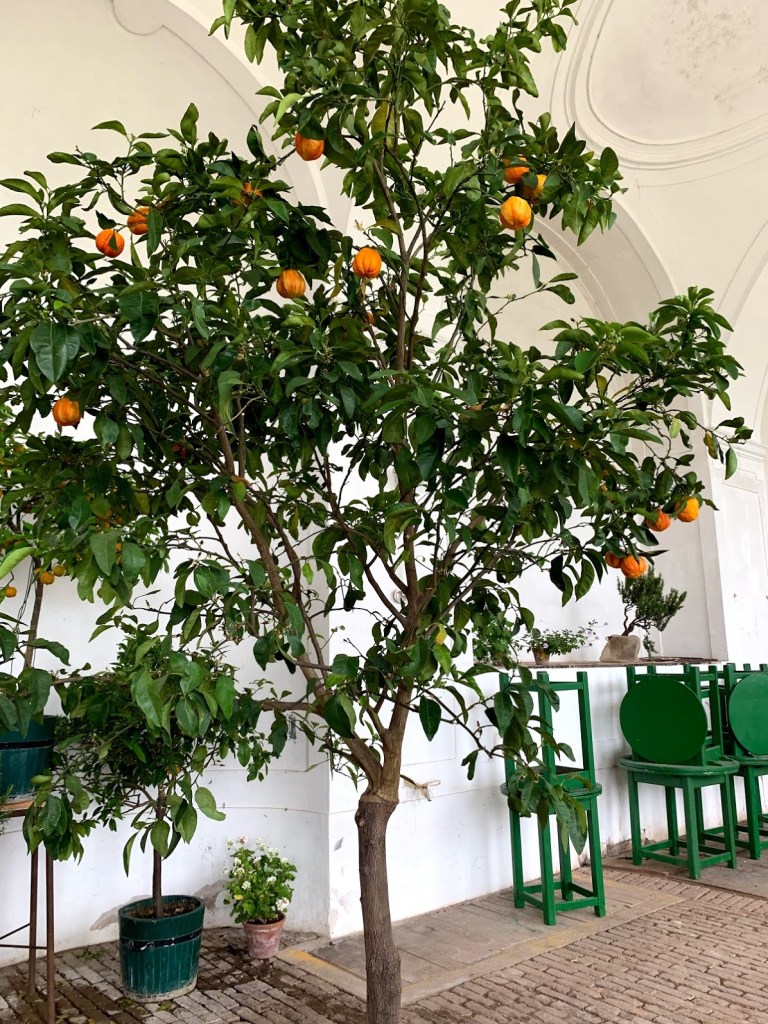
Within 20 minutes we were back at Schonbrünn Palace to continue the extensive garden tours. We saw the Orangery (which had palm trees and lemon trees), the fun maze gardens, and finally the hike uphill to the “Gloriette”. This Grecian double colonnade sits atop one of the highest points in Vienna.  The views of the Palace, gardens, and entire city of Vienna were phenomenal! The sun was shining and the cool breeze made it very pleasant to be on the hillside! Back down the hill we strolled through the fragrant rose gardens. There was a little café tucked behind the roses where we had a refreshing drink and afternoon snack.
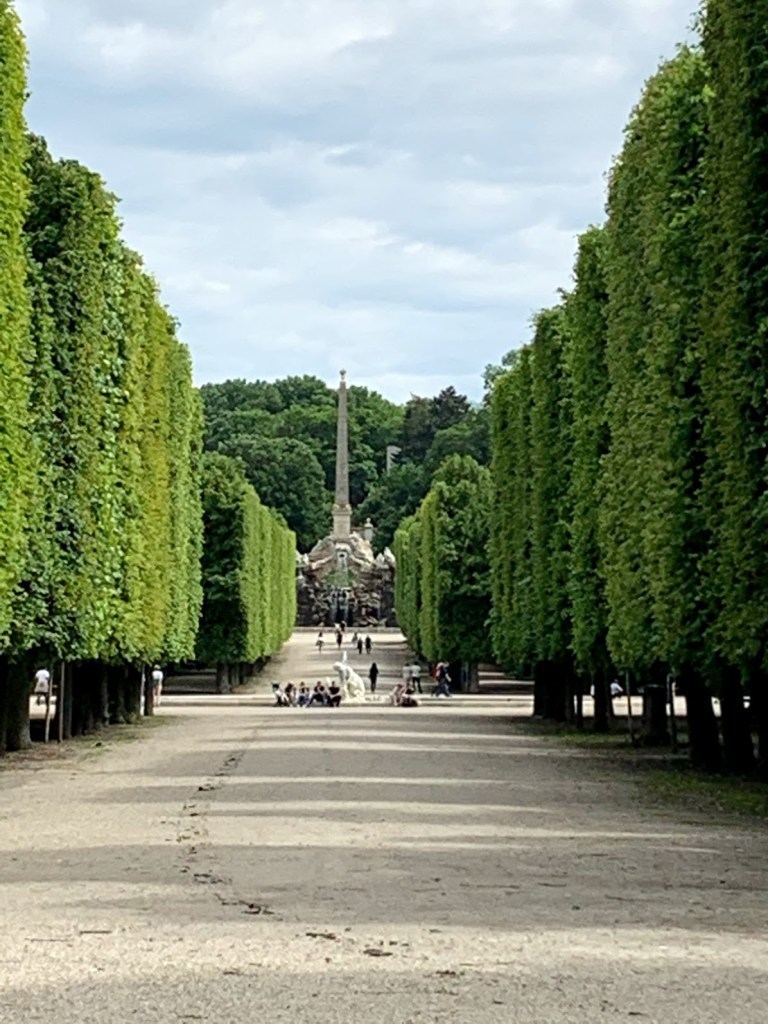
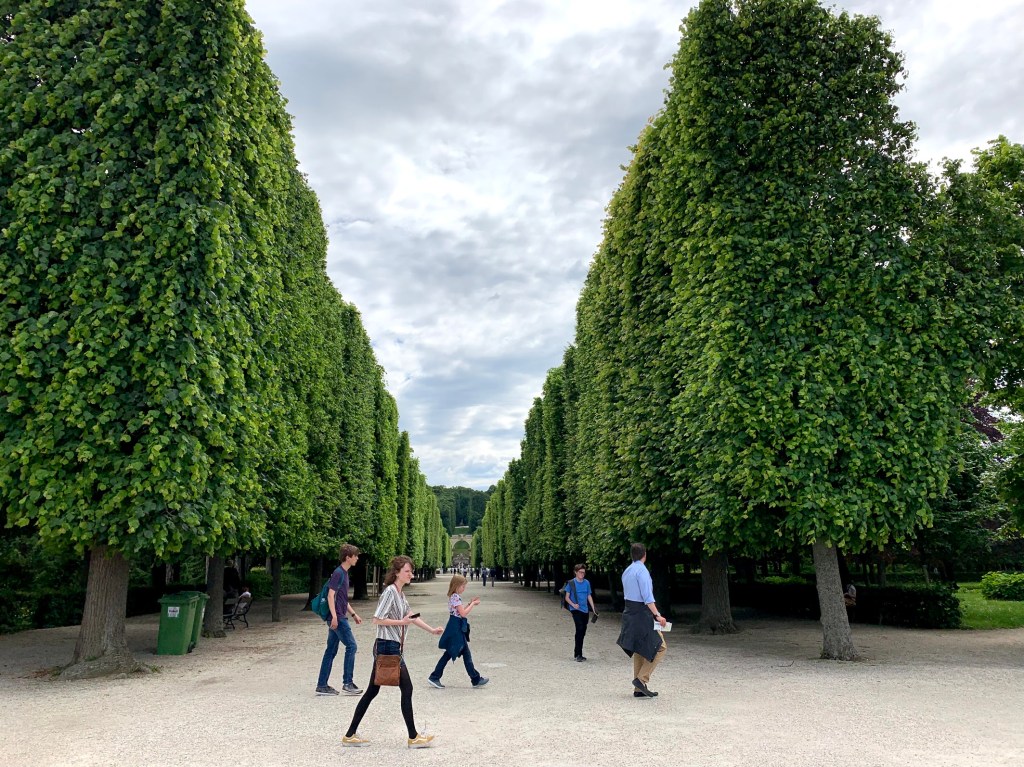
There were several tree lined avenues within the Palace grounds
Formal Gardens and Gloriette
The Gloriette
I took this photo after climbing to the top of the Gloriette
Close up of Schonbrünn Palace as seen from the Gloriette
Rose Garden

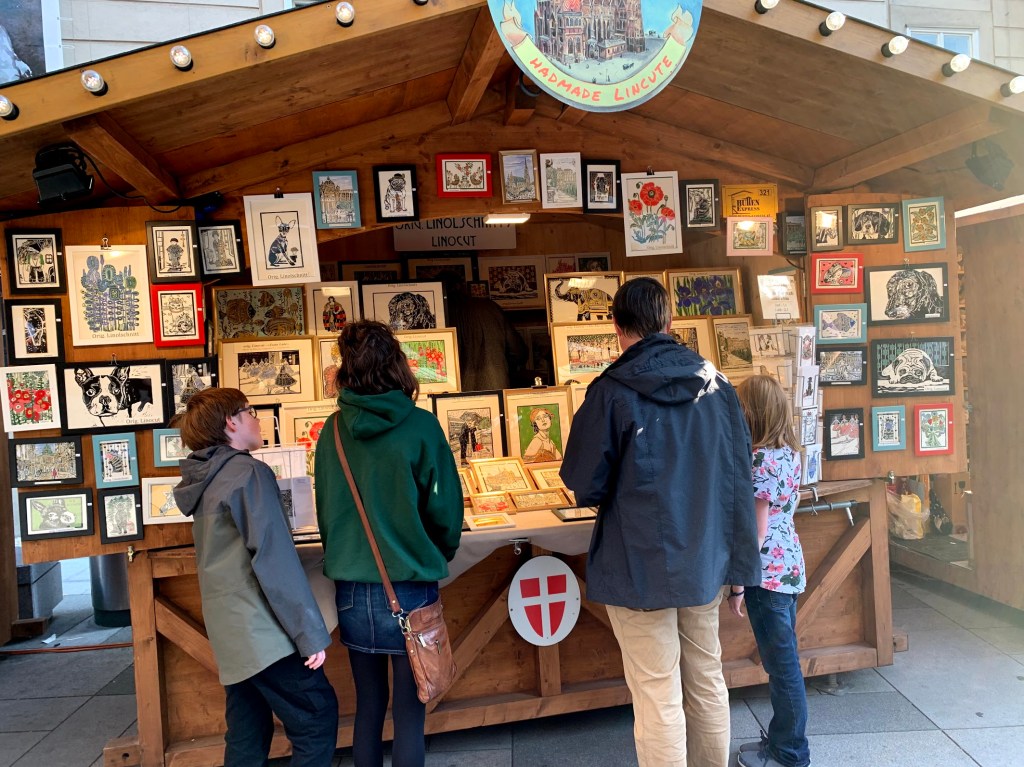
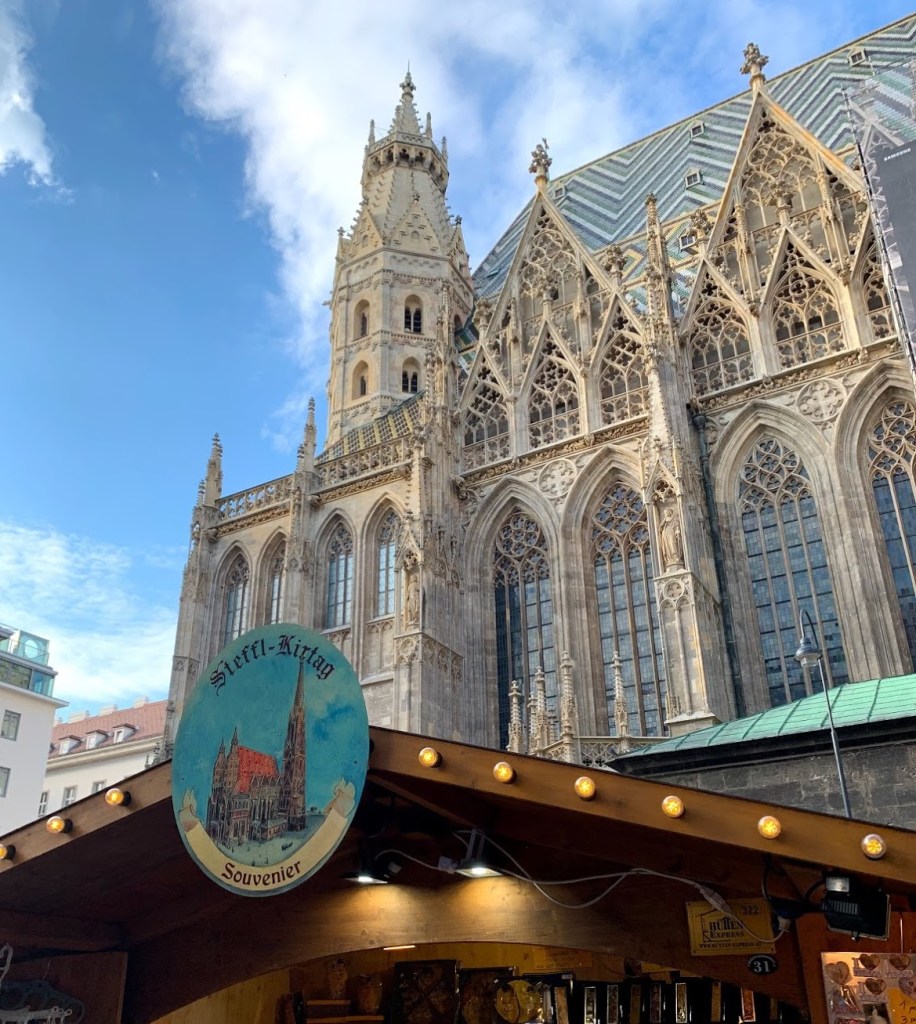
That evening we took Turah to our favorite Italian chain restaurant, Vapiano’s. We’ve eaten at several Vapiano’s throughout Europe. After supper we meandered around in the St. Stephen’s Platz Market. All of the vendors were selling local foods and crafts. We purchased Austrian honey and cheese. Our favorite stall belonged to Mikal, who was originally from Russia but had immigrated to Austria when he was a teenager. He was an artist and his art medium was ink linocuts. Turah chose two art pieces, one for herself and one for a friend. We also purchased two lovely linocuts, one of cats and the other of St. Stpehen’s, the Cathedral which majestically rose in front of Mikal’s art stall… as it has done for hundreds of years overlooking other market vendors.
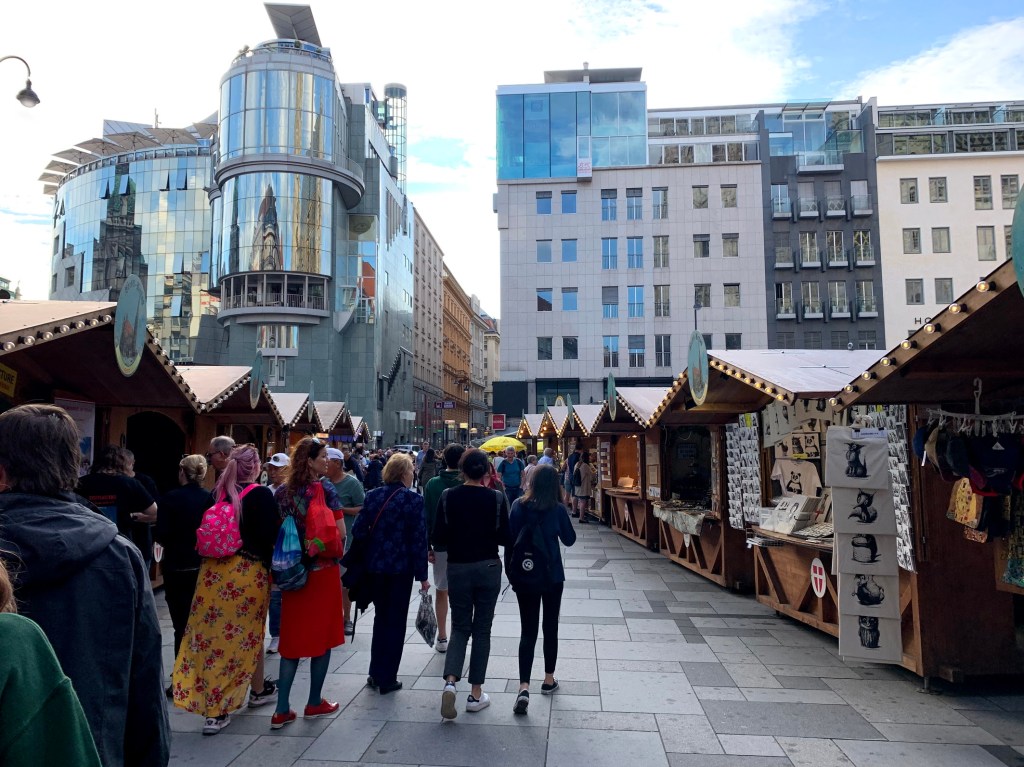
This photo was snapped just seconds before Mikal turned around to help us
I took this photo of St. Stephen’s Cathedral standing in front of Mikal’s booth.

Golden Fields

We checked out of our apartment and bid Prague goodbye! After being delayed on the highway for 30 minutes and Google warning us of future backups. Robert plotted another course for us to take to Vienna. It was better to drive through the charming villages and farmland of the Czech countryside.

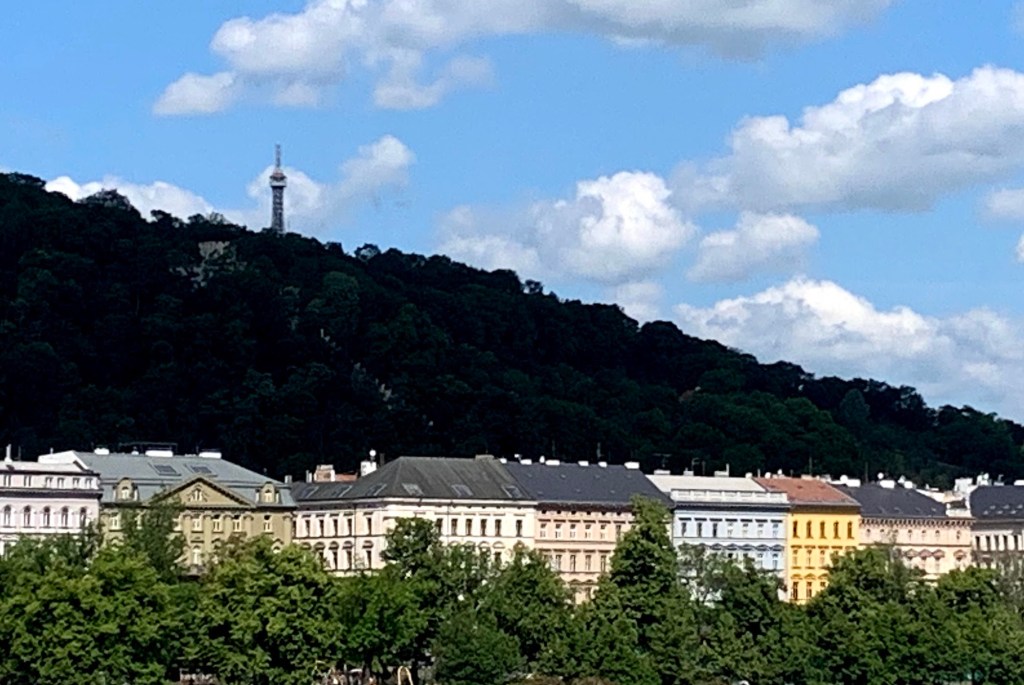
One last view of Prague
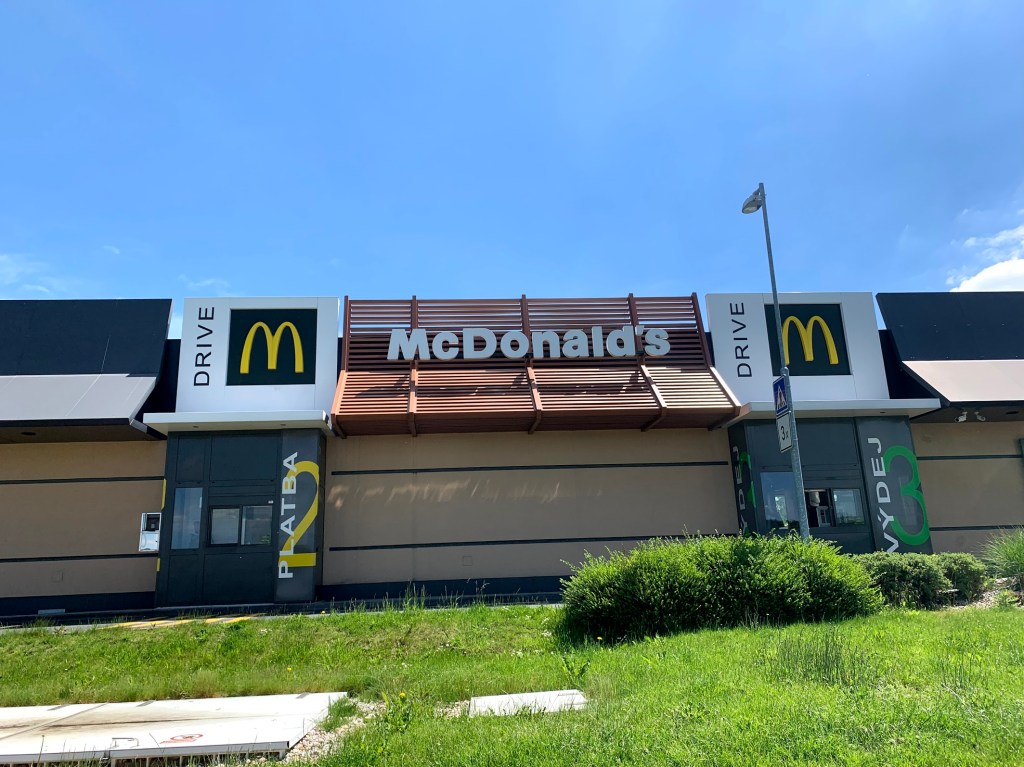
After being stuck in traffic we got off the highway and ate launch at a McDonalds! They had some unusual sandwiches and even spring rolls. It was all yummy.

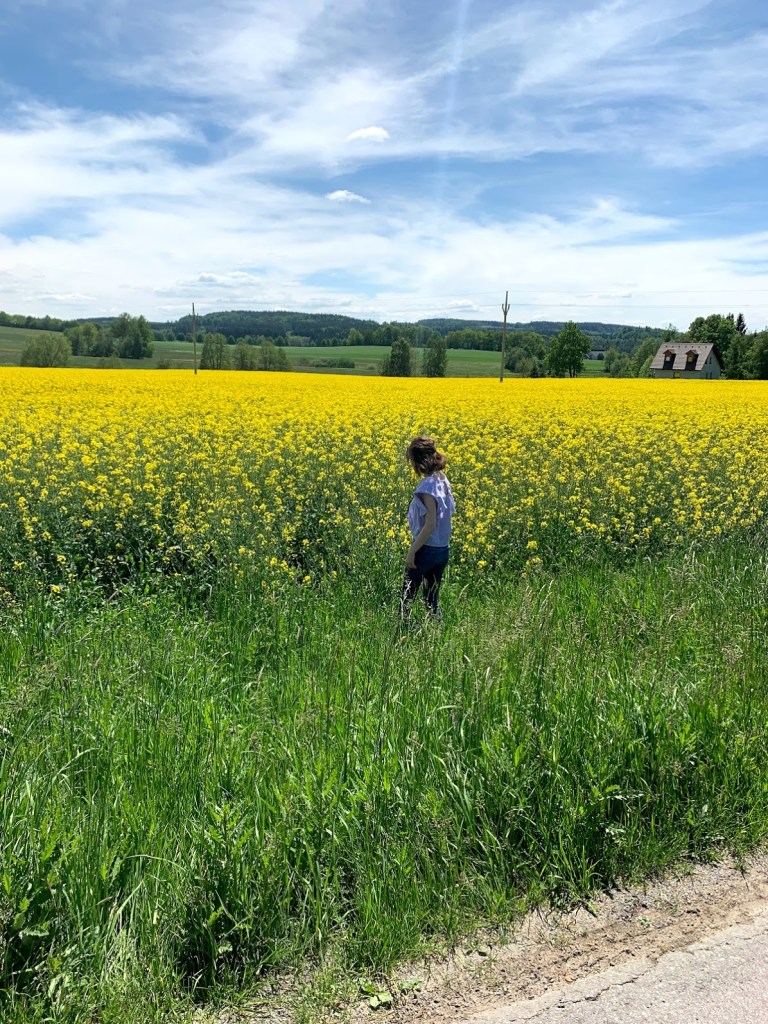
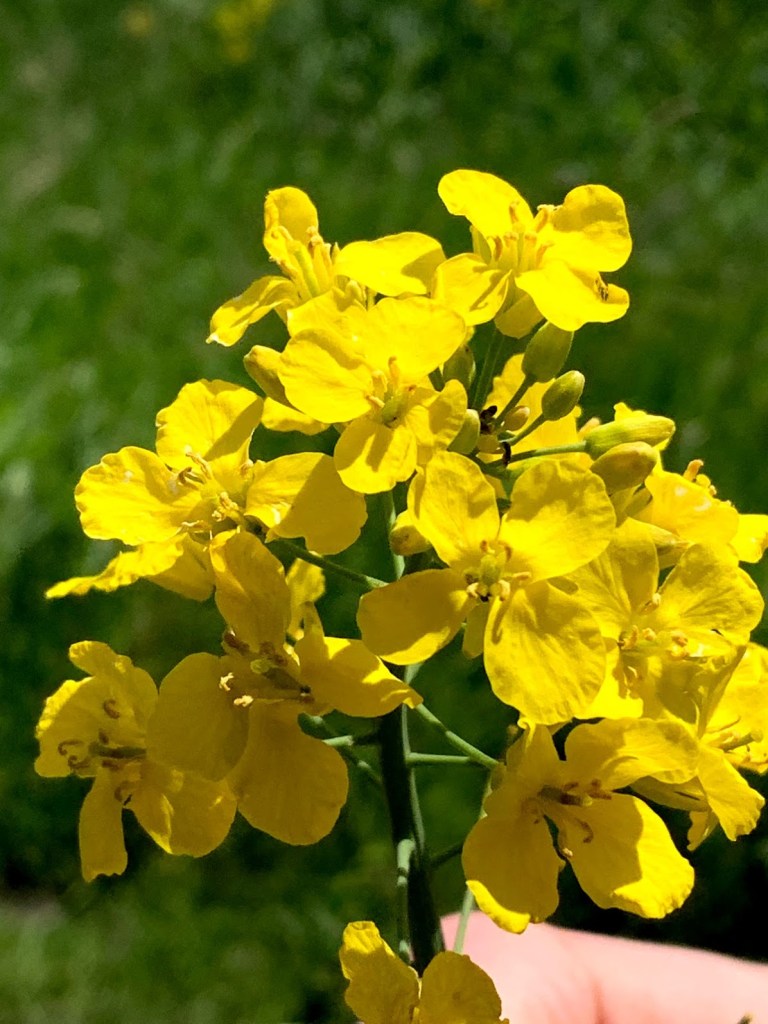
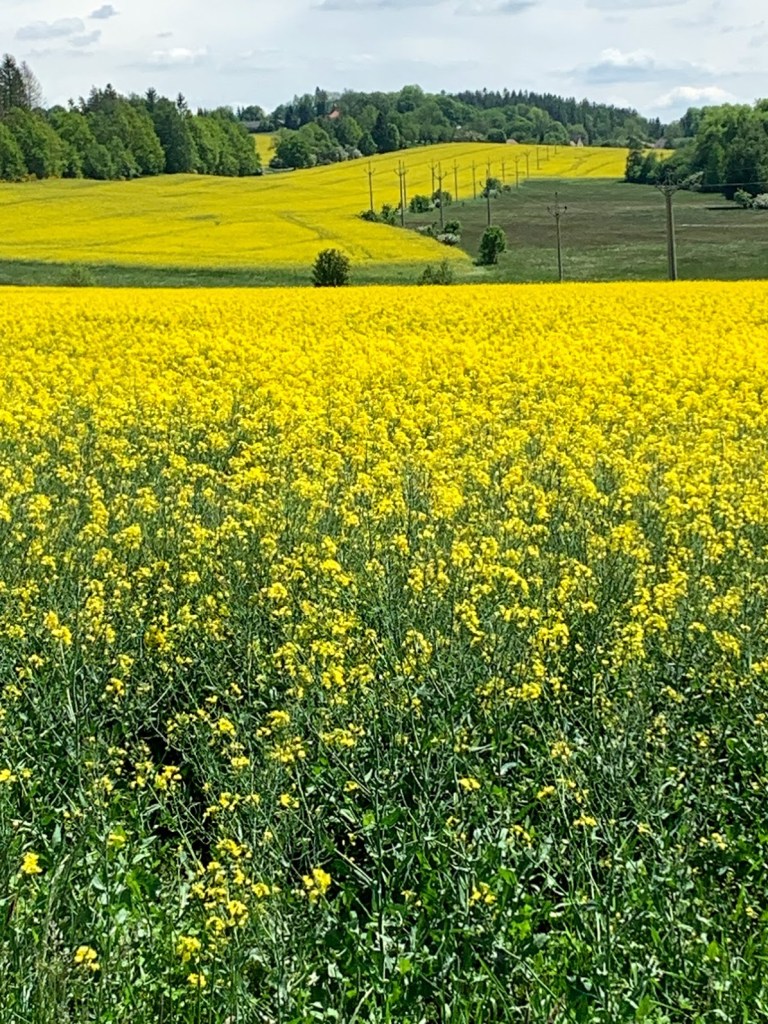
I’m glad we were forced off the highway because the Czech countryside was breathtaking. Our eyes were treated to rolling green hills, colorful little villages, and fields of yellow flowers offset by large sections of woodland. Curious as to what the yellow flowers were we stopped and took a photo. I later discovered the flower is the rapeseed plant used to make canola oil.

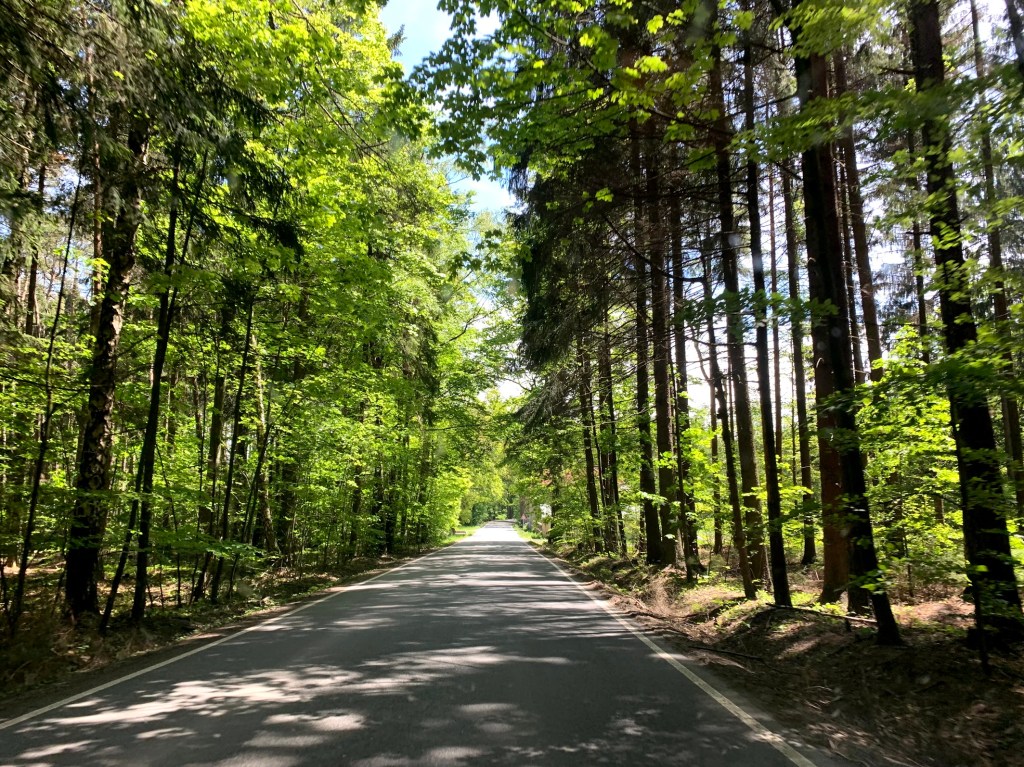
Drive through the woods
Golden fields

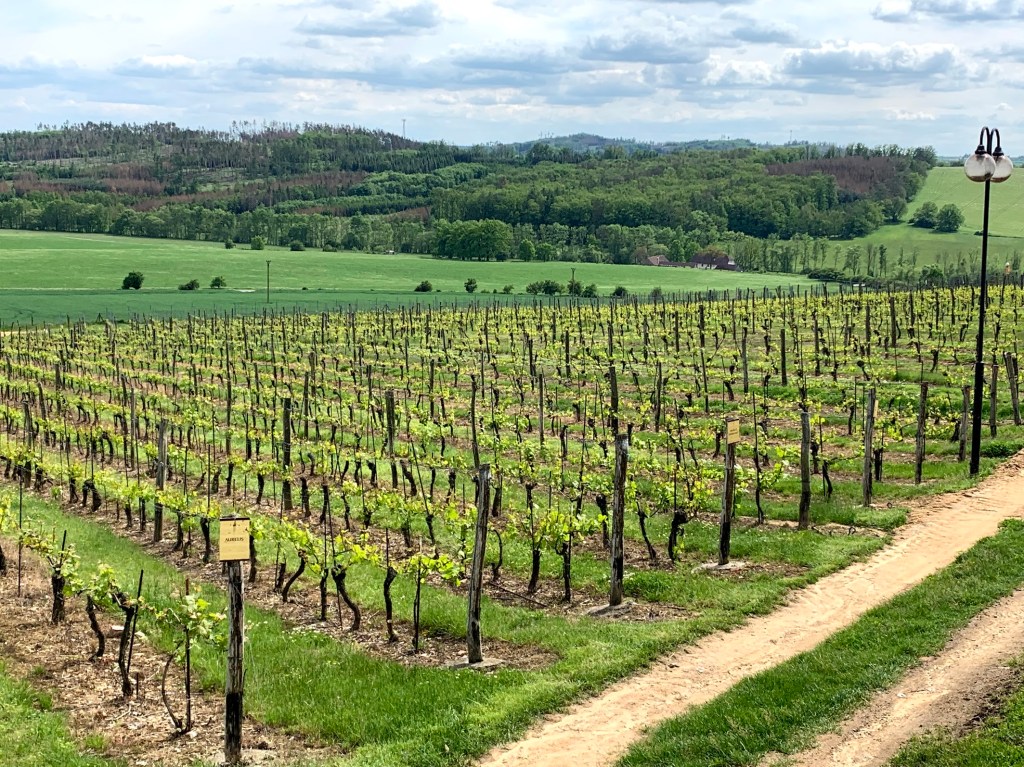
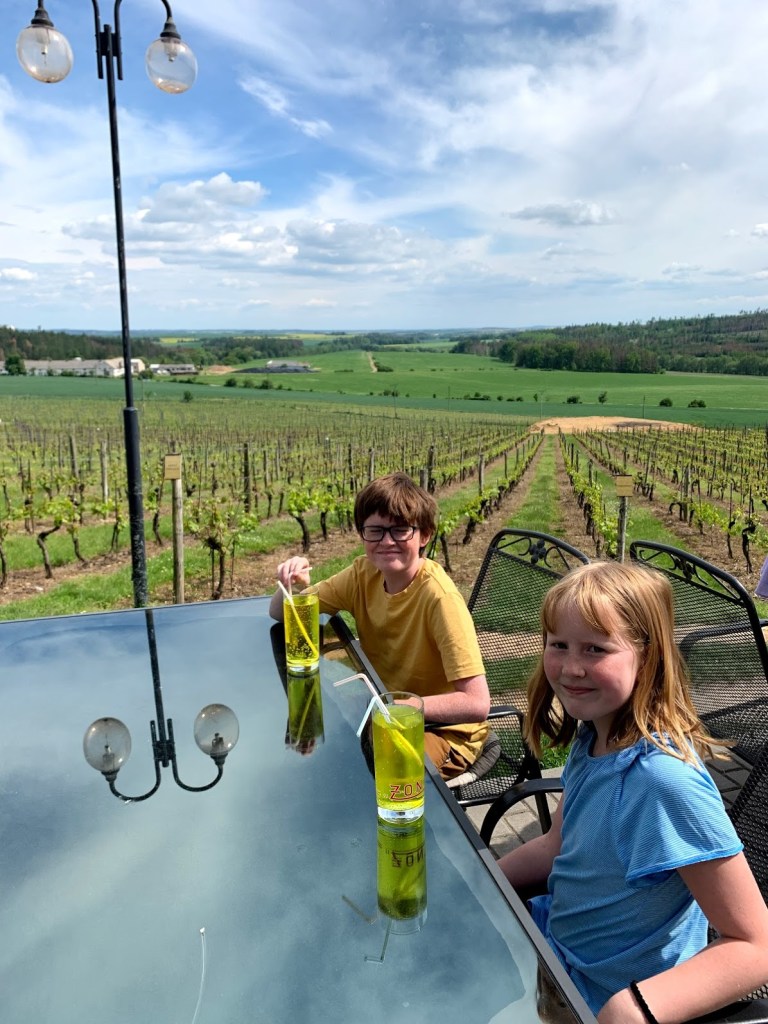
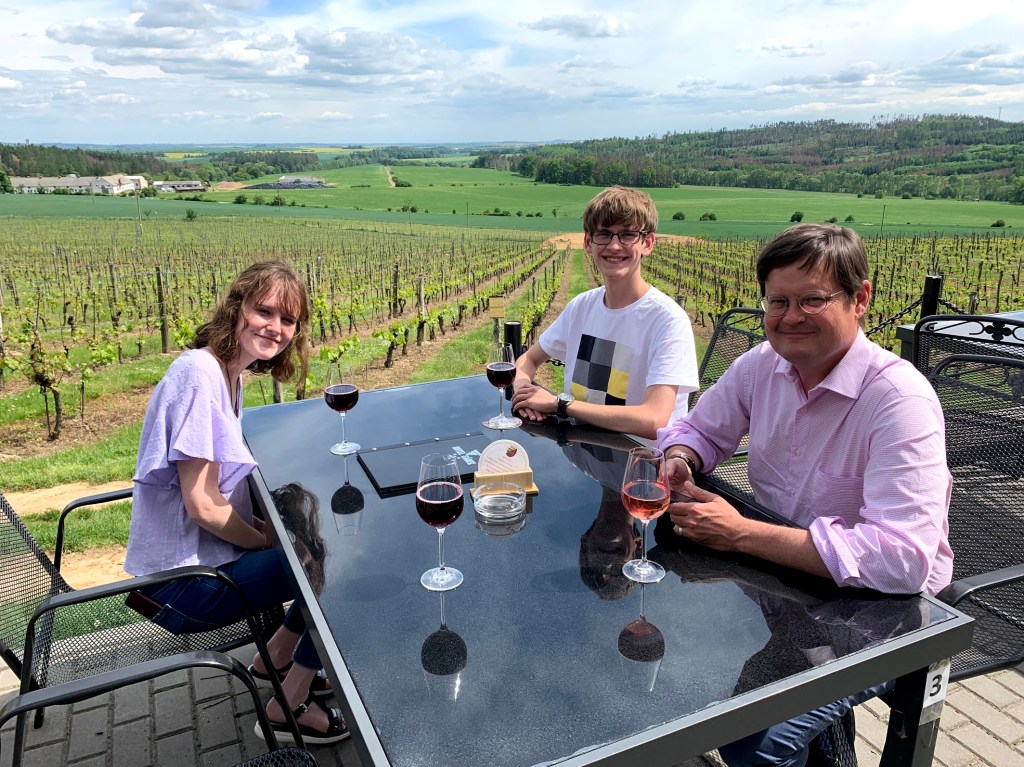
Near the Czech/Austrian border we stopped at a local vineyard to have a glass of Czech wine. We sat in the sunshine sipping wine grown in the vineyards beside us on the hillside.  Saduk vineyards and hotel was a small family operated affair and the staff was very friendly.

Saduk Vineyards
30 May 2019
Homemade lemonade
Ah the life! Sipping wine straight from the vineyard!
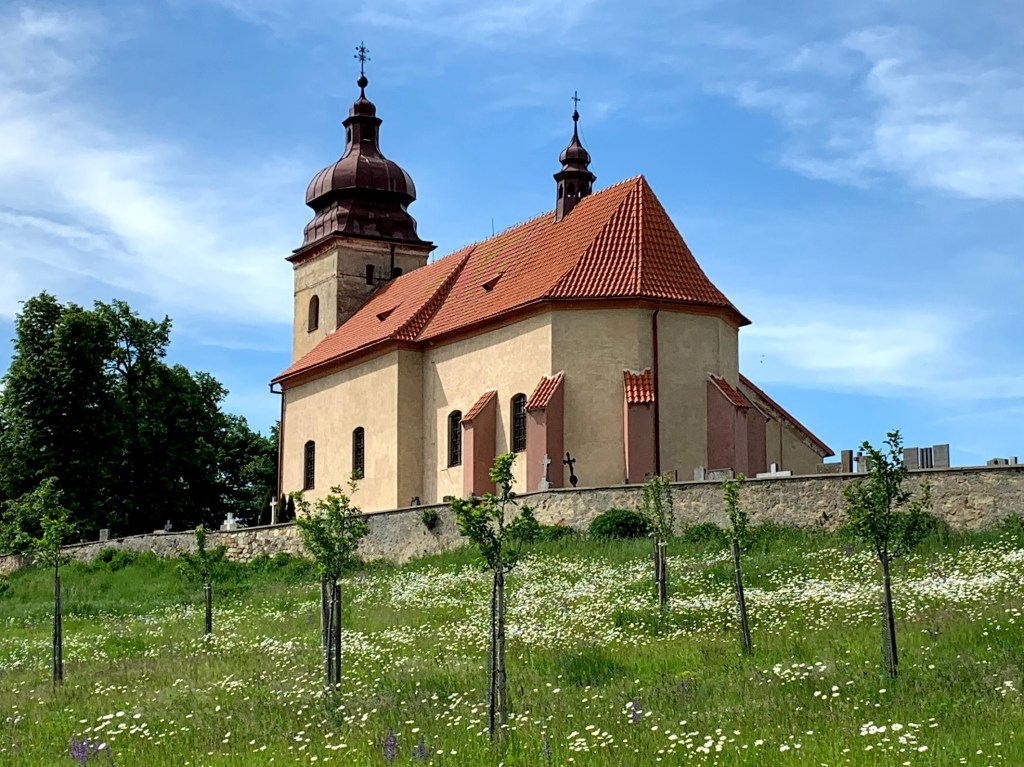
Just south of the vineyard was this lovely little country church

Once in Vienna, Robert dropped us off at our apartment and then turned in the rental car. Our apartment was little, but right in the heart of  Innerstadt Vienna. Because we had been to Vienna before, Liam knew his way around town. He decided to show Turah around by taking her out to find a local grocery and buy food for breakfast. Turah commented how surreal it is listening to her siblings communicate in German!
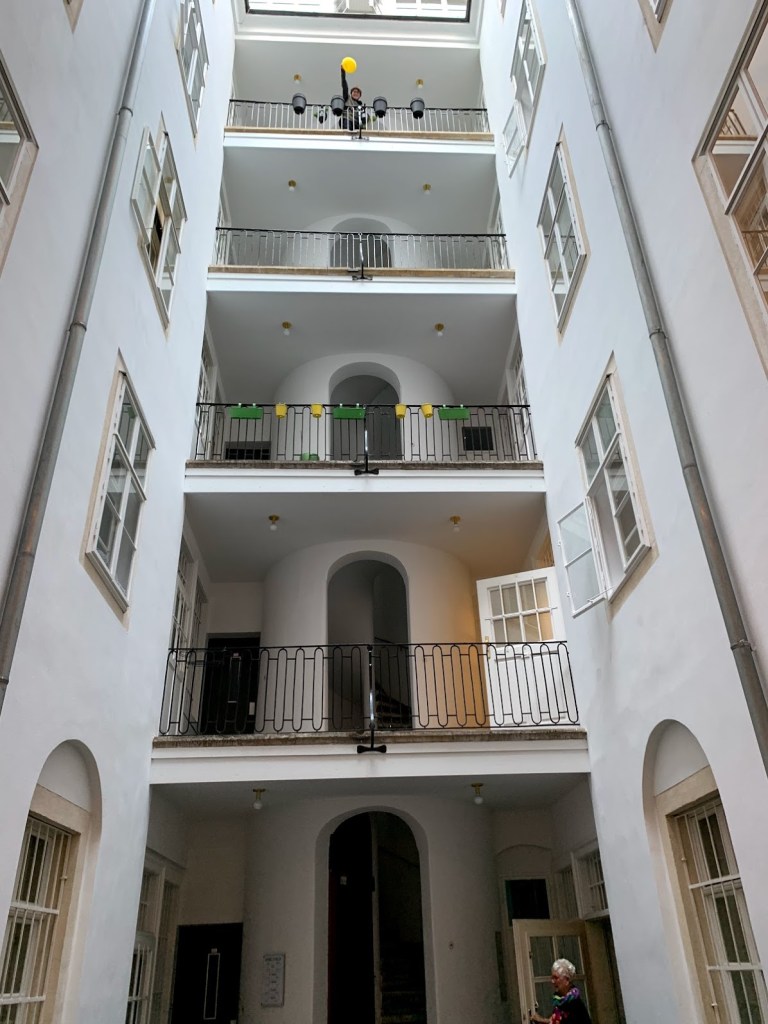
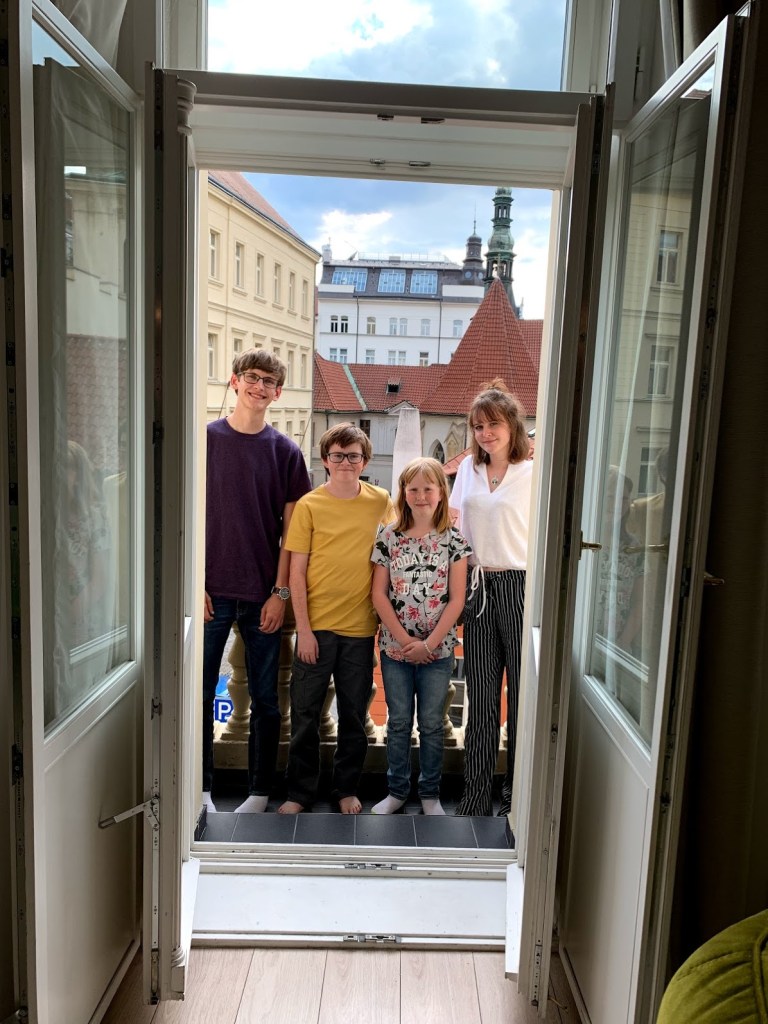
Our apartment was on the second floor. It’s the one with the door open. The apartments all opened onto a little courtyard, which had a door that accessed the main street outside.

The Master’s Apprentice

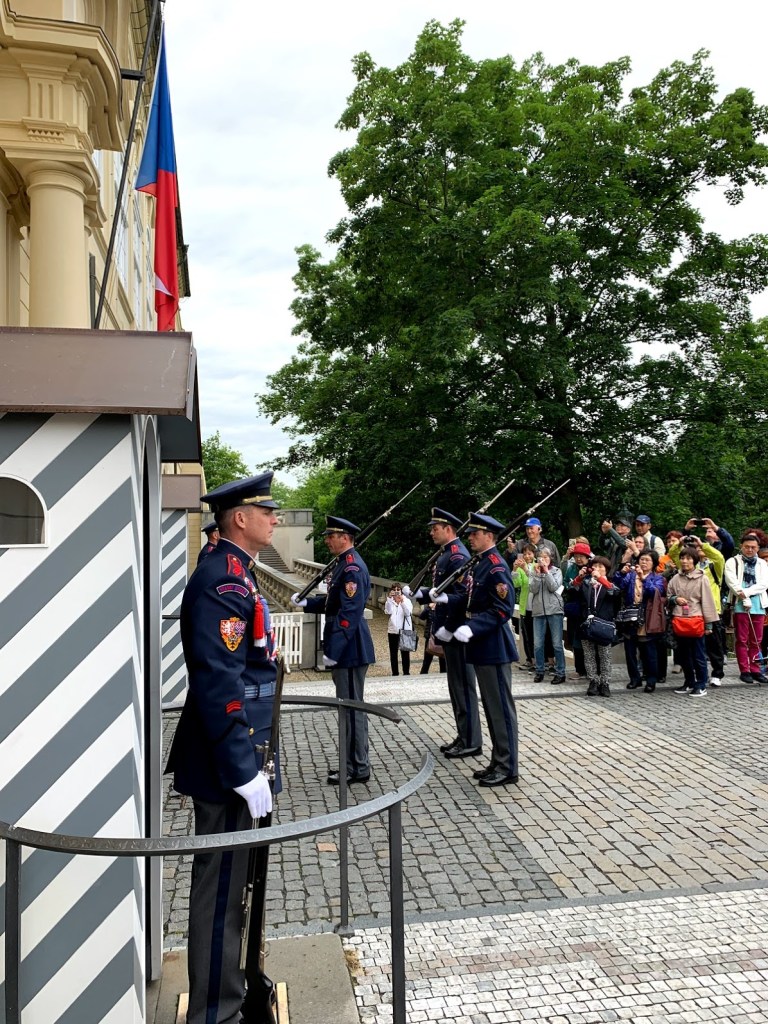
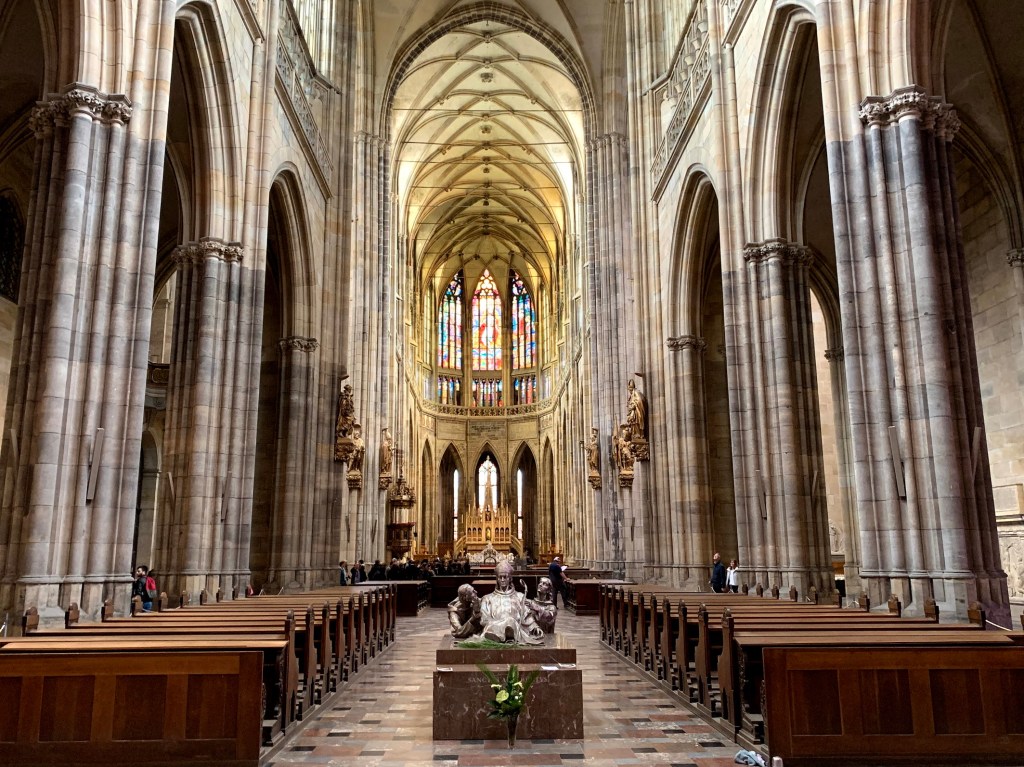
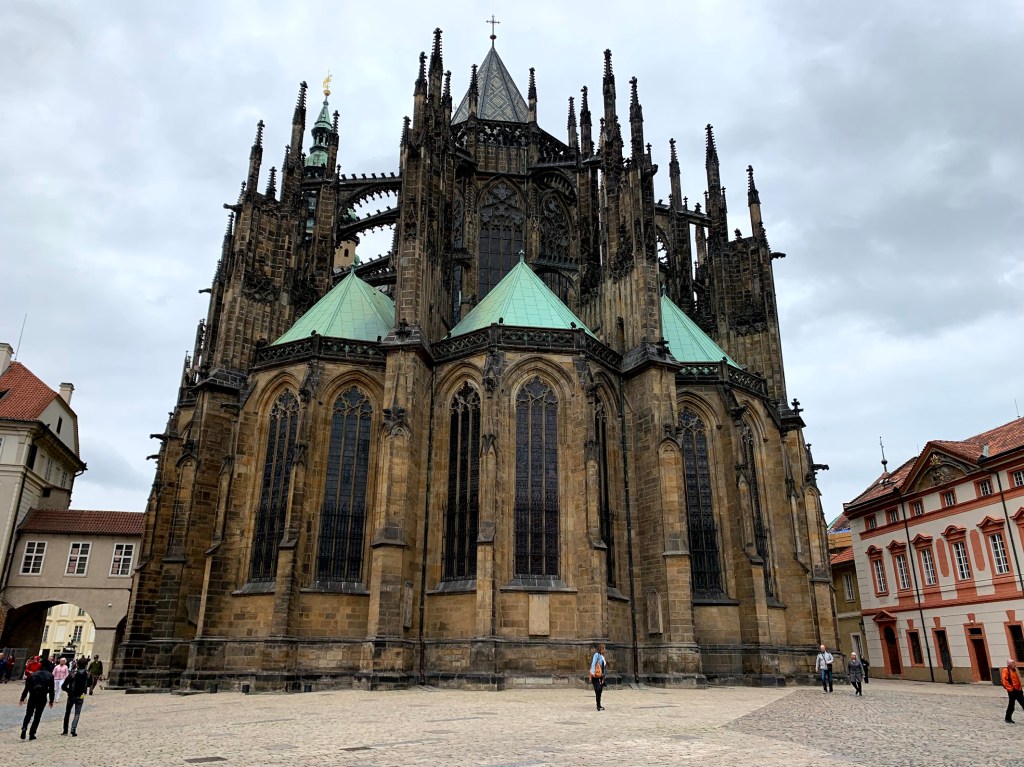
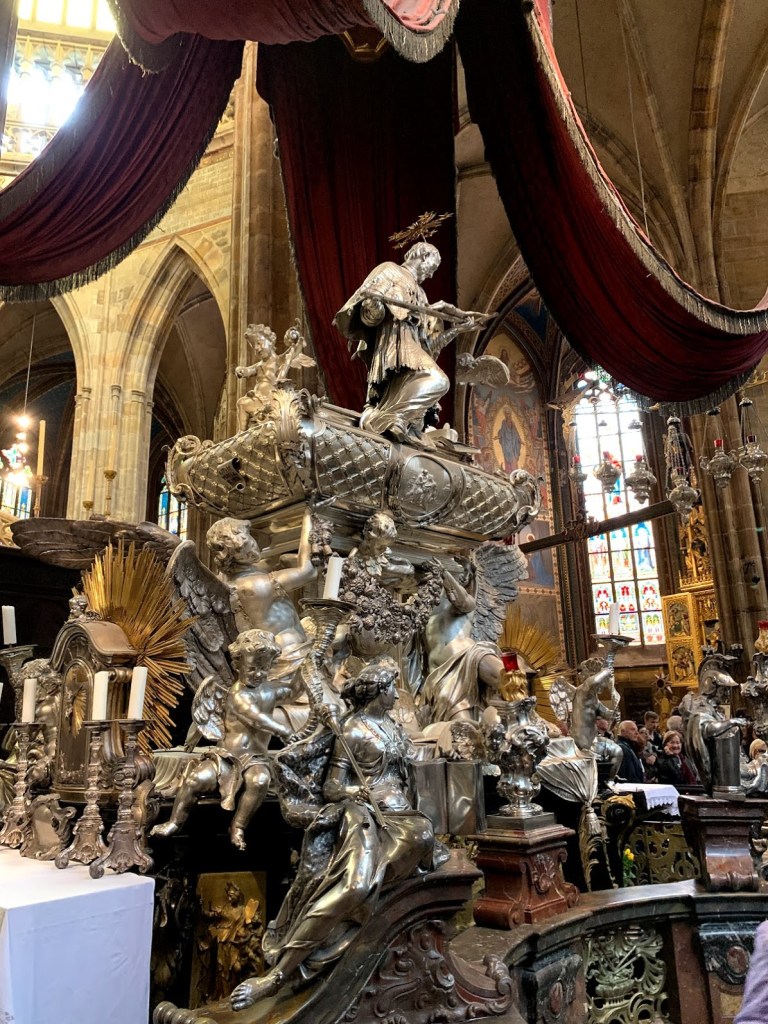
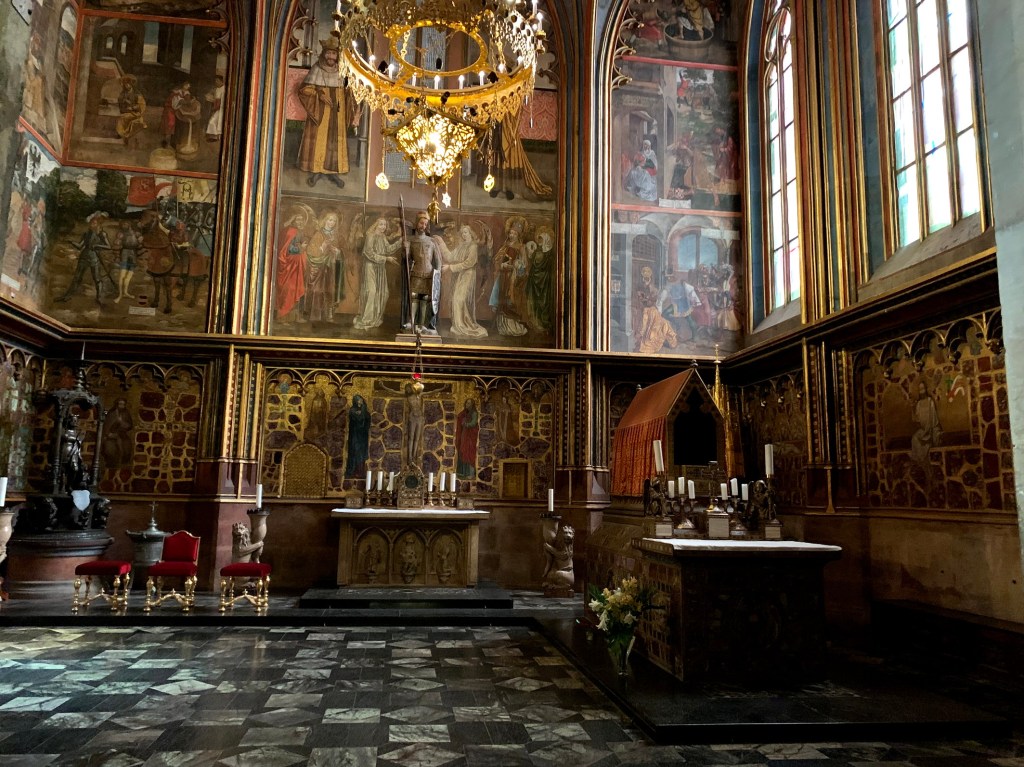
Cloudy, but not rainy we headed over the river via tram to Prague Castle. We arrived just in time to see the Changing of the Guard. After the 10-minute ceremony we entered the castle complex and went straight to St. Vitus, the 14th century gothic church that lies right in the centre of the castle. St. Vitus can be seen even from across the river with it’s dark stone and towering 15th century spires. Inside are the tombs of St. Vitus and St. Wenceslas. St. Vitus’ tomb was quite impressive with the phenomenal ornate silverwork tomb lying behind the High Altar. St. Wenceslas, who we know from the Christmas Carol “Good King Wenceslas Looked Down on the Feast of Stephen” is the patron Saint of Prague. He was also a beloved King of the Bohemian people ruling in the early 10th century. He had an entire chapel for his burial.

Changing of the Guard:
Though there is no more royal family the guard is kept to watch over the Castle and the President.
Inside St. Vitus in Prague
Backside of St. Vitus Church

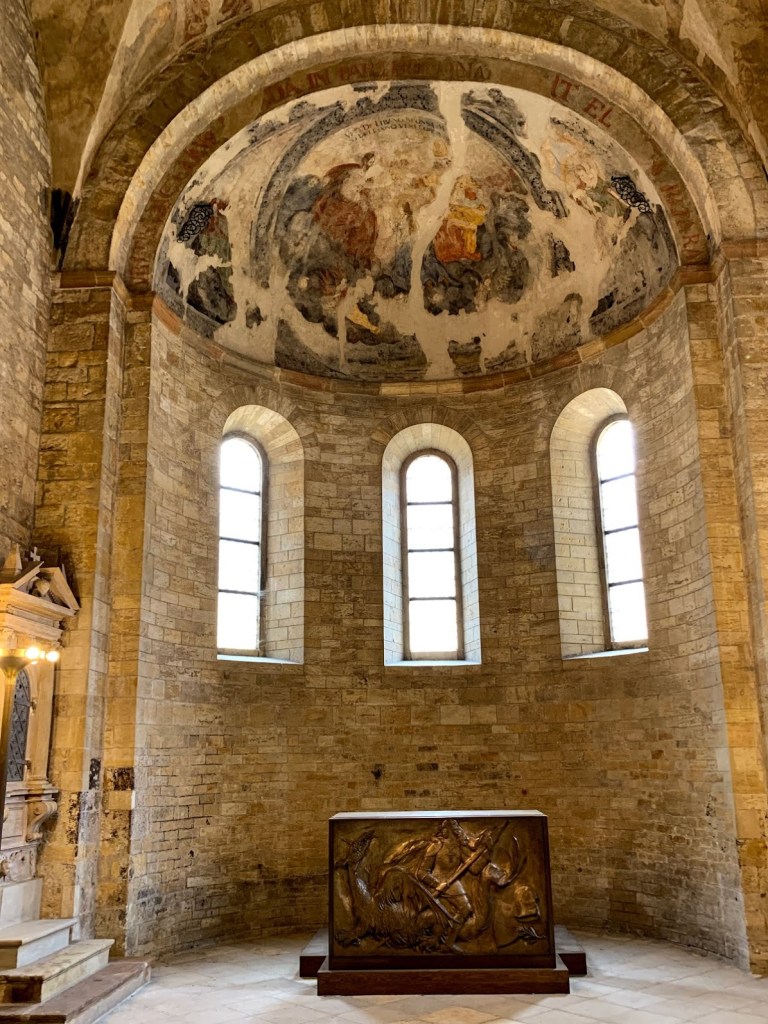
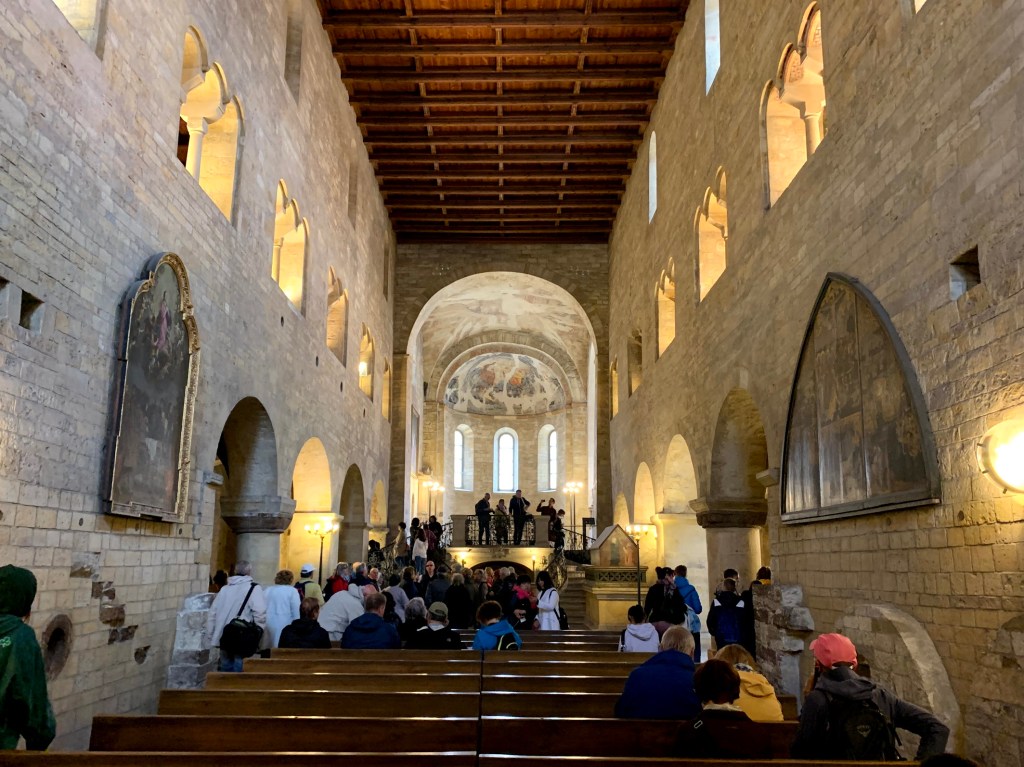
A few steps from St. Vitus was the Basilica of St. George which was smaller and built in the year 972.  The inside of St. George’s was much simpler, but elegant. The frescos were faded on the walls and yet the light played with the eyes as you looked up at the vaulted stone alcoves along the second floor.

High Altar from the 10th century

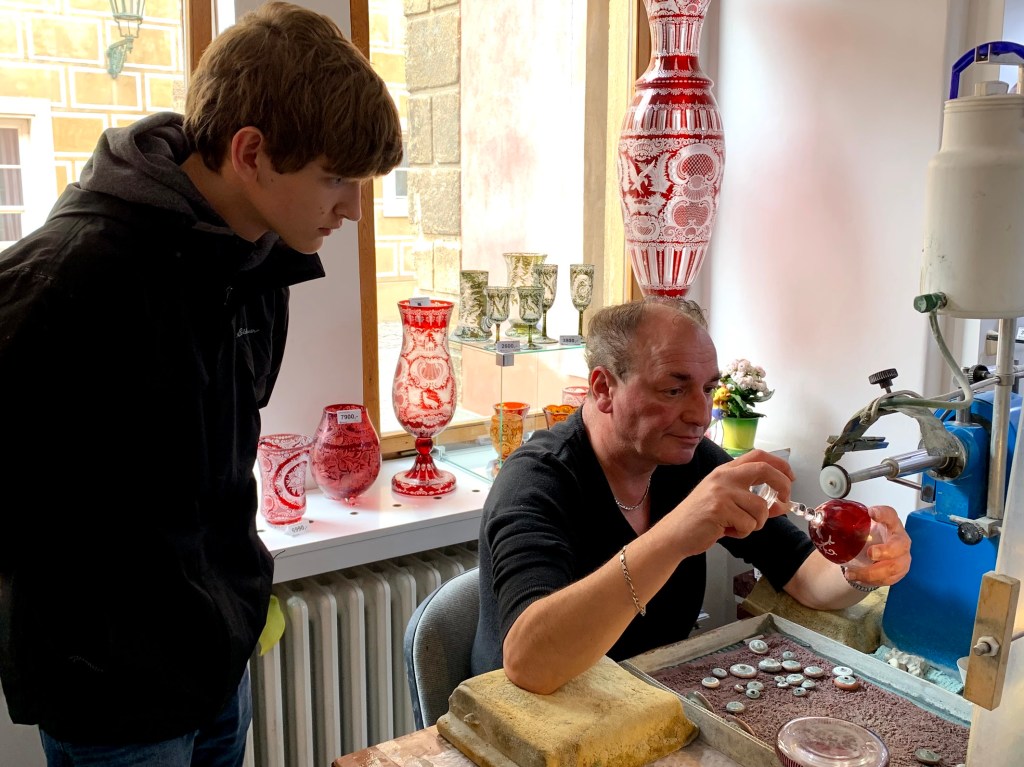
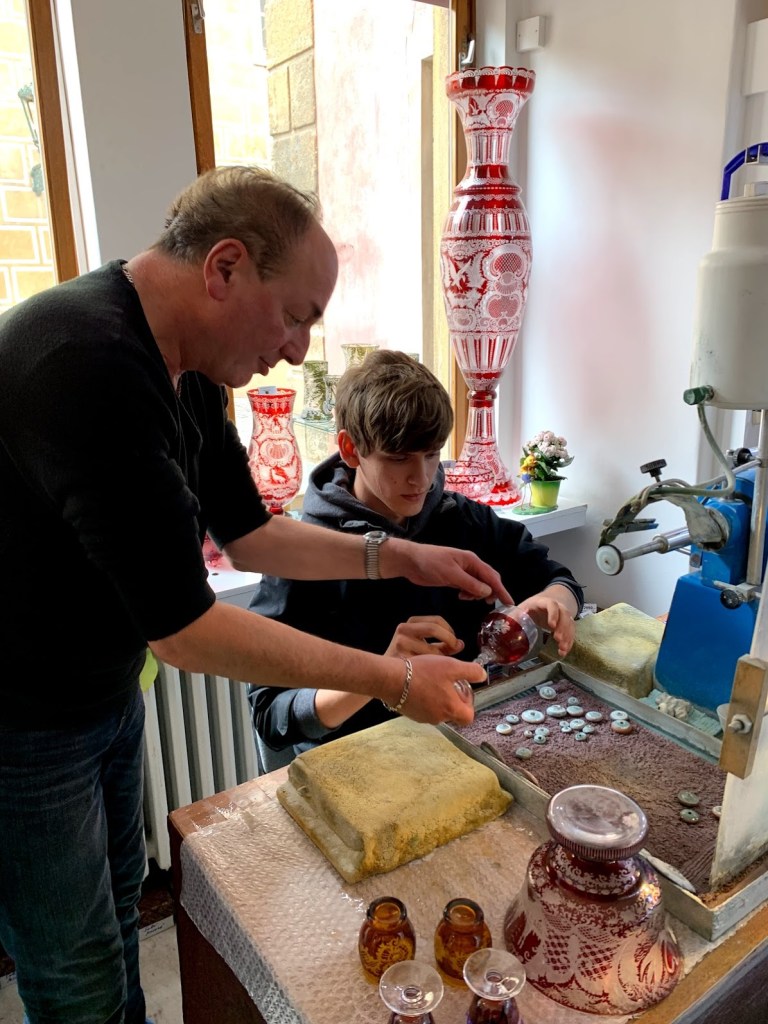
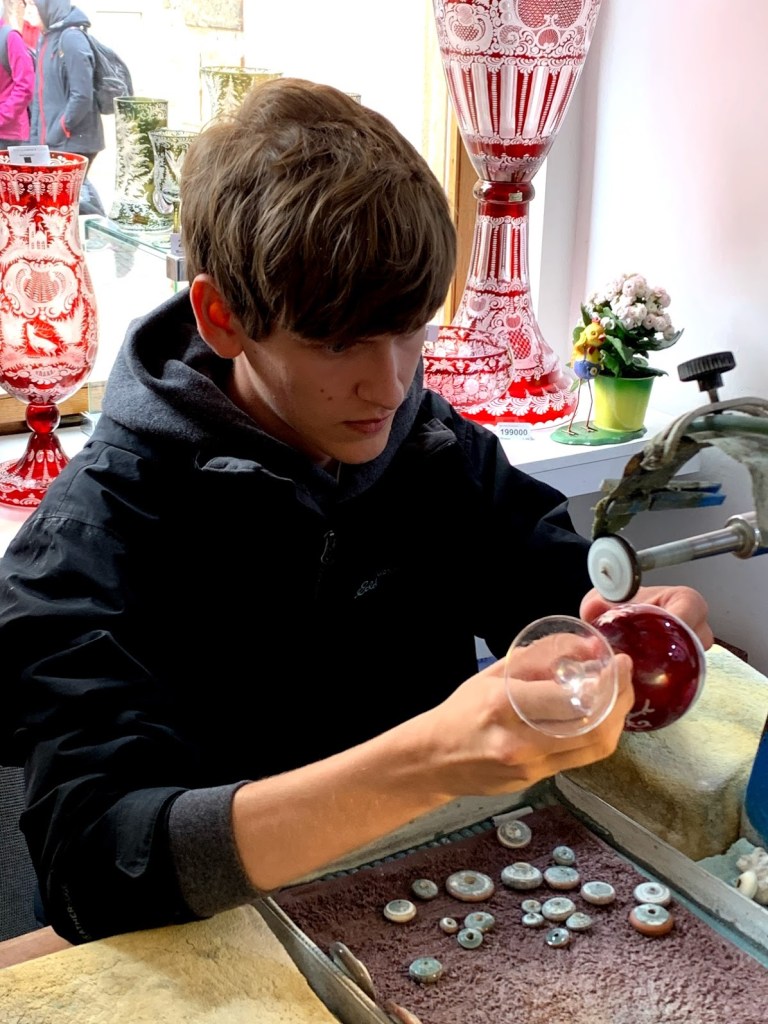
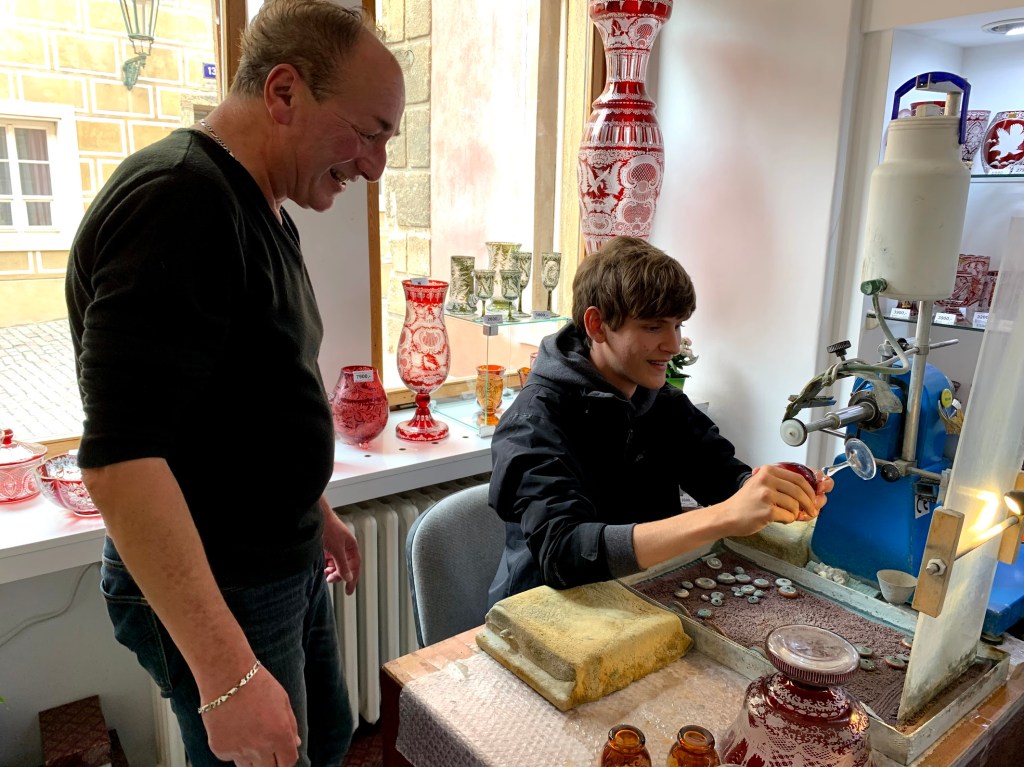
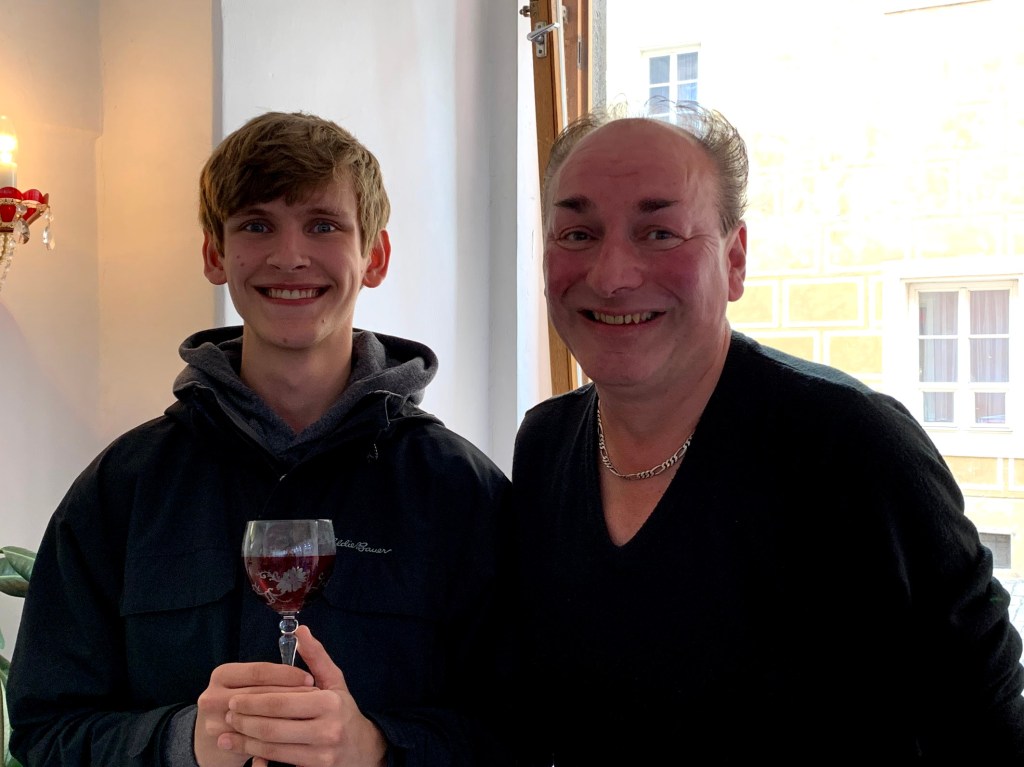
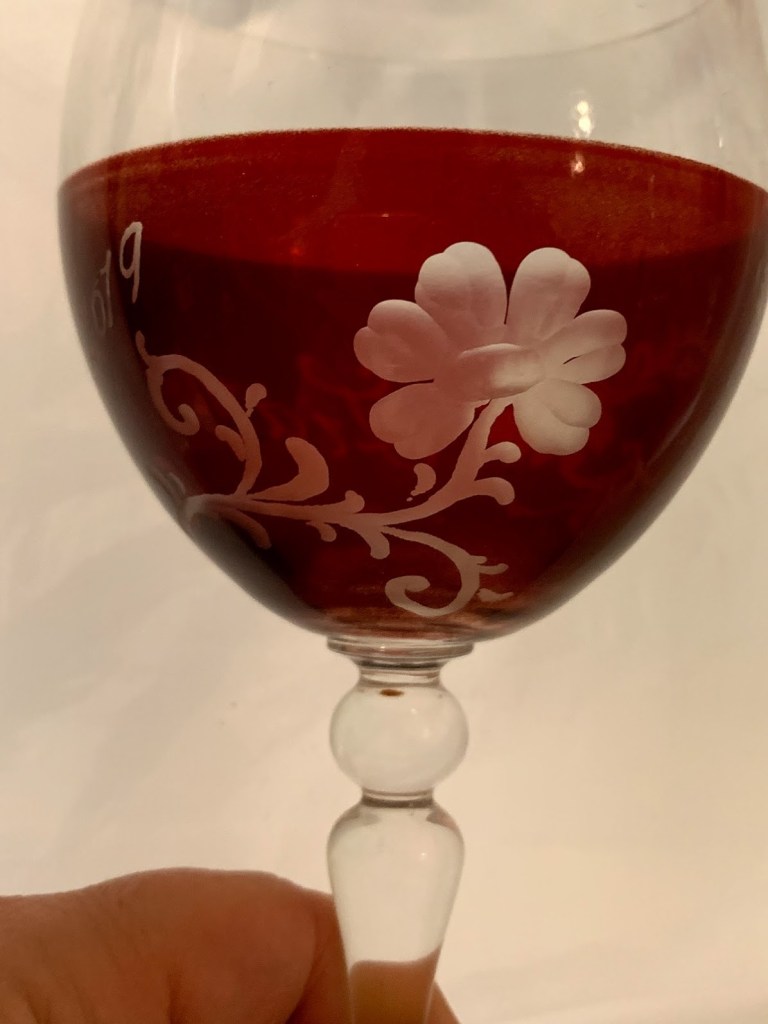
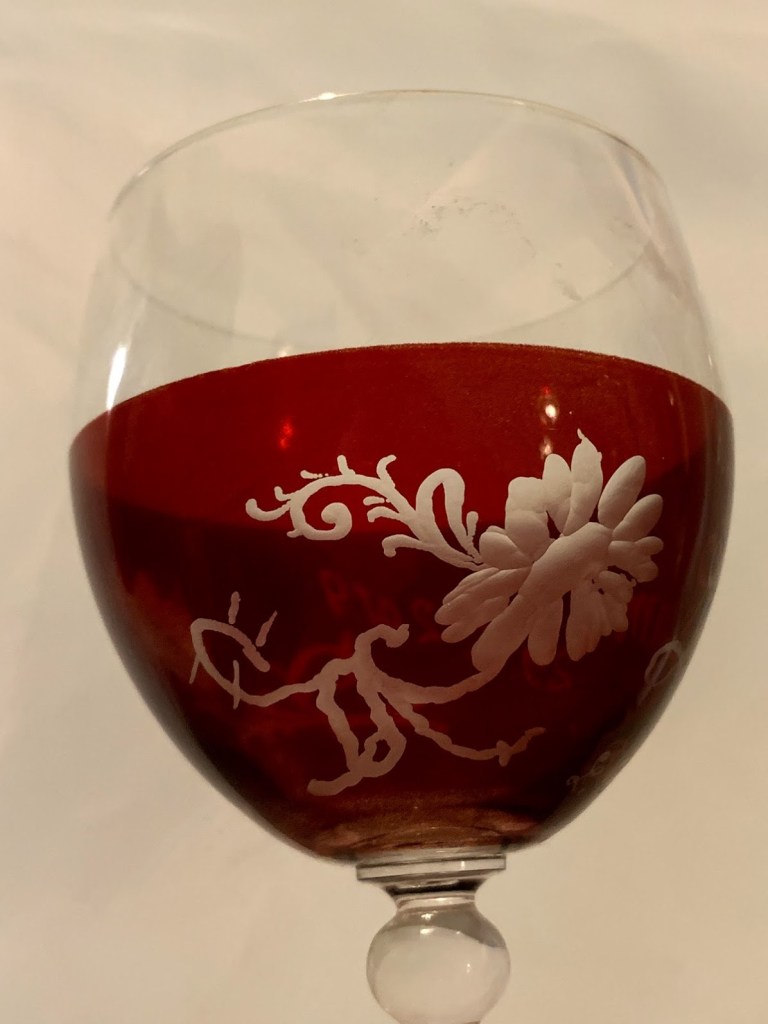
We meandered through the palace streets and soon found ourselves in the Egermann Glass Shop. Egermann is one of the oldest Czech Bohemian Crystal producers. The etched glasses and porcelain pieces were stunning. While we shopped Liam intently watched the master glass etcher, Mr. Bobela. After 20 minutes or so or. Bobela invited Liam to try and etch on a wine glass he had been working on. We found out later from a clerk, that this was a rare occurrence and that Liam was the youngest person ever to be taught by the 30+ year master! Mr. Bobela showed Laiam how to use the etching wheel and lathe. He carefully instructed Liam on how to etch a flower. Liam used the freshly etched flower on the other side of the glass as a guide. It took Liam about 20 minutes to make the flower and vine. Mr. Bobela was very impressed with Liam’s “natural talent” and said that Liam had “an eye” for the detailed work. Mr. Bobela etched his name and Liam’s name slightly bigger along with the date, into the red crystal wine glass. The red color comes from triple firing the crystal mixed with gold. Mr. Bobela gave Liam the wine glass for free as a gift. Both Master and apprentice grinned ear to ear as I took their photo with the finished glass! Liam is very interested in glass and crystal etching after having this opportunity of a lifetime to be taught by a master of this ancient craft. It is truly and experience he will remember his entire life!
Liam watched Mr. Bobela intently for quite some time and would occasionally ask him questions in German. It was their common language. When Liam didn’t quite understand, I’d translate between them. Mr. Bobela was impressed with Liam’s interest in glass etching and that he could speak simple German. Of course he was even more impressed, when Liam addressed him with a few Czech phrases!
I love this photo of the two of them smiling. Mr. Bobela spoke only a few words of English and simple German. This entire lesson was communicated through basic German and a lot of hand gestures!
Pleased Master and Proud Apprentice!
29 May 2019

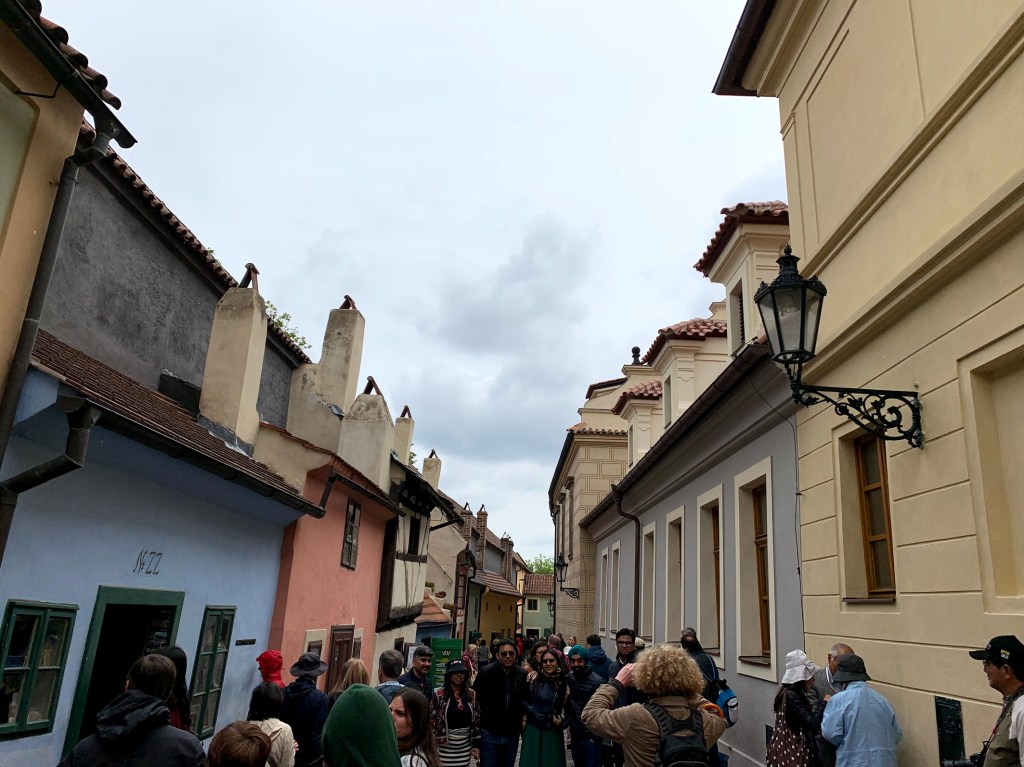
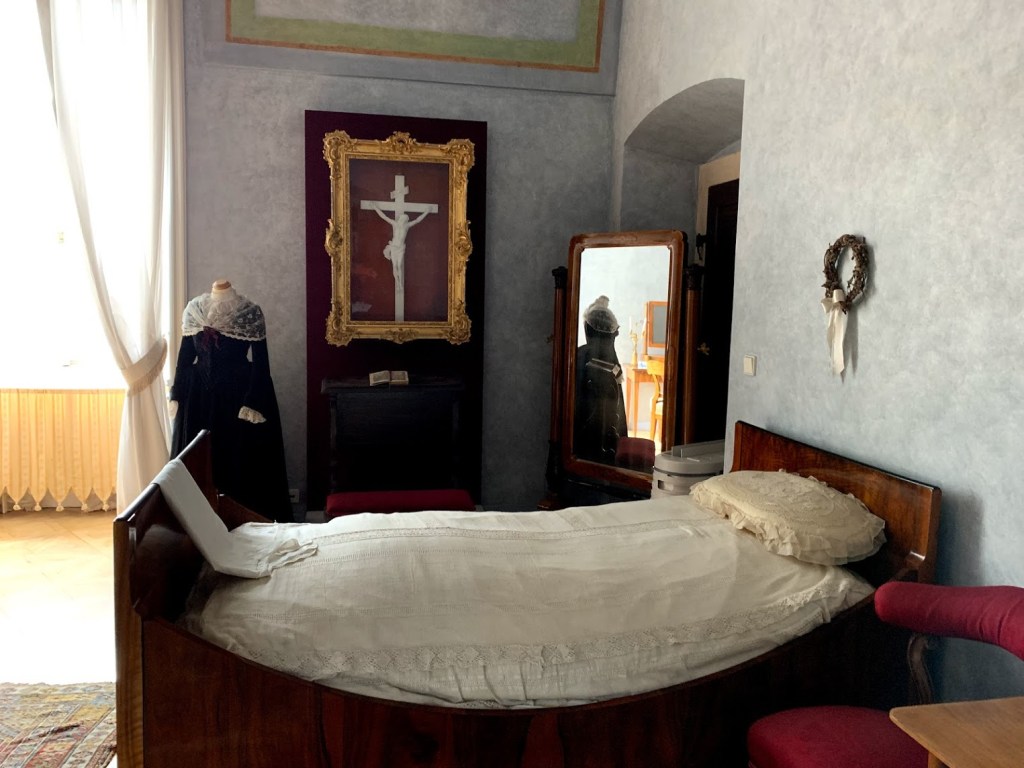
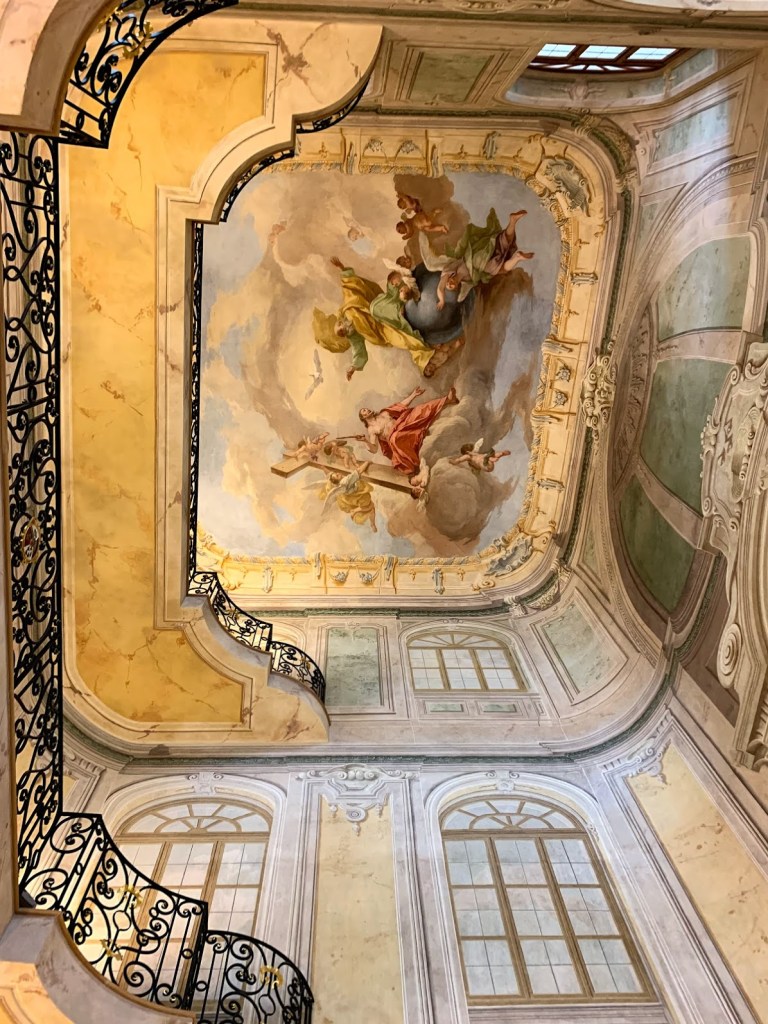
Our next stop was the Golden Lane. The homes in this “workers” area of the castle were set up to represent trades from the 15-17th centuries. We also toured a few apartments in the Rosenburg Palace of the 18th century. We left Prague Castle after lunch and caught the tram to The Church of the Holy Infant.

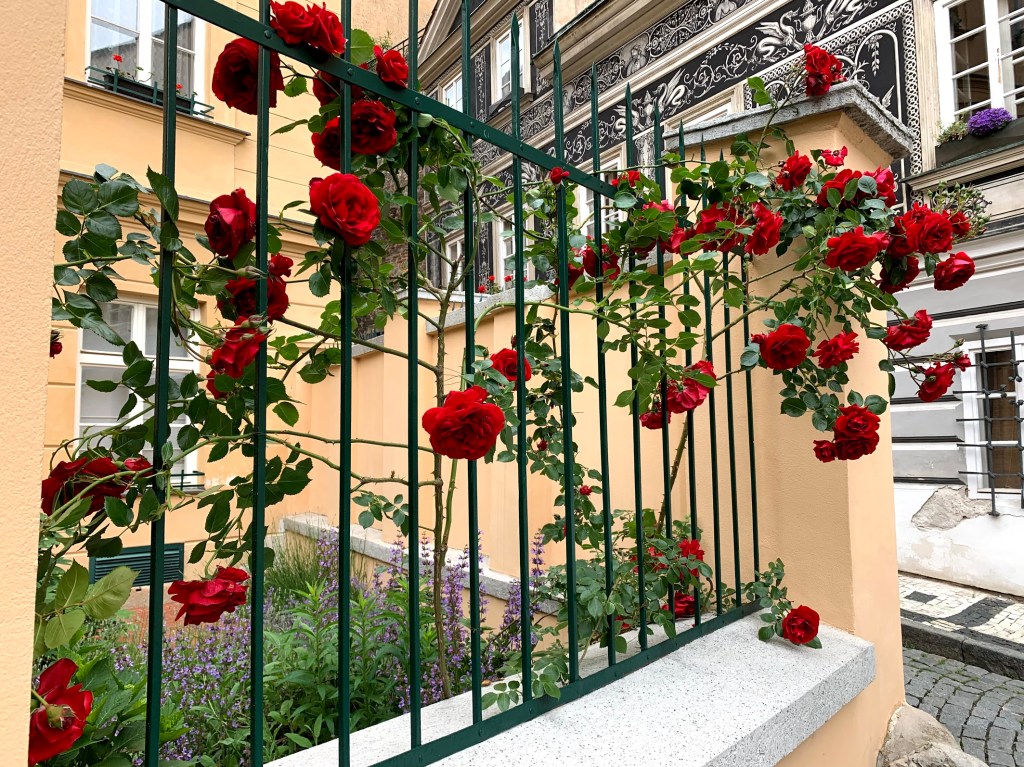
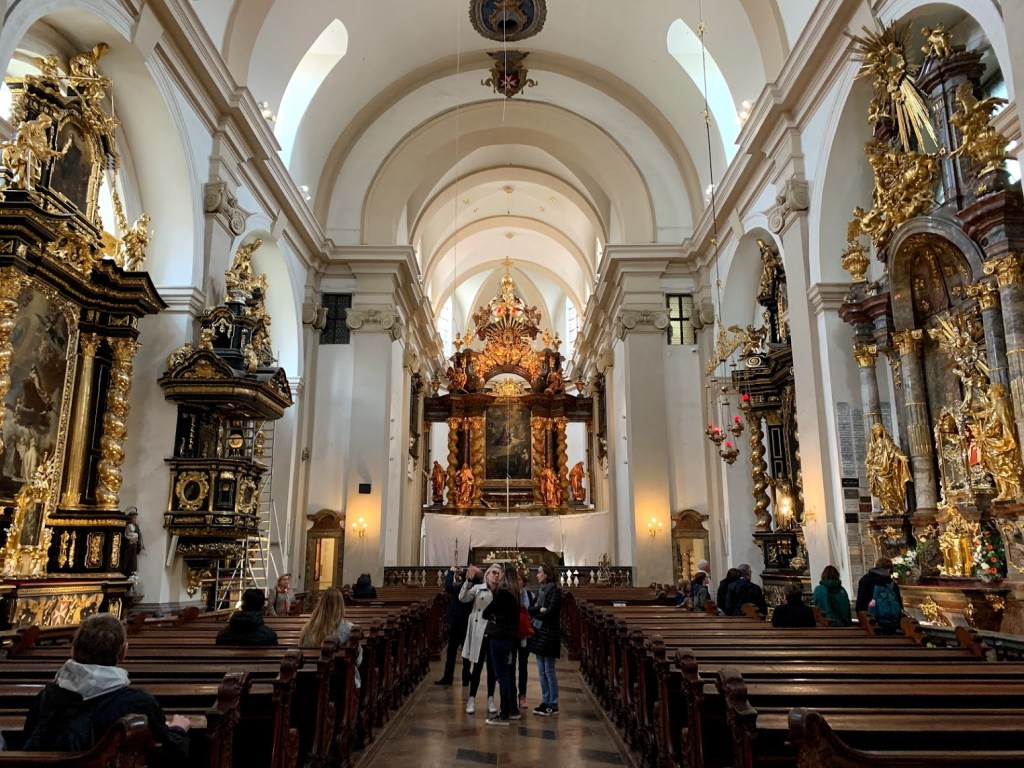
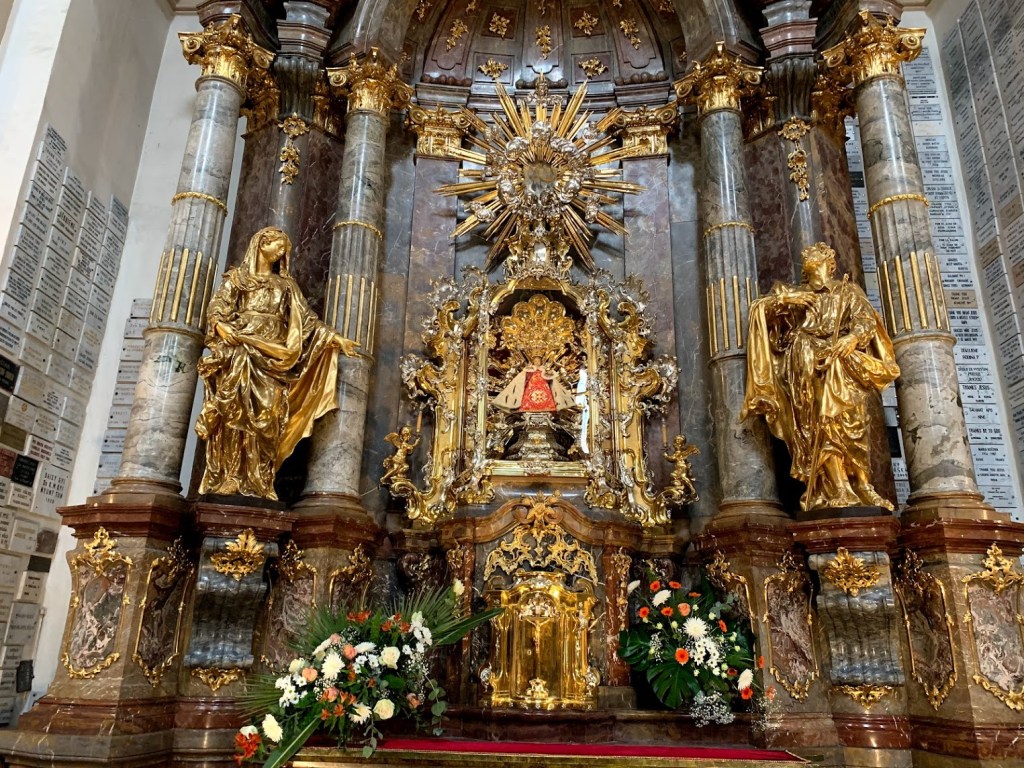
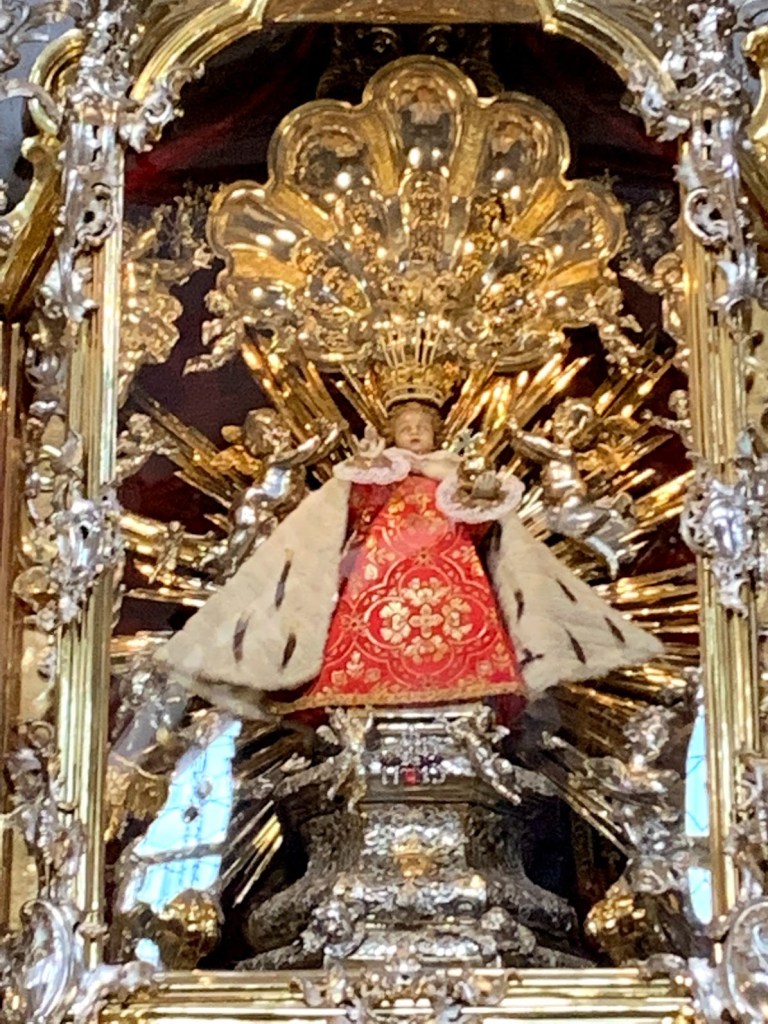
Inside the church resides a carved statue of the baby Jesus from the 1500’s. He is inside a golden shrine and owns more that 300+ magnificent robes and clothes.  The Carmelite Sisters in the nearby convent are in charge of maintaining the statue and changing his robes regularly. He is one of the symbols of Prague.The Mana Strala district around the church is full of quaint backstreets and beautiful buildings.

Sweet Baby Jesus
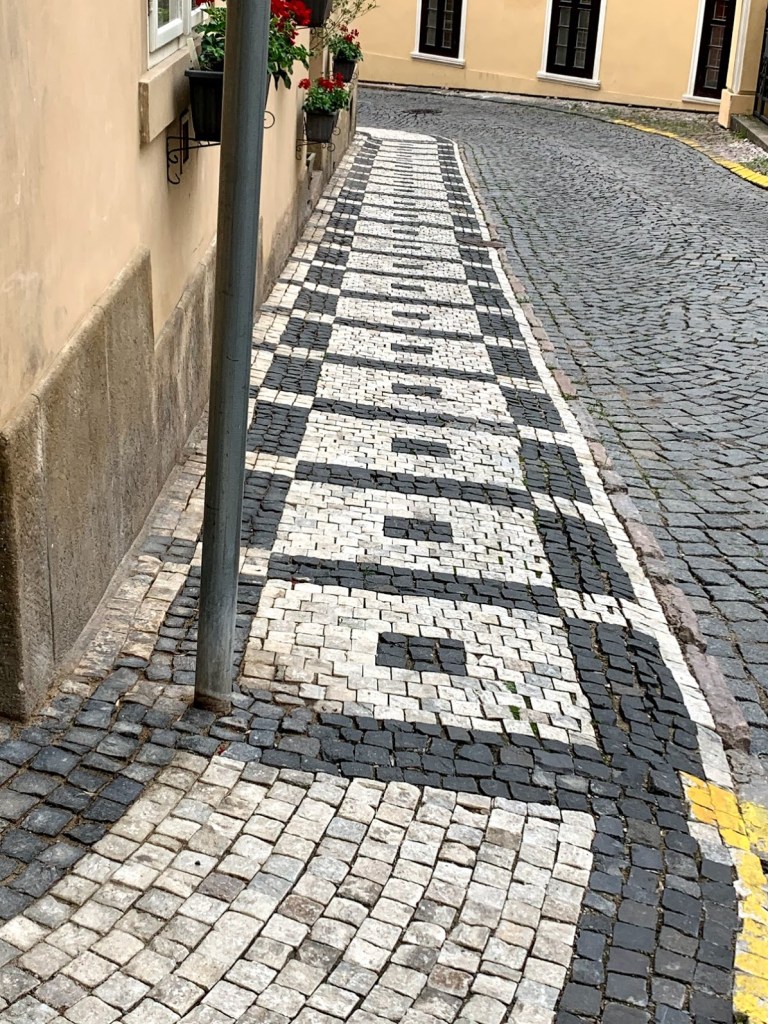
All of the sidewalks in Prague looked like this. The mosaic cobblestone was in excellent condition.
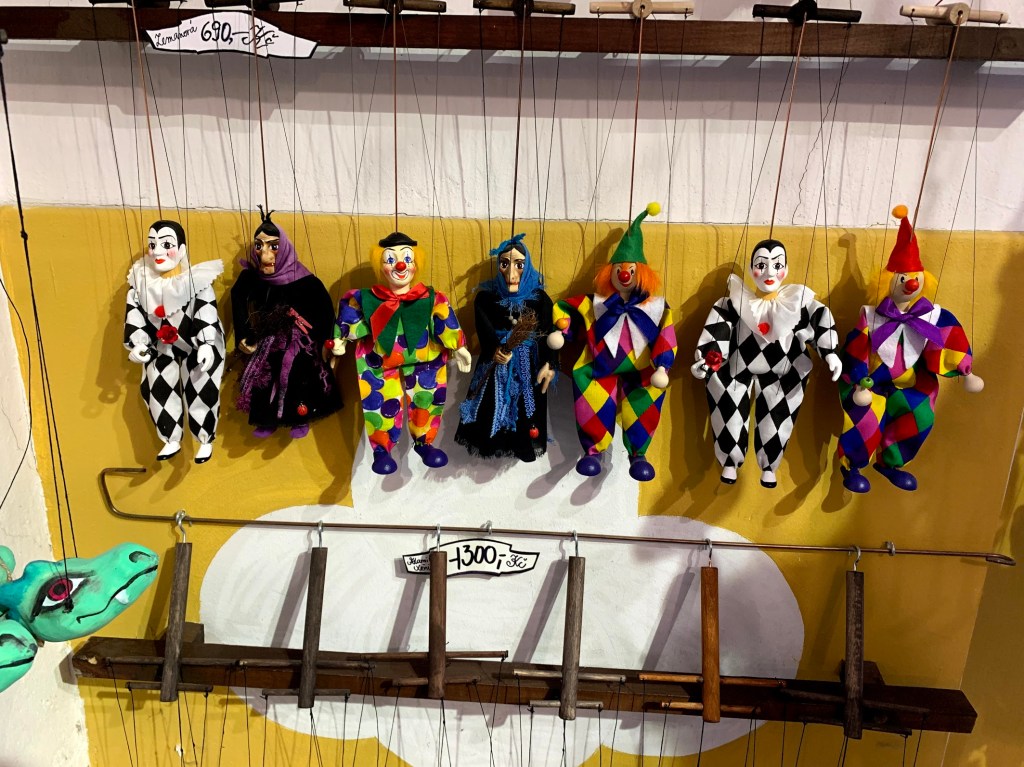
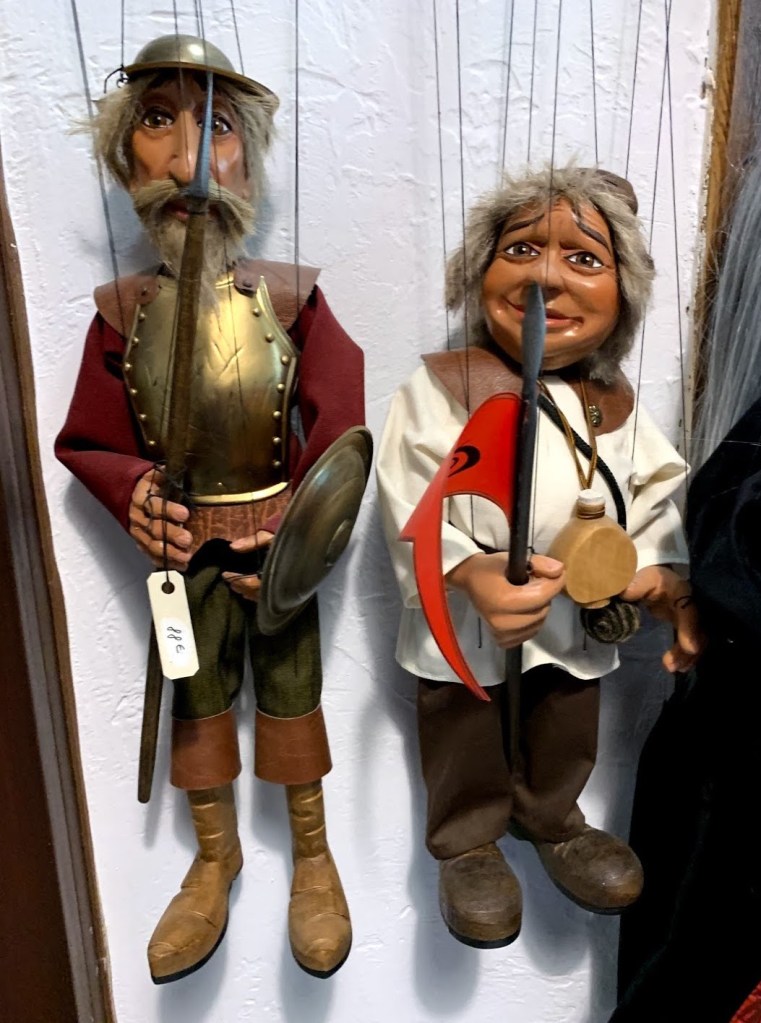
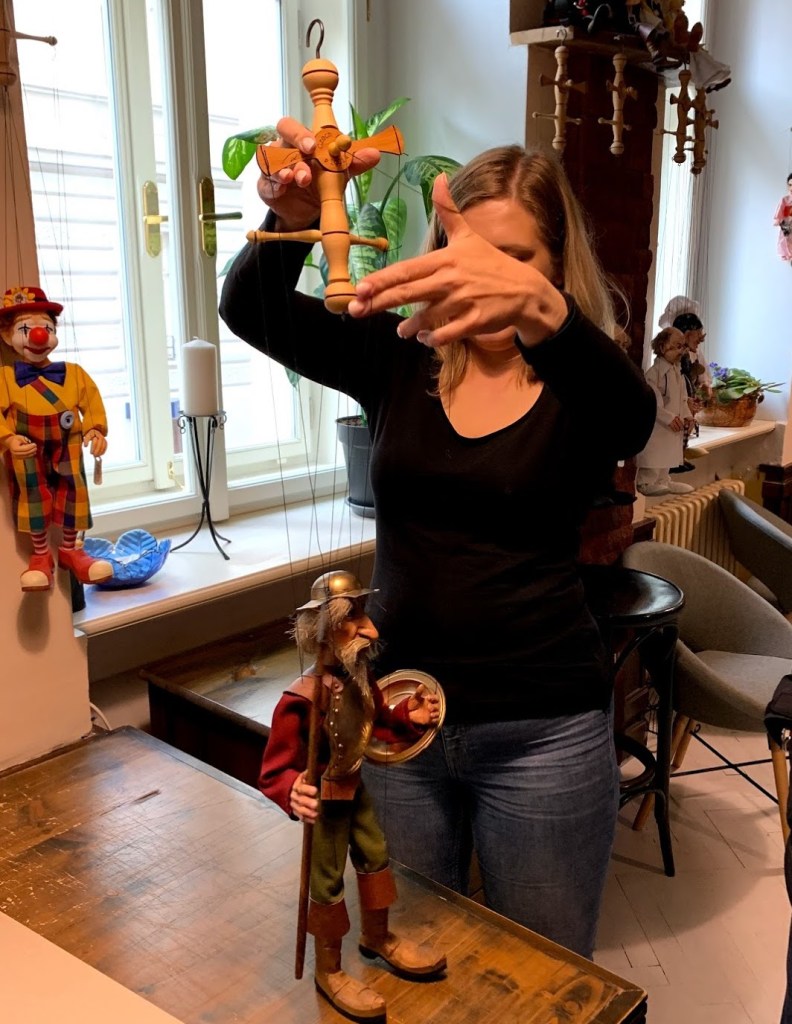
As we walked through the streets of the Mana Strala District we came across this little marionette shop. This is what nightmares are made of! I’m terrified of clowns!
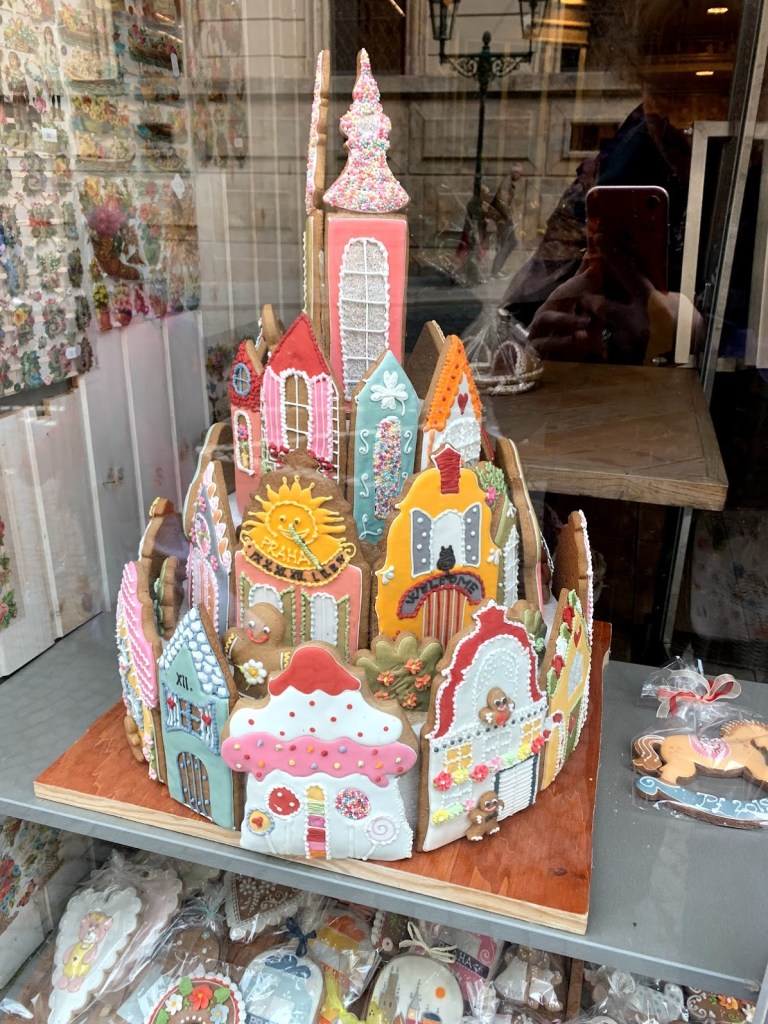
Mmmm delicious gingerbread!

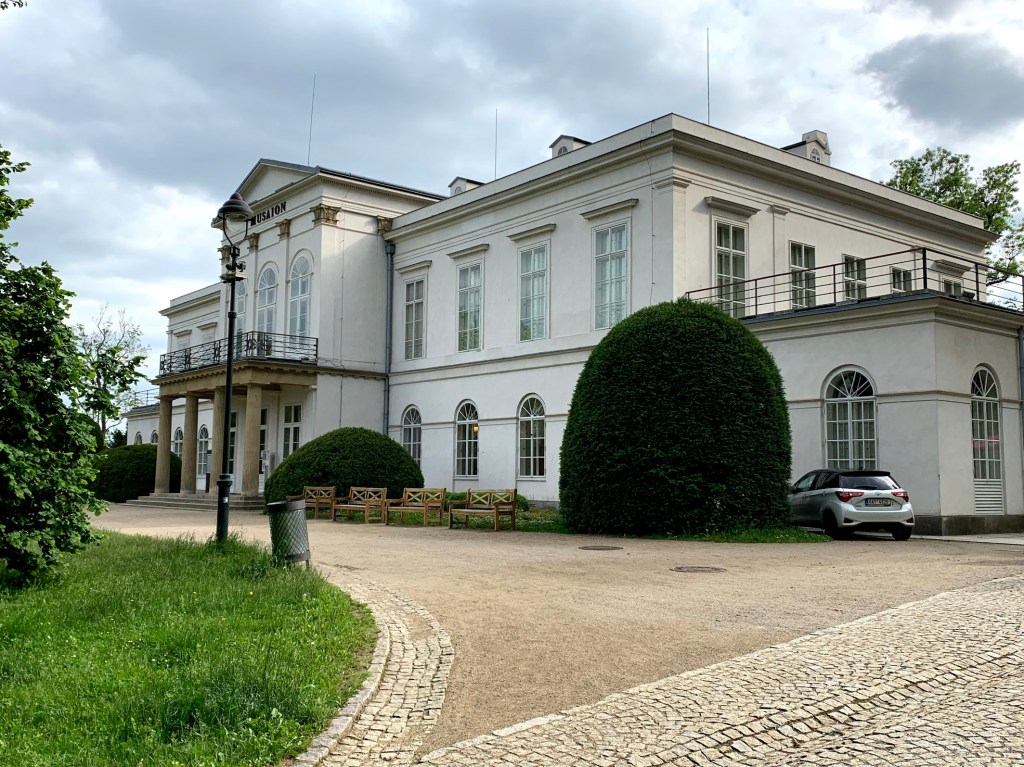
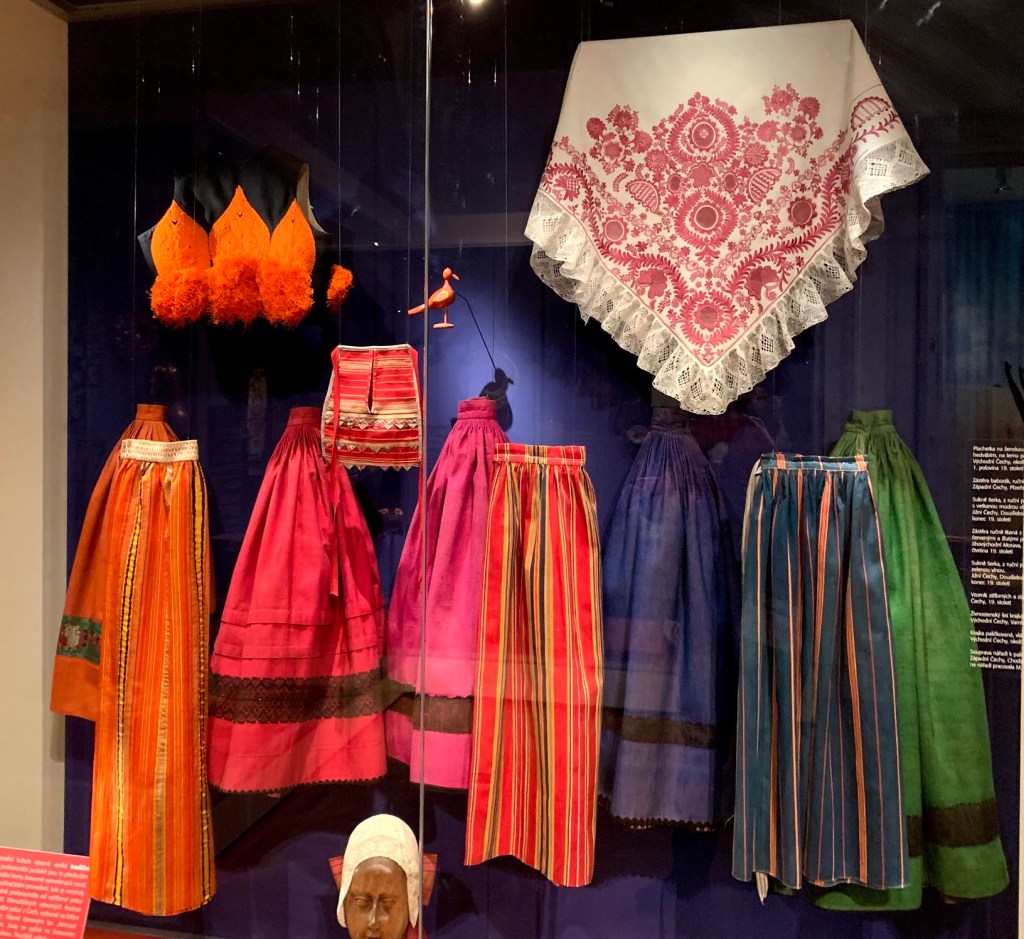
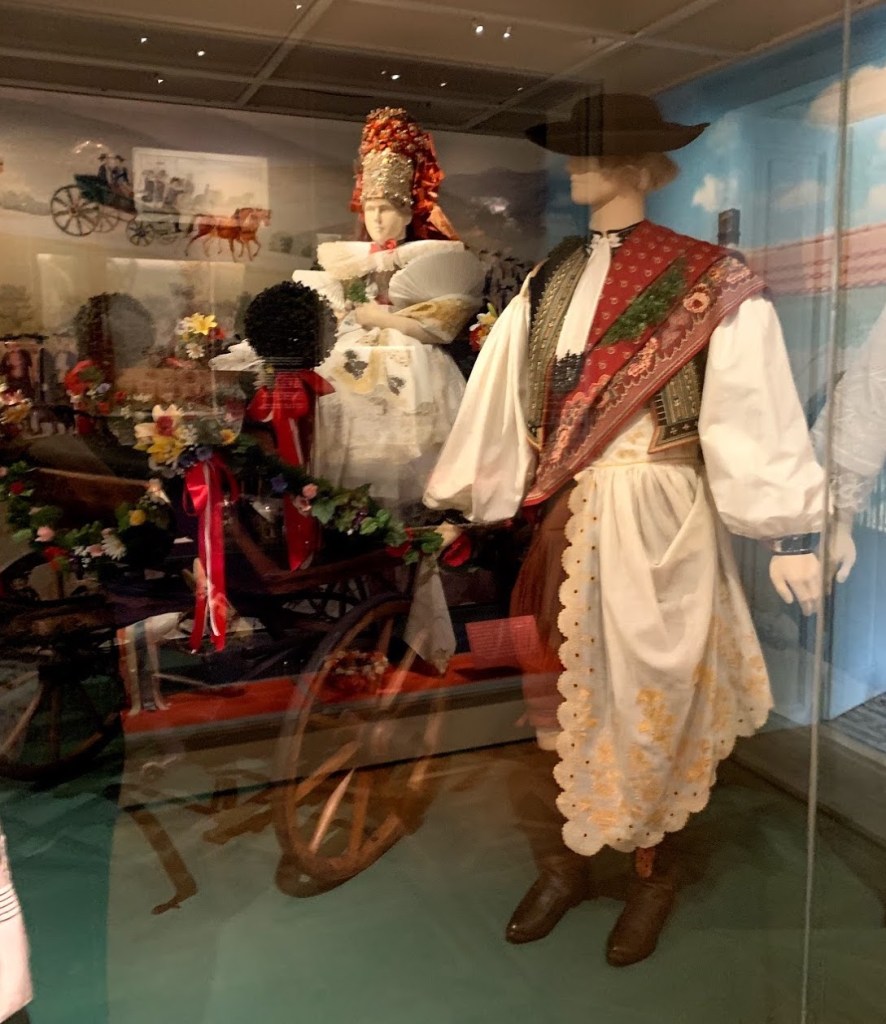
A quick tram ride and a lovely walk through the park brought us to the Czech Folk Arts Museum. Everyone enjoyed learning about local traditions and admiring the beautiful folk clothes and artifacts. The people of the Czech Republic are originally Bohemians. Many of the Western Bohemian clothing trends were inspired by the original patterns and colors of this region.

Traditional Czech wedding outfits

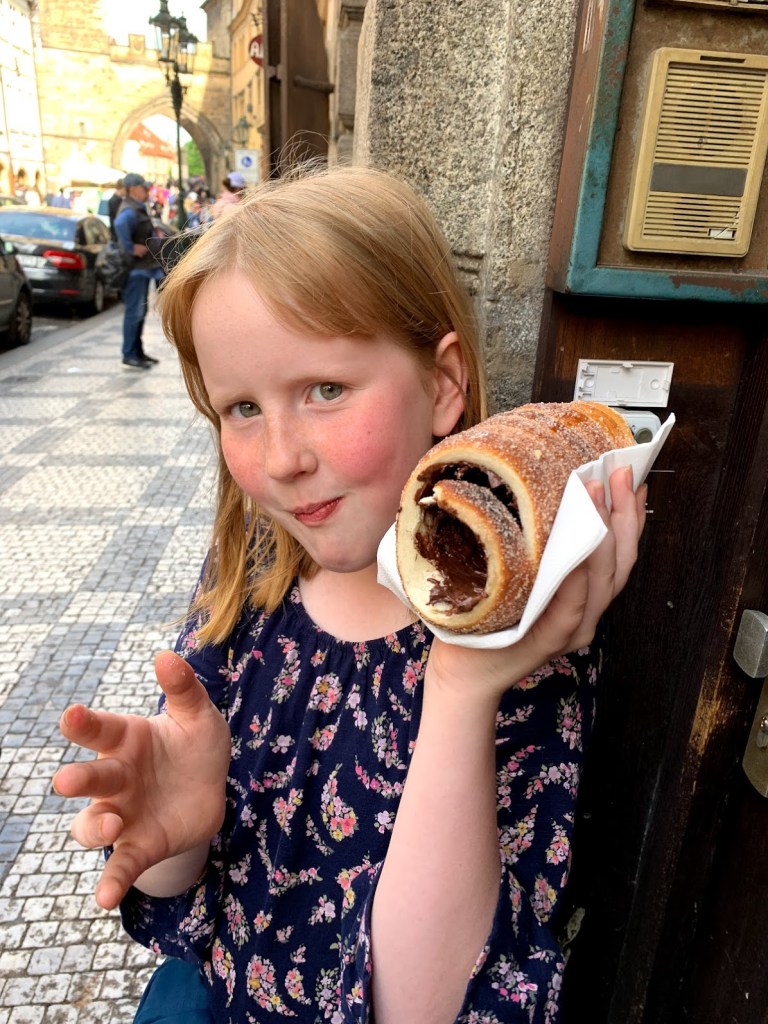
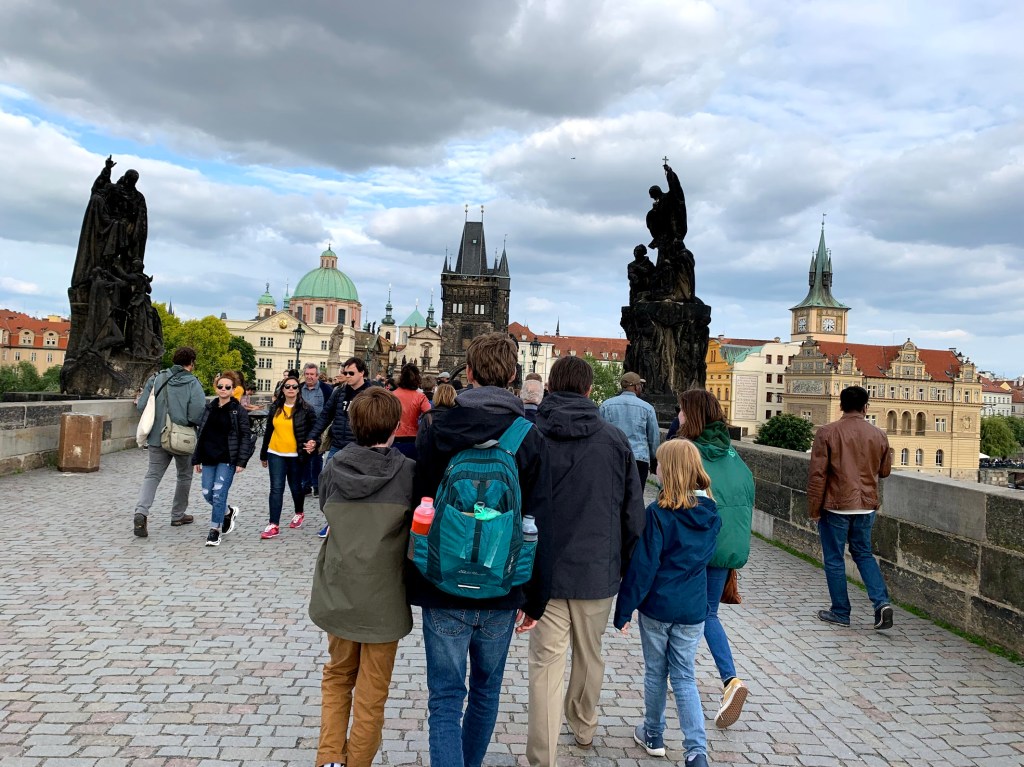
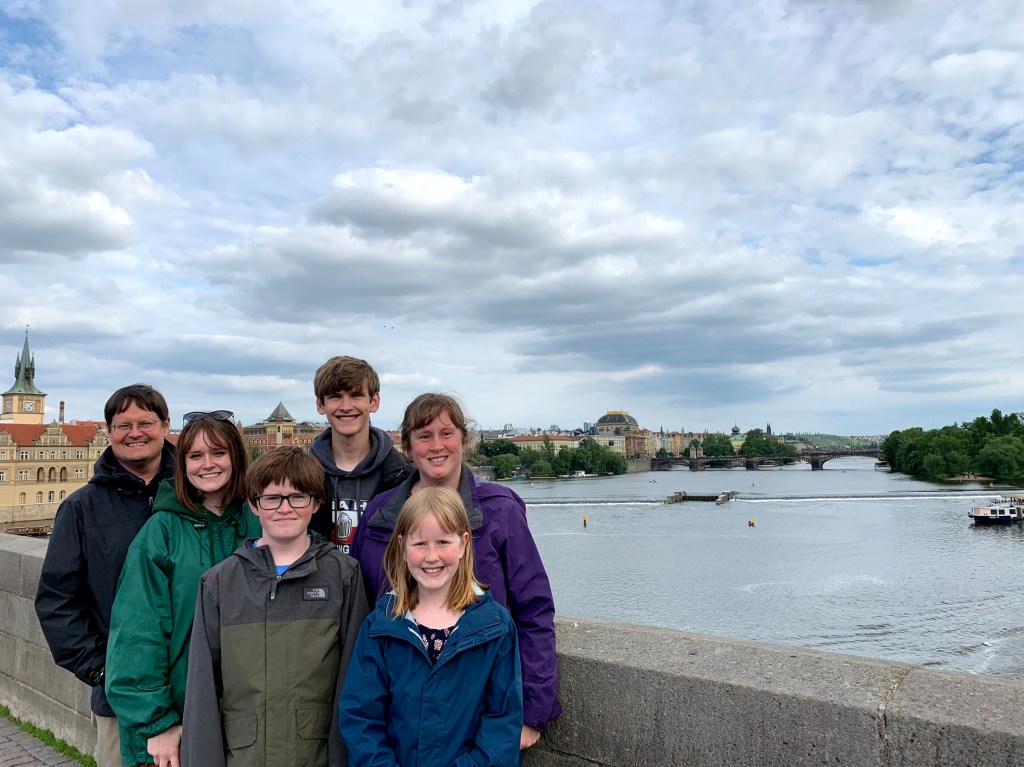
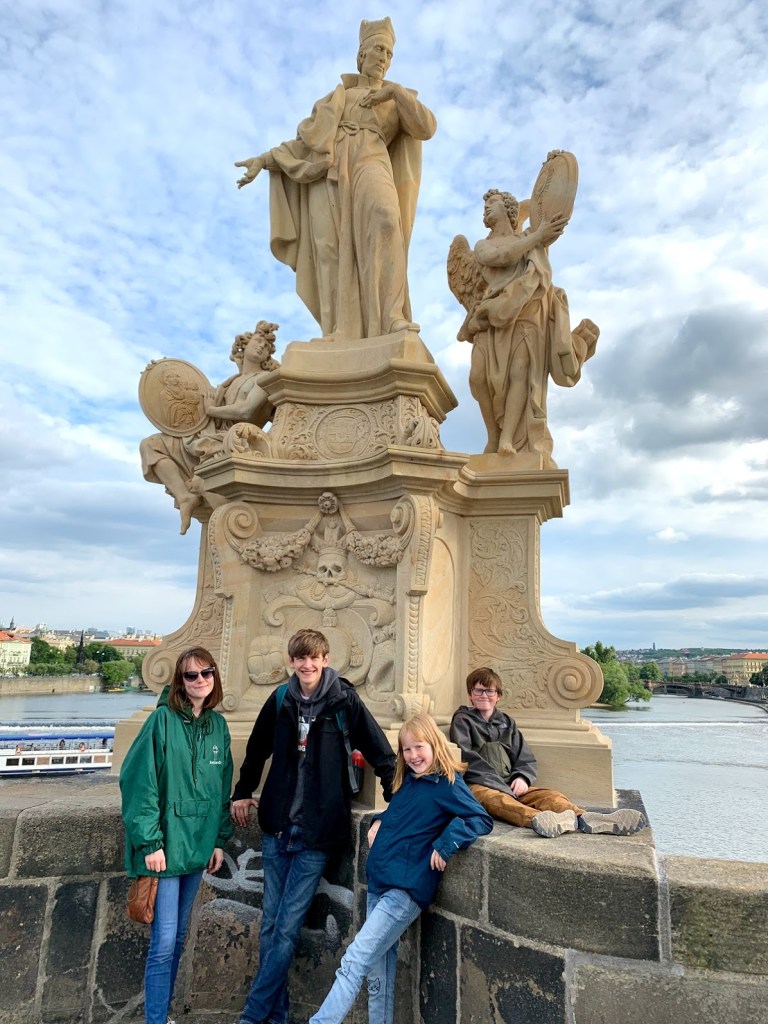
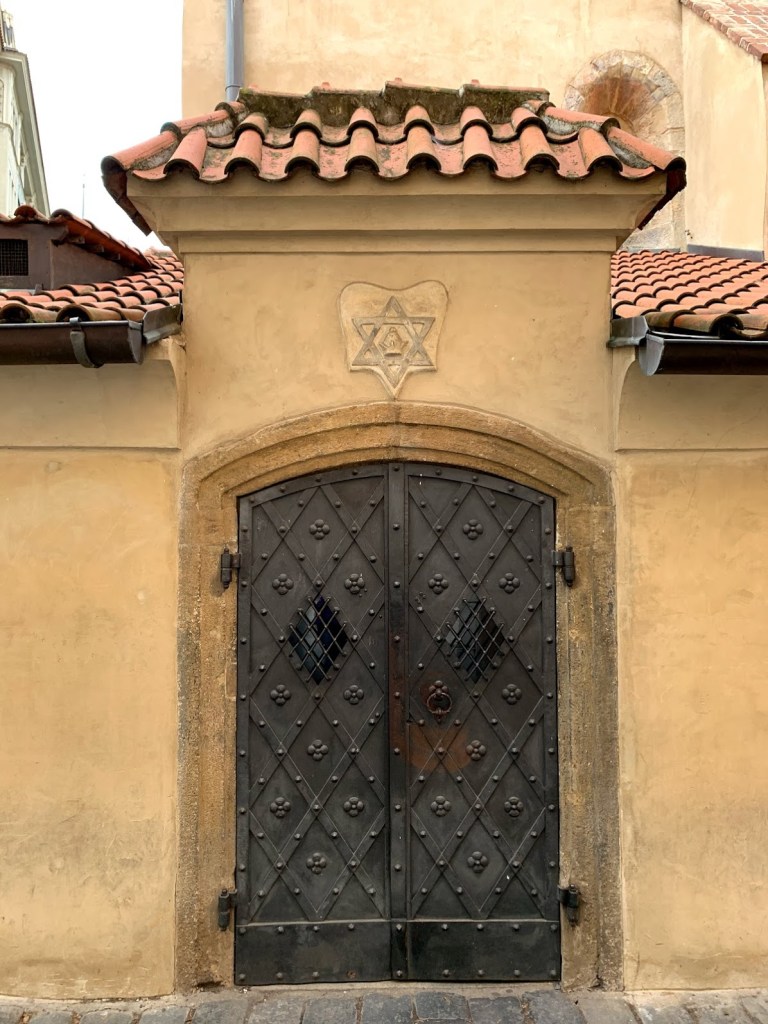
We made our way to St. Charles Bridge. Right before crossing this iconic 15th century bridge we ate a traditional Czech dessert…a coiled cinnamon pastry with chocolate or ice cream inside. We crossed the bridge admiring all the street artists and musicians and made our way over to the old Jewish Ghetto and walked by a Synagogue from the 14th century. Unfortunately it was closed, but the neighborhood was lovely.

The delicious Czech dessert:
It was called a chimney cake in English.
The center of the St Charles Bridge

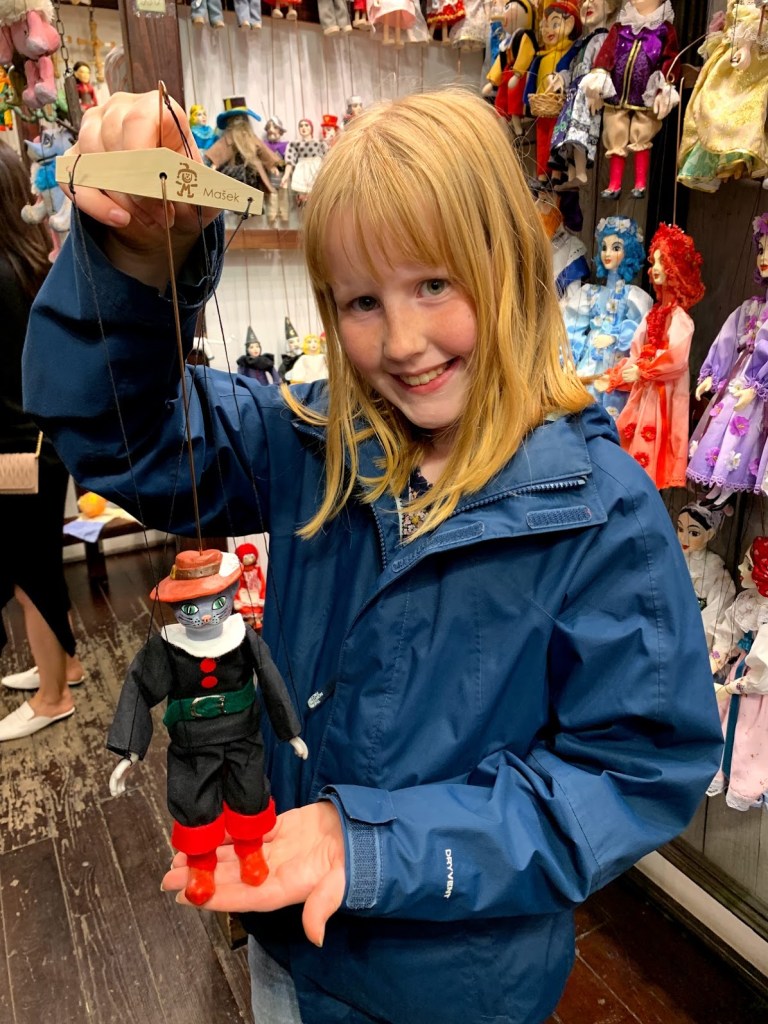
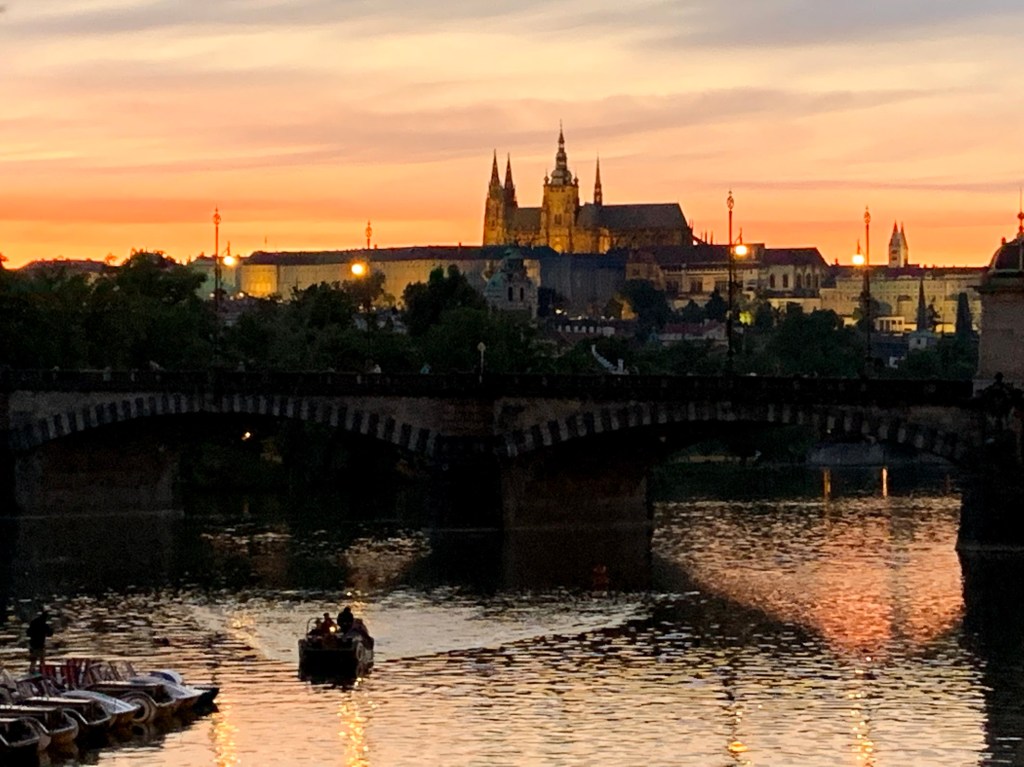
A short stroll brought us back to the main Old Town Square and a large marionette shop. Faywen got a cute little Puss n’ Boots marionette and we picked up a couple of souvenirs for family there too. After dinner we walked back to our apartment as the sunset cast hues of pink and orange over the silhouette of St. Vitus and the Prague skyline.

Faywen with her new Puss n’ Boots marionette
Sunset over the Vltava River and St. Vitus in Prague, Czech Republic

Dvorak’s Hometown

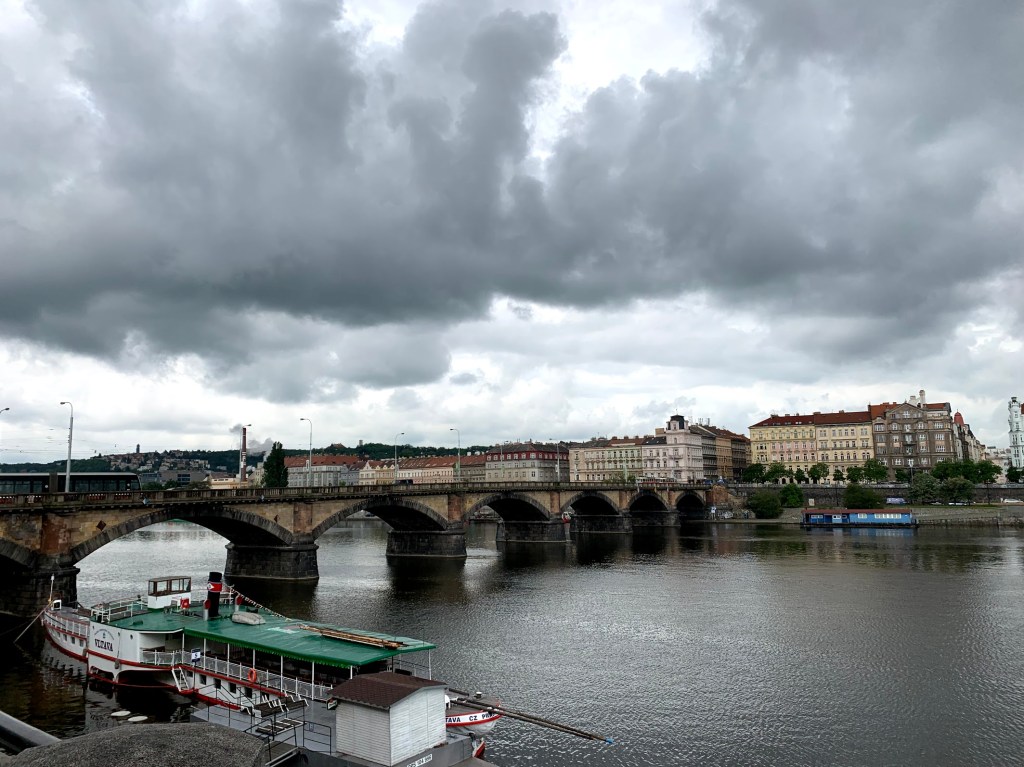
“Gray skies are gonna clear up”…or at least that’s what we hoped as we steeped out and walked down to the Vltava River walk. Unfortunately it would rain off and on until late afternoon, but it didn’t dampen our spirits.

Vltava River in Prague, Czech Republic

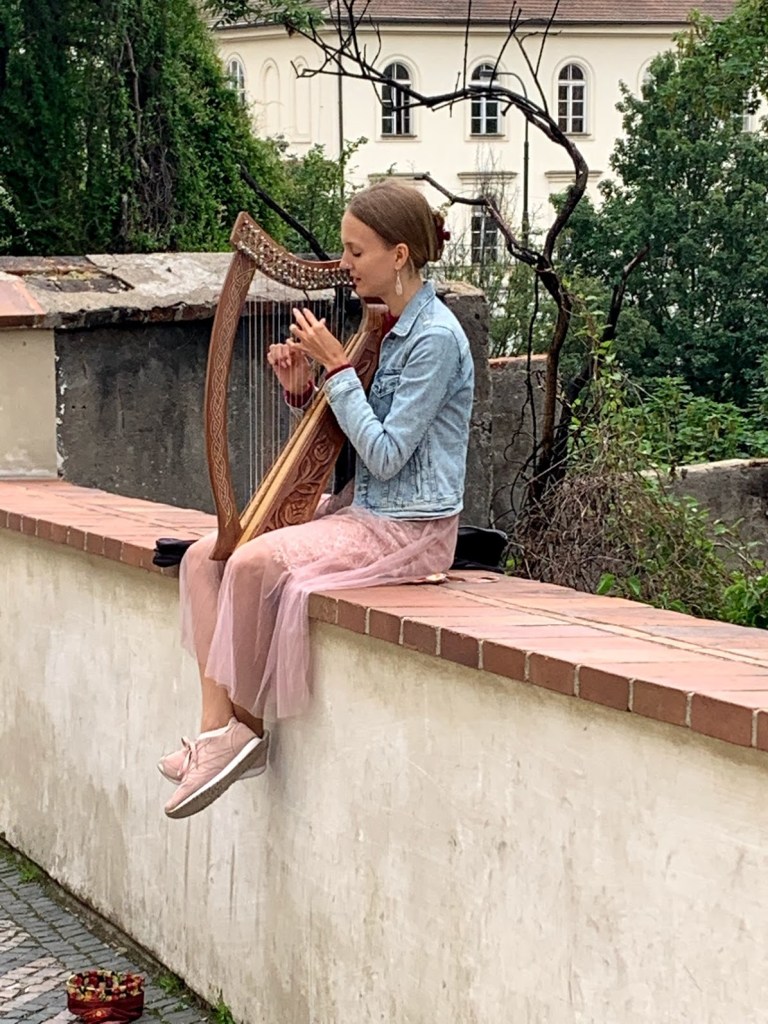
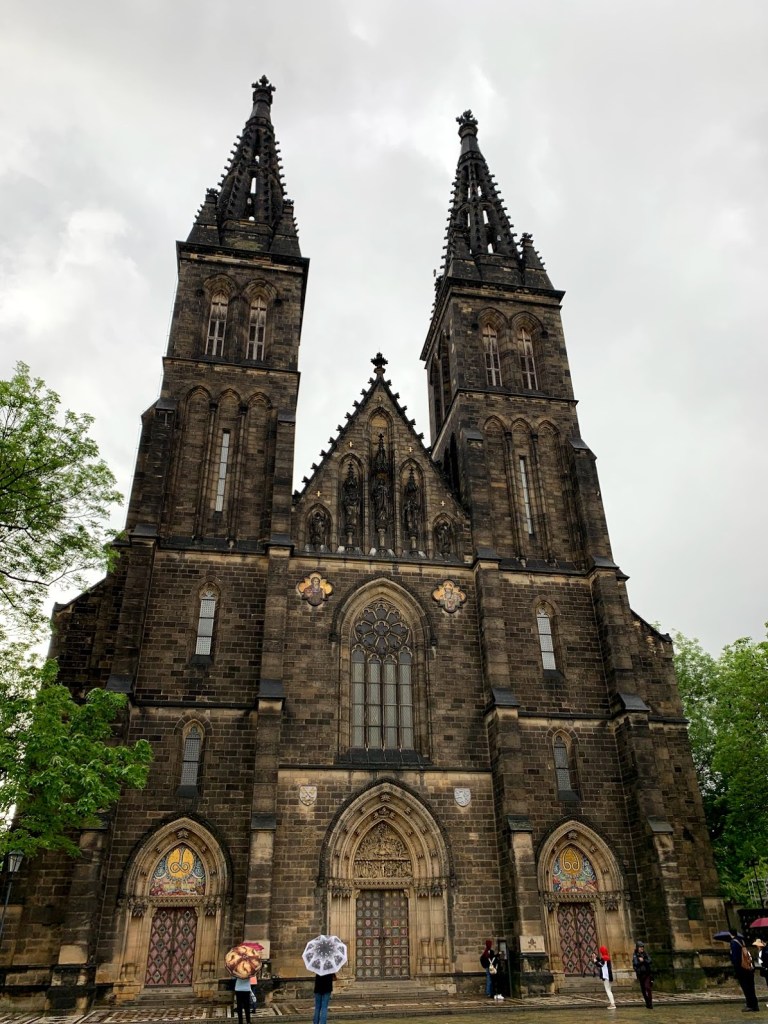
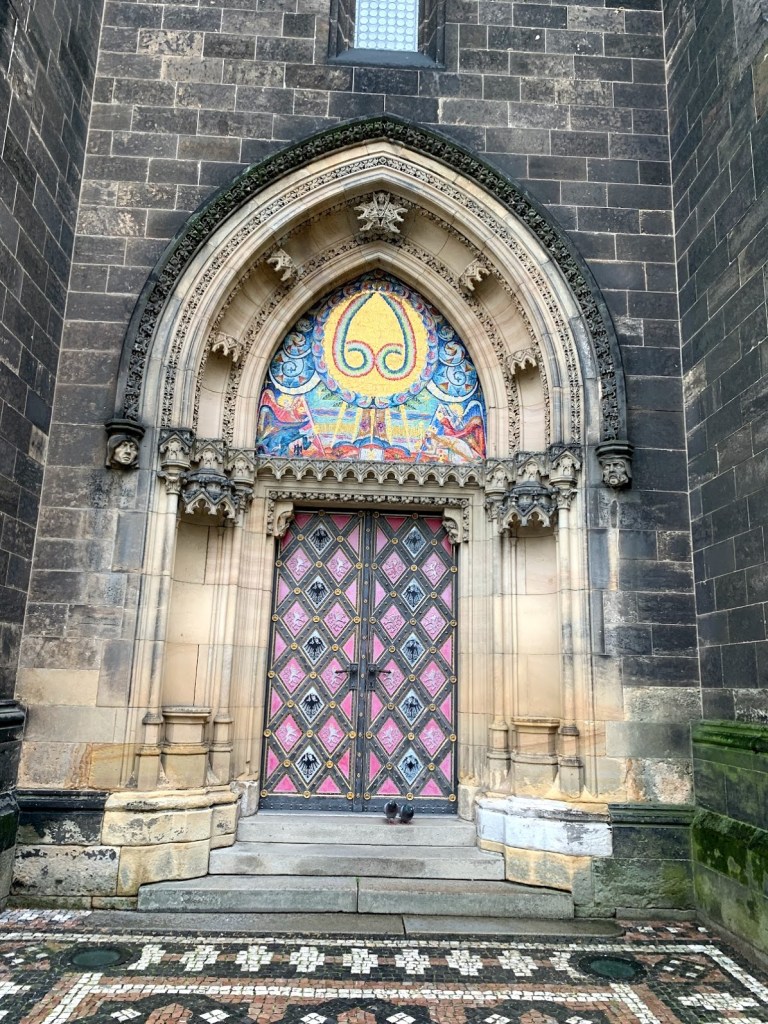
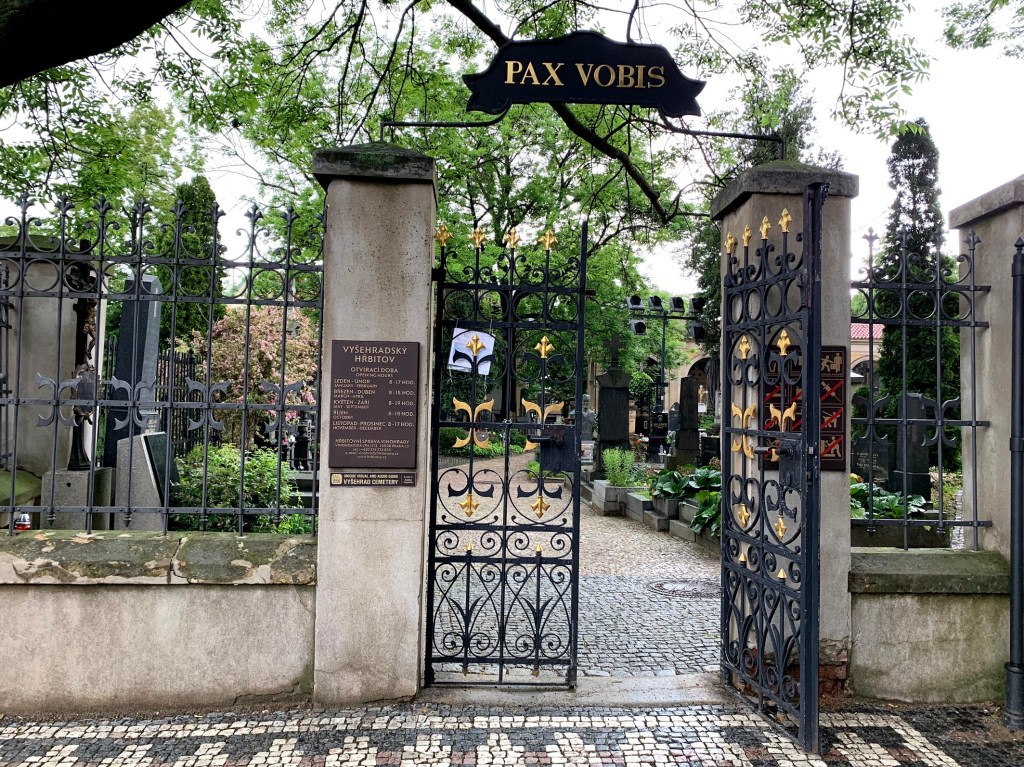
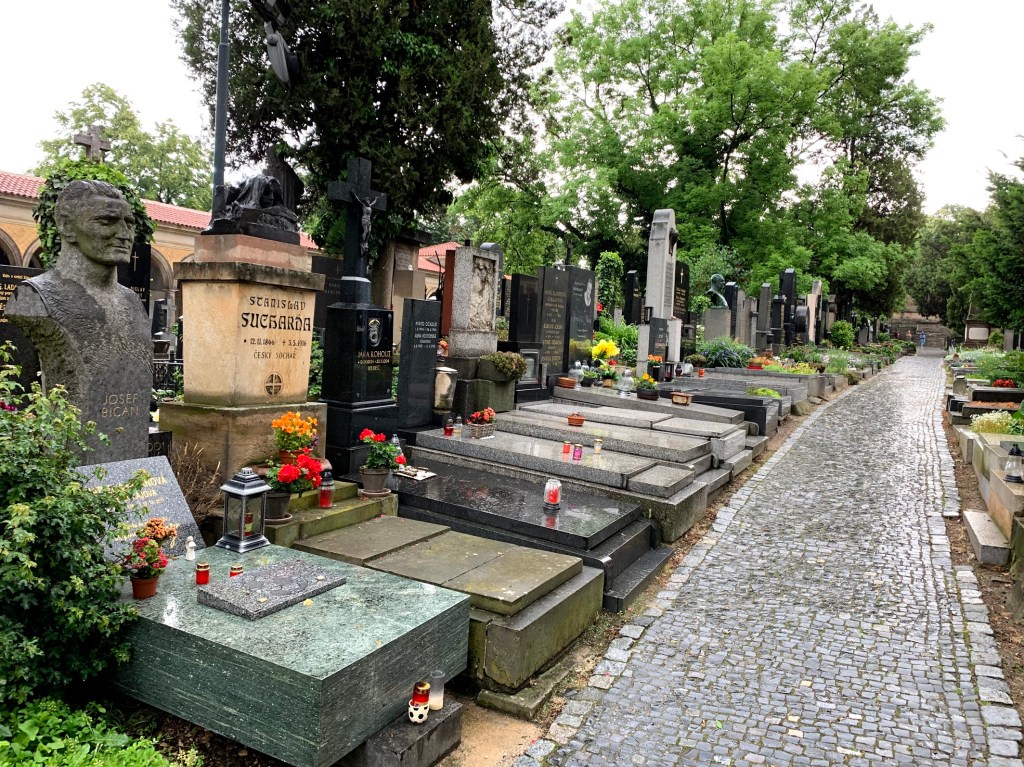
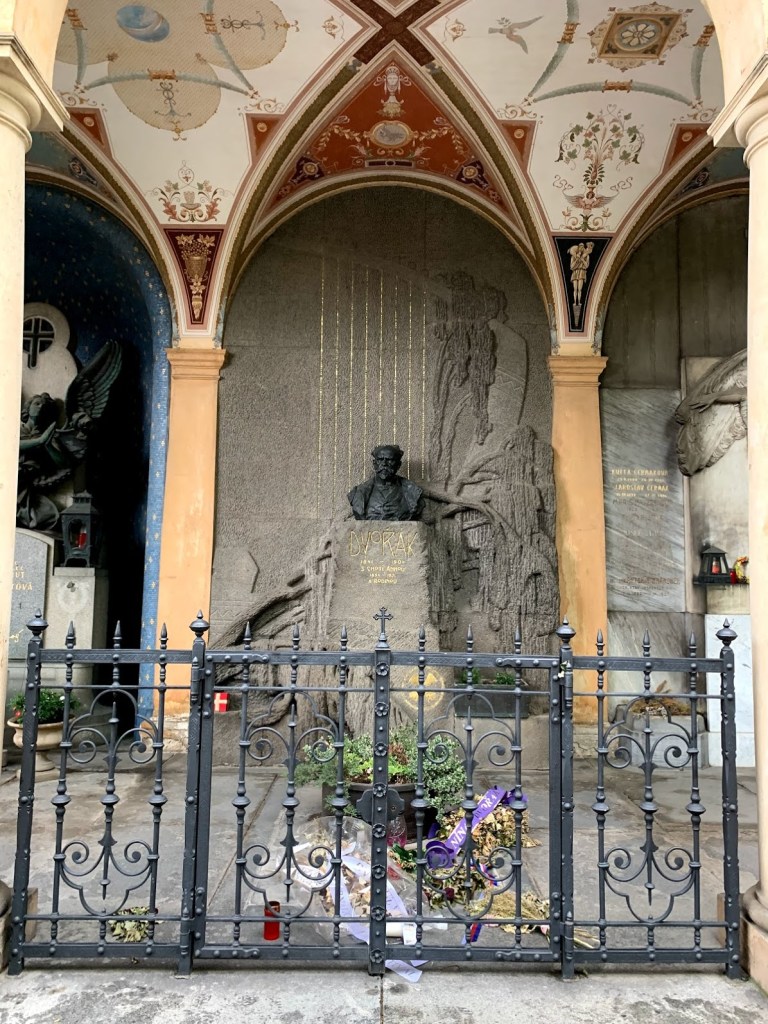
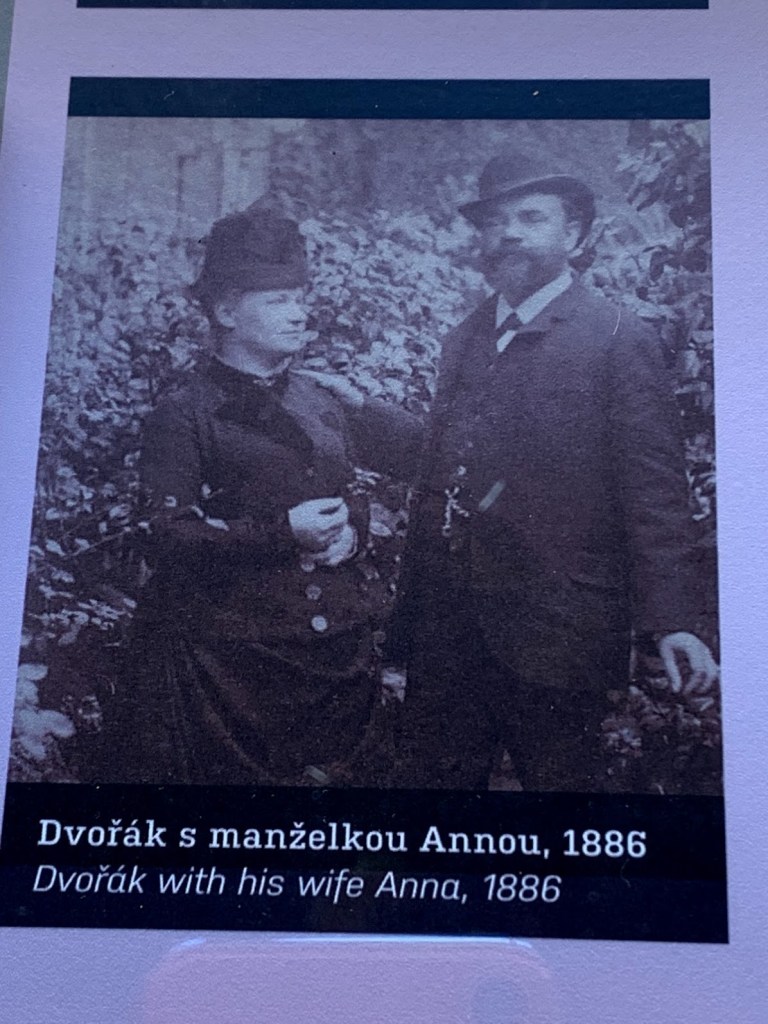
The rain held off as we walked the river’s edge watching all of the boats travel up and down. We soon found ourselves at the foot of a hill, which we climbed to reach St. Peter and Paul’s Church. The façade was a dark brown and black color accented with bright Byzantine like mosaics making it one of the most unique church buildings I’ve ever seen. Just to the right of the front doors was an elaborate wrought iron gate, which led into a beautiful old graveyard. Three sides of the graveyard consisted of gated family graves. We were looking for one in particular, that of Antonin Dvorak and his wife, Anna. Dvorak was a celebrated Czech composer who also spent time in America. Many of his most famous orchestral works are based on Slavic and American folk songs including the “Going Home” movement from the New World Symphony and his Hungarian Dances.

The grave of composer Antonin Dvorak and his wife Annou (Anne)
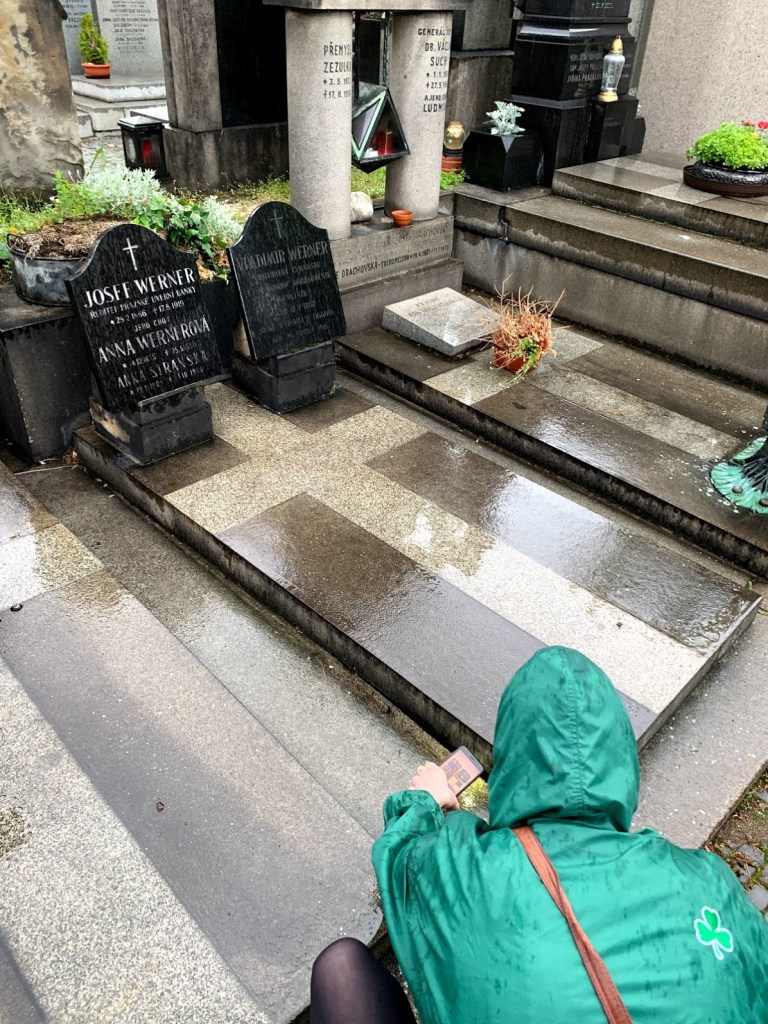
Turah found that one of the graves was slightly askew and used her phone light to look inside.We joked that the vampire had barely made it back before sunrise and didn’t quite close his coffin quick enough!

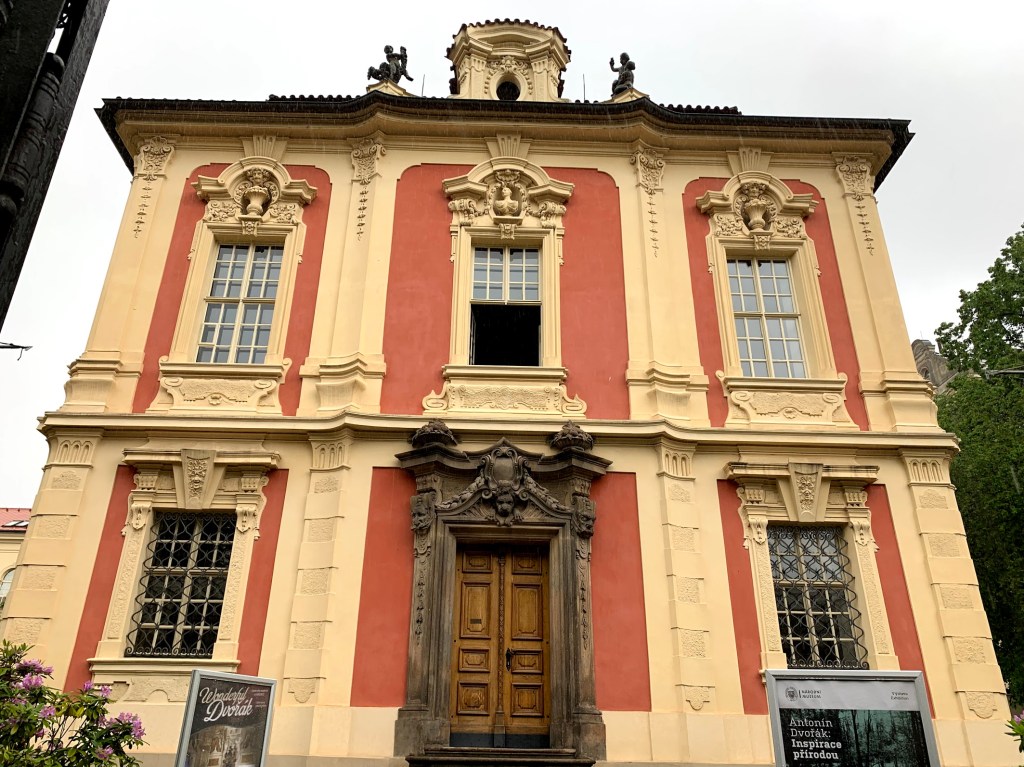
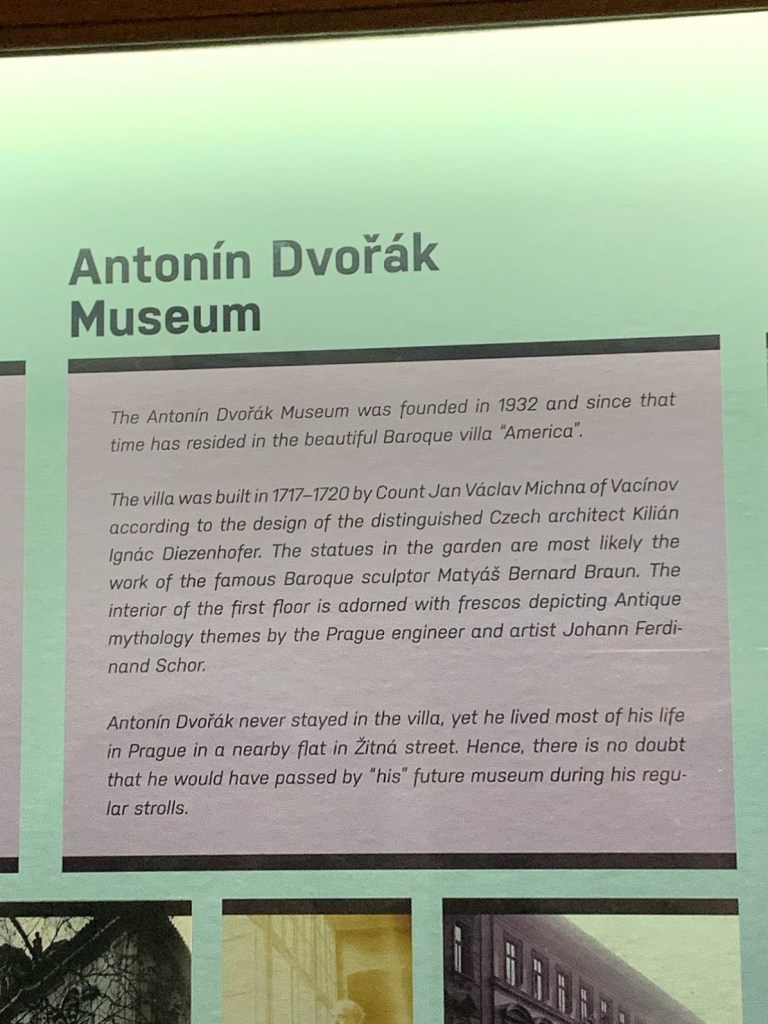
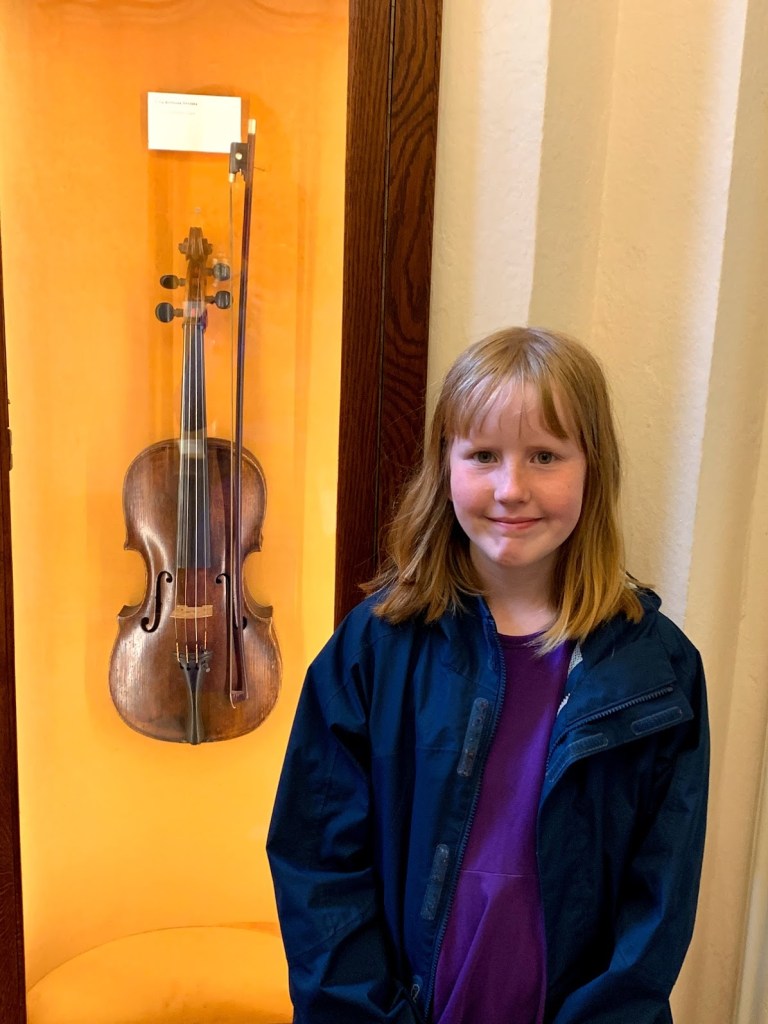
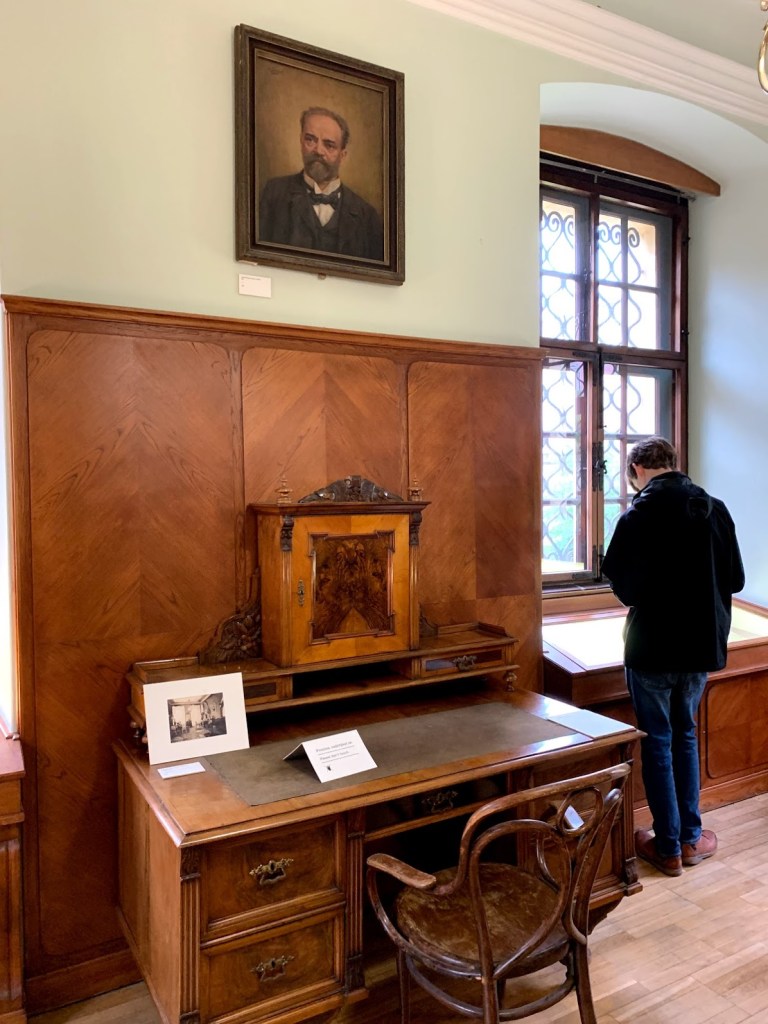
Liam and I both love Dvorak’s music and so when we left the graveyard we walked about 10 minutes to the Dvorak Museum located in one of his homes in Prague. The museum was well organized and it displayed many of his music compositions and personal items. Faywen loved the fact that Dvorak played the viola!

Dvorak Museum

The skies opened while we were in the museum and the rain continued as we walked along the streets. We popped into a little mall and purchased 3 more umbrellas. It was lunchtime and we were near our apartment so we went home to dry off and eat.

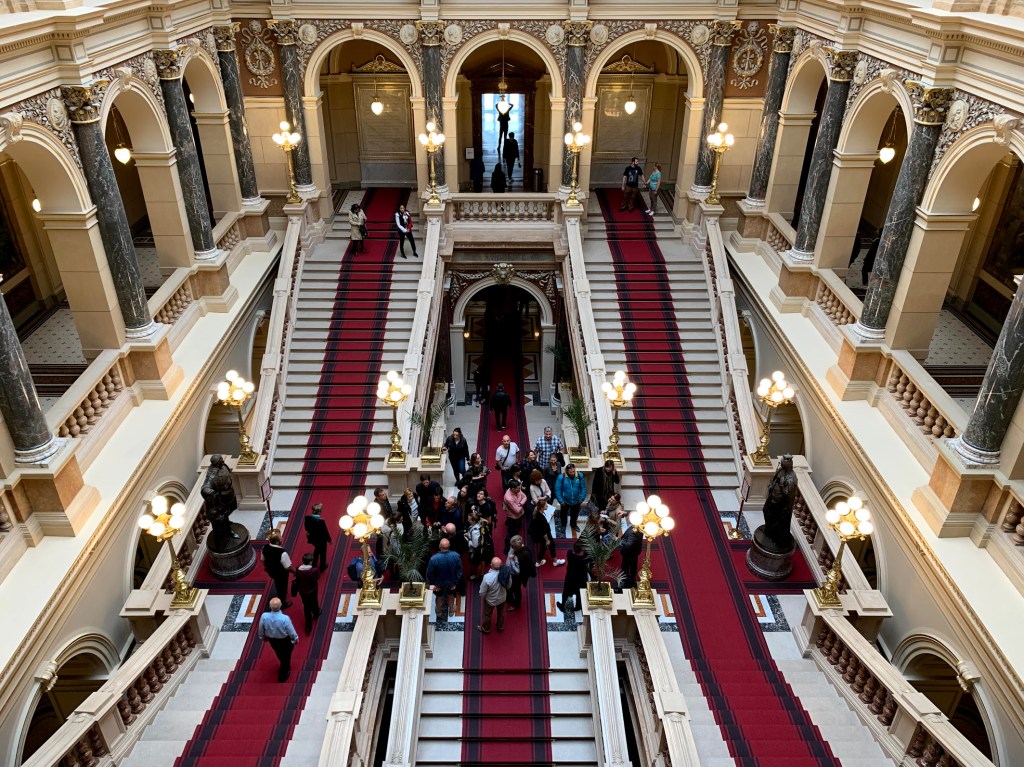
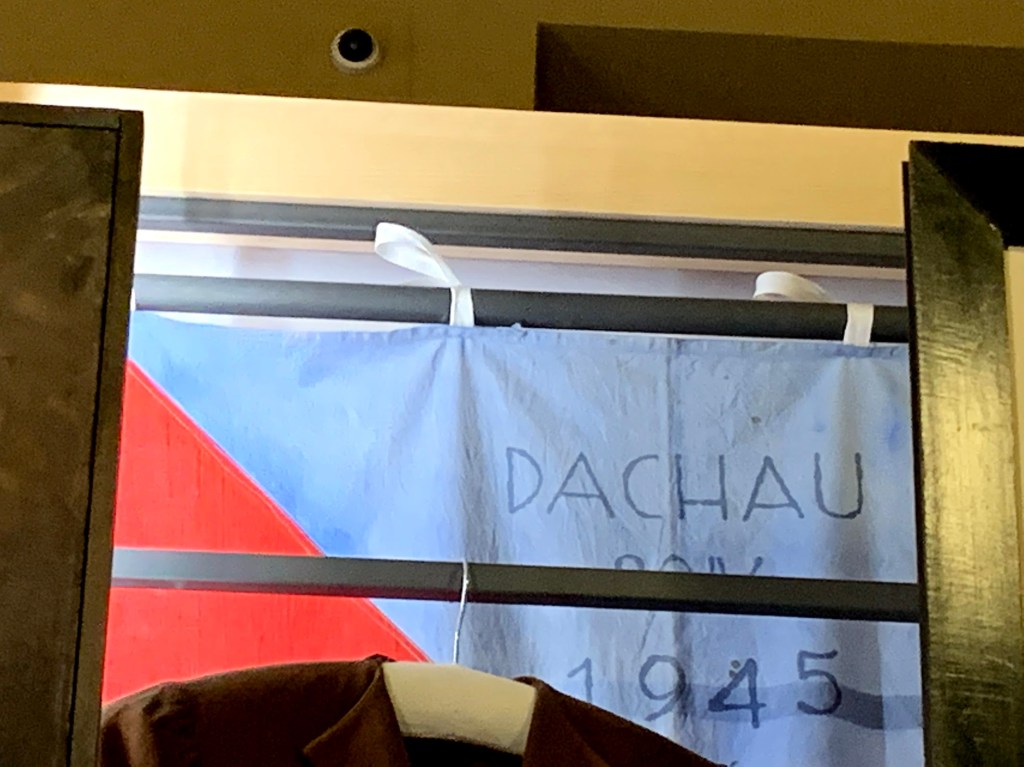
The rain lessened a bit so we headed out once again this time towards Wenceslas Square, the Prague Opera House, and eventually into the Czech National Museum.  The quadruple marble staircase was a feast for the eyes! The 20th century Czechoslovakia exhibit was very interesting. Robert and I particularly found the old Soviet propaganda and photos from the 1970’s-80’s memorable. We found a Czech flag made by prisoners at the Dachau Concentration Camp. It had been placed on the shoulders of the first US soldier to enter the camp on liberation day. We had read about this story while at Dachau last month.

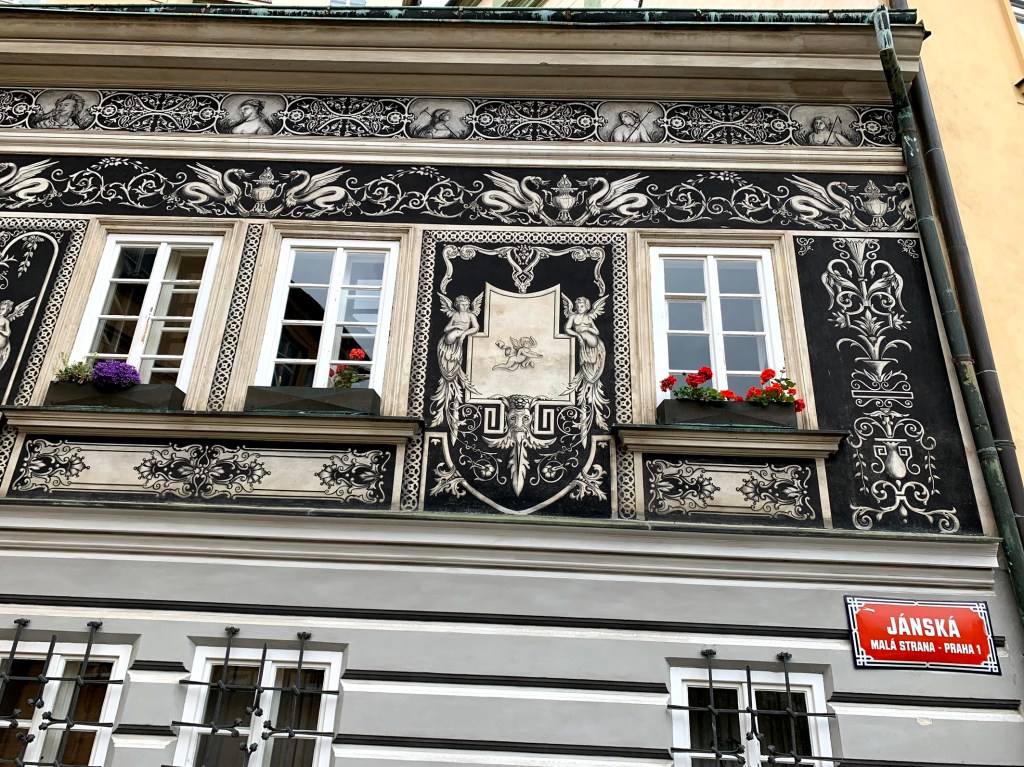
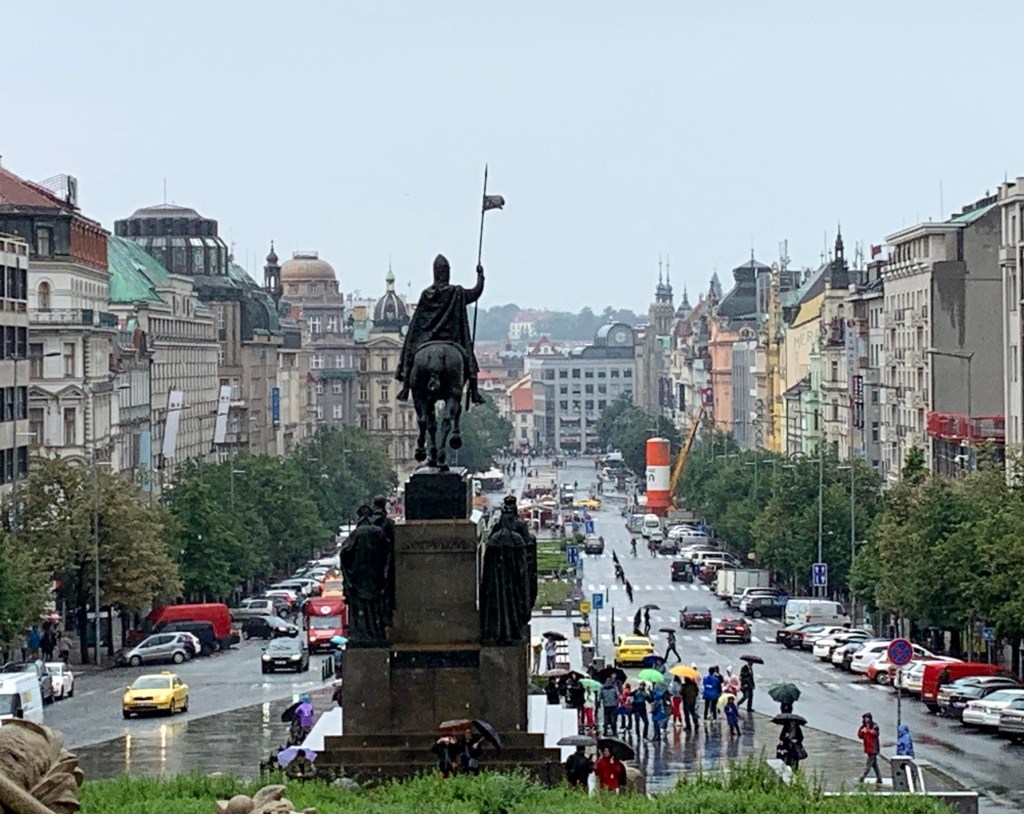
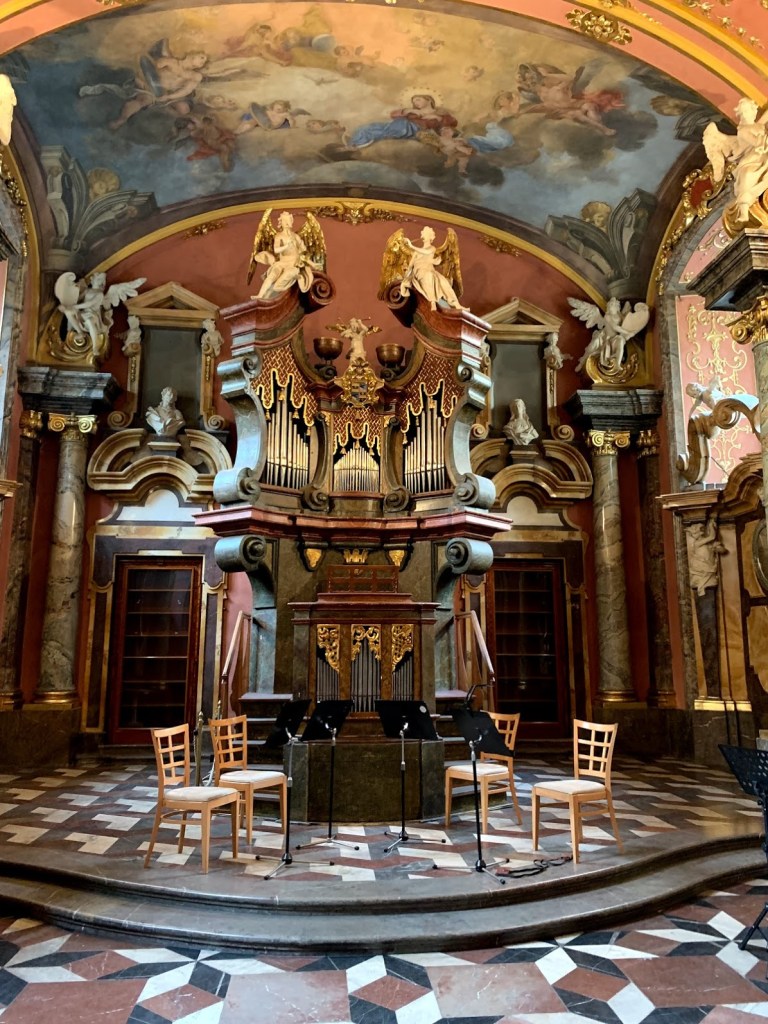
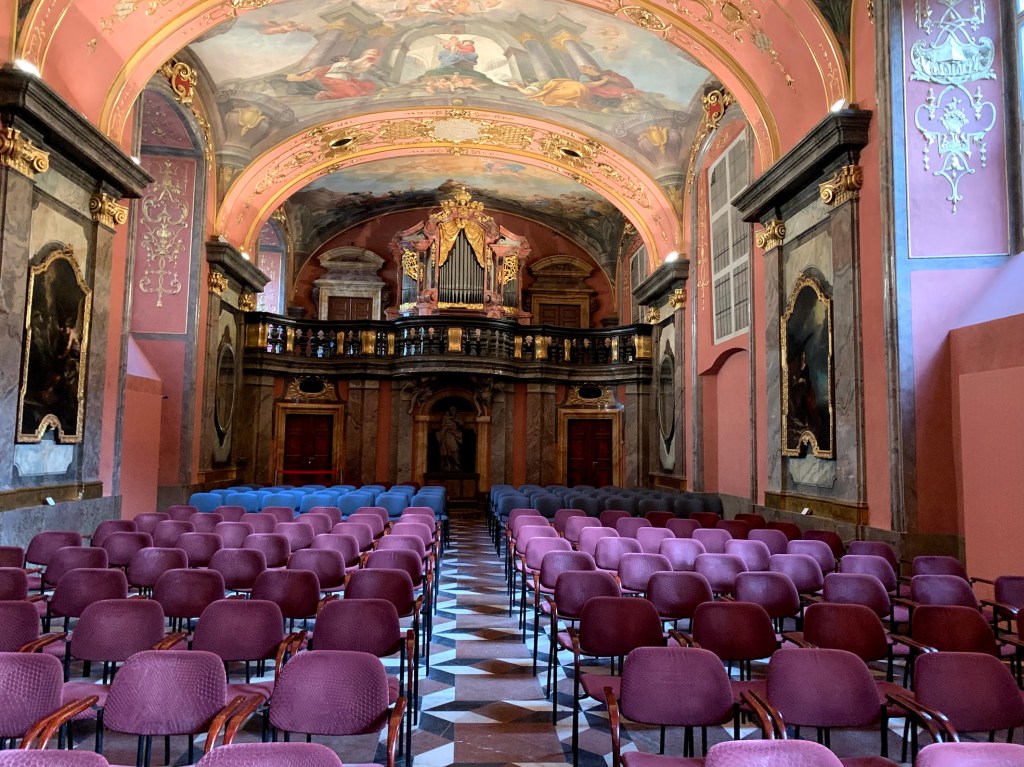
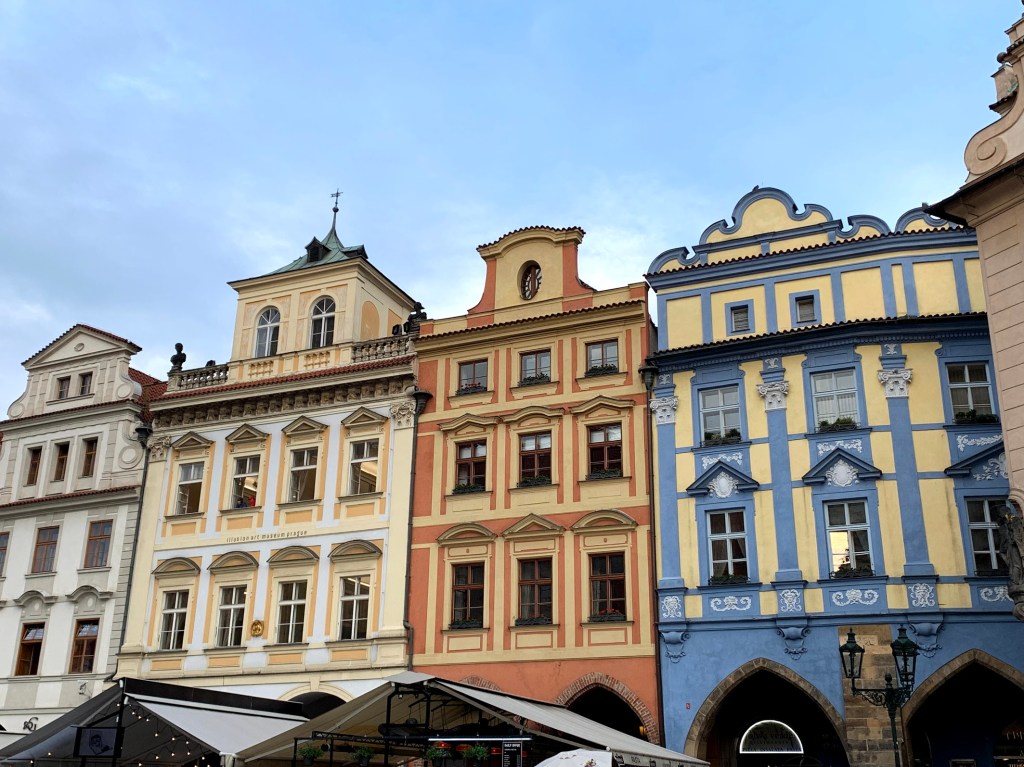
In front of the museum was the Wenceslas square and the main shopping thoroughfare for Prague. It reminded me a lot of O’Connell Street in Dublin. A few blocks and we were once again in the heart of Old Town Prague. The architecture of the 17-18th century painted buildings made the Old Town Square look like it had popped out of a European storybook! In one of these buildings we attended a musical concert. Members of the Dvorak Symphony Orchestra gave the concert. The quintet played Bizet, 3 Dvorak selections, Smetana, and the entire “Seasons” by Vivaldi.

Wenceslas Square:
This photo was taken from the steps of the Czech National Museum
Inside the Marble Hall:
This ornate 17th century hall is only open to the public for concerts. Mozart held concerts in this hall!
The Marble Hall is known for it’s decor and two organs, one in the back and the front of the hall.
Storybook buildings in Old Town Prague

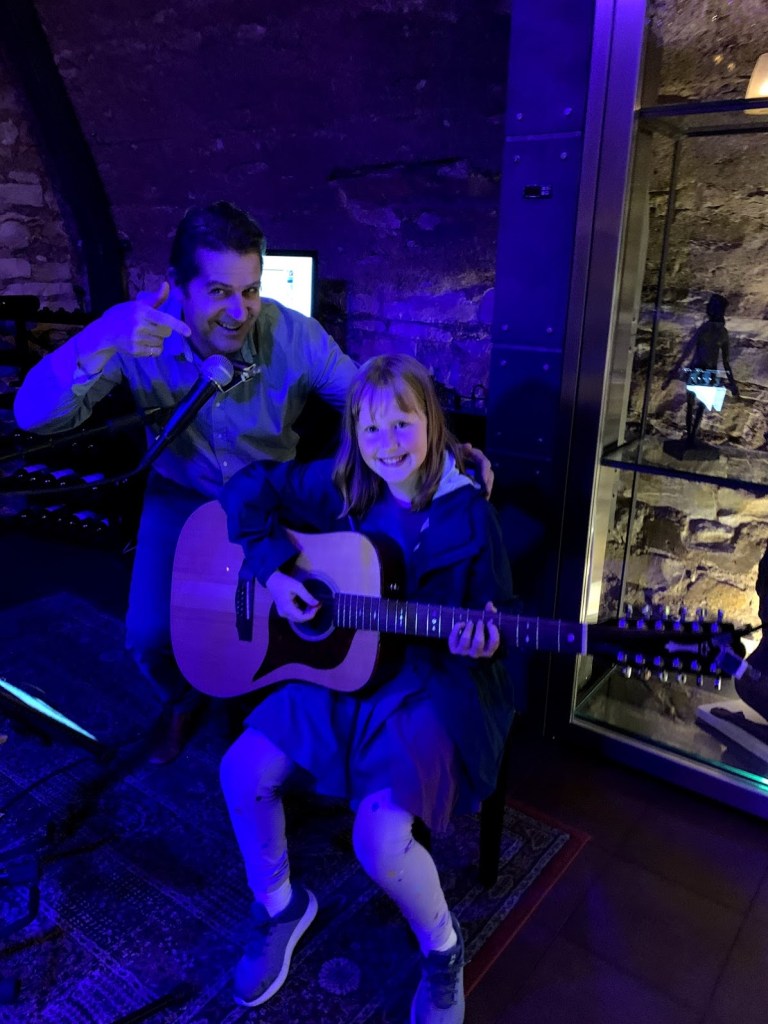
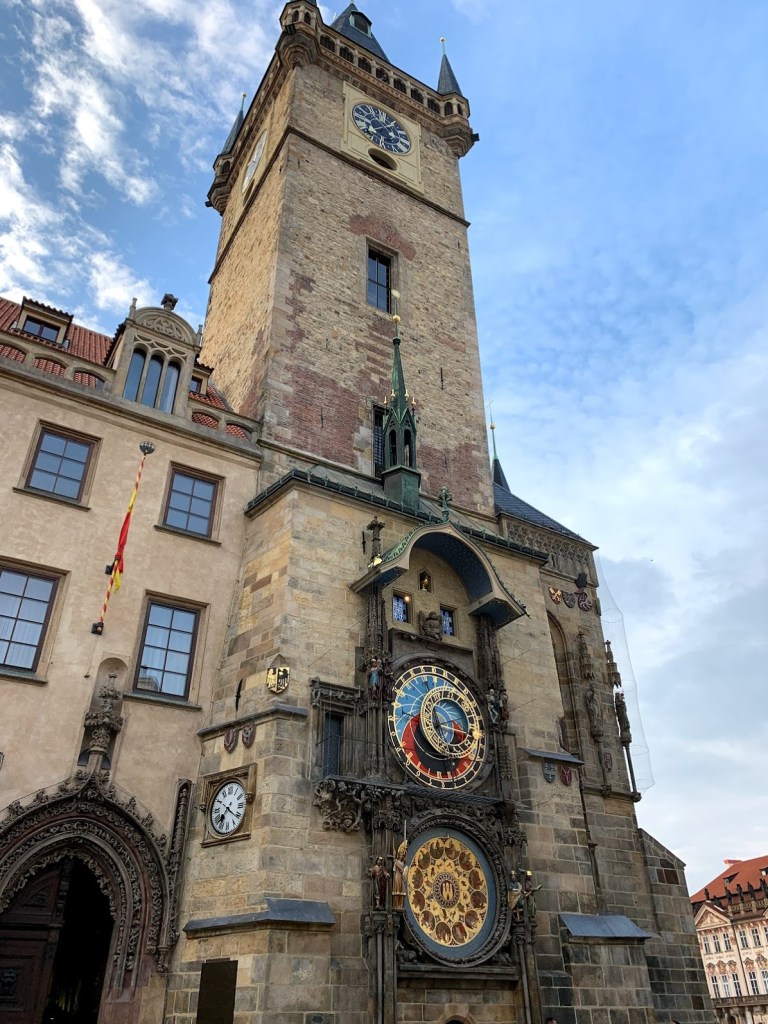
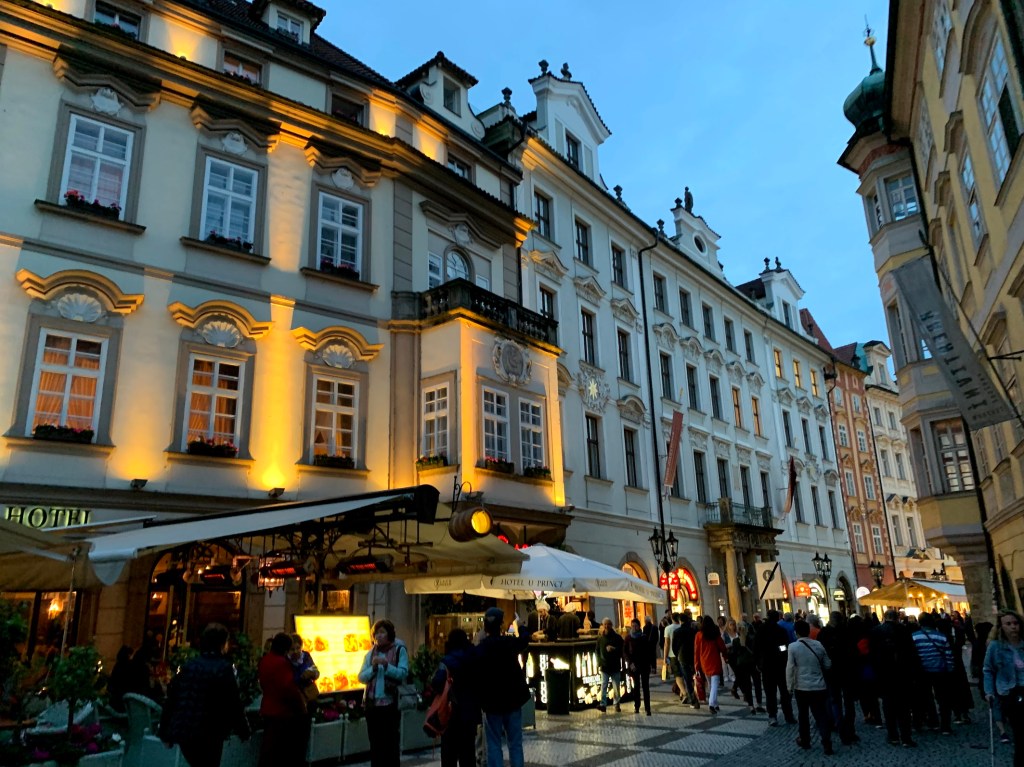
We ate dinner in an old 12th century cellar. The White Horse had delicious food and live music. Right at the end of our meal, Faywen went over and asked the musician to play “Country Roads”. He put in a pre-recorded track and everyone in the restaurant sang along. It was entertaining to be singing this song in an ancient cellar turned fancy restaurant in Prague! We’ve discovered that the song is very popular throughout Europe.  Faywen and I went over to say thank you and give him a tip. Ariminio was very kind and also visually impaired. We immediately bonded once Faywen mentioned I was legally blind. He has tunnel vision and makes his living as a musician. I took a cute photo of Faywen holding Mr. Ariminio’s guitar. Just after we left the restaurant the 16th century Astronomical Clock chimed. It is the oldest clock of it’s kind still in operation. It chimed 21 times for the 21st hour of the day. We walked home as dusk settled in and the lights turned on in the

Mr. Ariminio and Faywen
Astronomical Clock
Central Prague at dusk

Stille Nacht

We said farewell to the Bavarian Alps and drove towards Prague in the Czech Republic. To help break up the five-hour drive we stopped at a couple of interesting places along the way.

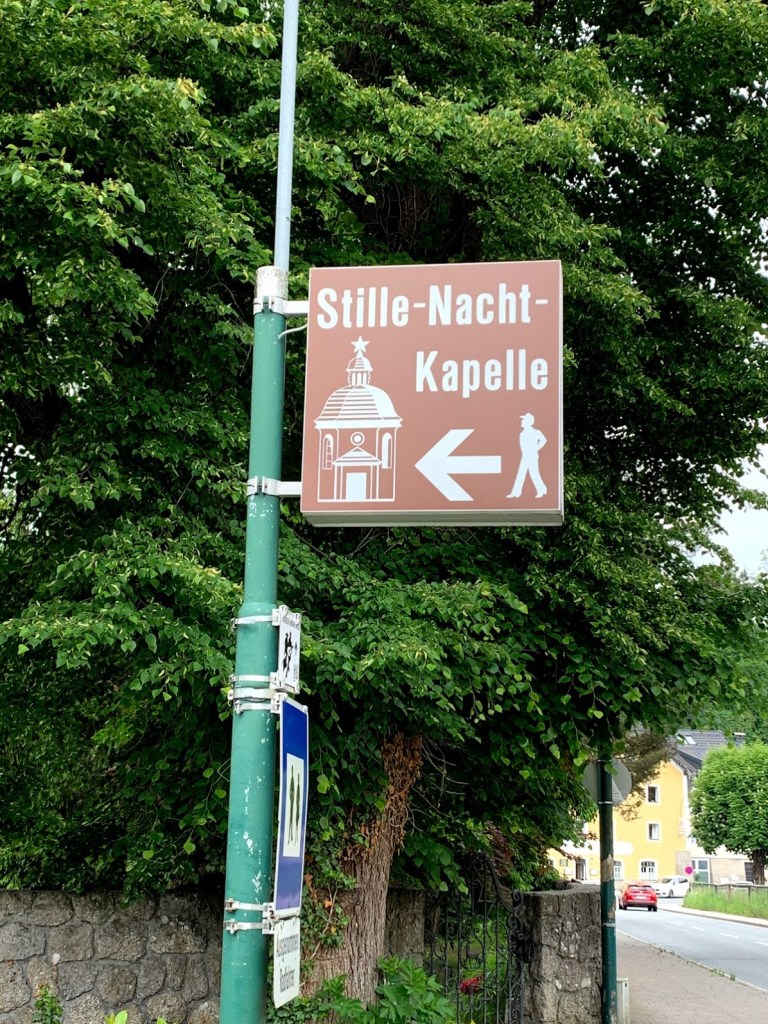
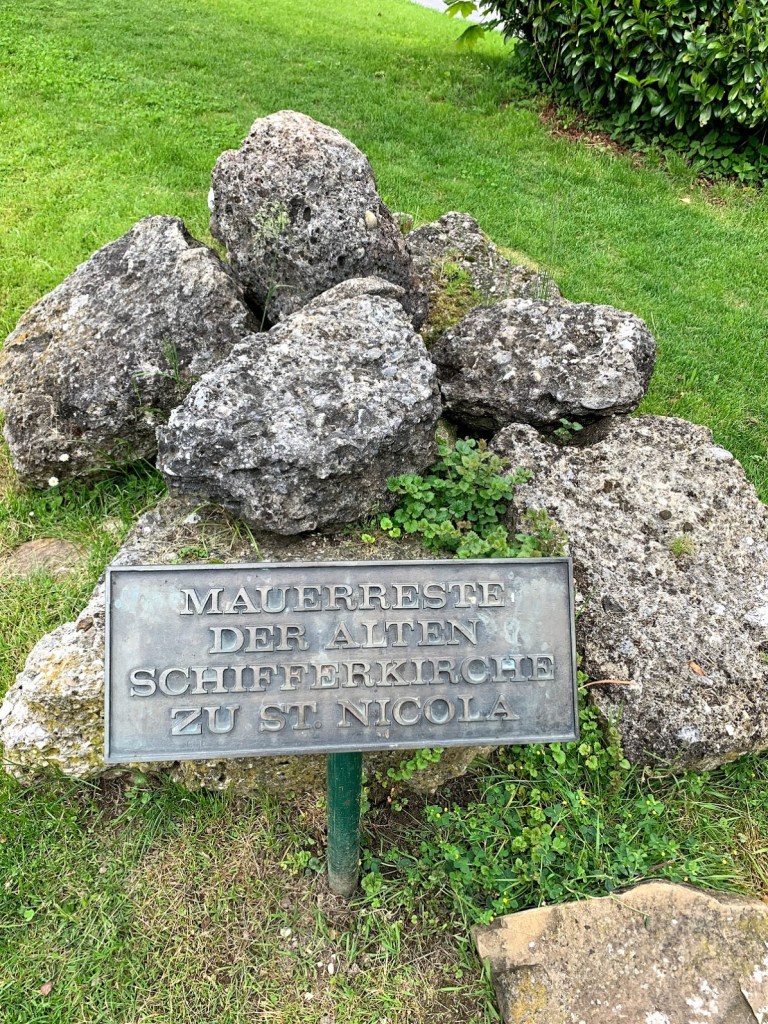
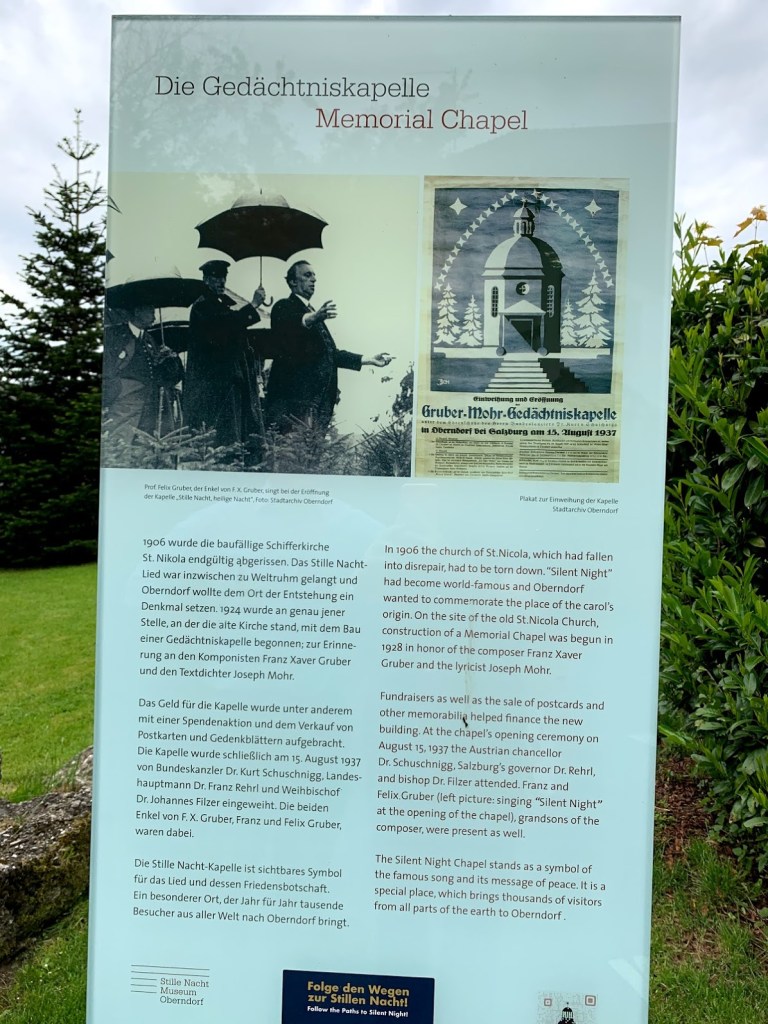
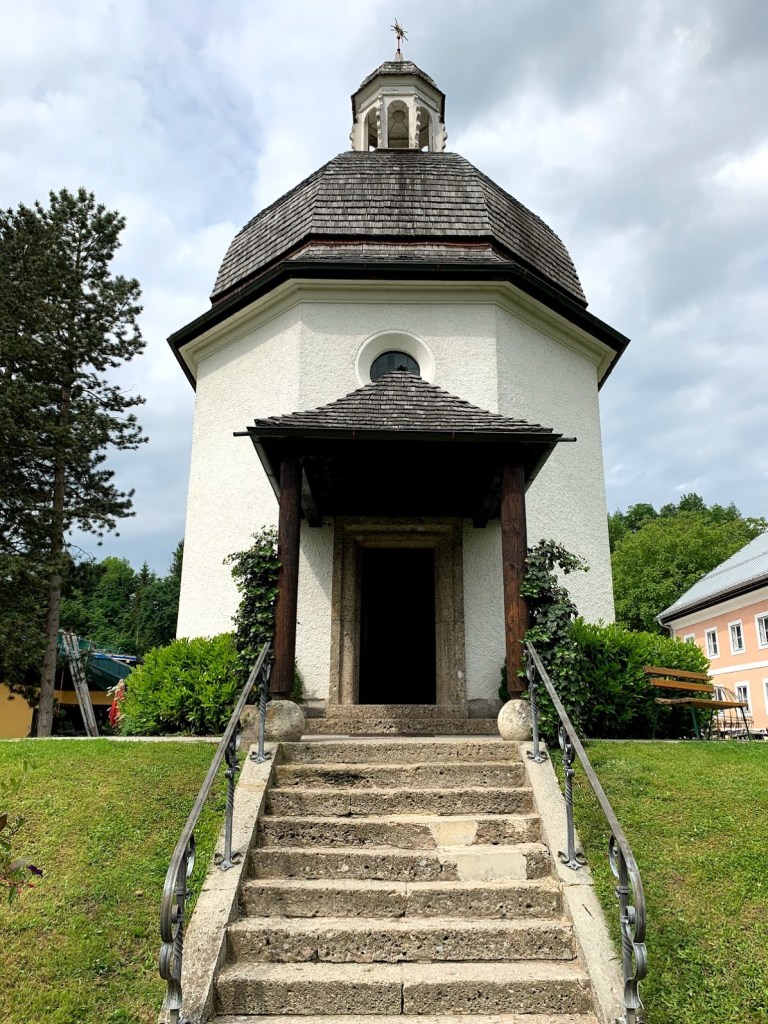
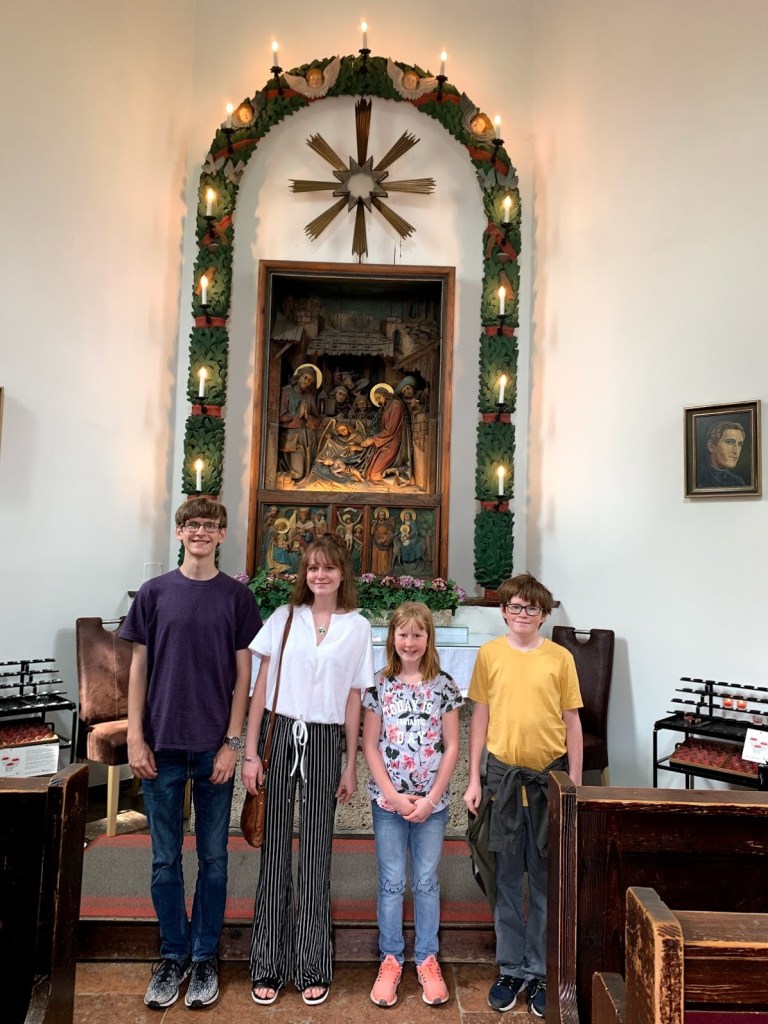
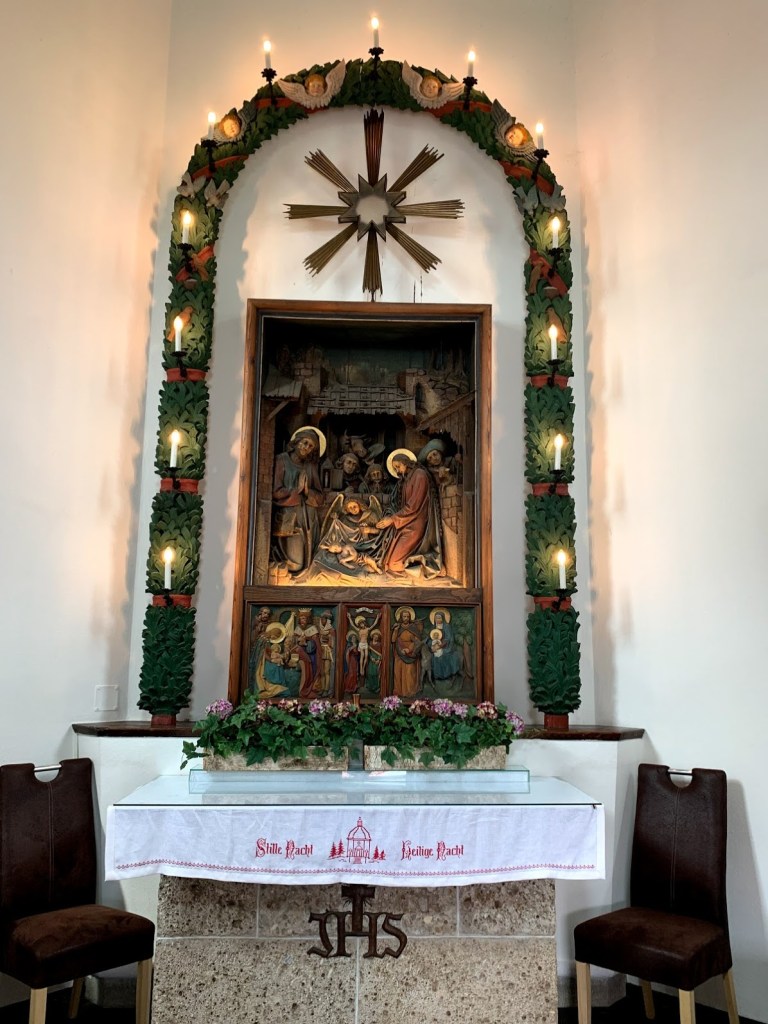
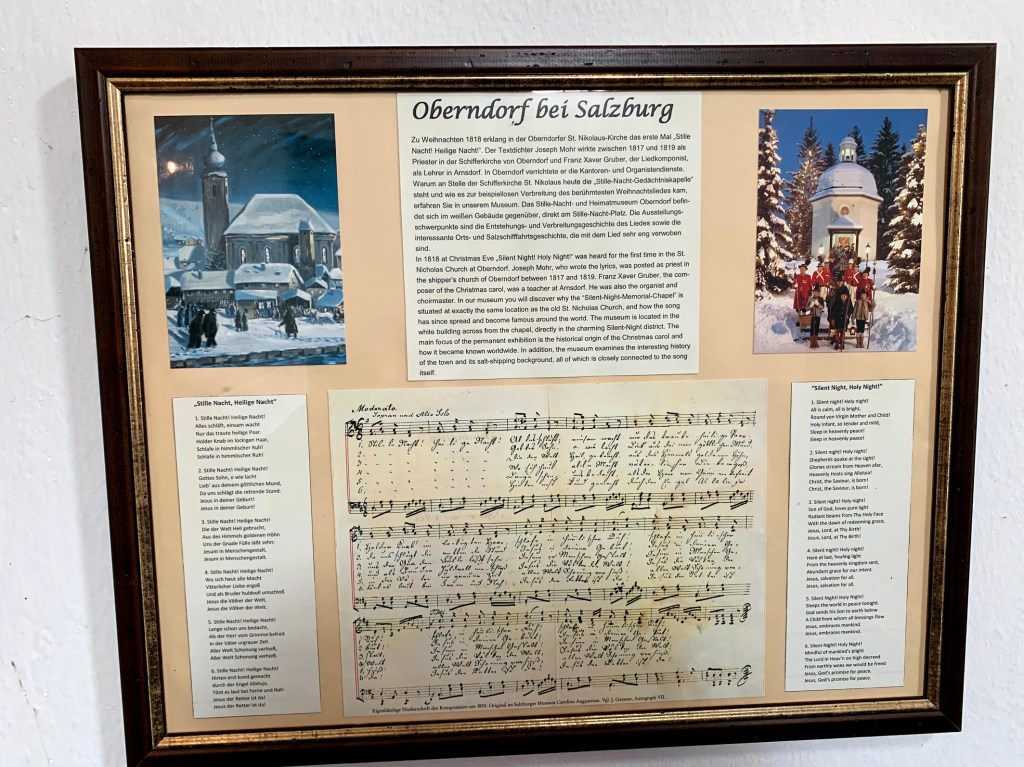
A bit over the Austrian border and just north of Salzburg is the town of Oberndorf bei Salzburg. In the town is a little round chapel along the riverside. It is a memorial chapel that marks the spot where the world’s favorite Christmas Carol was first performed. In 1818 Franz Gruber was the organist at St. Nicola’s church in the village. On Christmas Eve the organ bellows broke and Father Mohr came to Gruber and asked him if he could write a simple song for the little congregation to sing at Midnight Mass. Fr. Mohr gave Gruber a poem he had written a couple of years before and “Stille Nacht, Heilige Nacht” was the result. The two men sang the carol that night with just a simple Tyrolean guitar. Within a few years the little song became known throughout the world as “Silent Night”.  Sadly, St. Nicola Church fell into disrepair and was pulled down in the early 1900’s. By 1937 the townspeople erected the Stille Nacht Kapella to mark the birthplace of the world’s most beloved Christmas hymn. As we arrived we heard a group of French motorcyclists singing the last lines of the hymn in French.

This sign explains the memorial
27 May 2019
Silent Night Chapel in Oberndorf bei Salzburg, Austria
This is the only surviving copy of the original hymn written by Gruber and Mohr. It is a copy in Father Mohr’s hand. Note that the melody is in 6/8 and a lot more rhythmic than we sing it today.

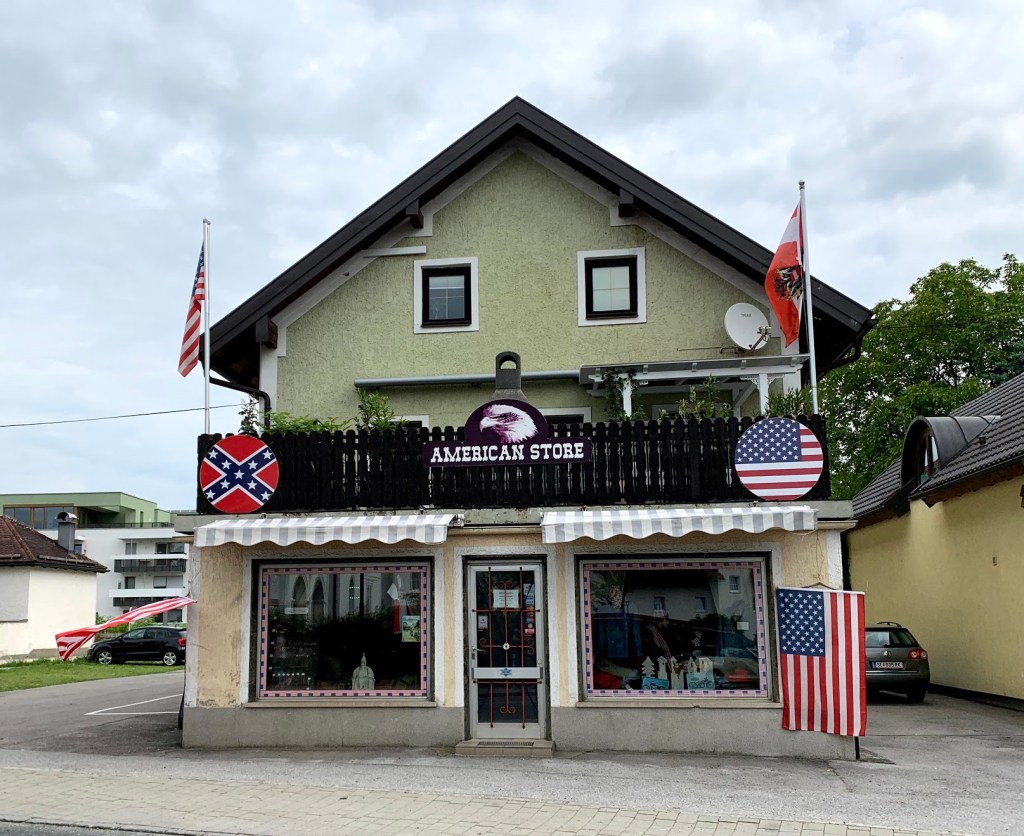
Nearby was a funny little American Store. Arnold the owner was very nice and it was fun seeing how Austrians perceive American culture and merchandise!

Americana meets Austria!
It was full of a lot of motorcycle biker leather, t-shirts, and cowboy items.
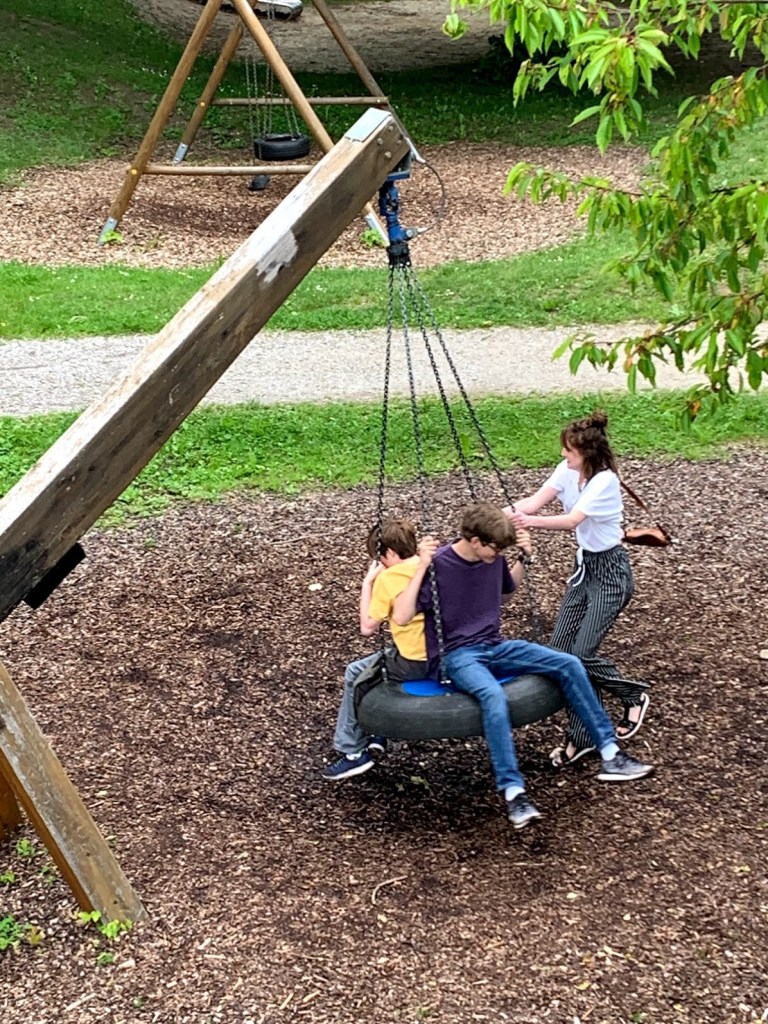
Ah the kids found some “danger” playground equipment…of course we had to stop and let them play!

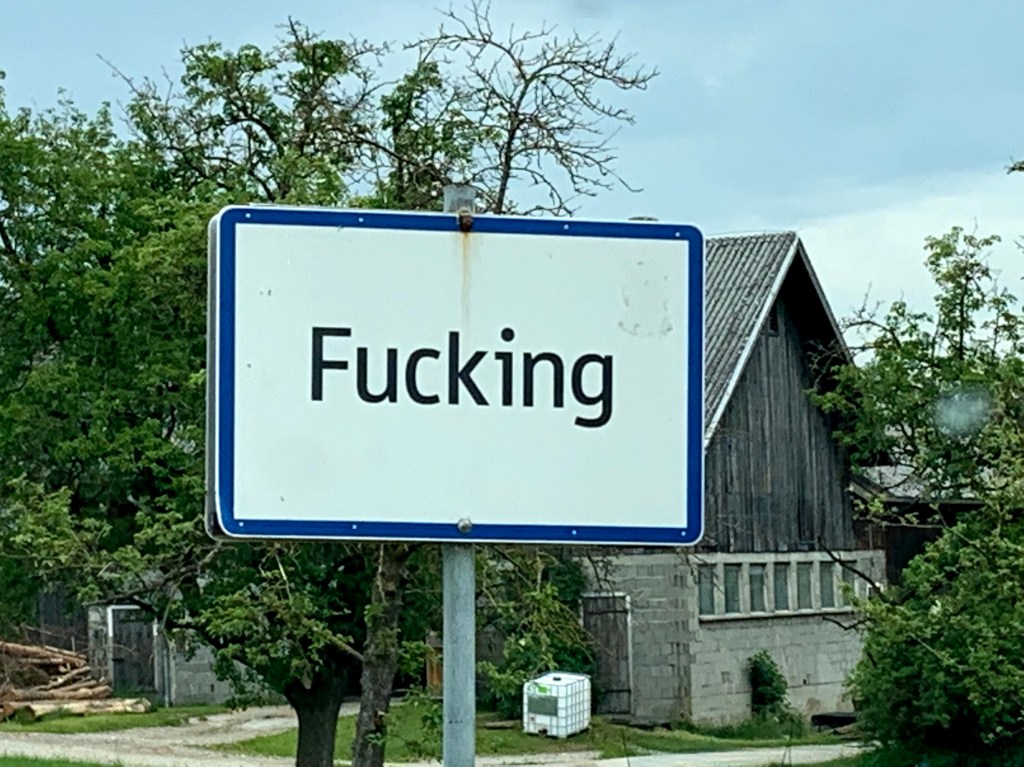
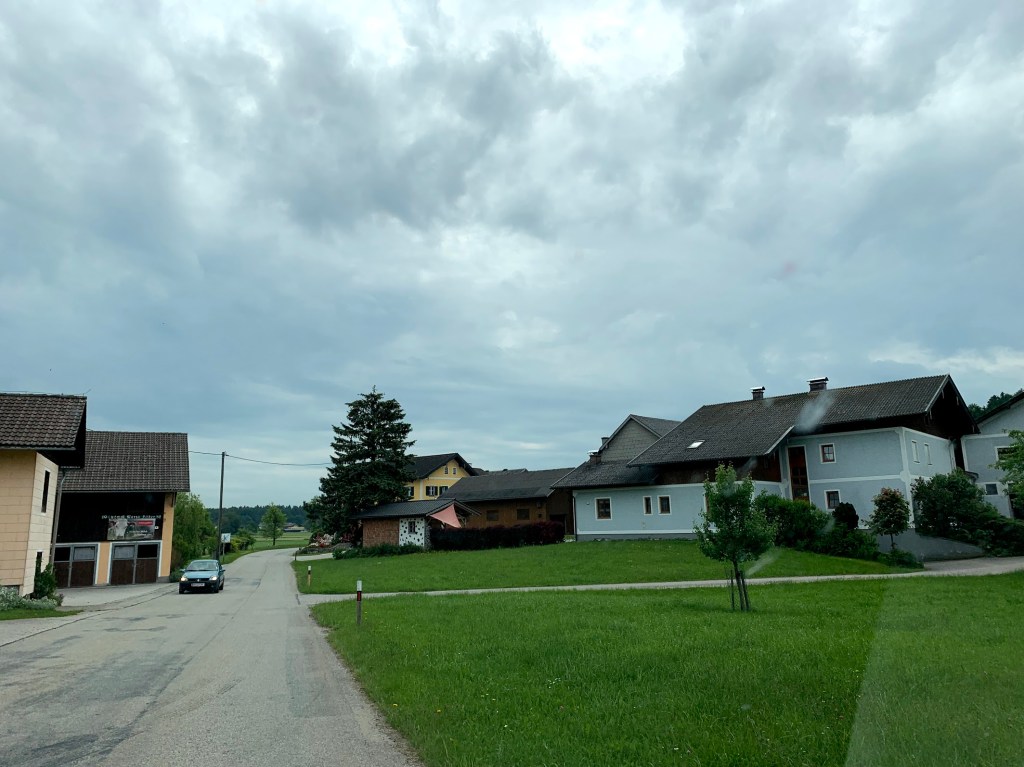
Outside of Oberndorf the rolling hills of the Austrian countryside gave way to pretty farms and hamlets. One such hamlet we discovered had a very interesting name…Fucking! Yep, you read that correctly! So here’s the backstory on this little hamlet of 15-20 houses set in the luscious green Austrian farmland. It seems that in Austrian the name Fuck came from a famous warrior who lived in the area. The suffix “ing” means “place of” in German. So Fucking literally means “the place of the warrior Fuck”(pronounced in German “Fook”). Gotta love cultural anomalies!

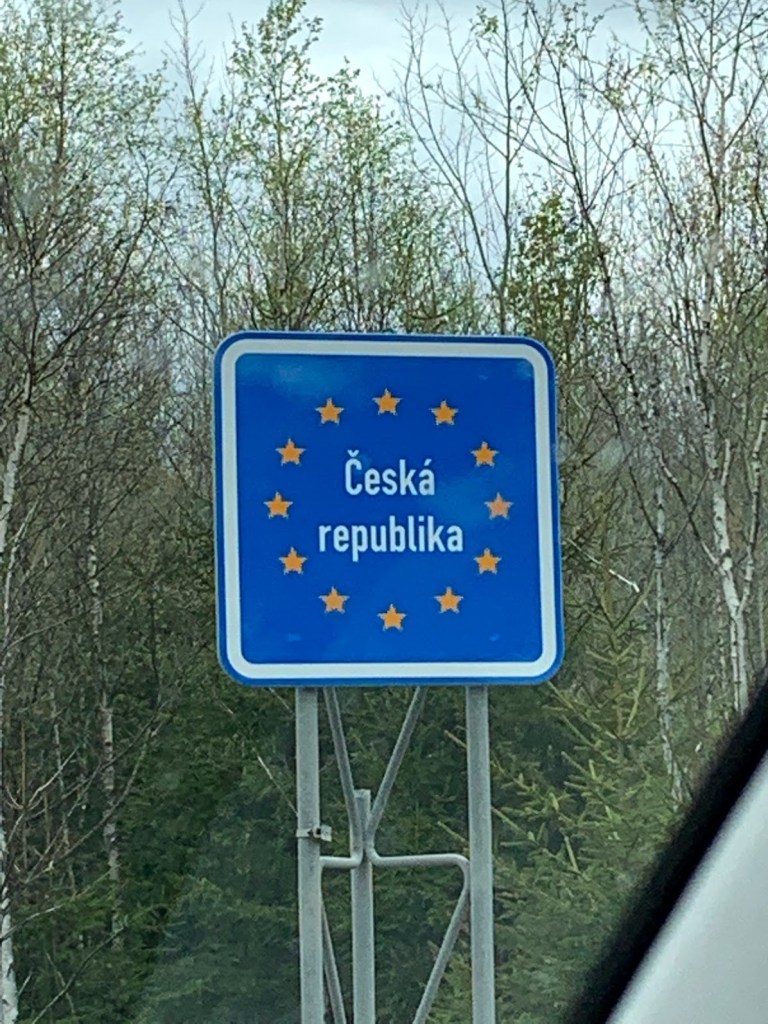
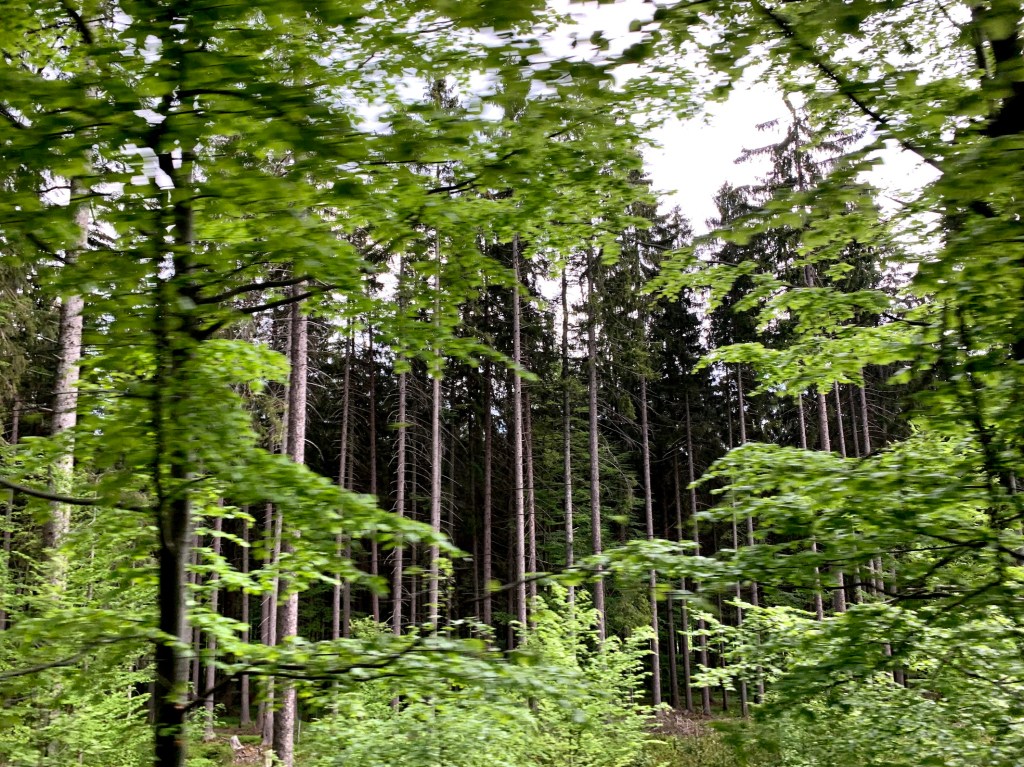
The rest of the day we drove through the countryside, returning briefly to Germany before crossing into the Czech Republic. The region around the border was thickly forested. It was easy to imagine the big bad wolf or evil witch in her candy house lurking in the dark, black forests. I just caught a glimpse of Little Red Riding Hood’s cape as we drove by!

Czech Republic border sign
Into the deep dark woods…

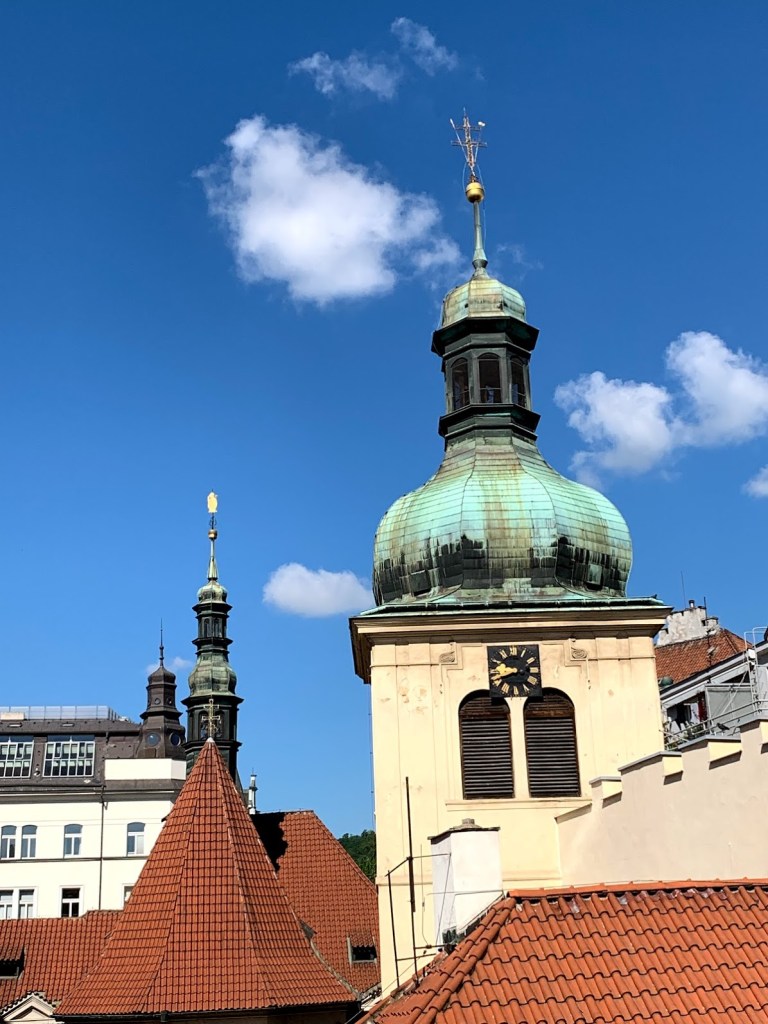
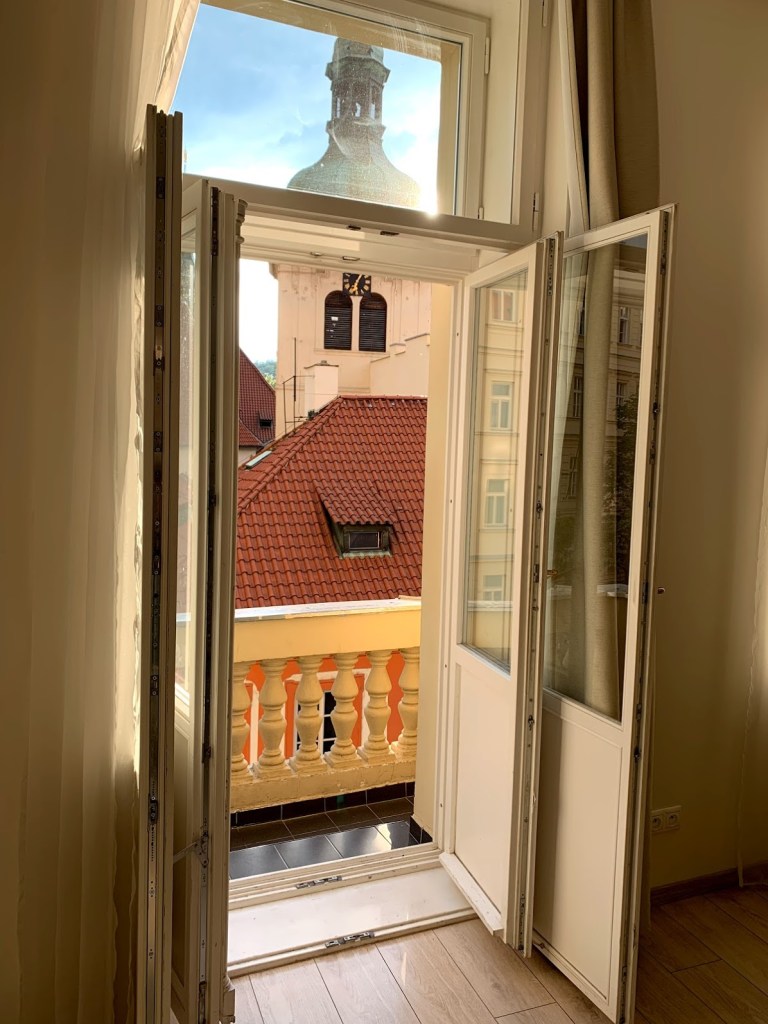
The sun peaked out from behind the clouds as we drove into Prague. Our apartment was perfectly located on the edge of Prague Old Town. We had a charming balcony that overlooked an onion domed church spire and baroque buildings. Robert and the kids headed out to find the local grocery and exchange some Euros for the Czech Koruna, when the church bells began to ring calling people to Vespers. As I stood on the balcony the evening sunshine cast it’s rays on the church spire and set the old cream walls and orange colored tiles aglow!

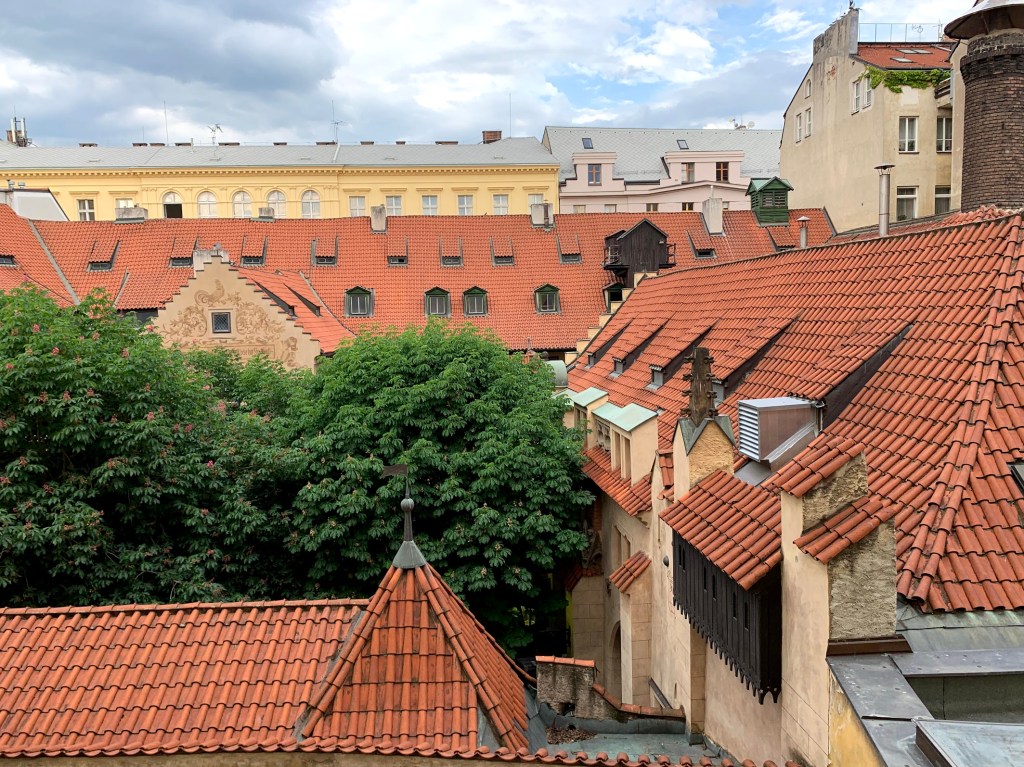
View from our back window:
In the tree covered courtyard was a local brewery.
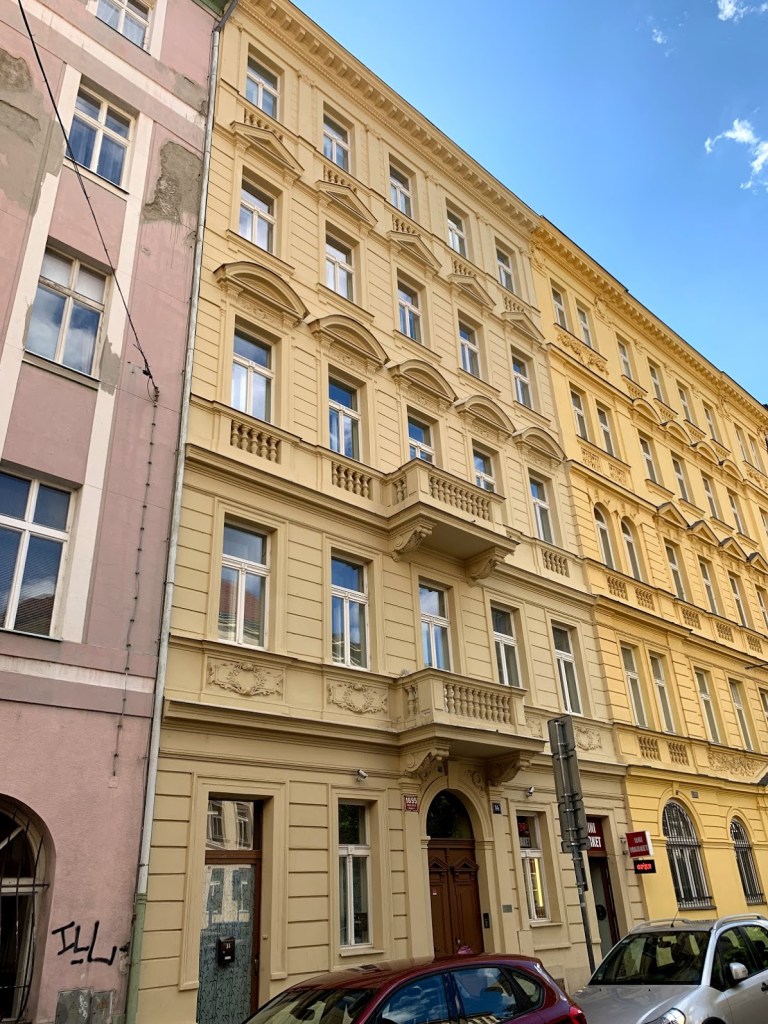
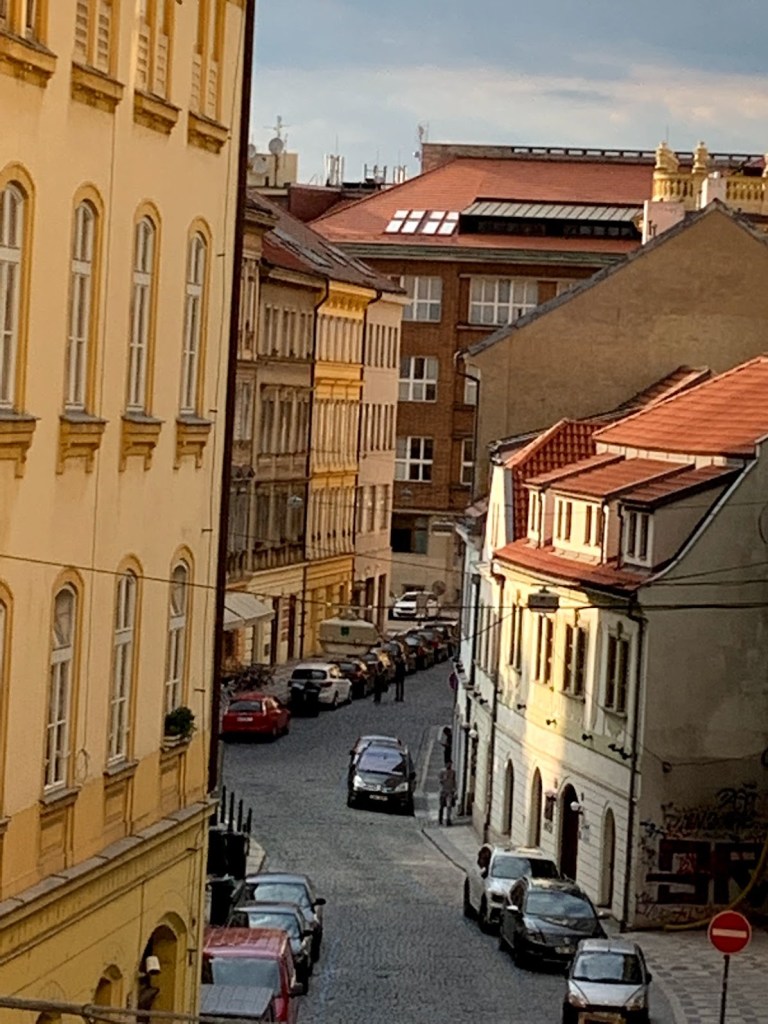
View down the street from our balcony
The setting sun cast a warm light that made the church and balcony glow!

Climb Every Mountain

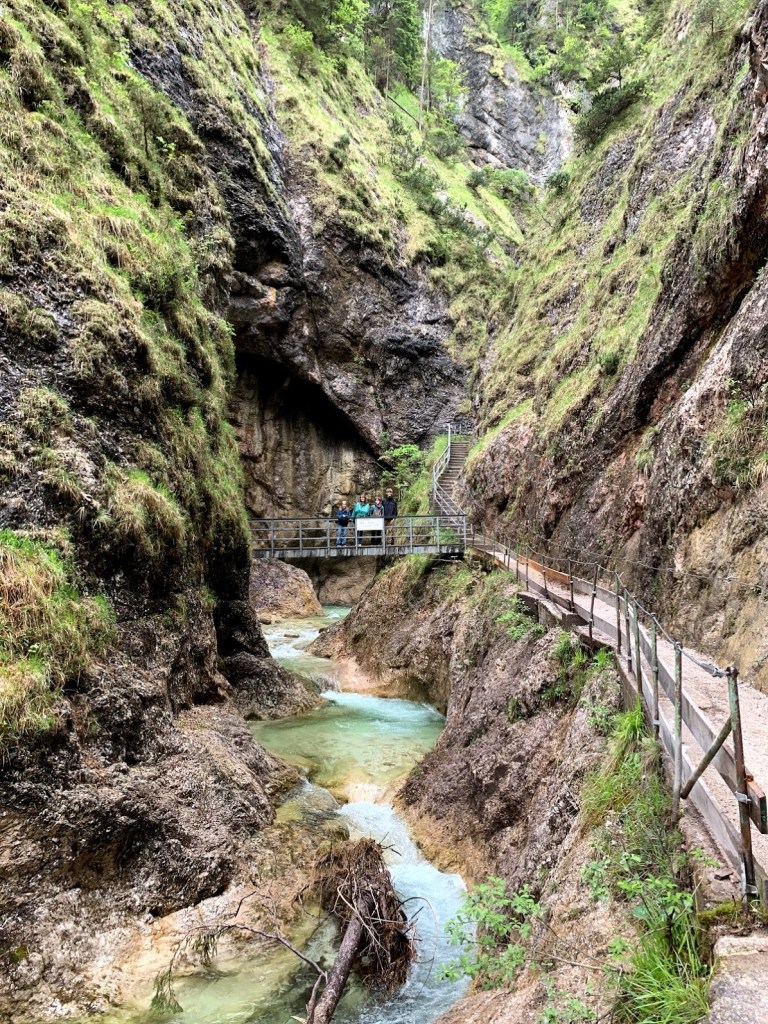
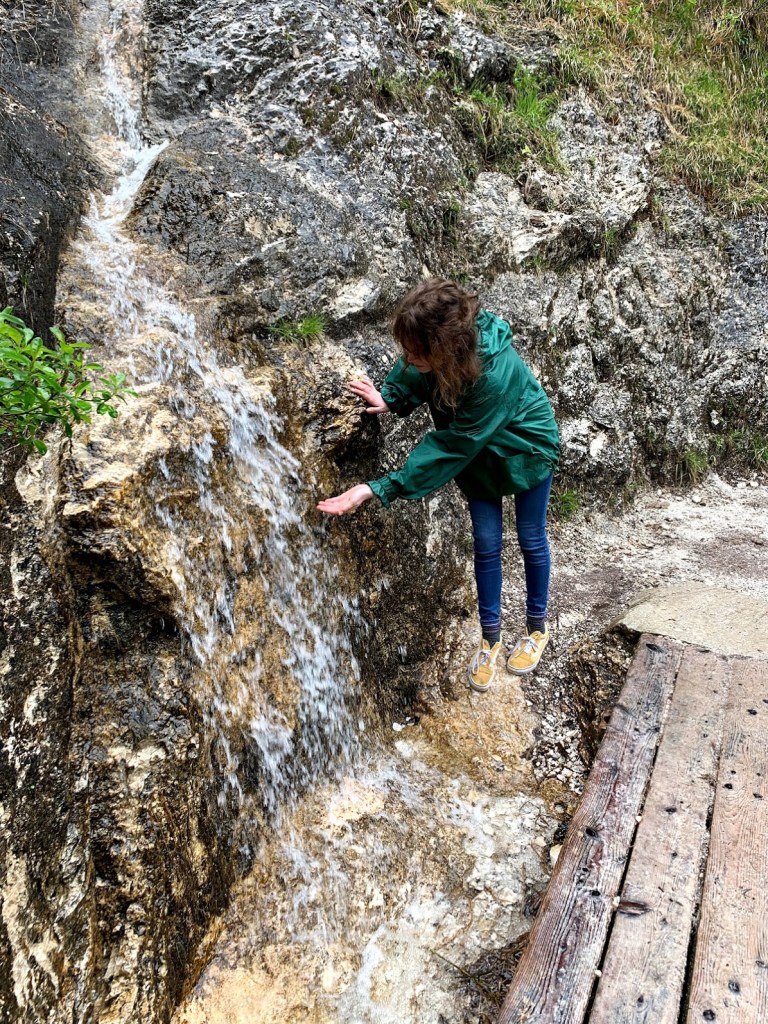
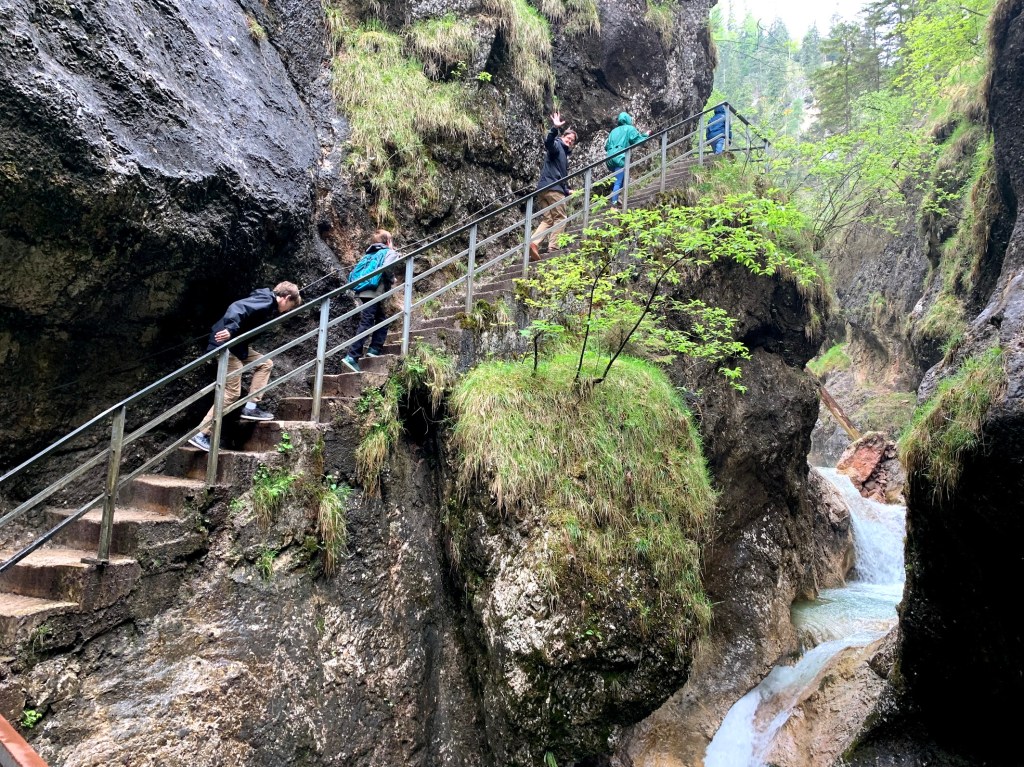
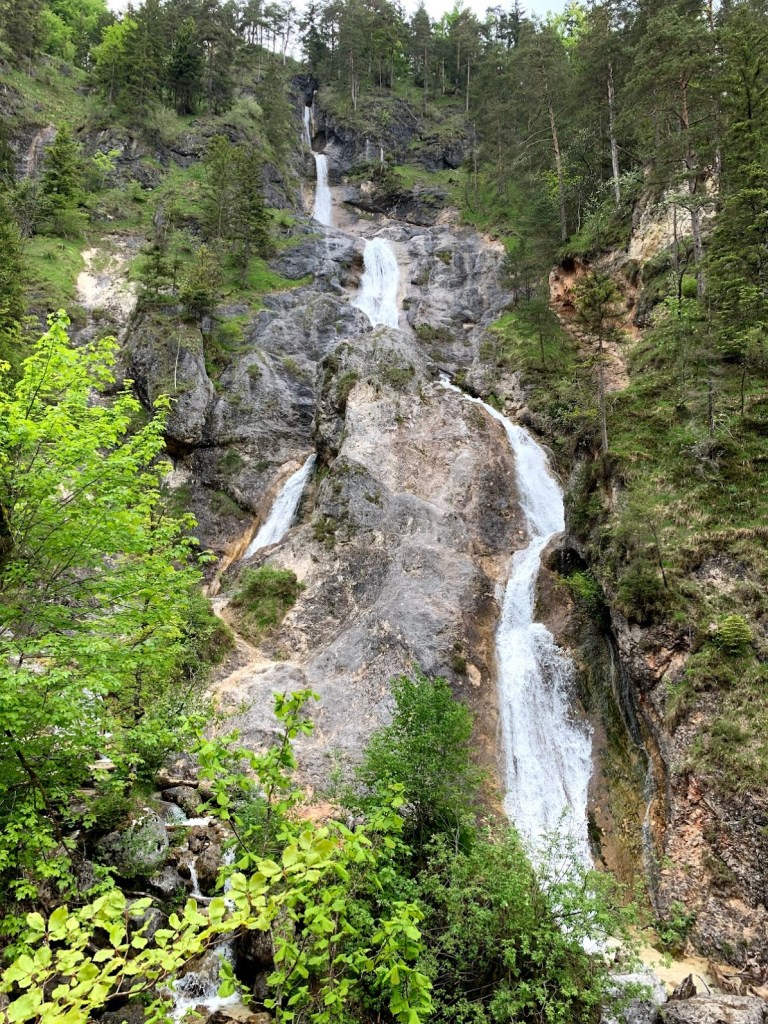
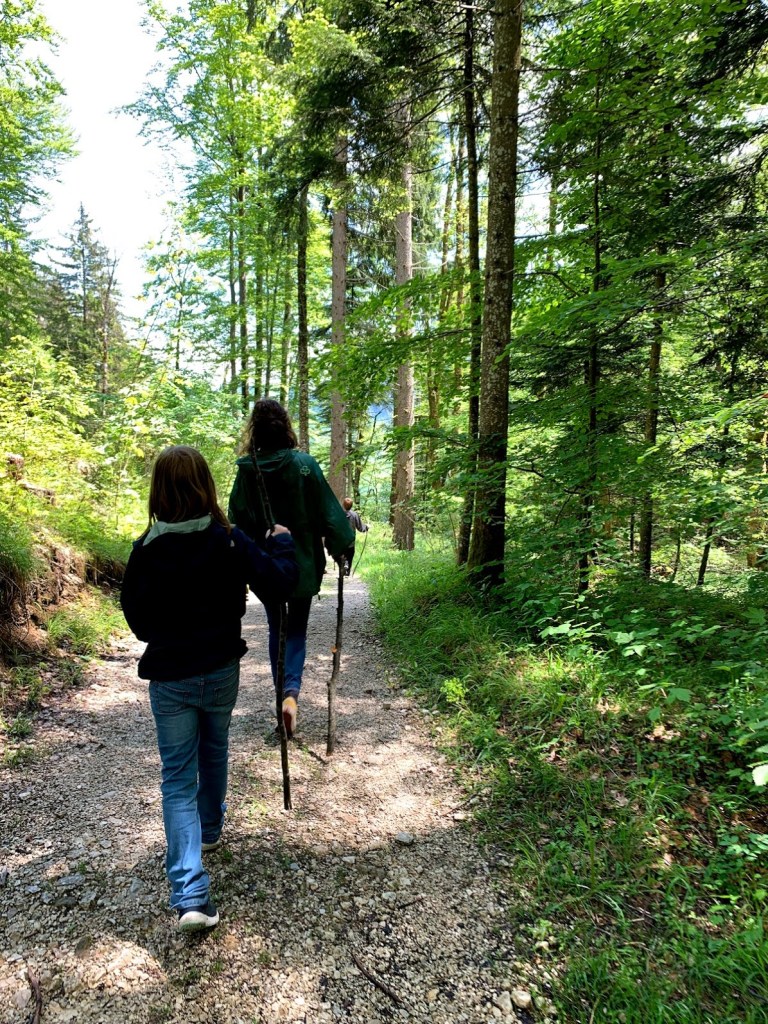
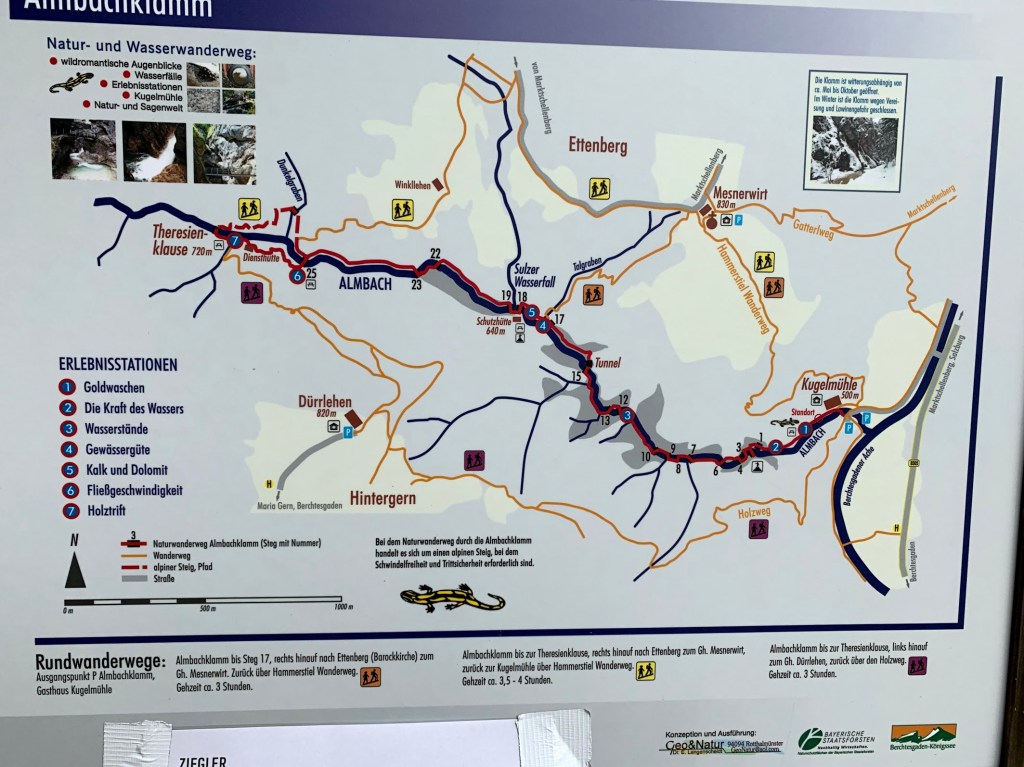
Up and over the mountain was today’s theme! We drove to the Almbachklamm, a natural gorge just south of our hotel in Germany. The Almbachklamm is one of Germany’s finest gorges. We entered the gorge hear the Kugelmühle, a marble ball mill and began what would be a 3.5 hour hike. We then hiked along stone and wooden planked trails that hugged the gorge cliff face. Sometimes it was very narrow and there was only a rope to hang onto for guidance. The gorge was full of beautiful rock cliffs, waterfalls, and wild flowers growing in the rocks as well as along the riverbank.

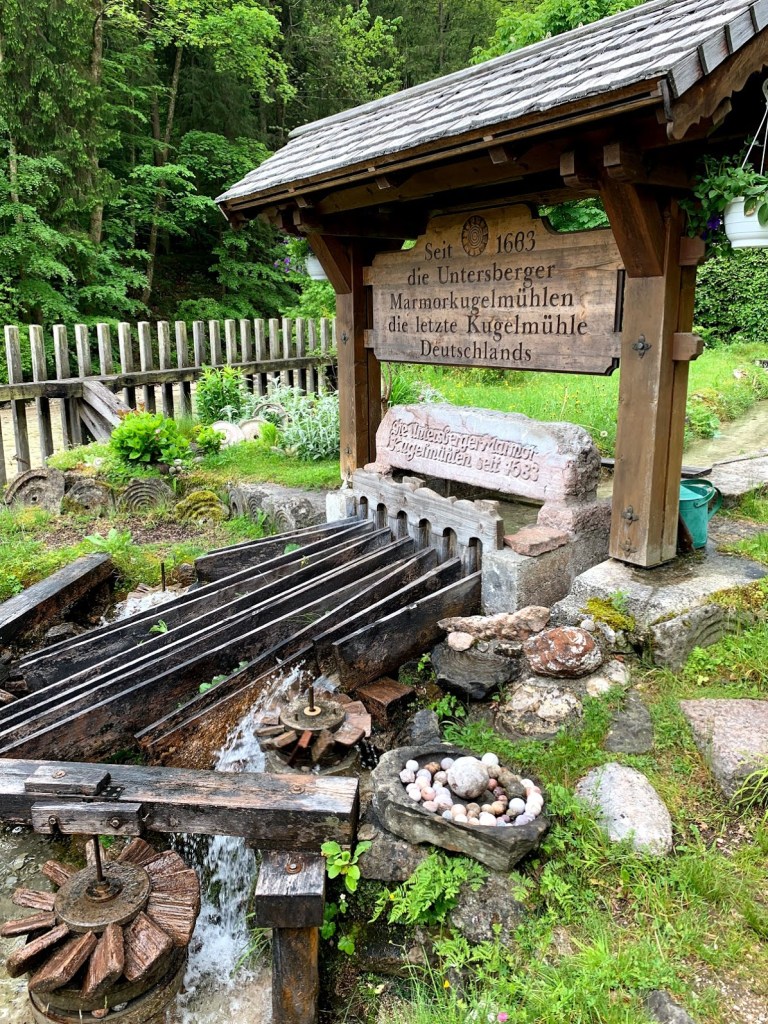
Kugelmühle in Almbach, Germany:
The watermill has been smoothing out marble stones since 1583
A beautiful portion of the gorge
There were many bridges and staircases in the gorge

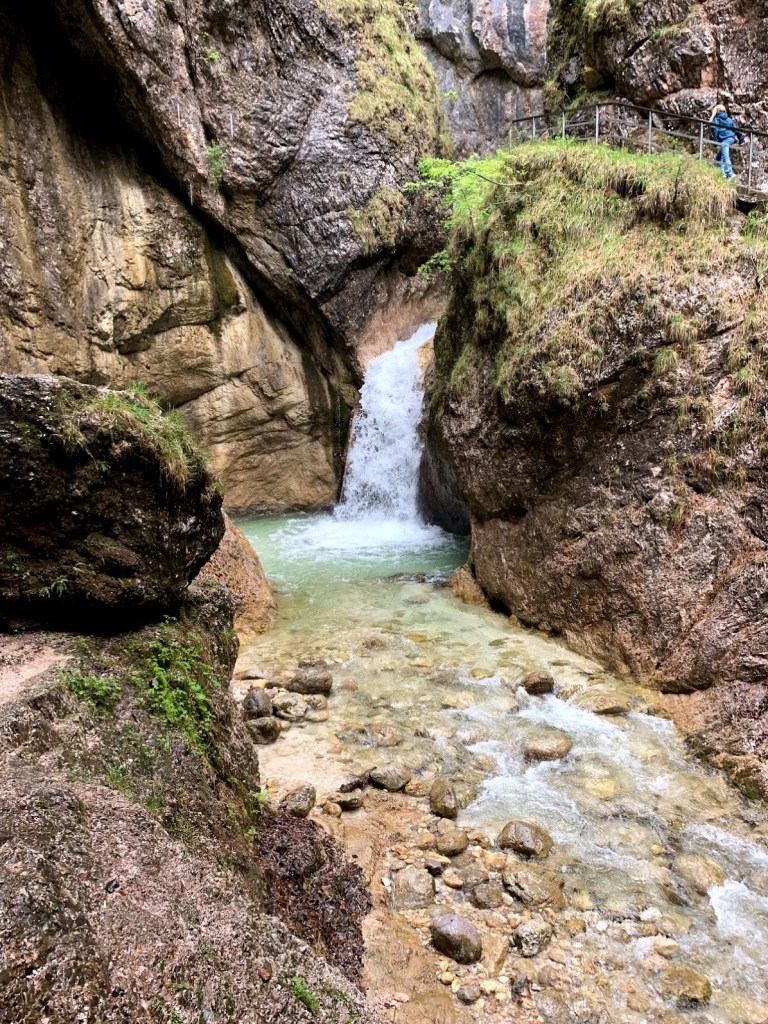
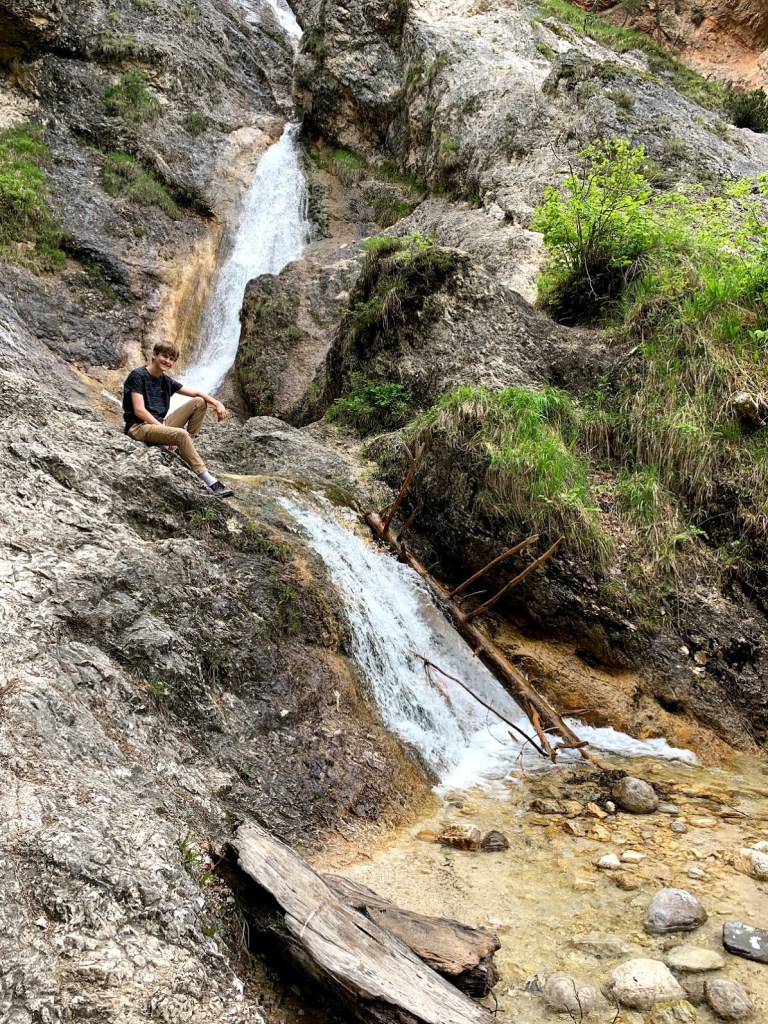
Once we got to bridge 19 we had to make a decision as to which path to take. However first we hiked about five minutes to see a large double waterfall. While viewing the falls the kids noticed that there were little pools and rather large steady boulders to climb. Liam in particular was able to climb up to the halfway point and reach out and touch the left waterfall with his hand. He said that the water was sharp and cold!

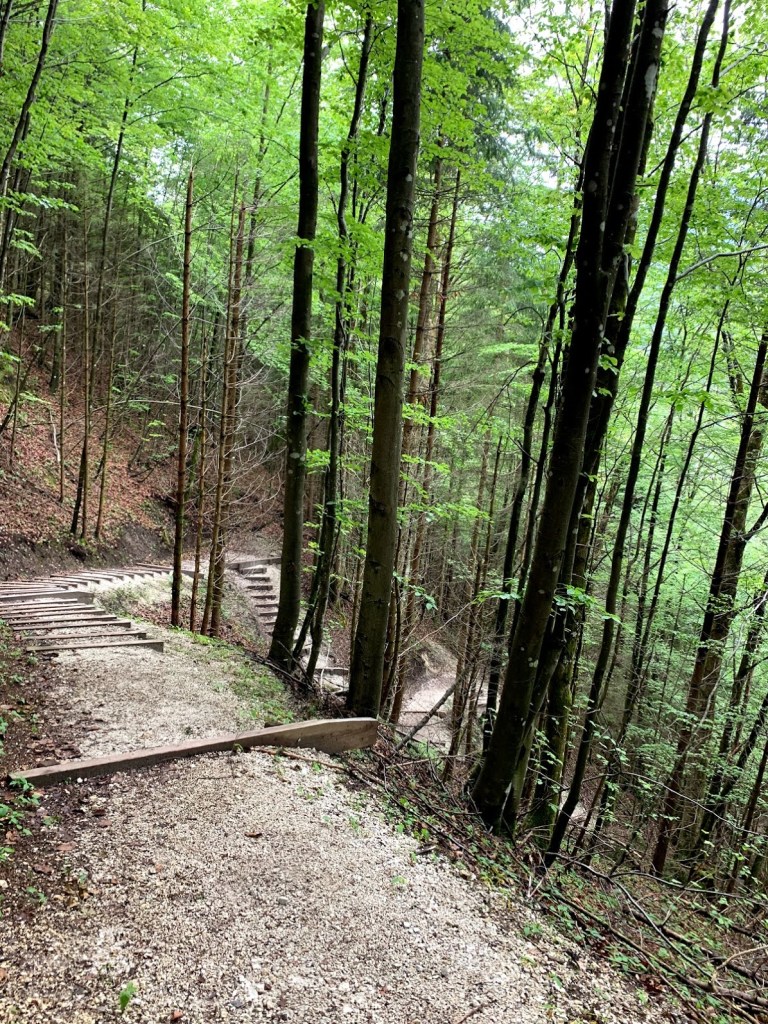
From the waterfall we hiked straight uphill and out of the gorge. It was very steep, but once on the ridge the woods became very quiet except for the occasional chirp of a bird or rustle of a tree branch.

The wooded path switchbacked a lot up the gorge. Sometimes we thought it would never end!

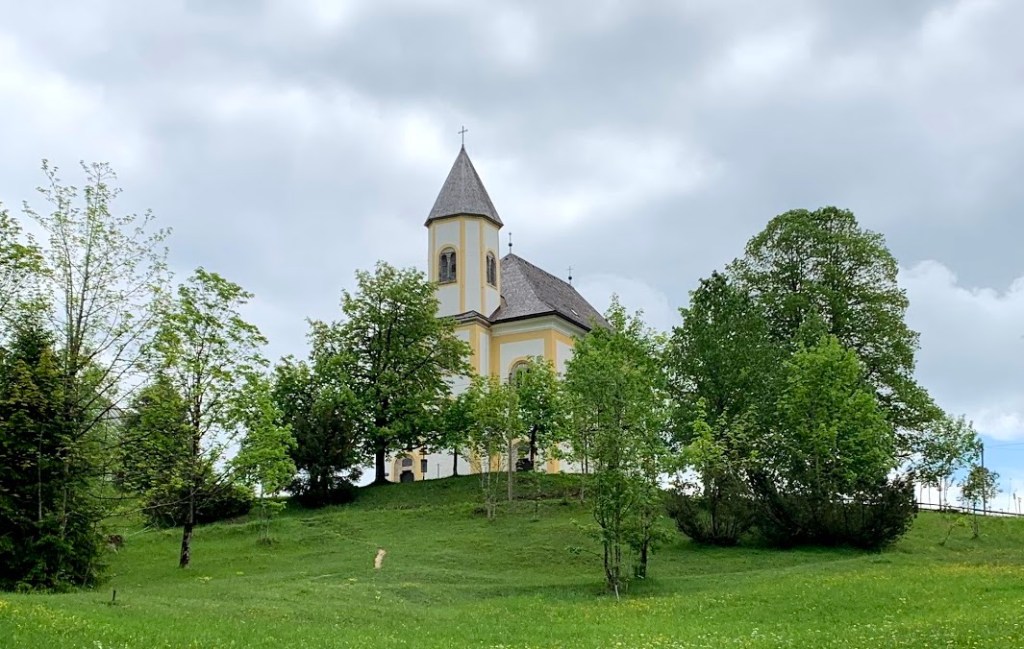
At the top of the gorge we came across the little village of Mesnerwirt. There was a stunning yellow and white country church in a field of yellow dandelions, as well as a small restaurant. We had a refreshing meal and drank a lot of water before heading down a different path back to the Kugelmühle and the car.  The gravel and root path made it difficult in places. Occasionally we would stop to enjoy the views and listen to the coo coo birds in the forest!

Mesnerwirt Church
We hiked 3.5 hours and spent another half hour for lunch at the top.
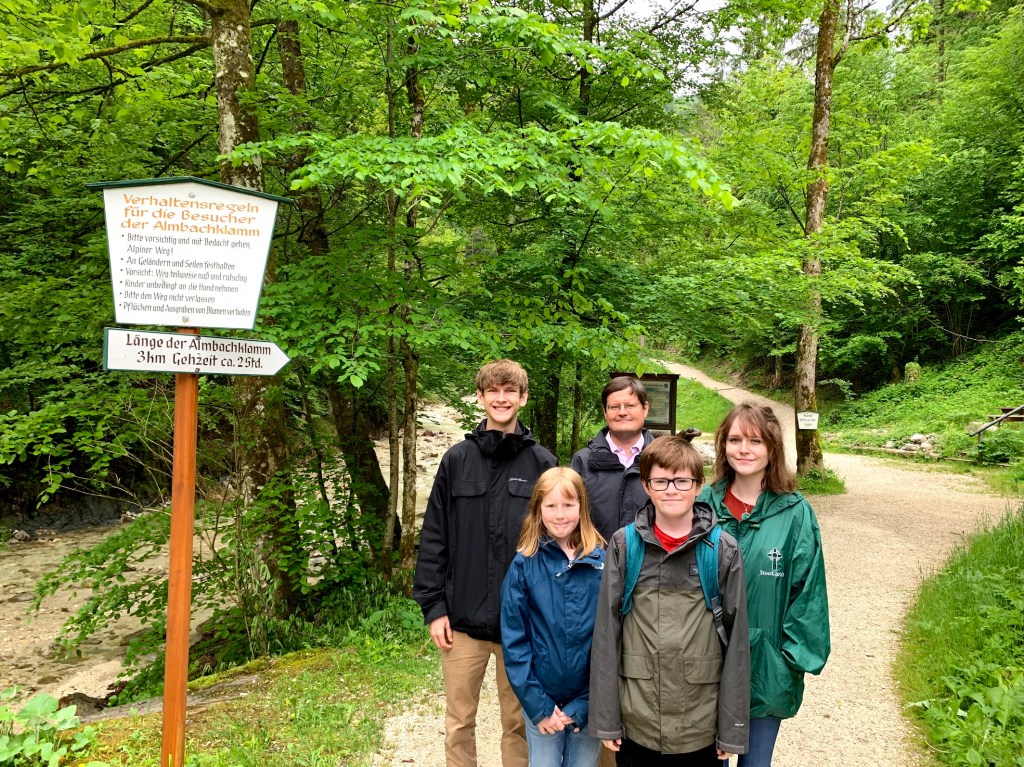
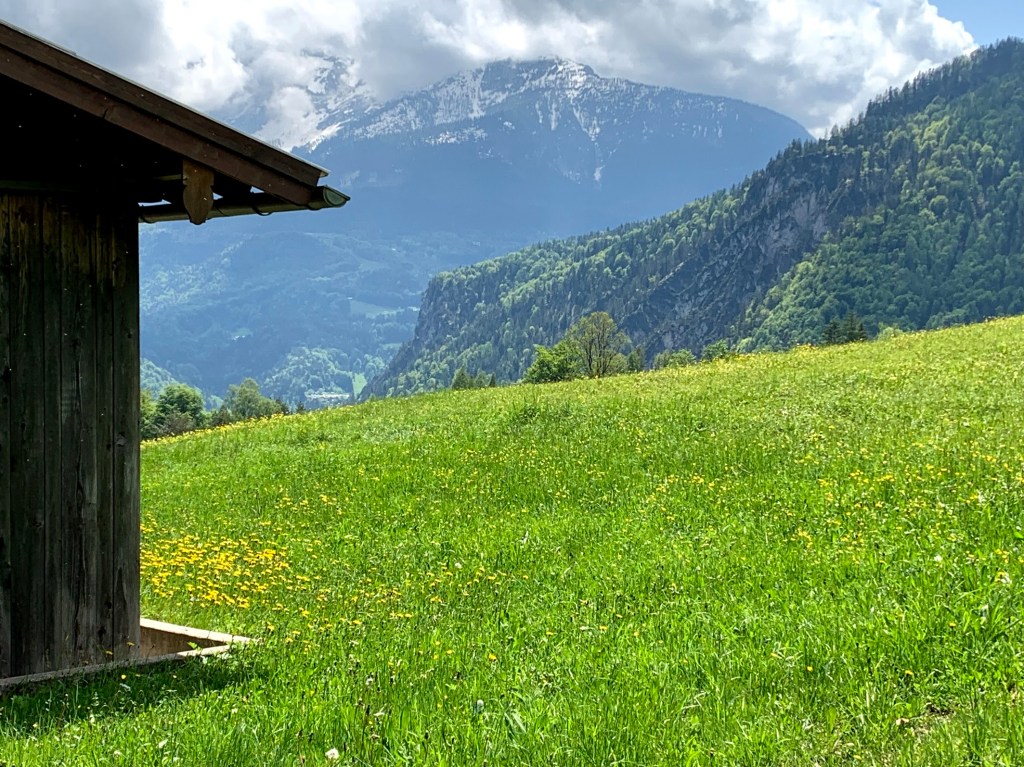
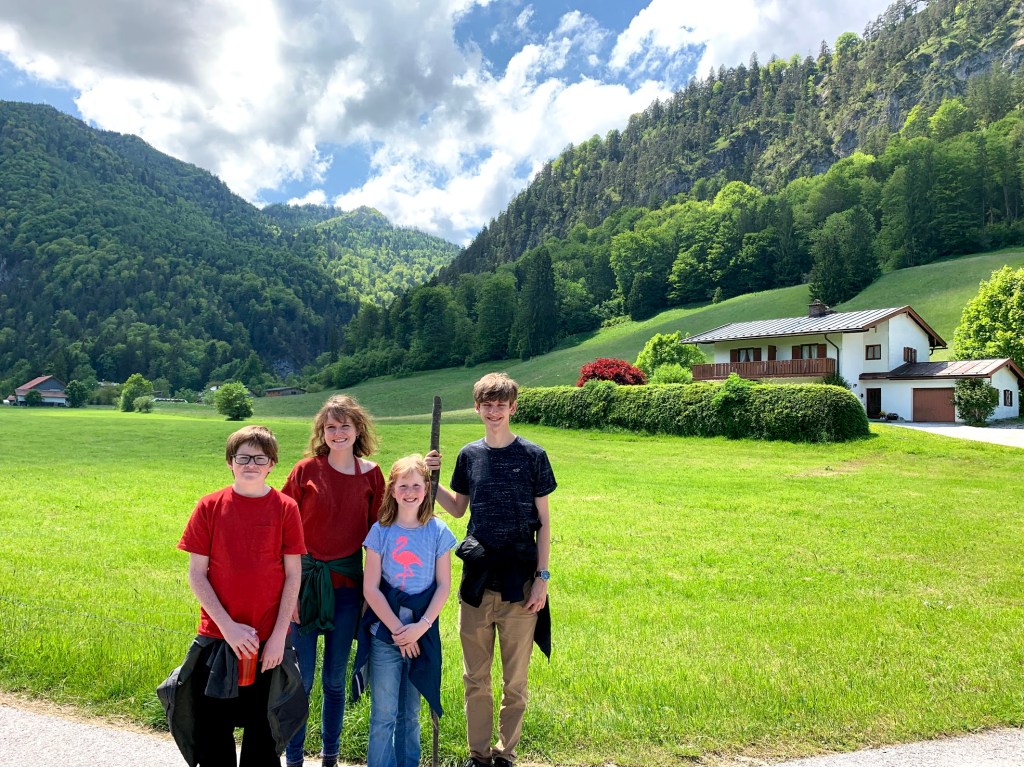
The gorge entrance is between the two mountains behind the kids. We then hiked up and over the mountain behind the house.

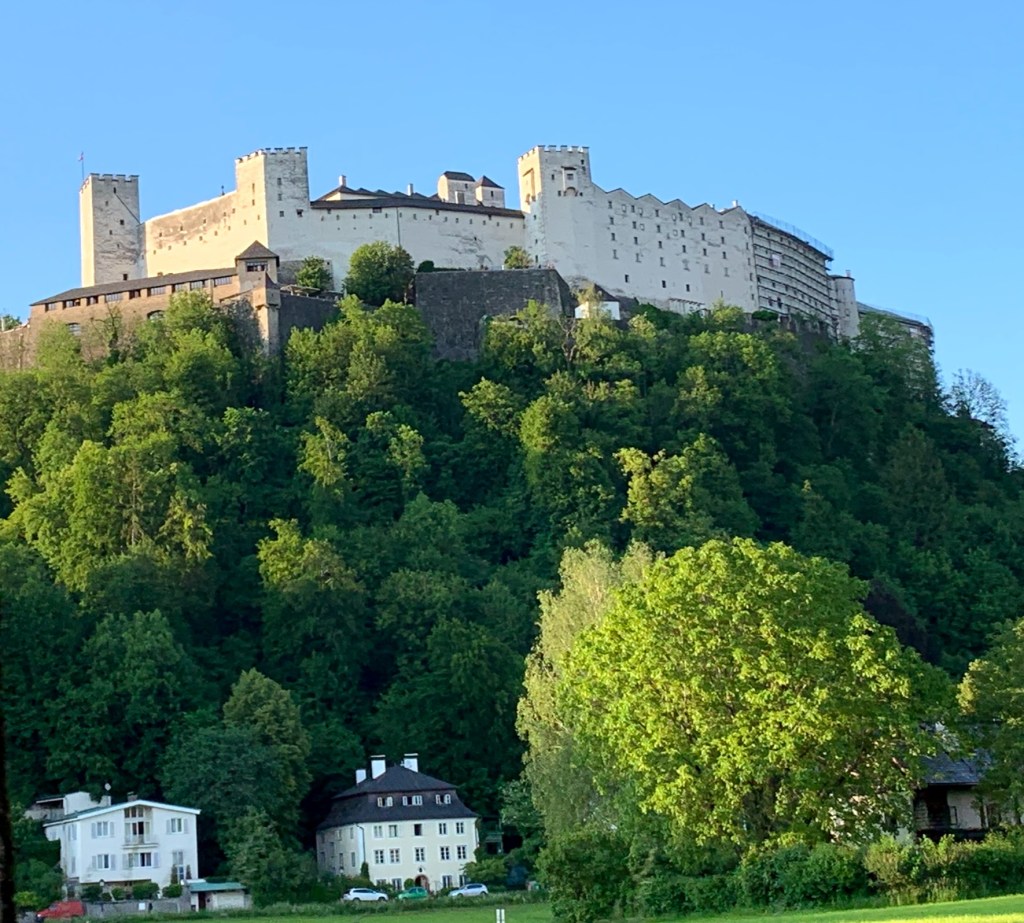
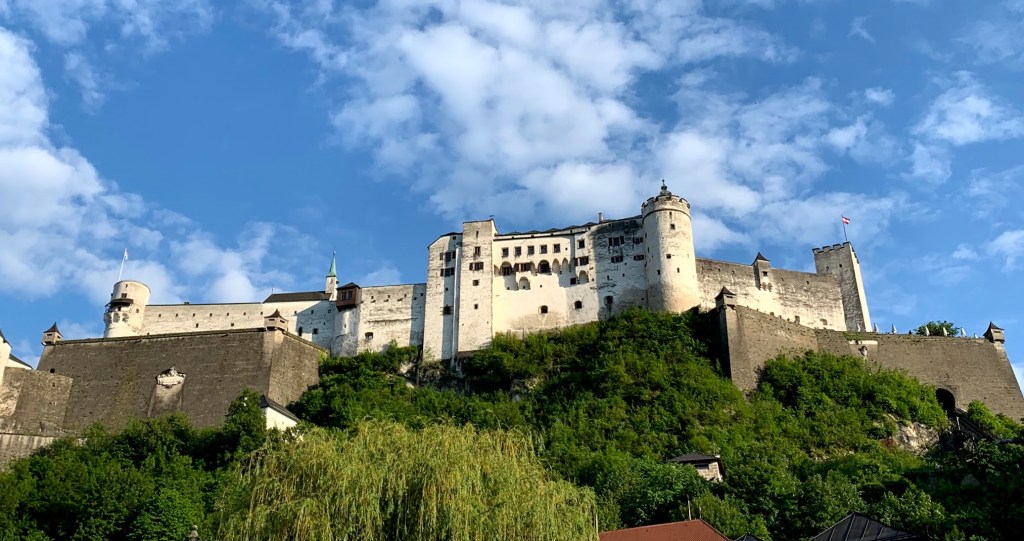
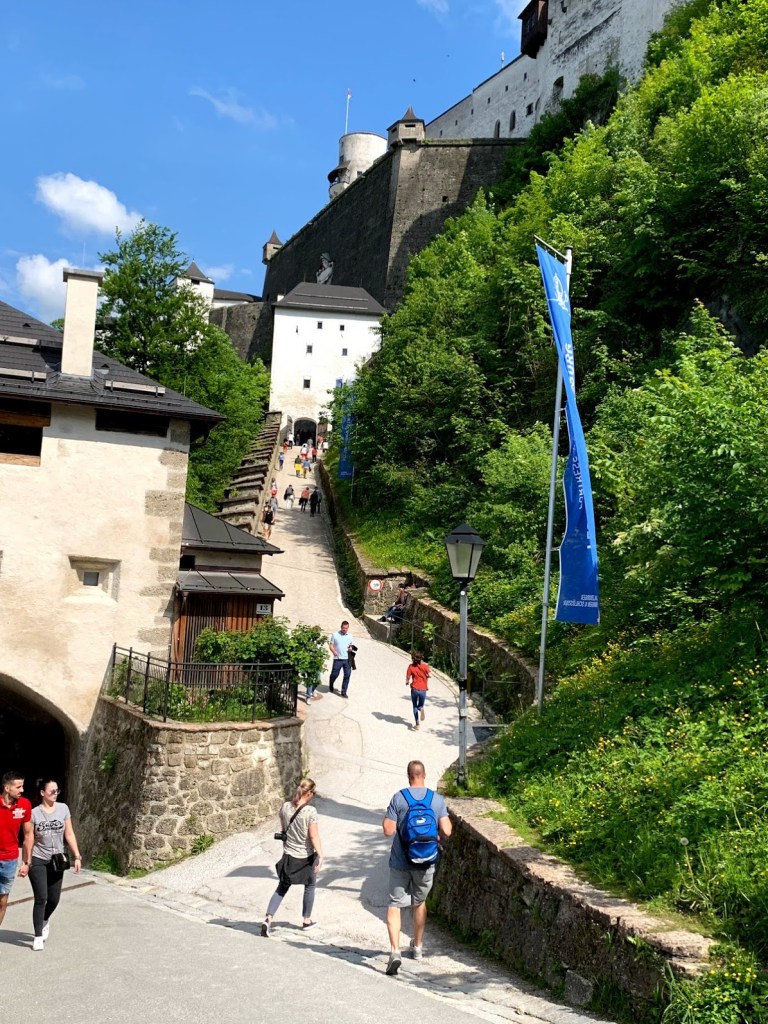
Our afternoon adventure took us back to Salzburg in order to see the Hohen Salzburg or Salzburg Fortress. In hindsight we probably should have done the Fortress the day before, because the only way to access it is to climb 20 minutes uphill! There was a funicular, but we didn’t discover it until after the climb! Needless to say we were a bit cranky, but a little café inside the fortress gave us the well-needed treats we had earned. We had ice cream, apple strudel, coffee, and tea.

Hohen Salzburg as seen from the country road behind it
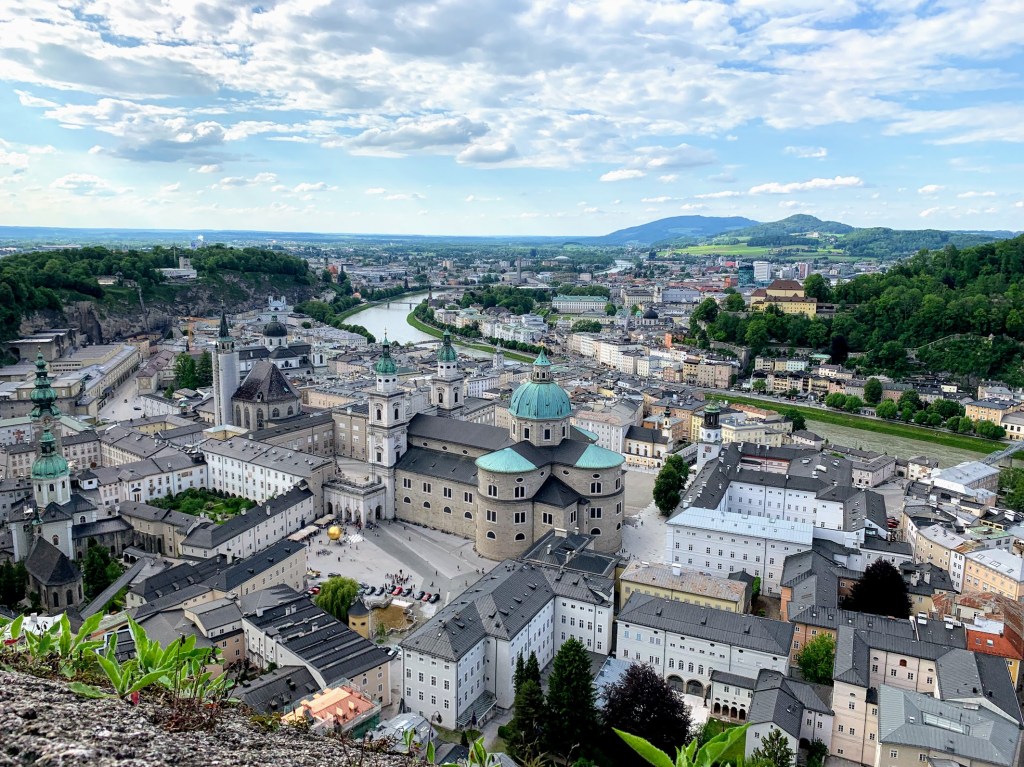
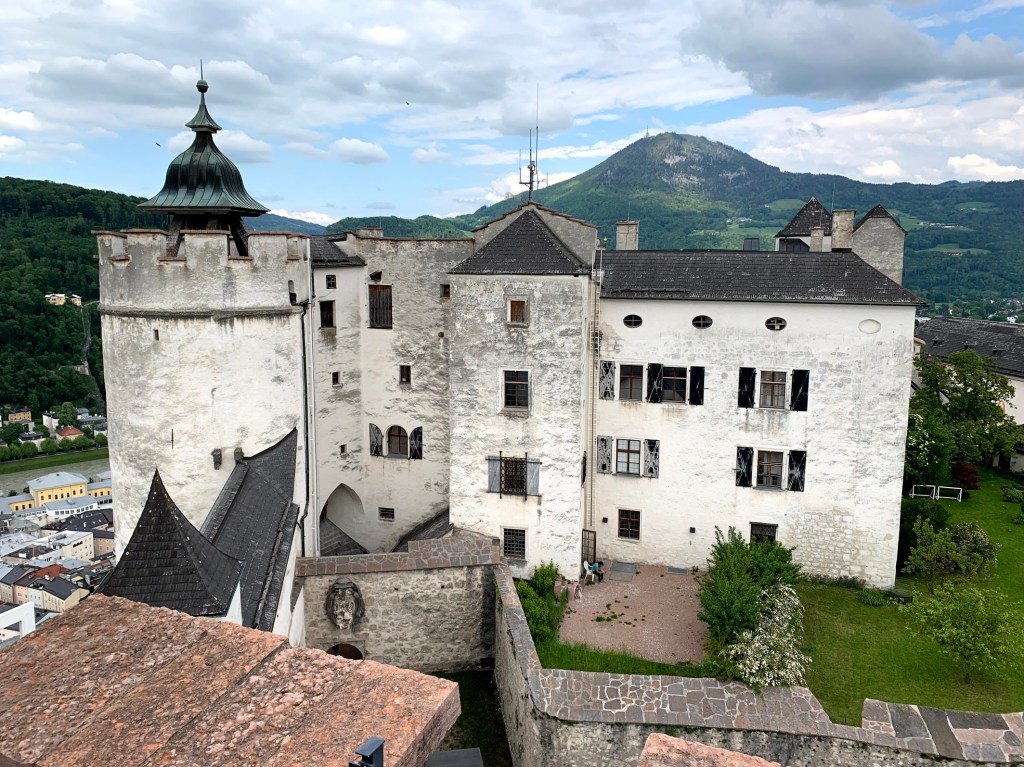
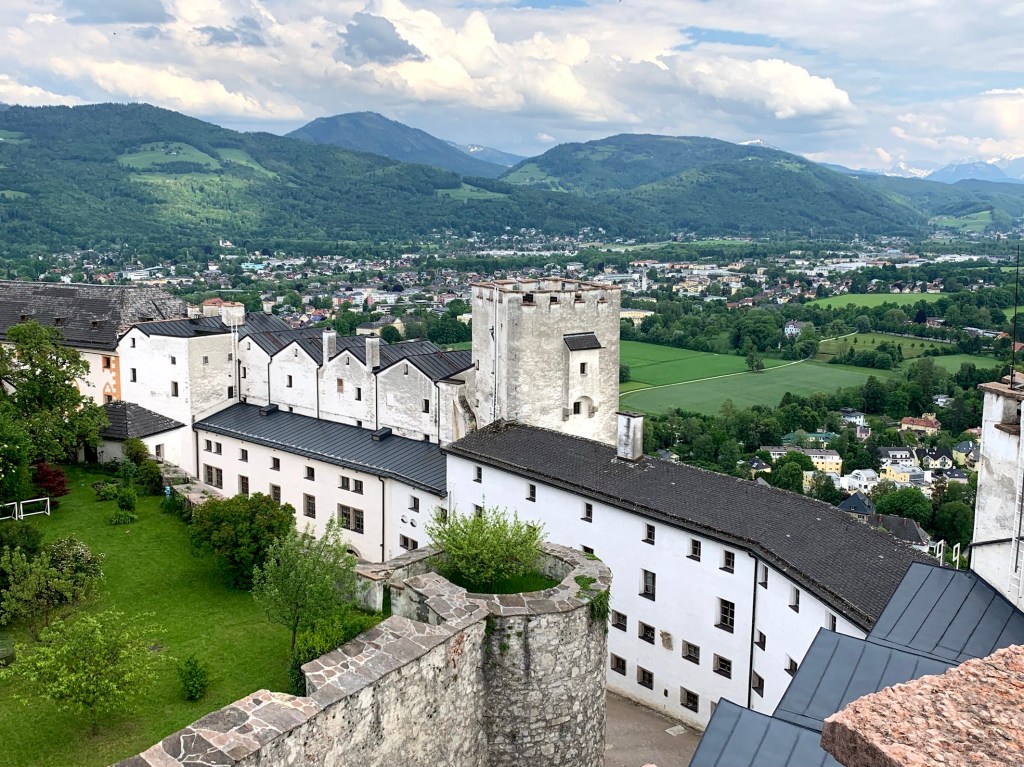
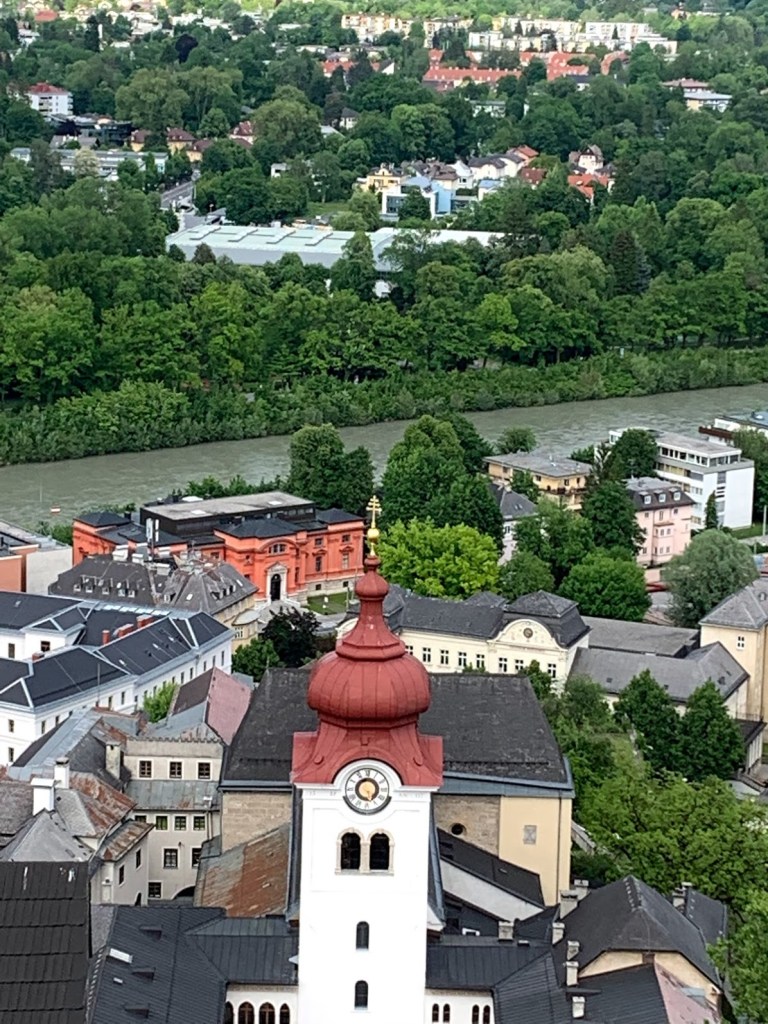
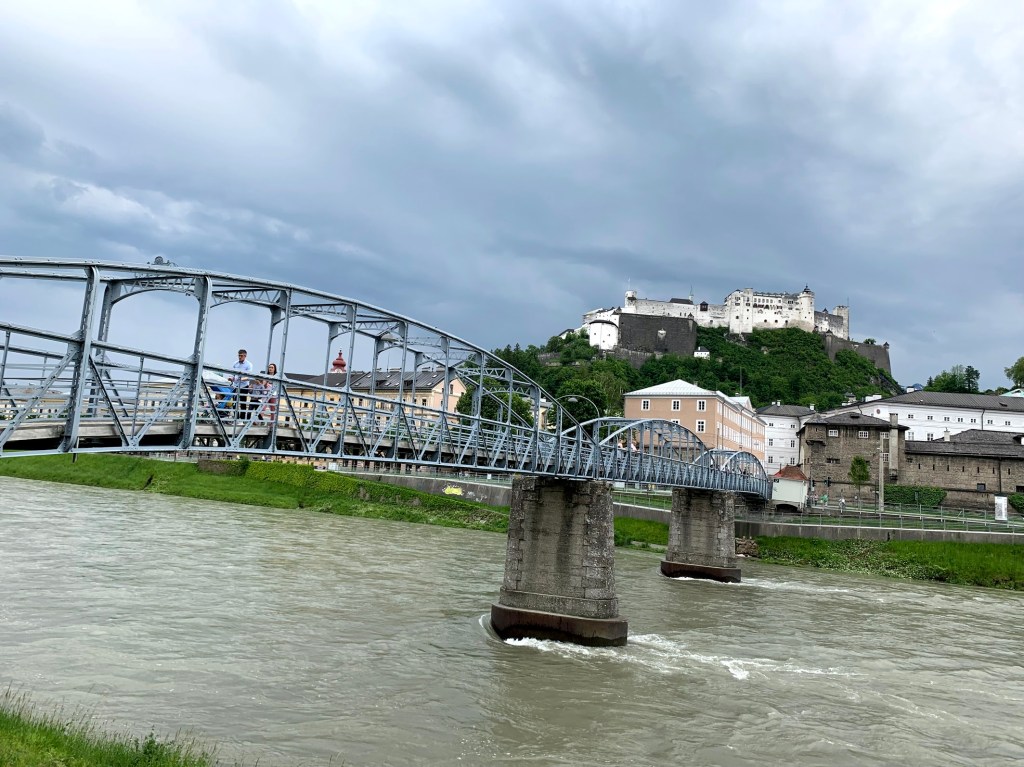
Hohen Salzburg or Salzburg Fortress as seen from the Dom Cathedral of Salzburg in town

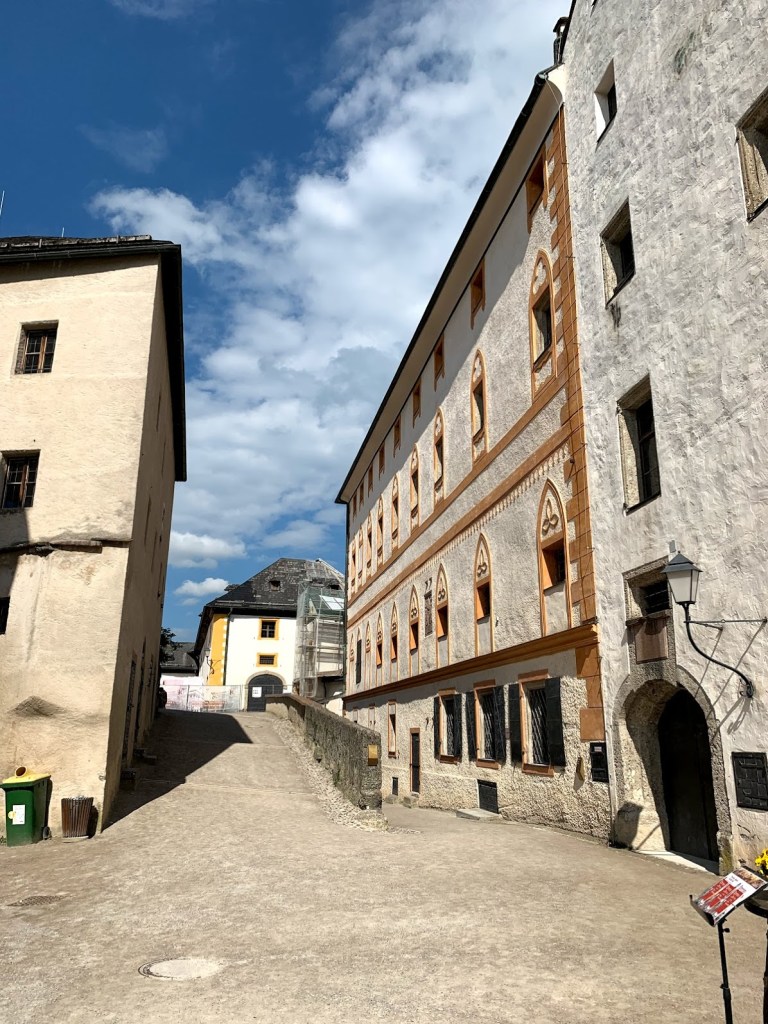
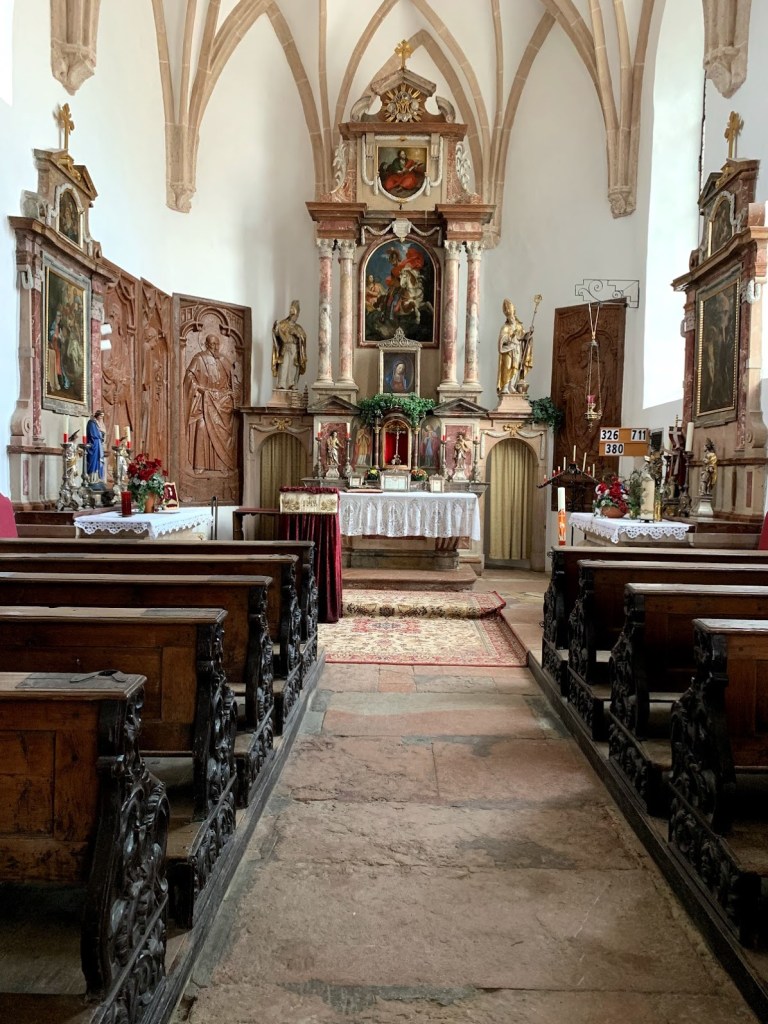
The white washed buildings within the fortress were charming and I particularly liked the museum and chapel. However the best part of the fortress was the lookout from the parapet and castle walls. It was the highest point in all of Salzburg.

View of Salzburg and the Salzsach River from the fortress
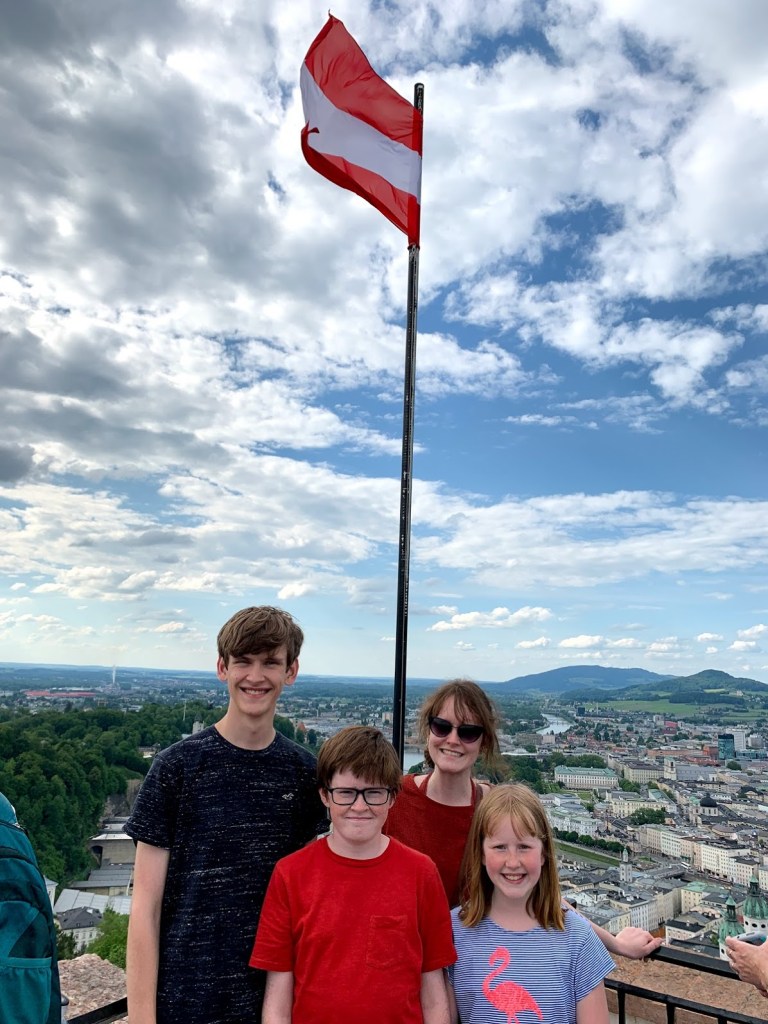
At the very top of the fortress with the Austrian Flag

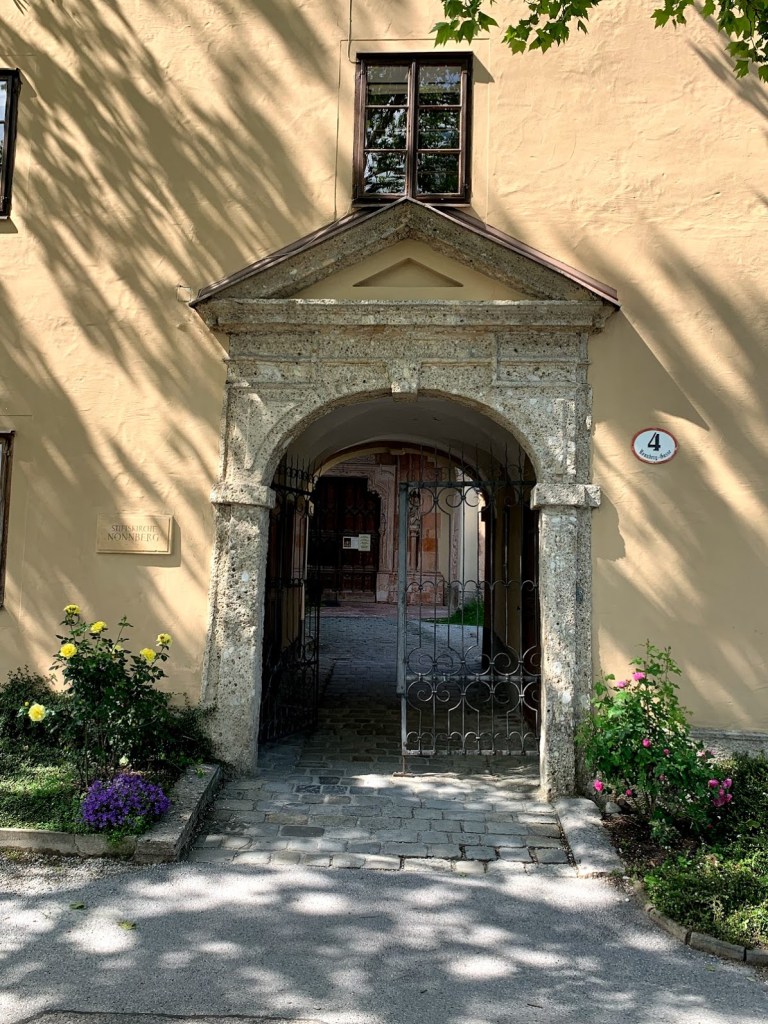
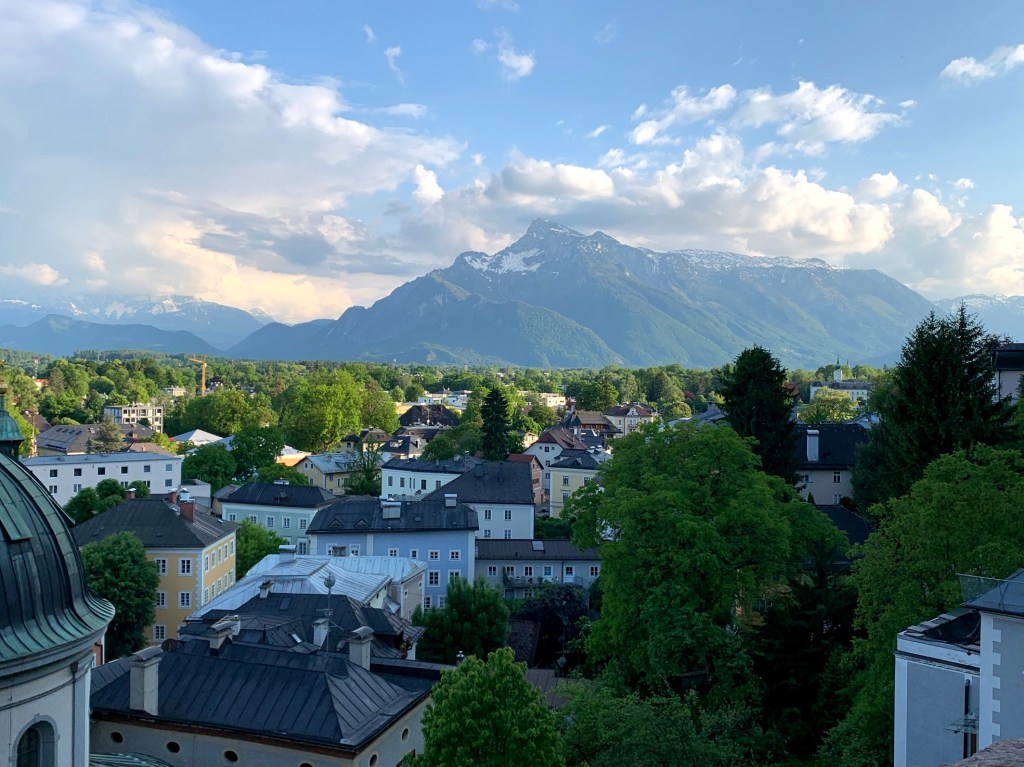
We took the funicular down the hillside and did a little shopping before heading back to the car. On our way we passed by Nonnberg Abbey. Faywen wanted to look inside briefly, but she and I discovered that the Sisters were singing Vespers. The door was slightly cracked. We just stood and listened to their heavenly voices. It was a befitting way to end our visit to Salzburg.

The sun setting on Unterberg Mountain as seen from the Abbey Gate

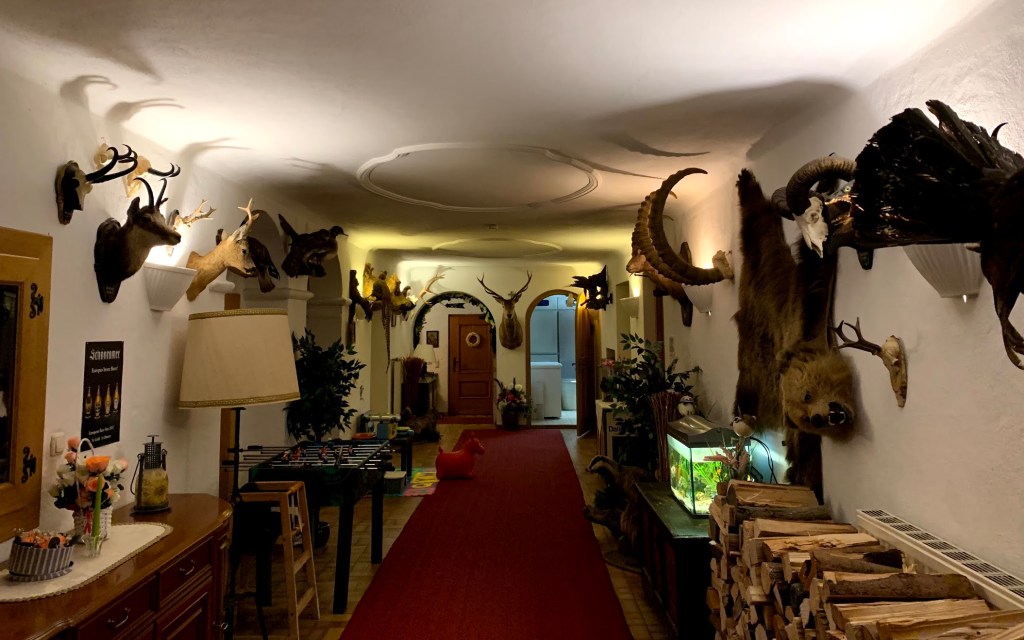
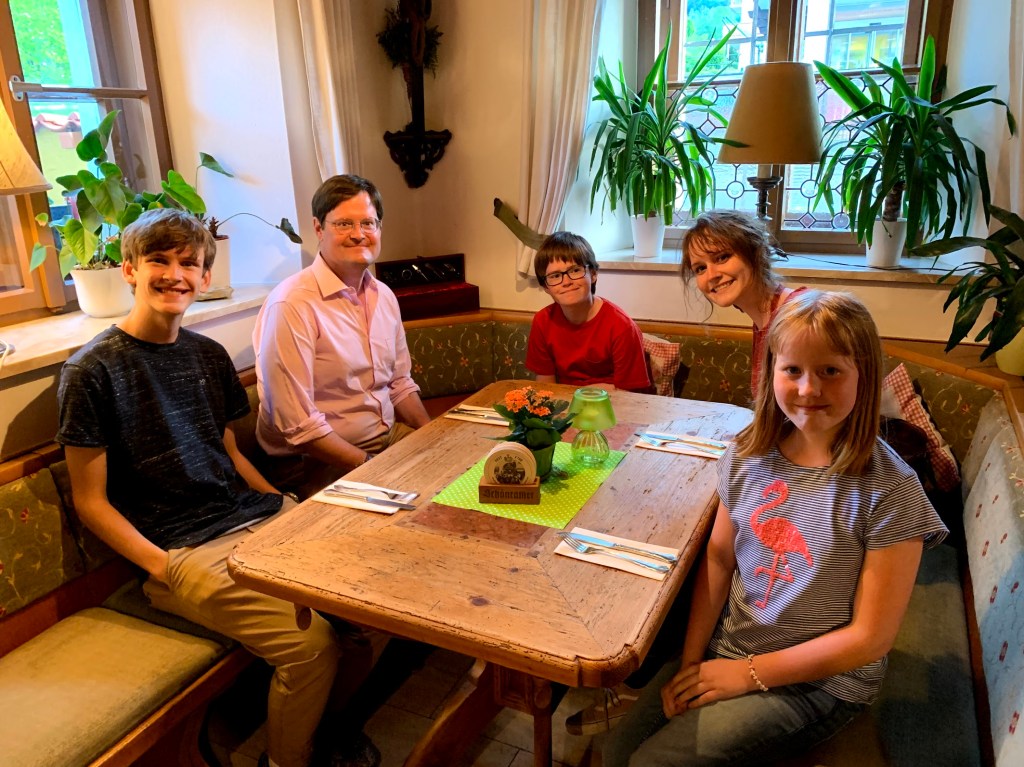
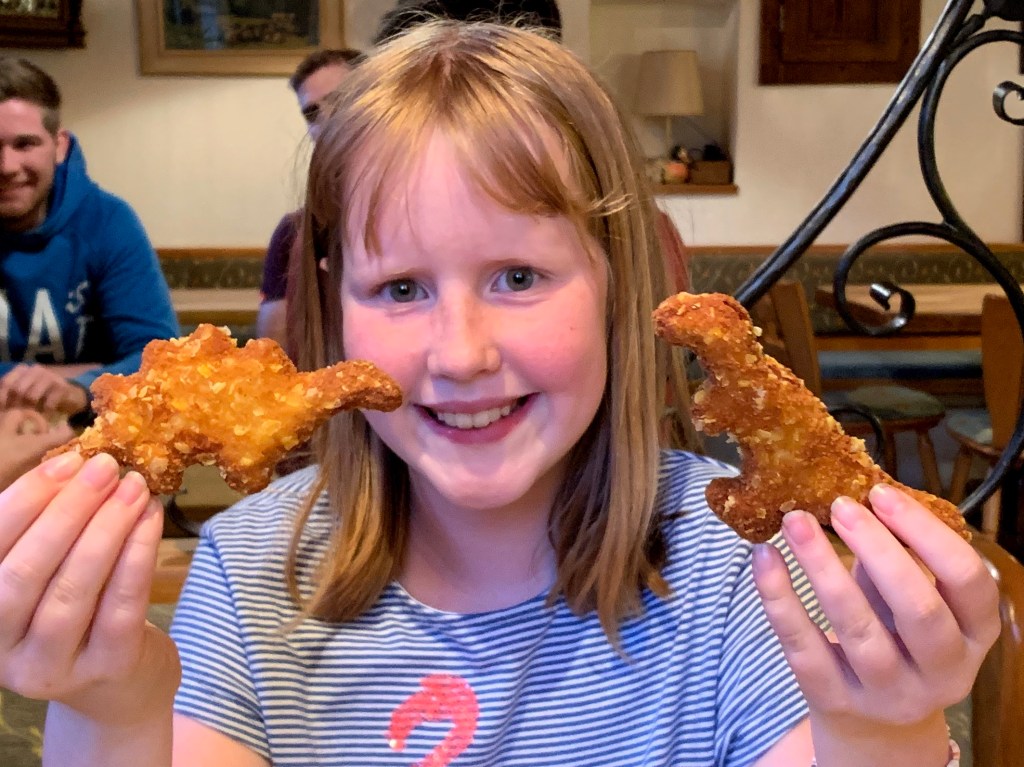
For dinner we ate at a local lodge restaurant. The interior reminded me of how Gaston from Beauty and the Beast would have decorated his restaurant, because of all the antlers and taxidermy animals. The food was traditional German stews and Schnitzel. Faywen’s schnitzel were even shaped like dinosaurs!

“I use antlers in all of my decorating!”

The Hills Are Alive!

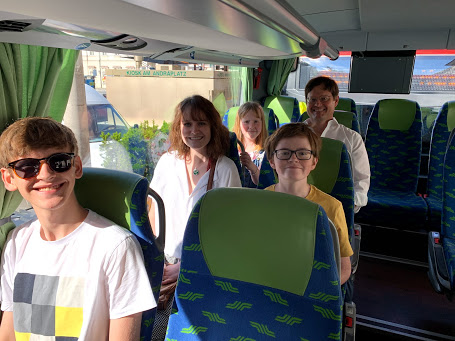
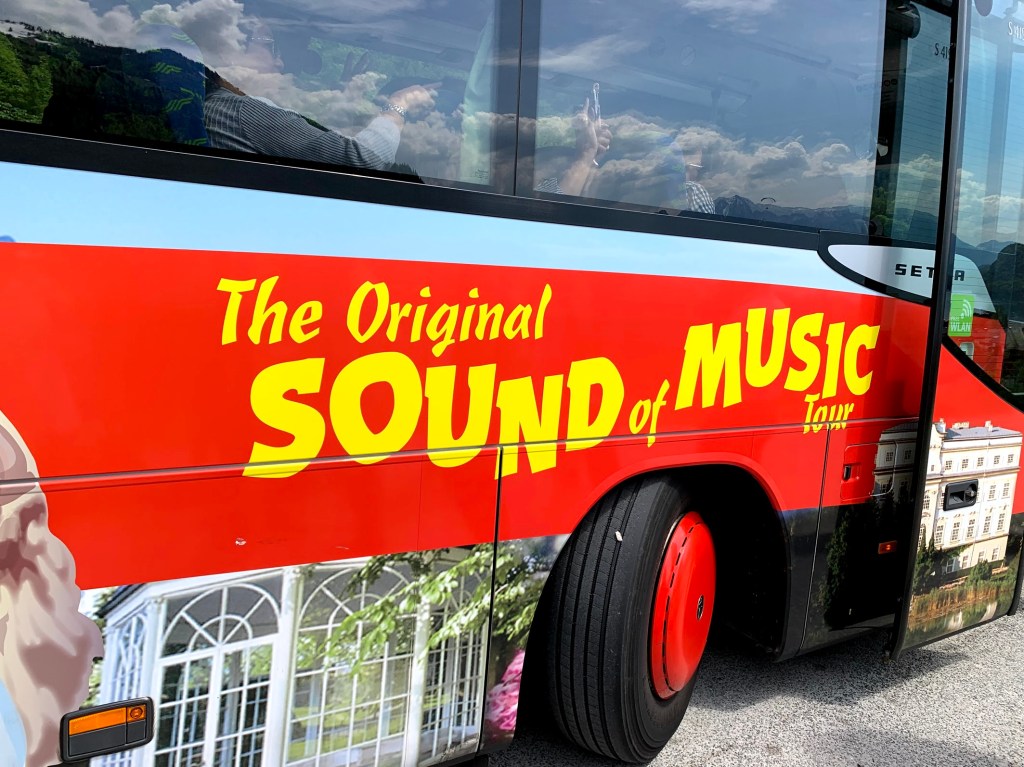
The hills are alive with the Sound of Music! Today was the day we took our touristy 4 hour-long bus tour. We arrived in Salzburg and boarded the bus at 9:00. We drove around Salzburg with our enthusiastic guide Birgit, who is originally from Germany. It seems that Austrians don’t really embrace the story of the Von Trapp family compared to the rest of the world.

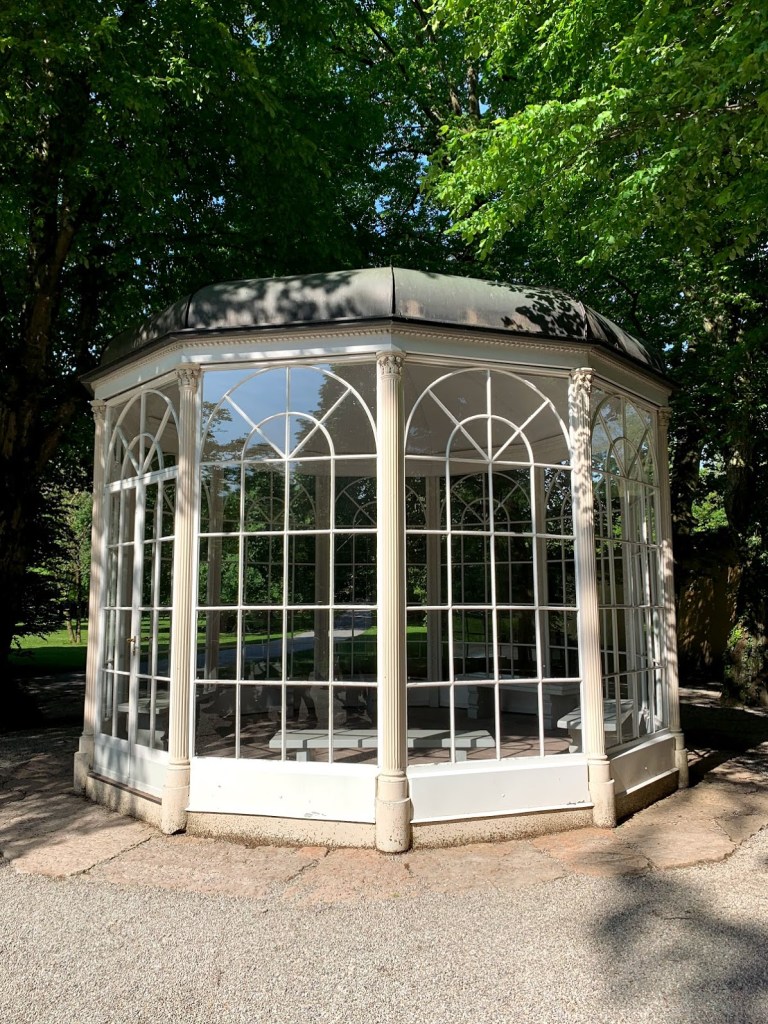
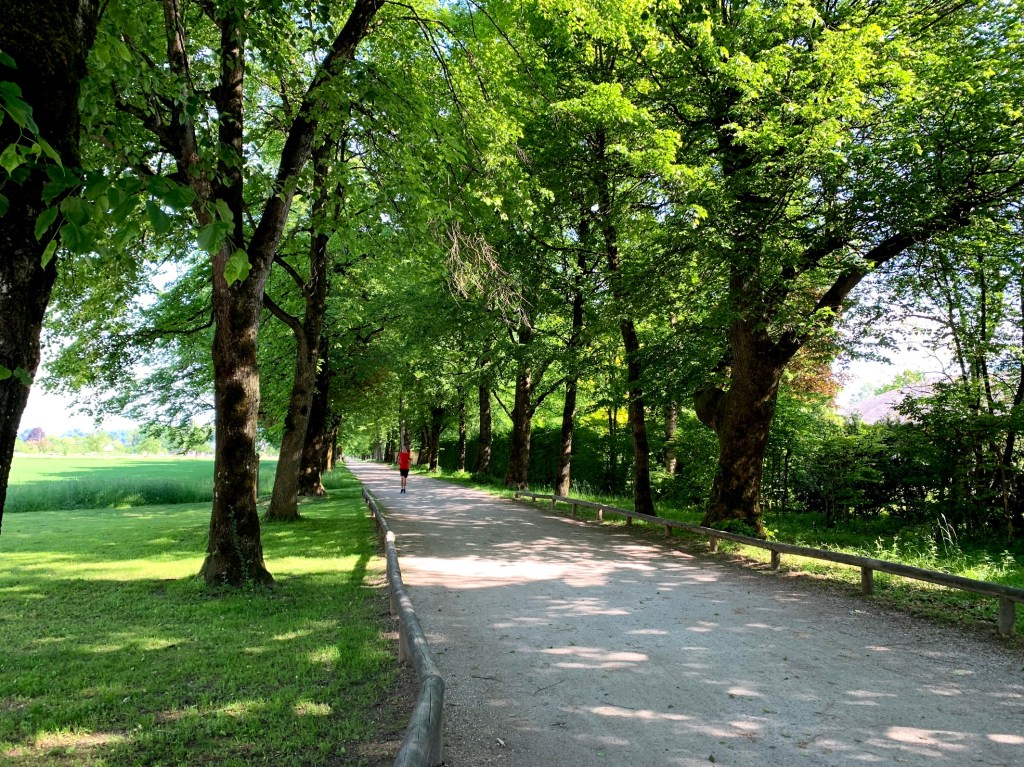
We drove by Nonnburg Abbey where Maria Von Trapp was a postulant. Various parts of the movie were filmed within the abbey walls and at the gate. Our next stop was at Hellbrunn Palace where the iconic gazebo used in the movie is located. The gazebo is very small and the famous “I am Sixteen Going on Seventeen” dance sequence was actually filmed in a Hollywood replica, but all the outside shots were in front of the original gazebo. Also located at Hellbrunn Palace is the tree-lined lane where the children climbed the trees in their play clothes.

The Gazebo
Tree lane at Hellbrunn Palace

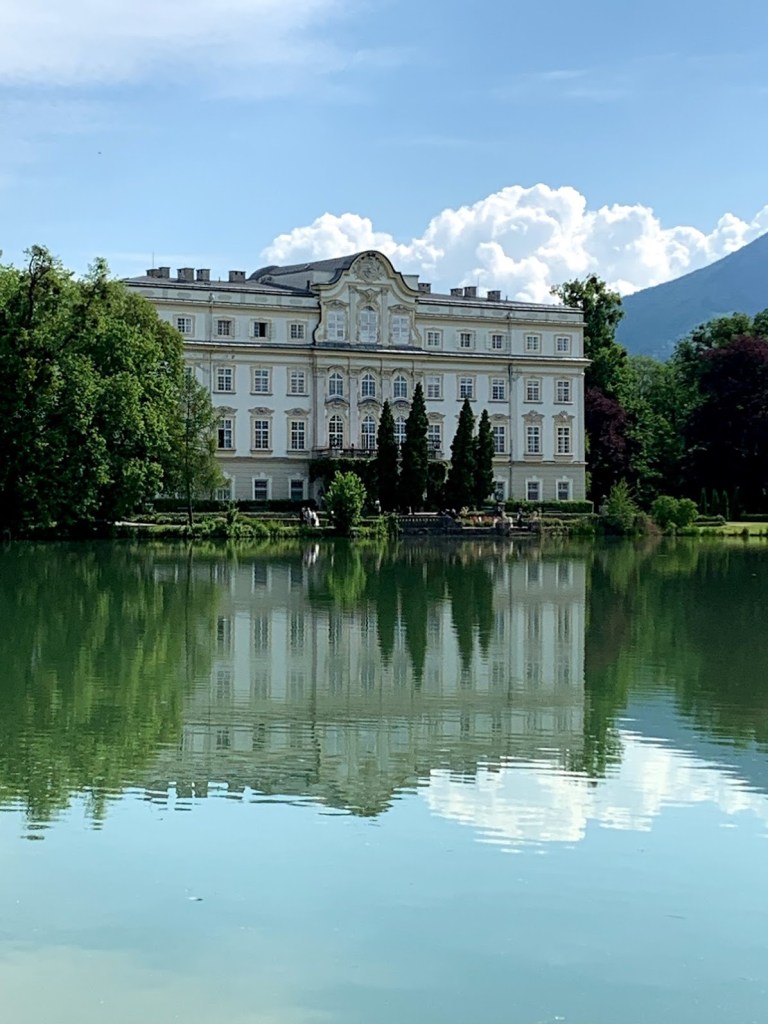
The tour then took us a couple of kilometers to the Leopold House. The stunning white mansion was used to film the back patio scenes on the lake with the breathtaking Unterberg Mountain in the background. We learned that when they filmed the scene where everyone falls out of the boat into the lake, there was a scuba diver underneath in case of an emergency rescue.

Back patio of Leopold House

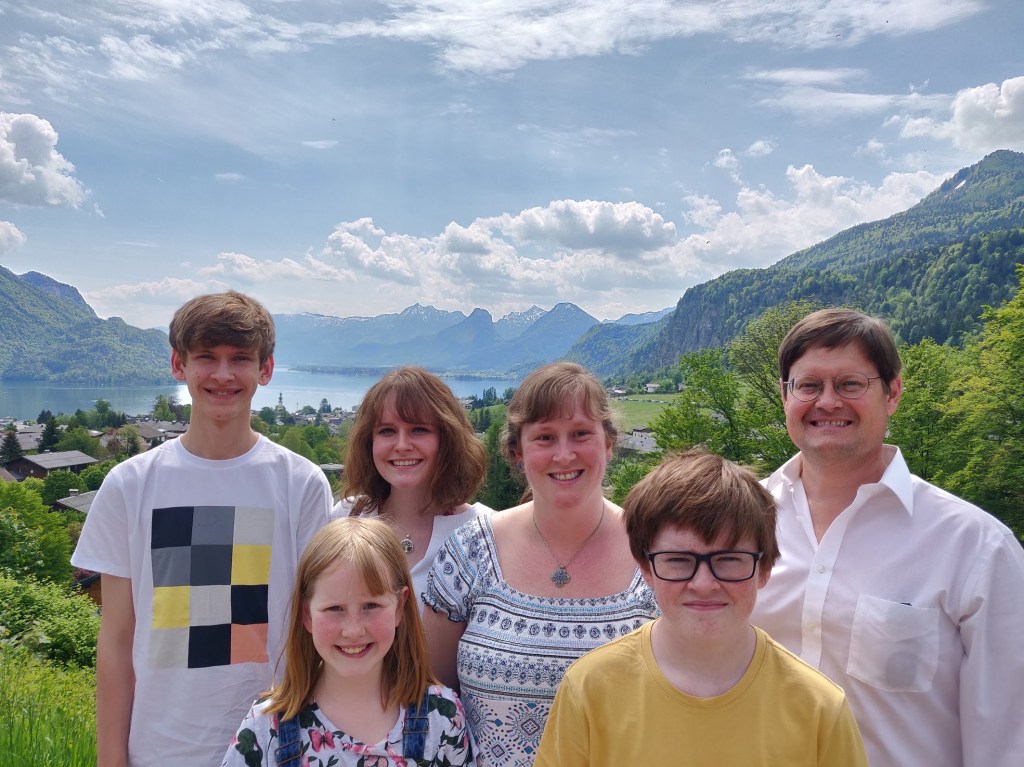
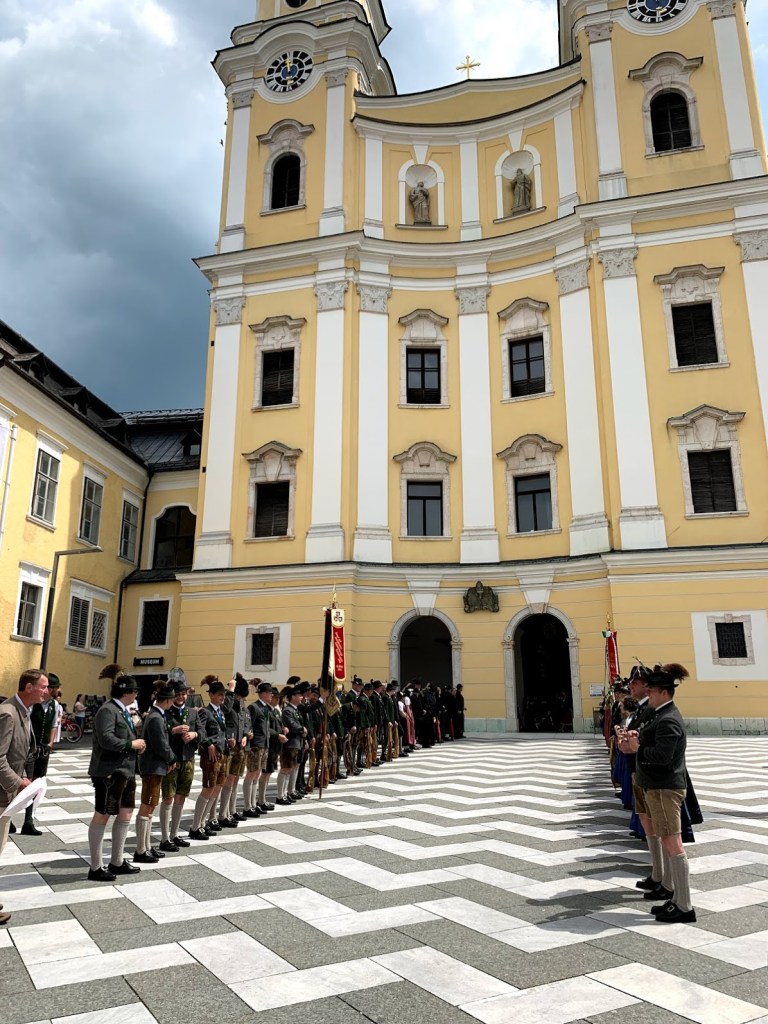
We then drove along the mountain ridge singing Sound of Music songs, until we came to Wolfgangsee. This mountain lake is about 45 minutes east of Salzburg. From our scenic overlook you could see all the little villages nestled along the lakeshore stretching as far as the eye could see! A few minutes further on we drove into the village of Mondsee and spent an hour walking round. We saw the church where they filmed the Von Trapp wedding. However we got to see a “real” wedding at the front of the church! The wedding party, family, and friends were all lined up out front. The bells rang and the bride and groom exited as a brass band played. Everyone was dressed in traditional Trachten…lederhosen and wool jackets for the men and colorful dirndls for the women.

Wolfgangsee, Austria

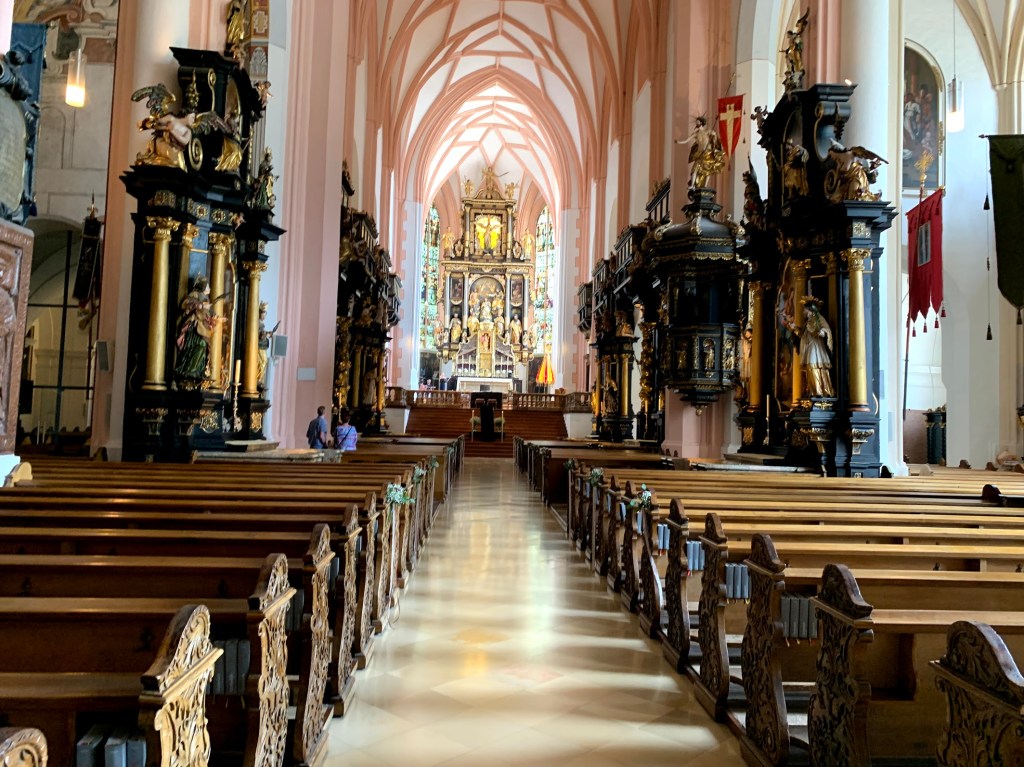
After observing the wedding the church was open to the public. We then purchased meats, cheeses, breads, and amazing strawberries from the Marktplatz in front of the cathedral. It was a beautiful spring day to sit on the edge of the fountain and eat lunch together as a family!

Wedding party outside of the Basilika St. Michael in Mondsee, Austria
Inside St. Michael’s

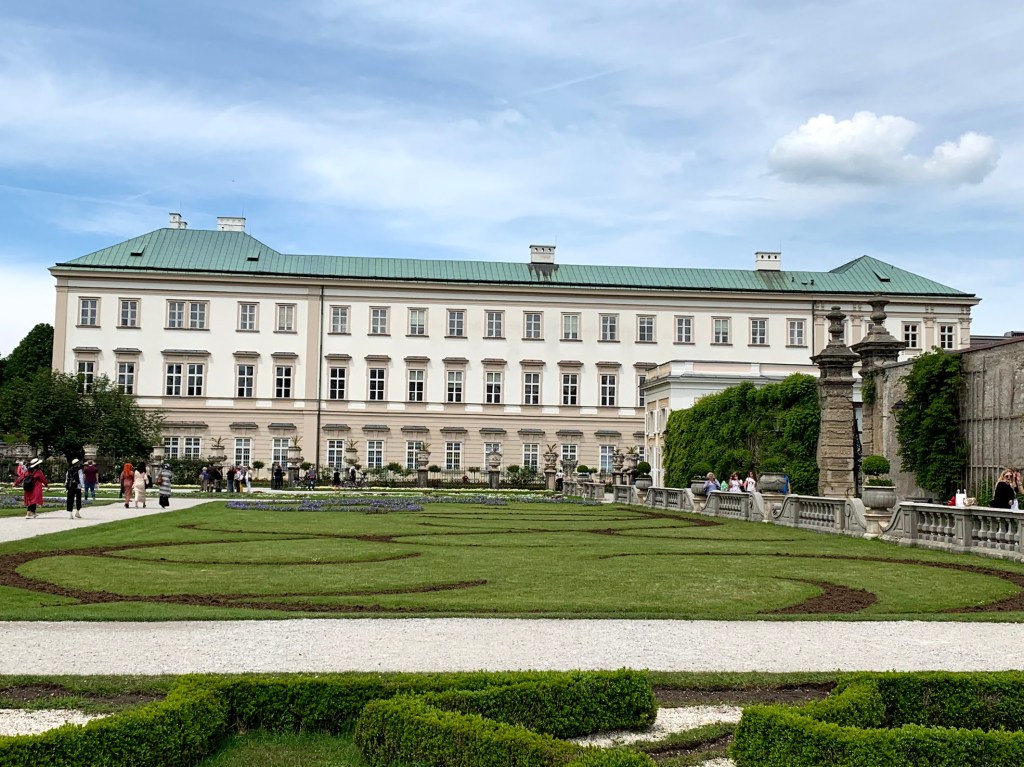
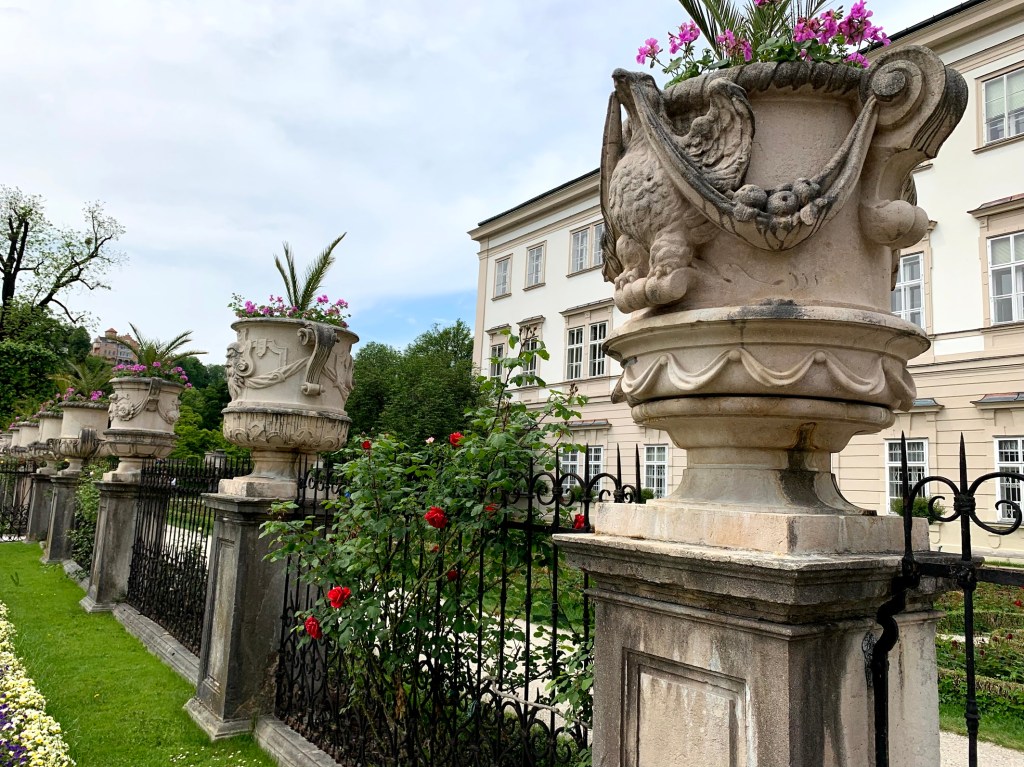
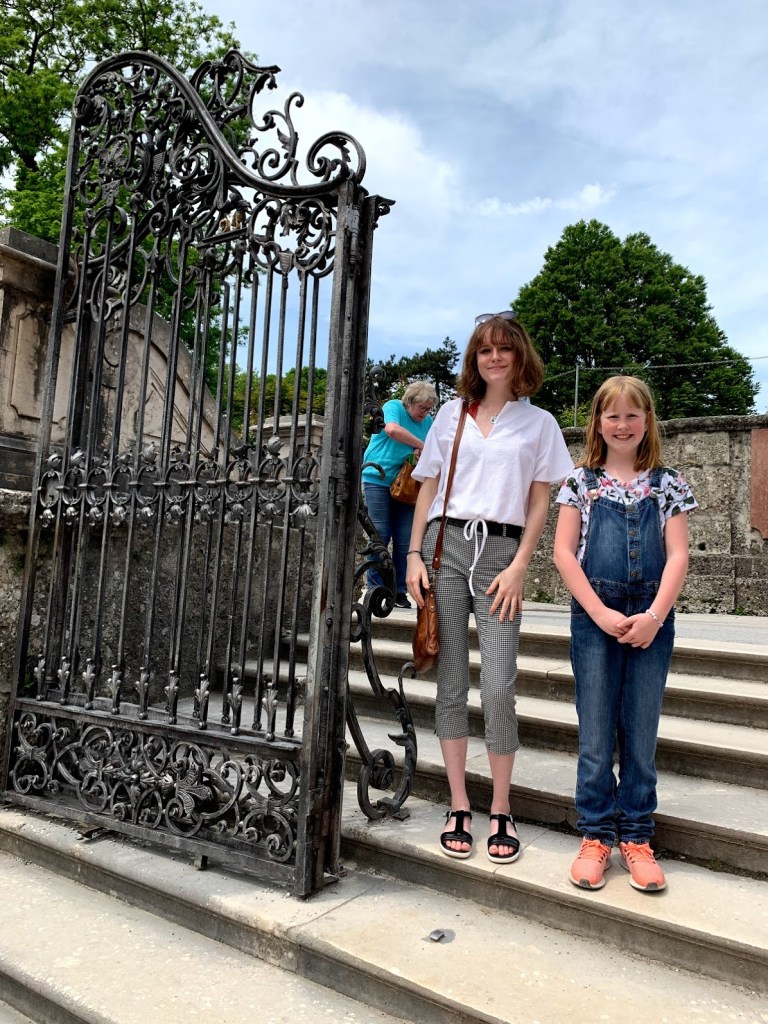
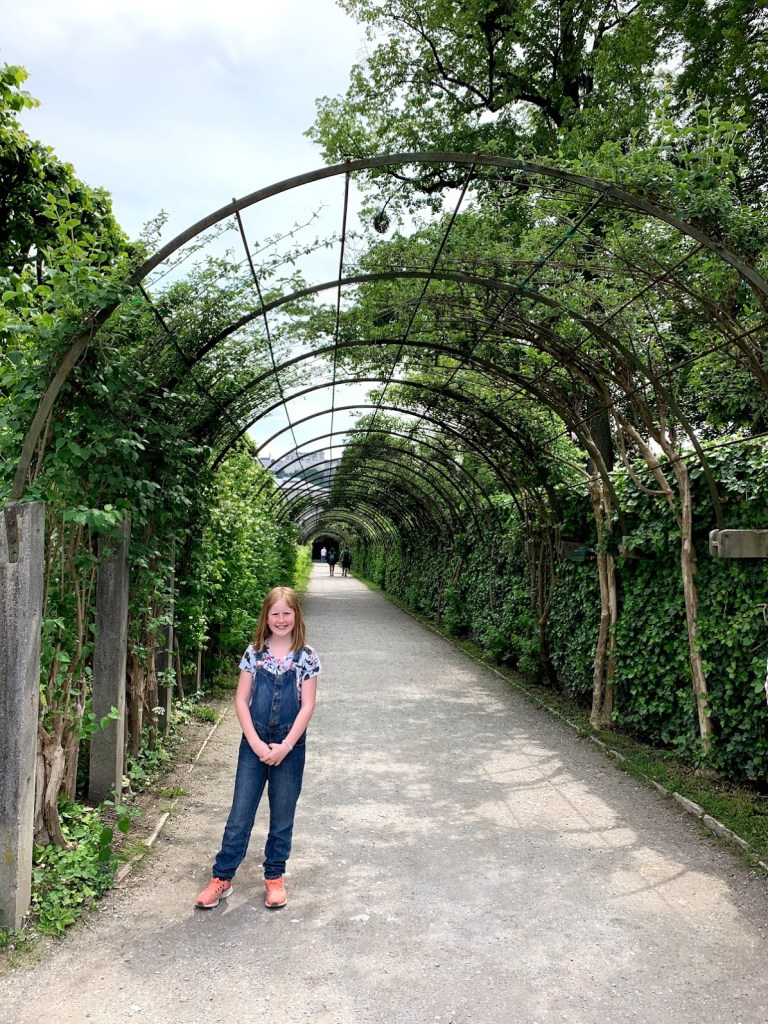
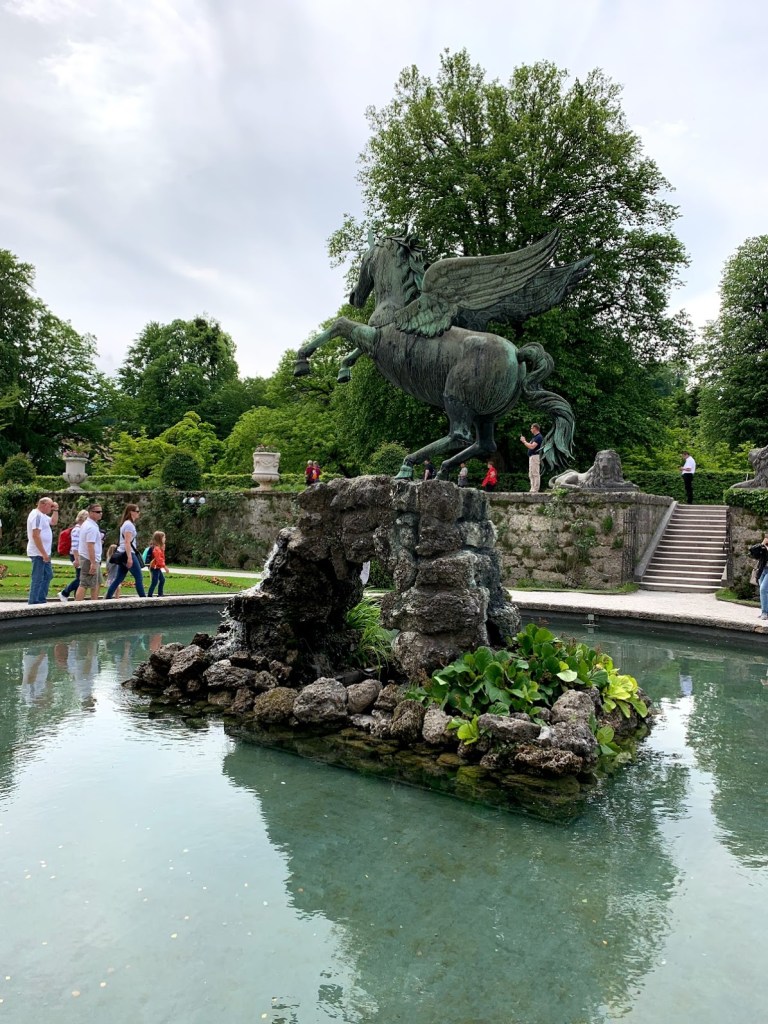
The tour ended with a video on the bus about the making of the movie and another sing-along. Our final destination was the Mirabell Palace in central Salzburg. Mirabell is known for its fountains and gardens many of which were used in the “Do Re Mi” song (steps, Pegasus fountain, and arched path).

Mirabell Palace in Salzburg, Austria
The flower gardens at Mirabell Palace were beautiful
Pegasus Fountain in the Mirabell Gardens

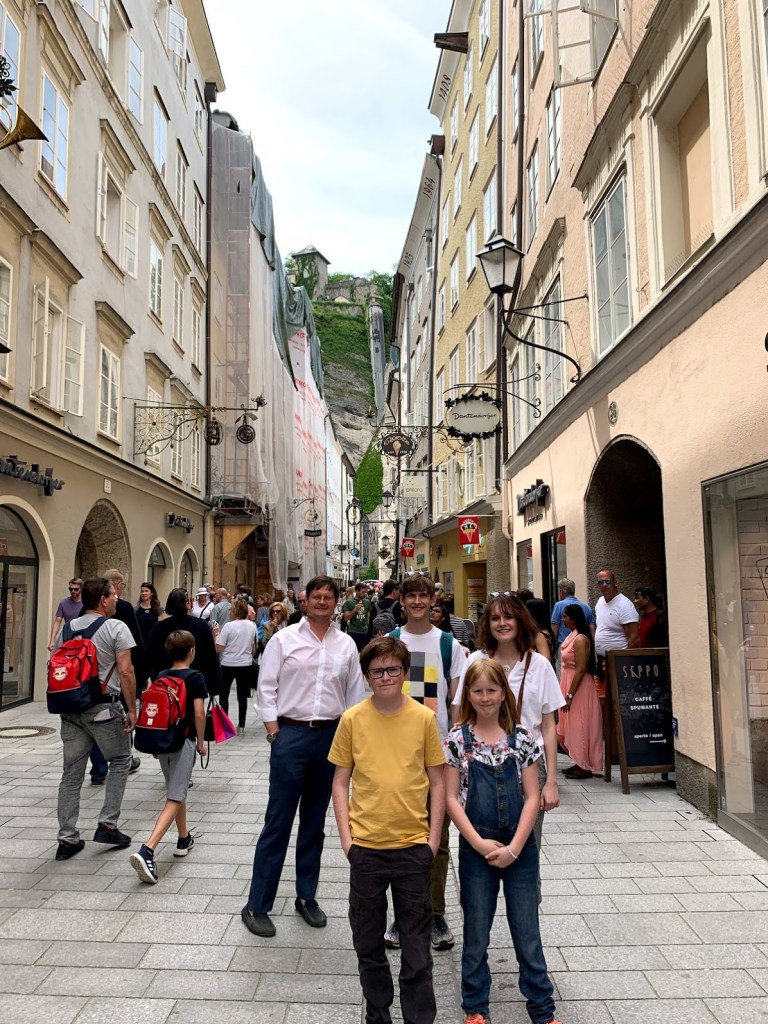
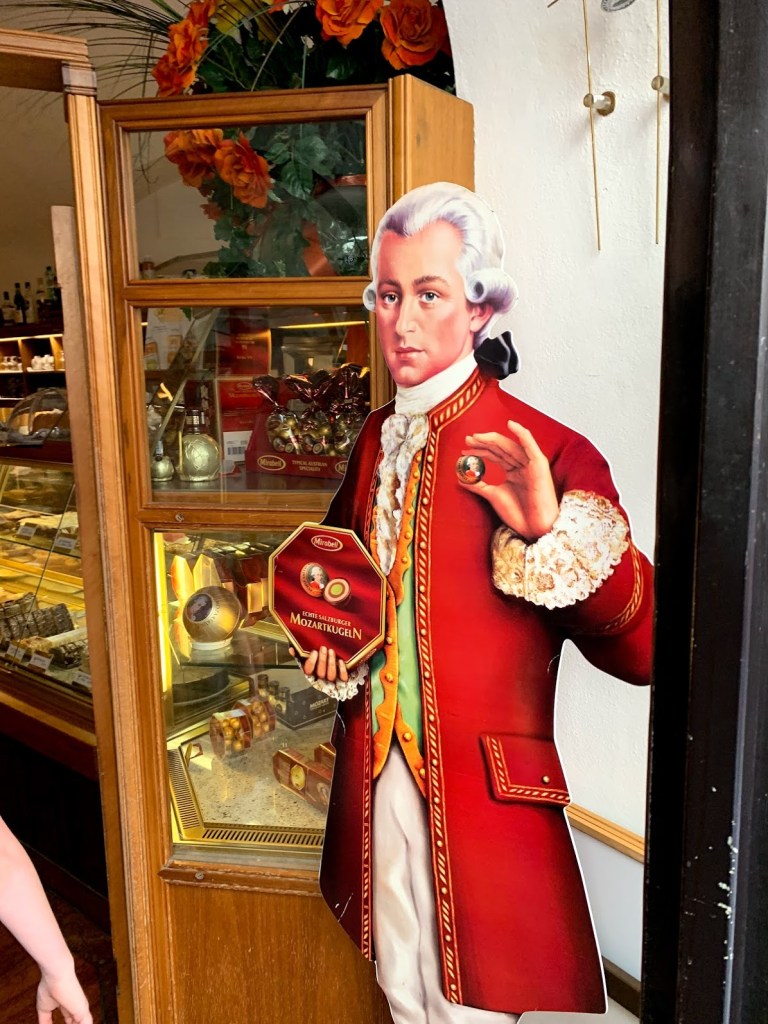
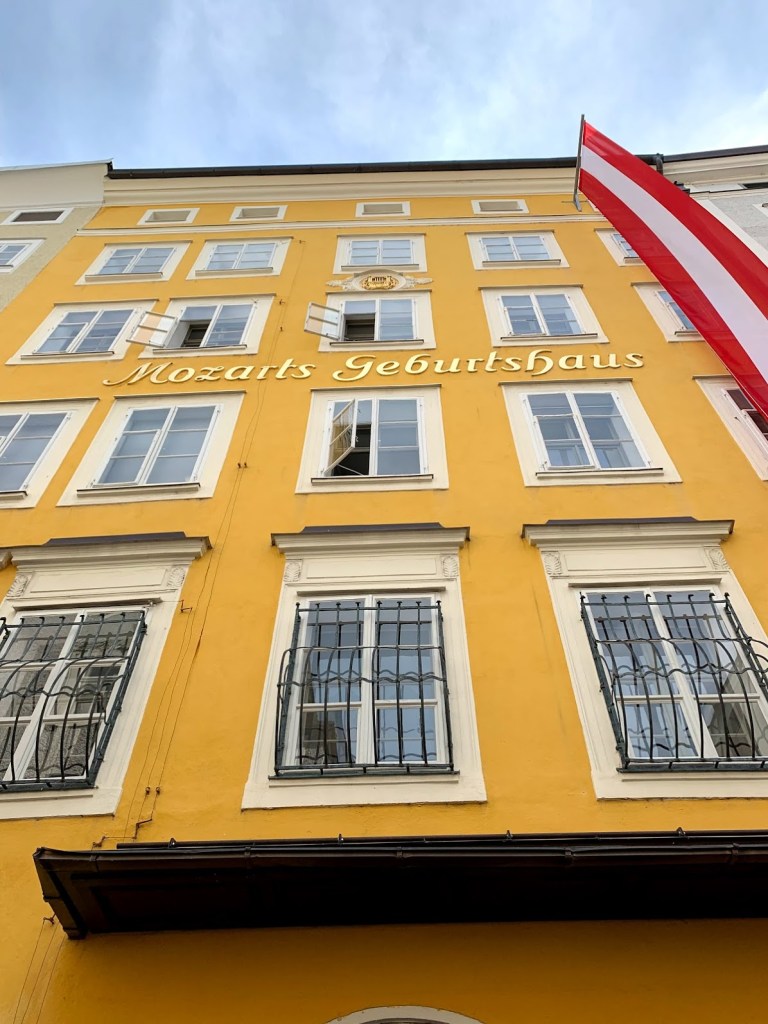
After the tour we meandered around the gardens, got a little lunch at a café by the Salzsach River, and then began hiking around the city. We walked up and down the old town main street, ate a Mozart kügel treat (chocolate covered marzipan ball), saw Mozart’s birth house, the Salzburg Dom Cathedral, and shopped in a little market.

Main shopping street in old town Salzburg

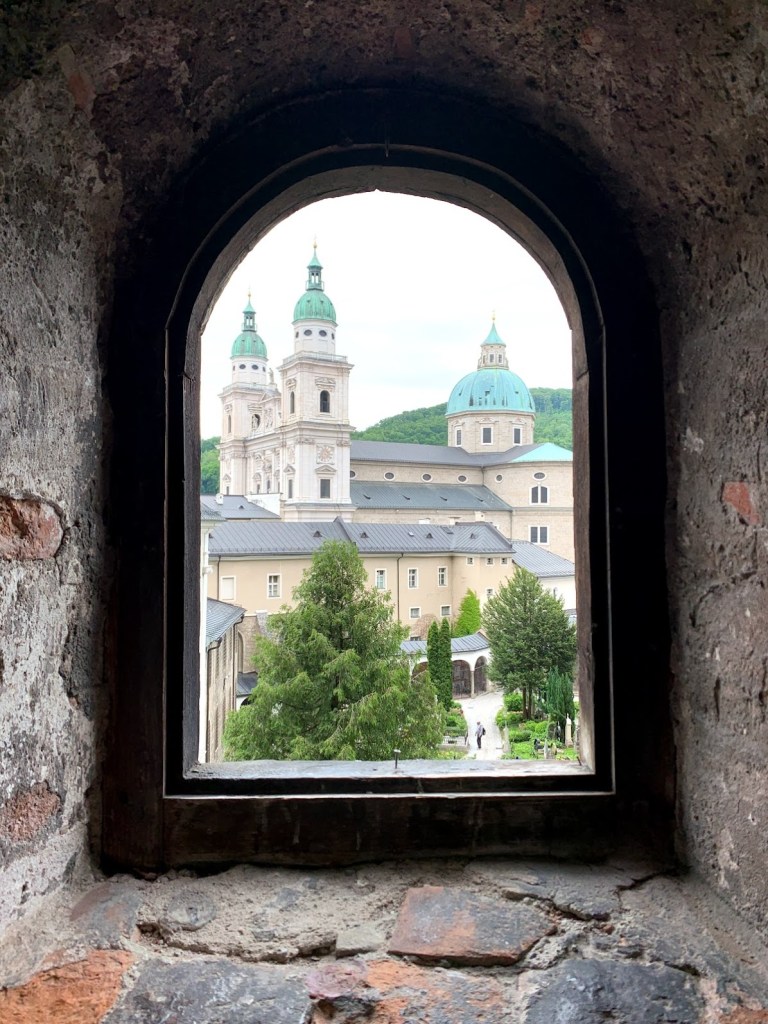
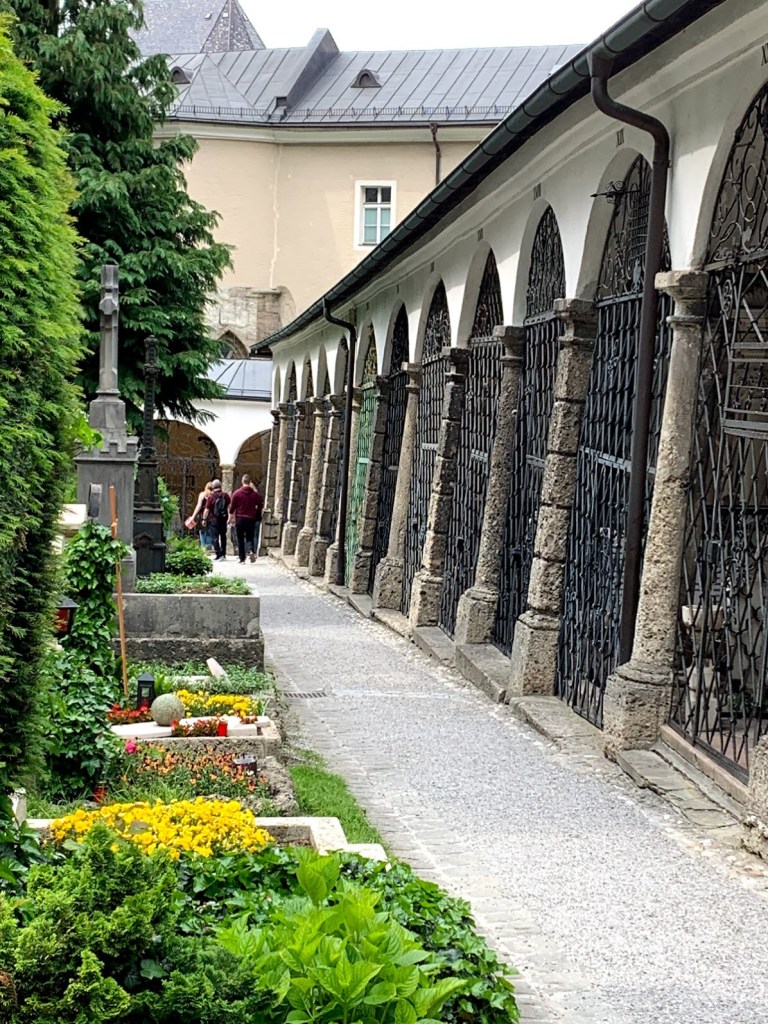
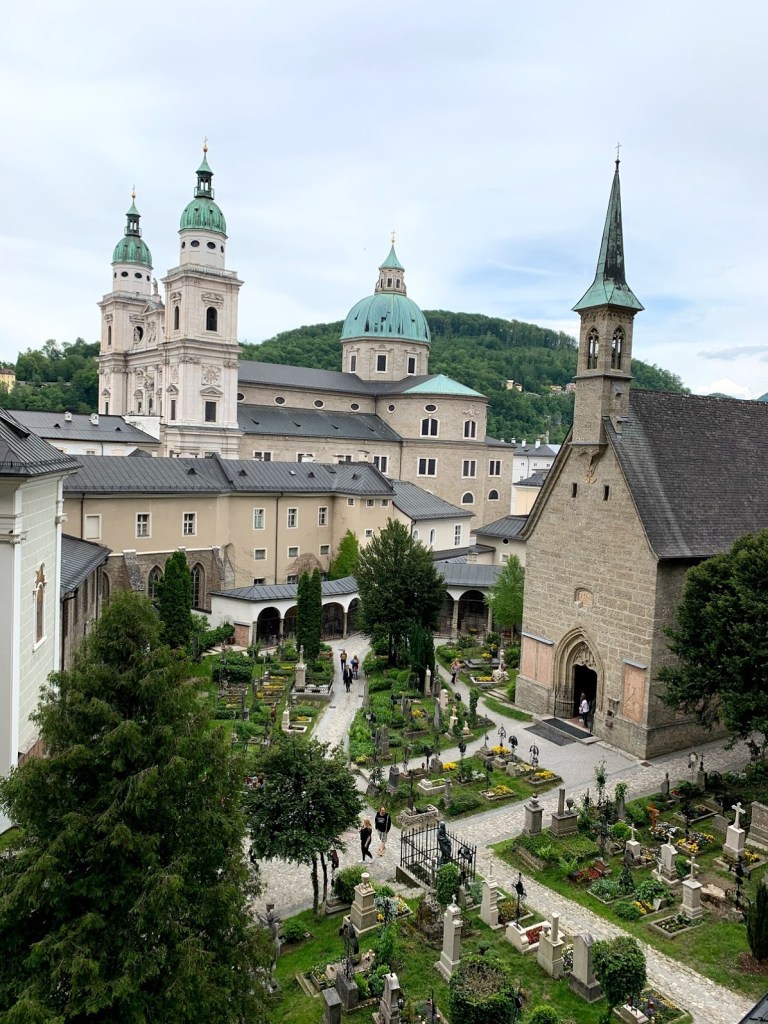
I particularly liked St. Peter’s Cemetery, but unfortunately the church was closed due to renovations. We climbed the old carved out caves near the cemetery which afforded us lovely views of the rooftops, cemetery, and Dom Cathedral. The stone chapel inside the cave dated from 1178 and the other old alcoves were a reminder of Salzburg’s past. The town’s wealth came from salt mines in the hills.

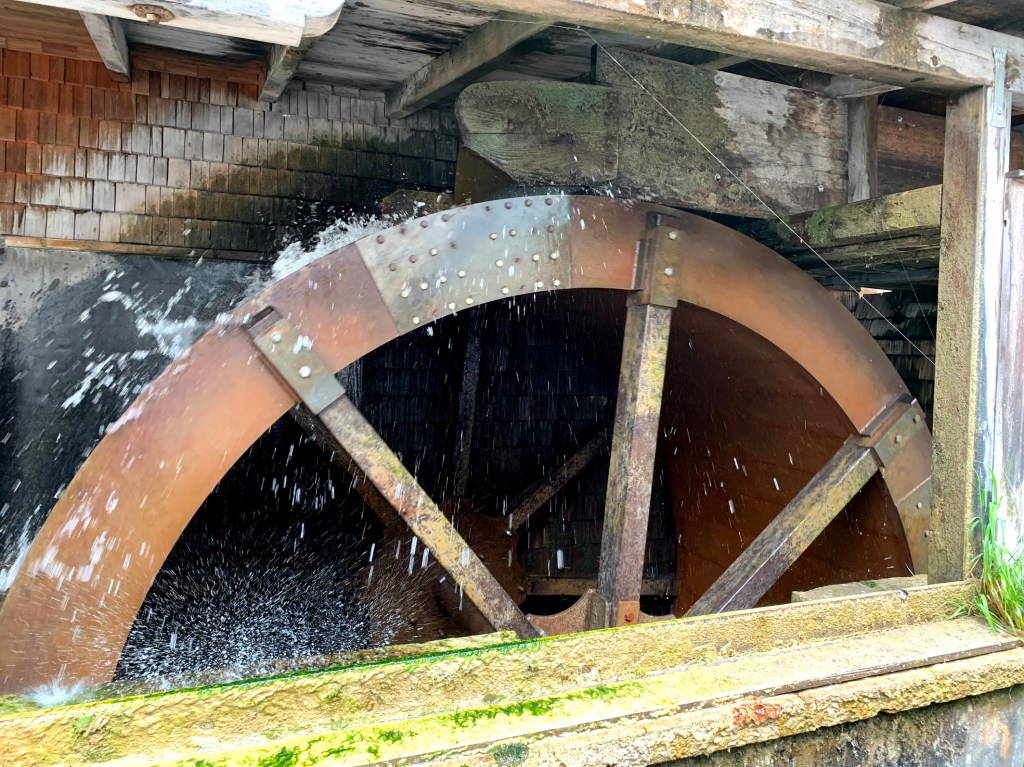
Right outside the cemetery was a waterwheel still in operation
St. Peter’s Cemetery as seen from the hillside caves:
The little chapel belongs to St. Peter’s and the church in the back is the Dom Cathedral of Salzburg.

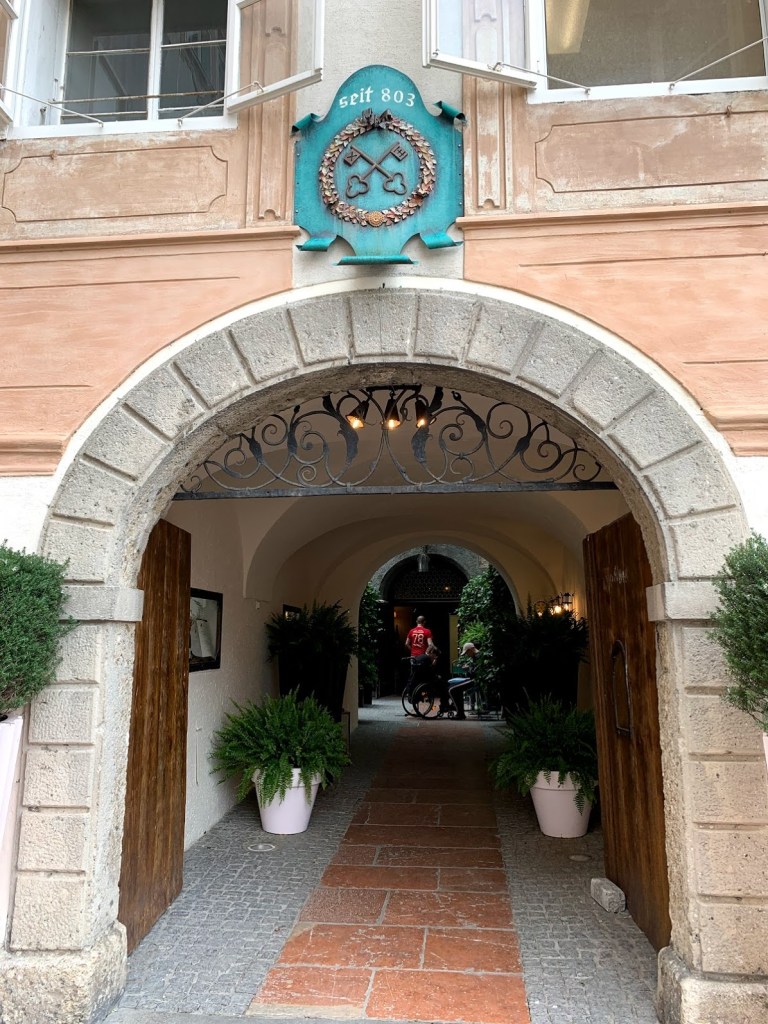
We then took a quick walk past the oldest restaurant in Europe, which dates from 803 AD. As we made it back to our car we passed the church where Mozart’s Mass in D Minor premiered and crossed the “Do Re Mi” bridge used in the film. The rain clouds settled over the Salzburg Fortress as we settled into the snug dry corner of a traditional Austrian restaurant from the 18th century.

The Do Re Mi Bridge over the Salzsach River:
On top of the hill is the Salzburg Fortress

Hallstatt, Austria

The morning of the 24th of May we packed up the car and drove to the iconic village of Hallstatt, which is nestled in the Austrian Alps. Turah was very excited to see the Alps for the first time. However we did have a little hiccup at first. We got stuck in a traffic jam about an hour out from Graz and had to turn around and reroute ourselves. It added about an hour to the trip, but in the end it was a much prettier drive through the winding country roads.

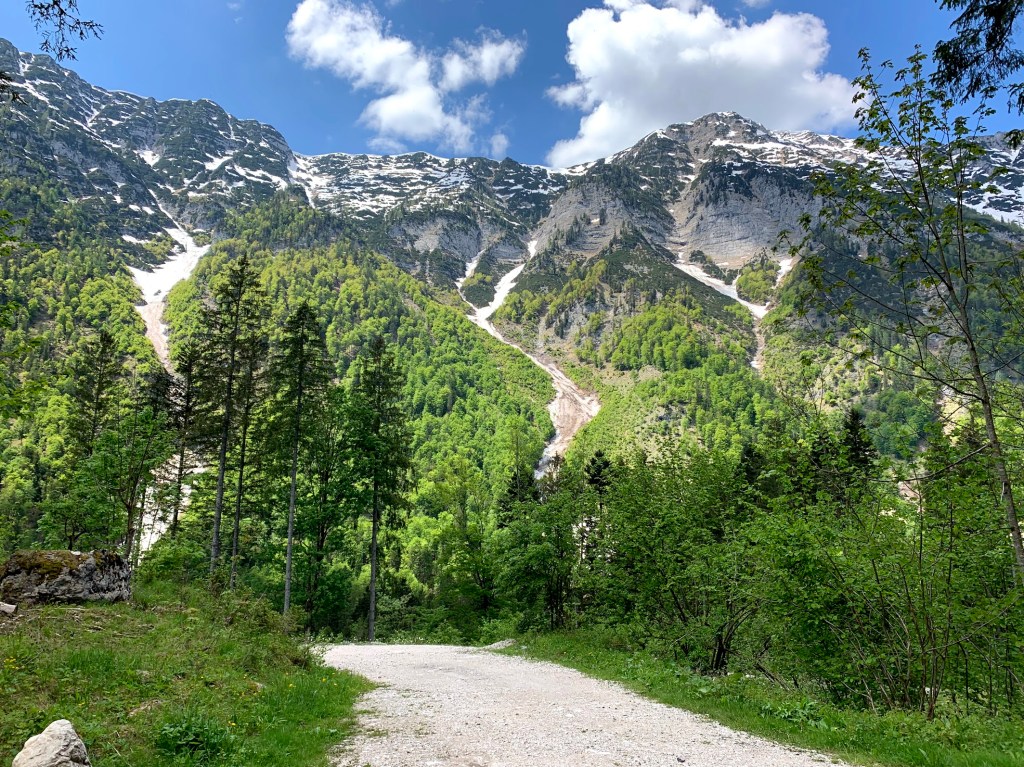
Austrian Alps

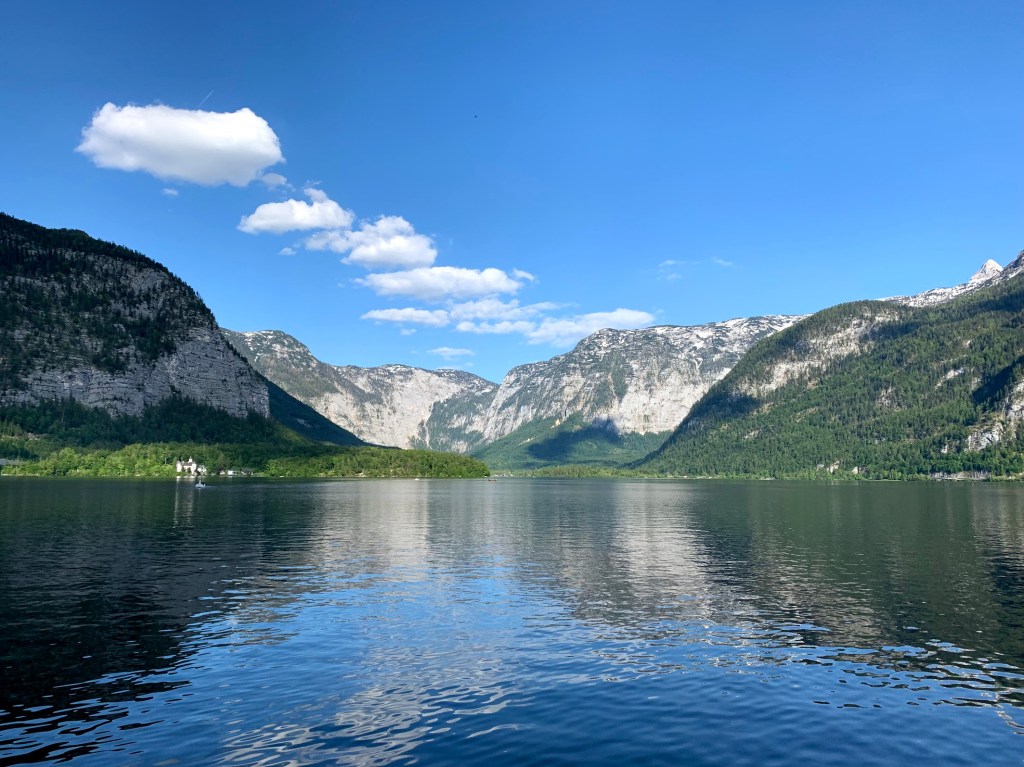
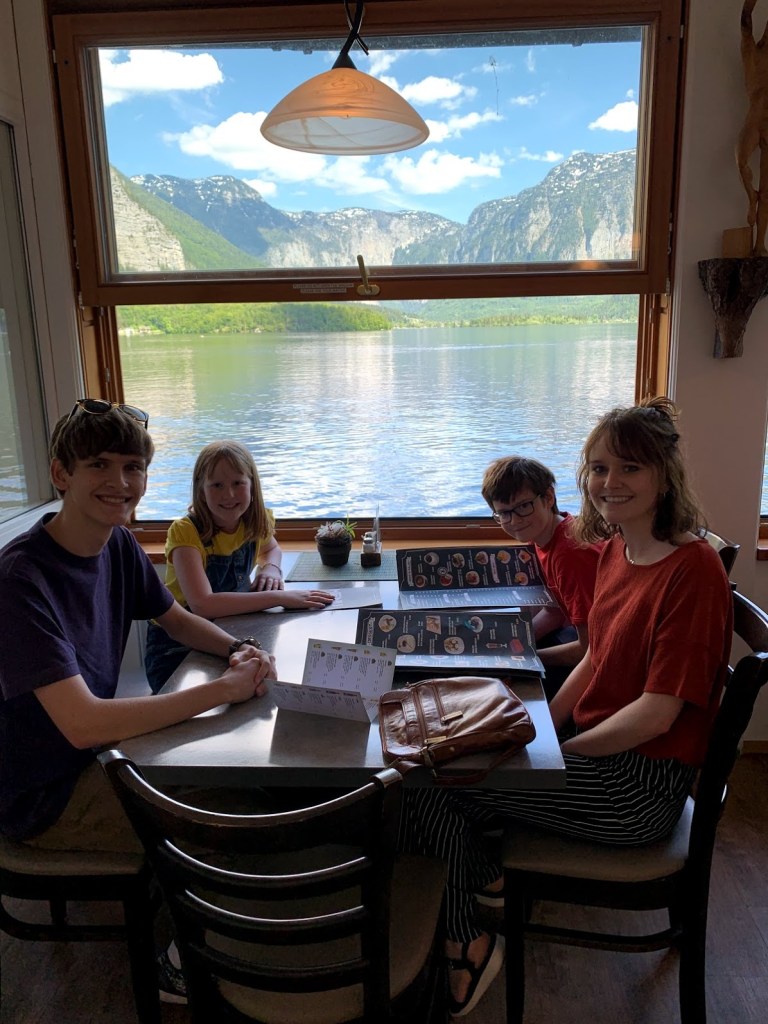
The village of Hallstatt lies along the Hallstättersee, a crisp Alpine lake. The town with its traditional colorful homes is built into the mountainside. We found a place to park and walked along the main street that hugs the lake. It was lunchtime when we arrived and we found a lovely little local restaurant with views of the lake from our table.

Hallstättersee
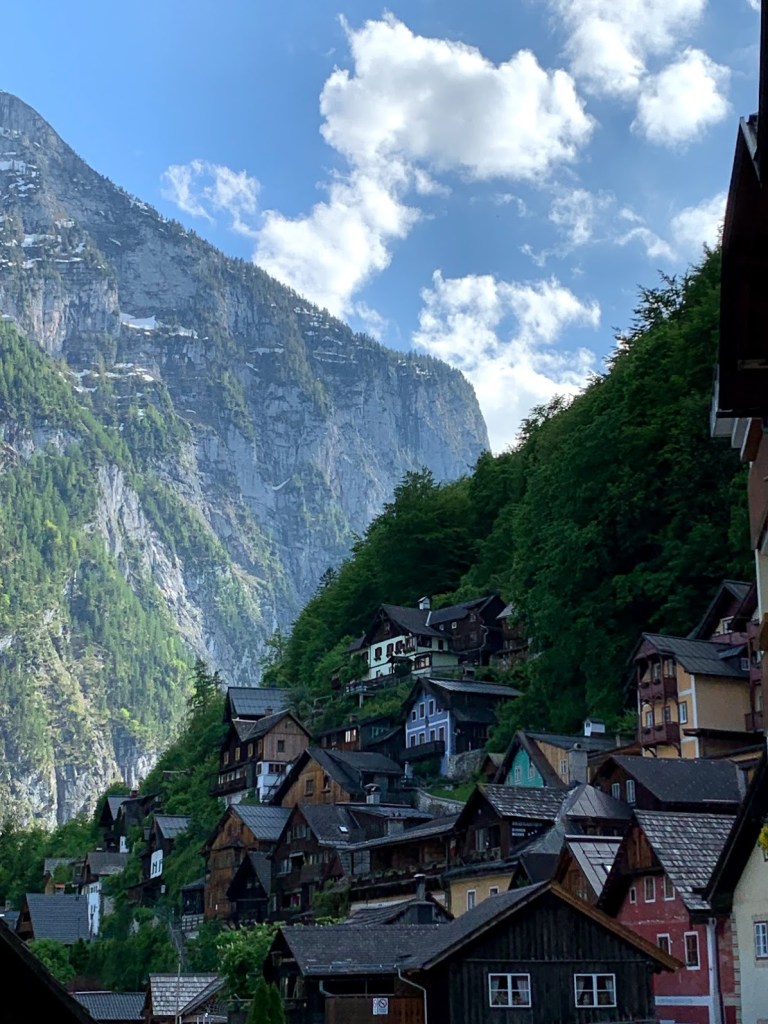
Village of Hallstatt, Austria
View from our table

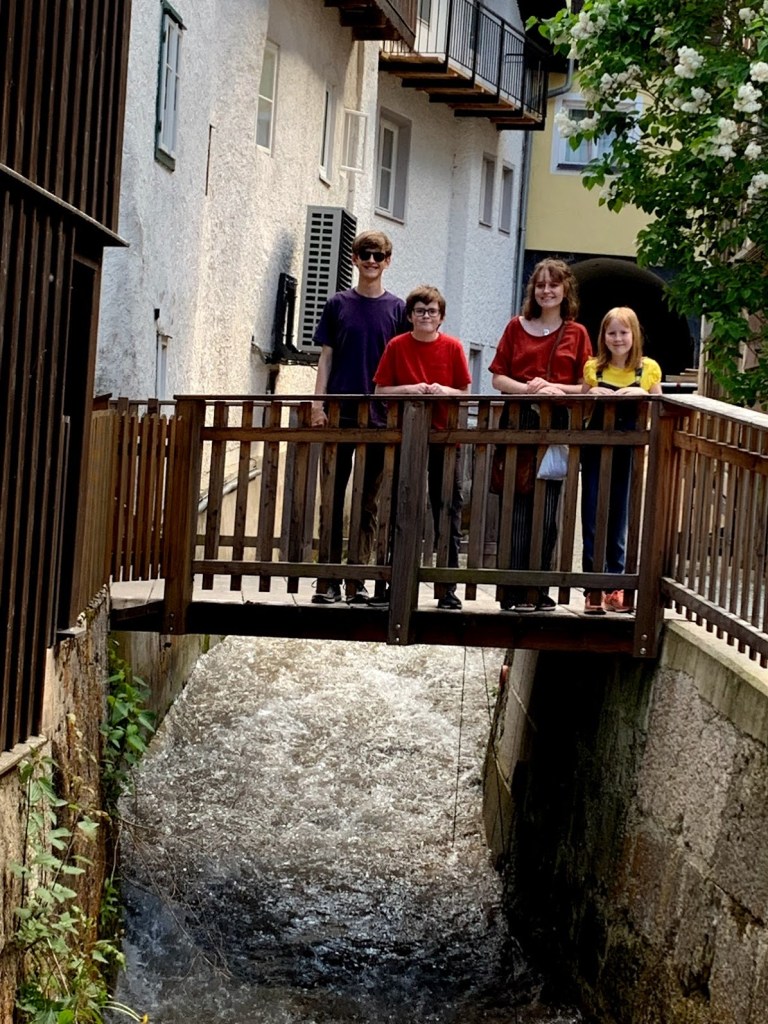
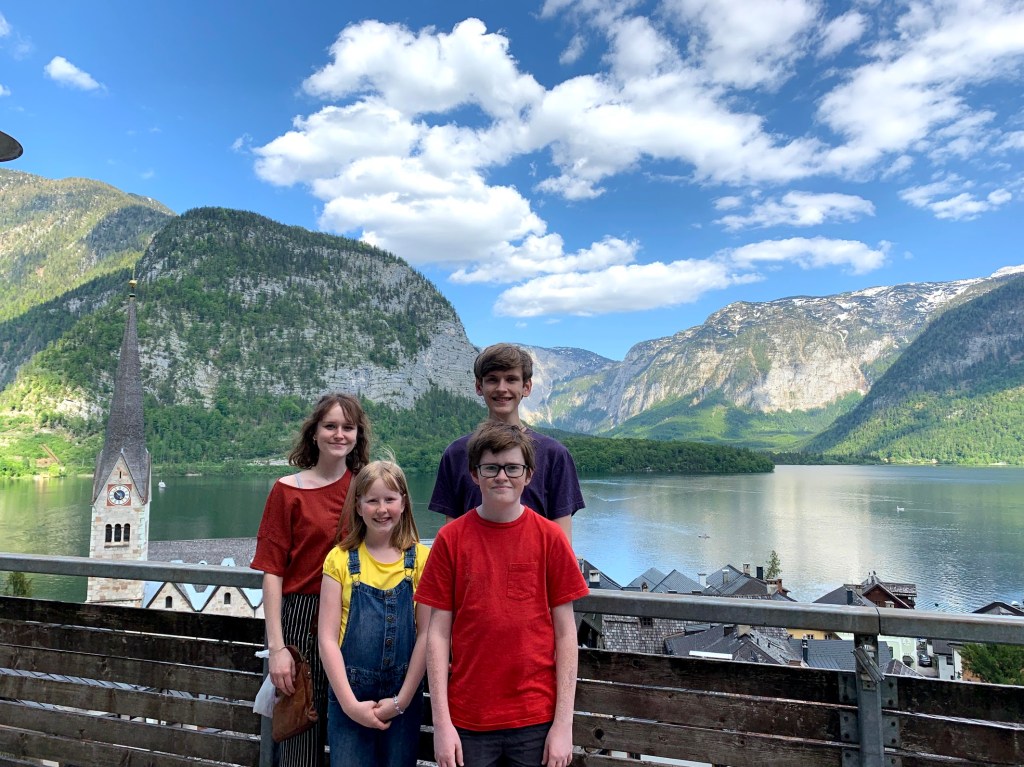
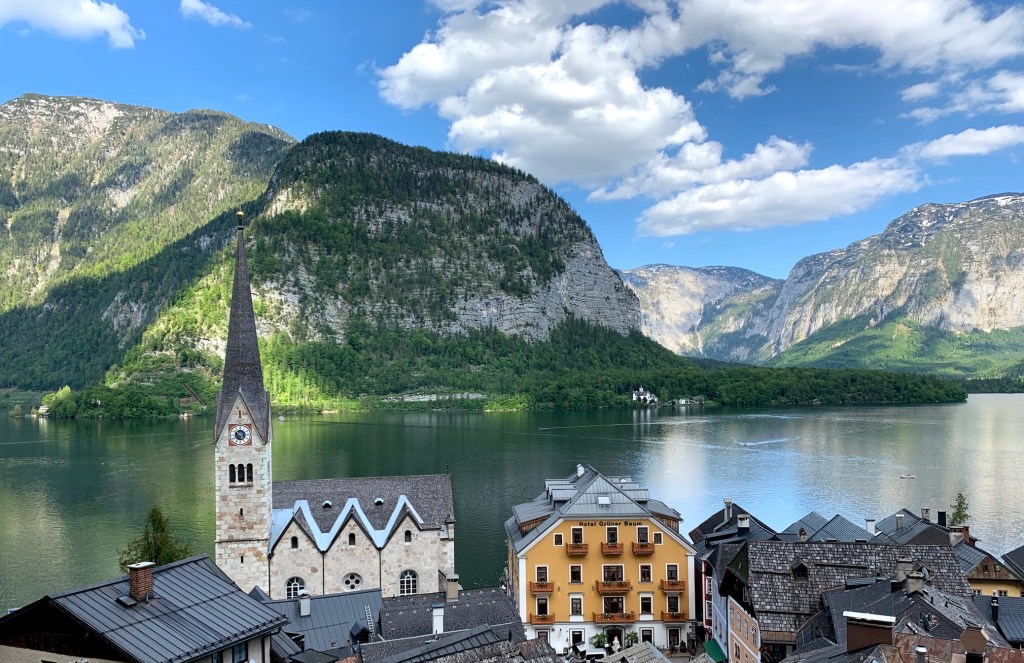
The refreshing lunch gave us the energy to walk around town and up and down the various charming back alleys that meander their way through the mountainside. There was a beautiful waterfall, which turned into a gracefully cascading stream winding it’s way through the mountainside homes. From an overlook on the side of the mountain we were just meters above the rooftops of Hallstatt and could see the Church spire, homes, and the stunning mountain and lake vistas!

Cascading river
Overlook of Hallstatt and the lake
Hallstatt sits alongside Hallstättersee in the heart of the Austrian Alps

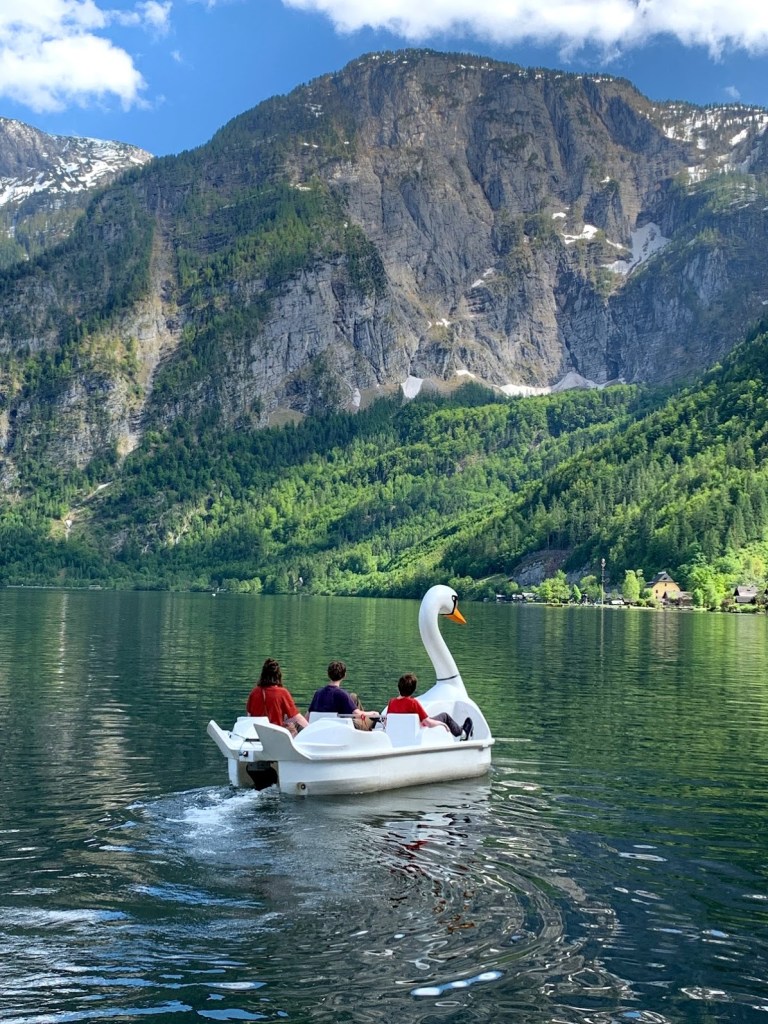
Before ascending up through the village, Turah, Liam, and Seamus took a 30-minute paddleboat ride out on the lake. The classic swan shaped boat was easy to pedal and the three of them enjoyed spending time together in the center of the lake. Faywen is a bit afraid of boats so she, Dad, and I went exploring the local shops and the Marktplatz in the center of the village.

Turah, Liam, and Seamus in their swan paddleboat
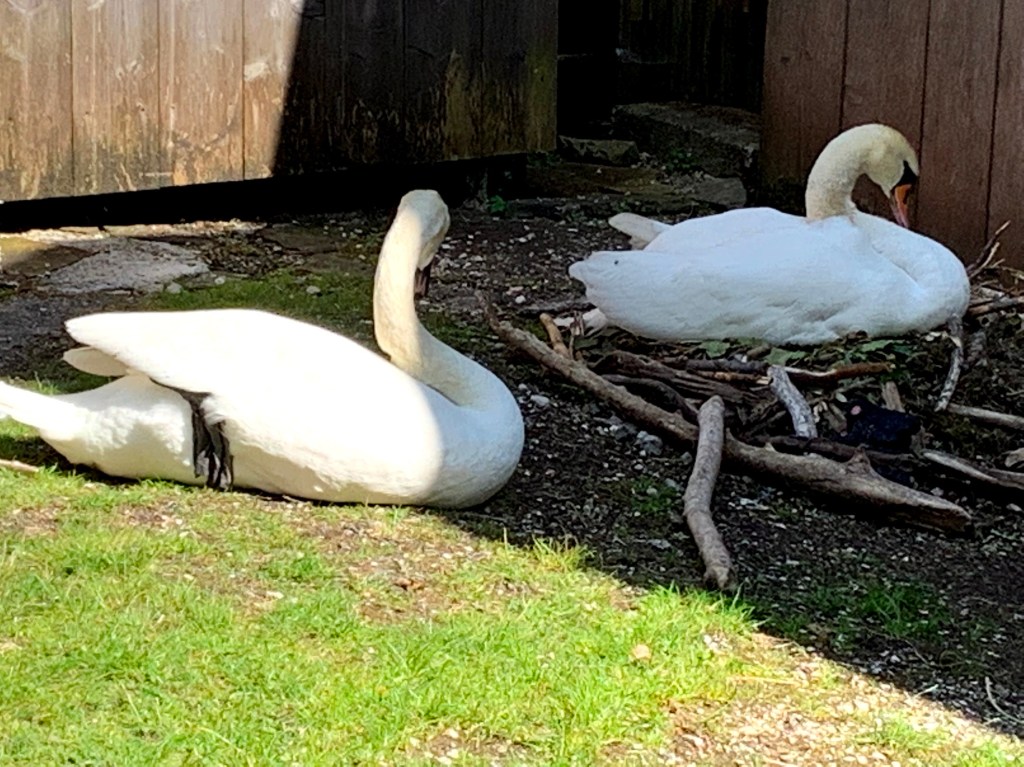
A mother swan sits on her nest while her mate stands guard:
The swans were about 4 meters from the lakeshore. I took this photo with my zoom in order not to disturb the nest.

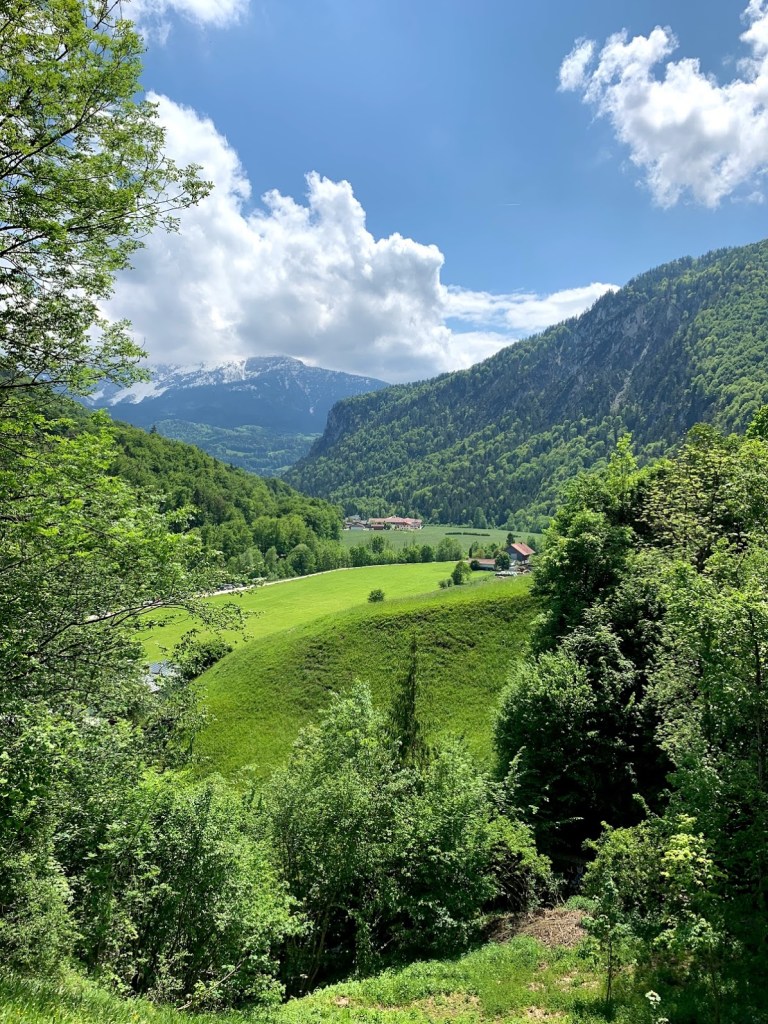
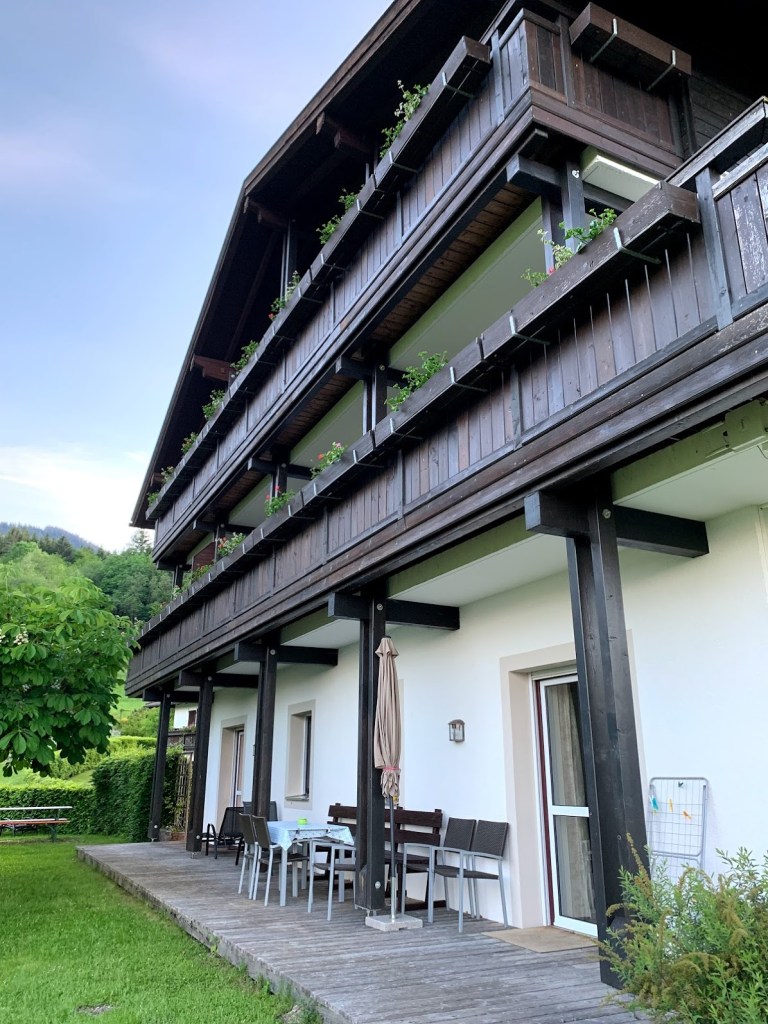
It was a beautiful spring day to explore Hallstatt. After spending the entire afternoon there we drove once again through the Austrian countryside into Germany. We decided to satay in a small hotel/guesthouse in Anger, Germany just over the border from Salzburg. The kids had a good-sized apartment and patio. Robert and I had our own little apartment with a balcony. The views from both rooms were spectacular!

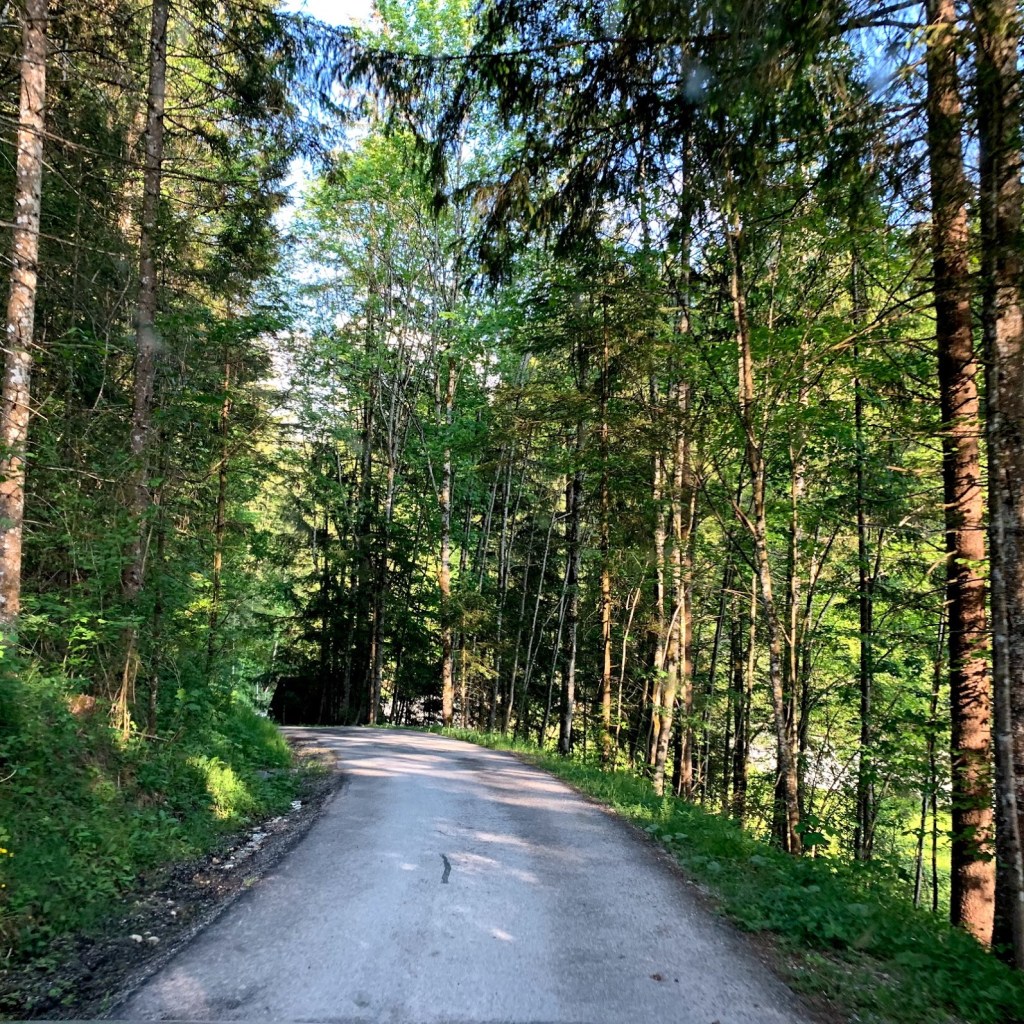
Country lane in the Alpine woods
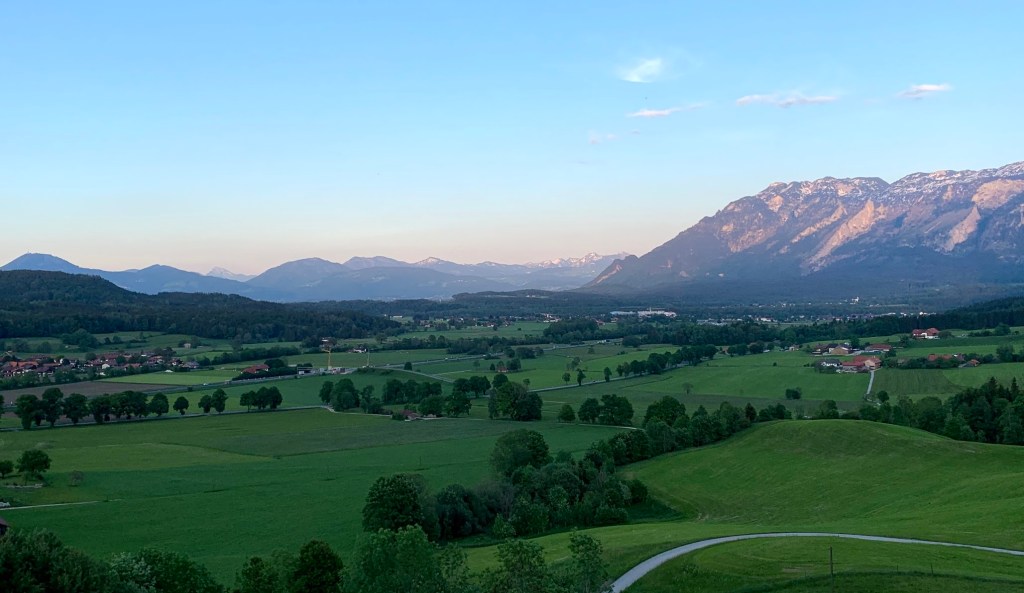
View of the mountains and valley from our guesthouse in Anger, Germany
Guesthouse in Anger, Germany:
The kids had the entire patio to themselves!

Turah Comes for a Visit!

Our eldest, Turah, finished her sophomore year at GVSU and had a couple of weeks between the end of the semester and her summer internship to come and visit us here in Graz. The kids already had two scheduled days off from school. We asked for the other three days off in order to travel around Austria, Germany, and the Czech Republic.

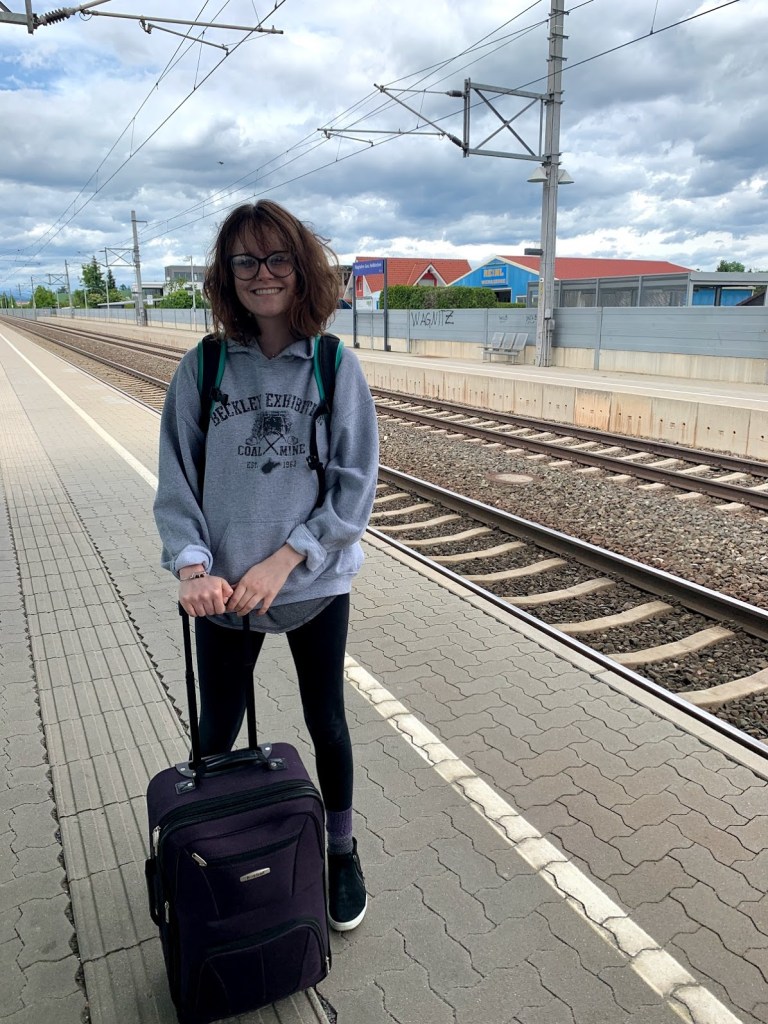
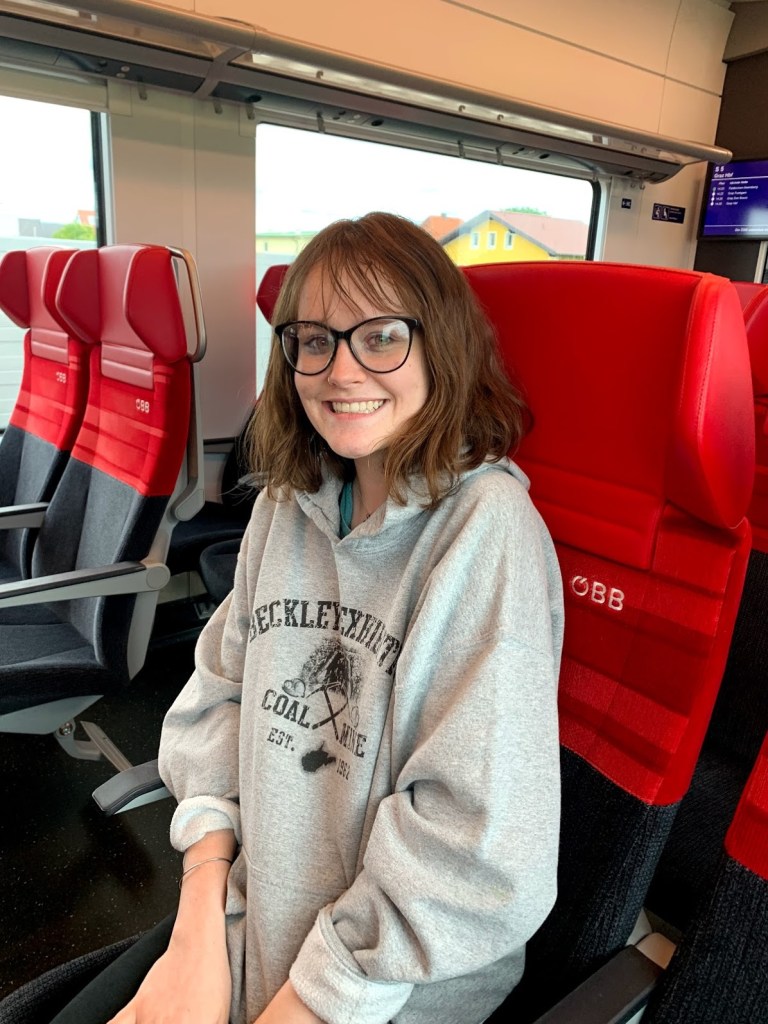
Turah arrived on the 22nd of May in the early afternoon. The Graz airport isn’t very large, so it was easy to see her as she cleared customs. She ran into our arms with a very tired, but happy look on her face! She immediately got to ride her first European commuter train, because the airport is south of the city. She told us about the various flights and how she had to run in Detroit to her connecting flight to Amsterdam!

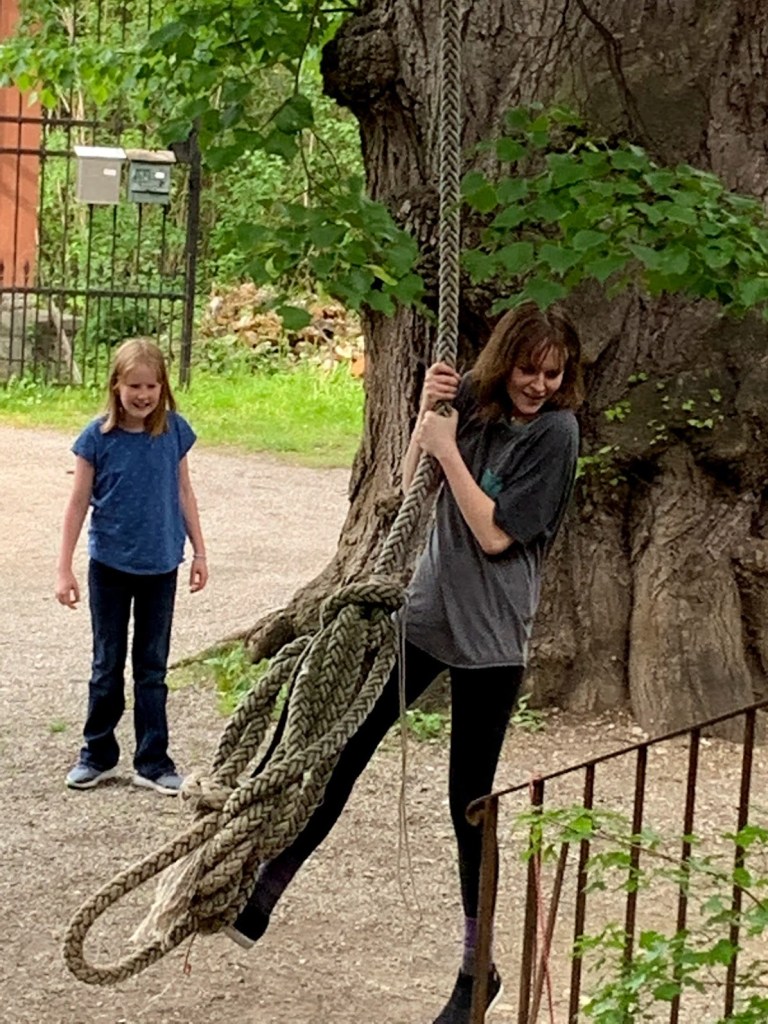
She took in everything as the train pulled up into the Graz Hauptbahnhof. We caught the tram, stopped at Sorger to let her eat a bit of late lunch, and then walked up the hill to our home. Her siblings came running out the door to greet her. For the rest of the afternoon Liam, Seamus, and Faywen entertained Turah. She got a thorough tour of the house and gardens. The kids quickly introduced her to the little bikes and of course the Linden Tree swing rope!

Wheeeee!

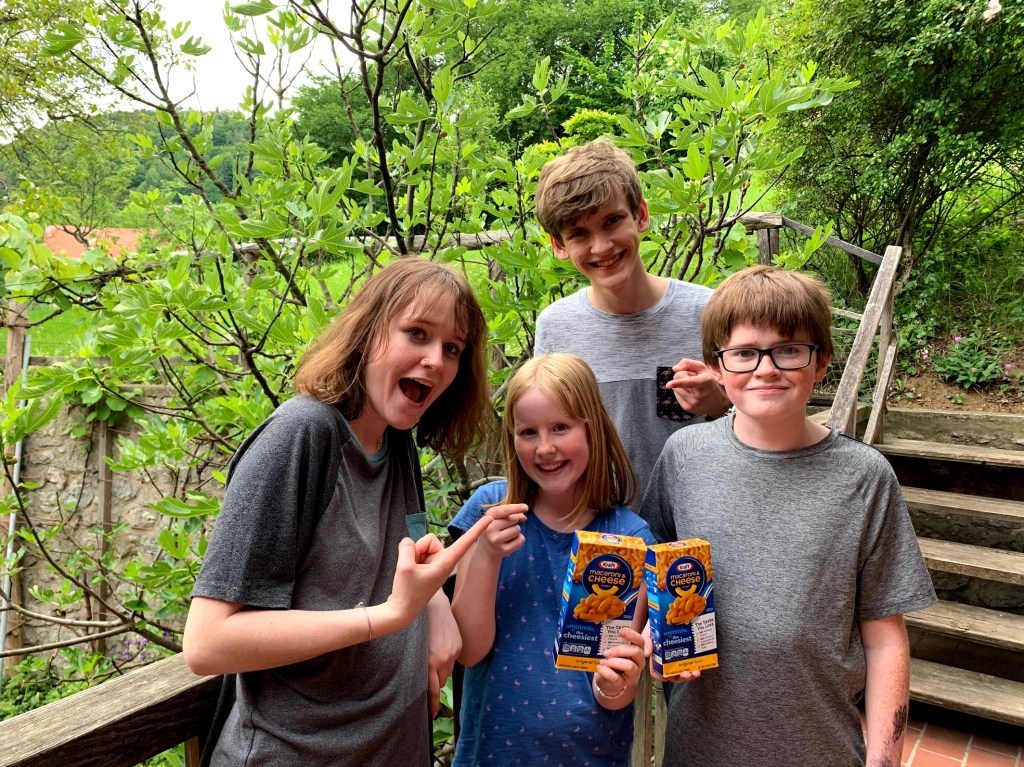
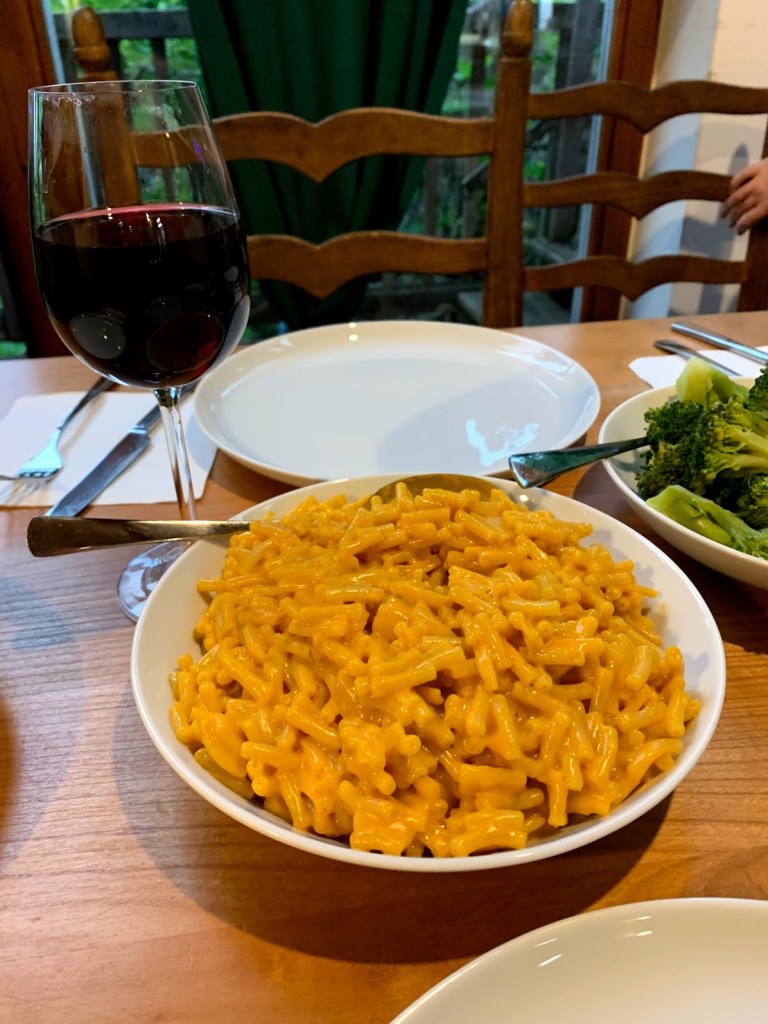
Turah had asked us if there was anything from the USA we would like her to bring. The only thing we could think of that we all had a craving for was Mac n’ Cheese! Robert cooked it beautifully with wursts and broccoli. It was very satisfying to eat Mac n’ Cheese!

Hurrah for Mac n’ Cheese! Thanks Turah!
Mmmmm Mac n’ Cheese!!!

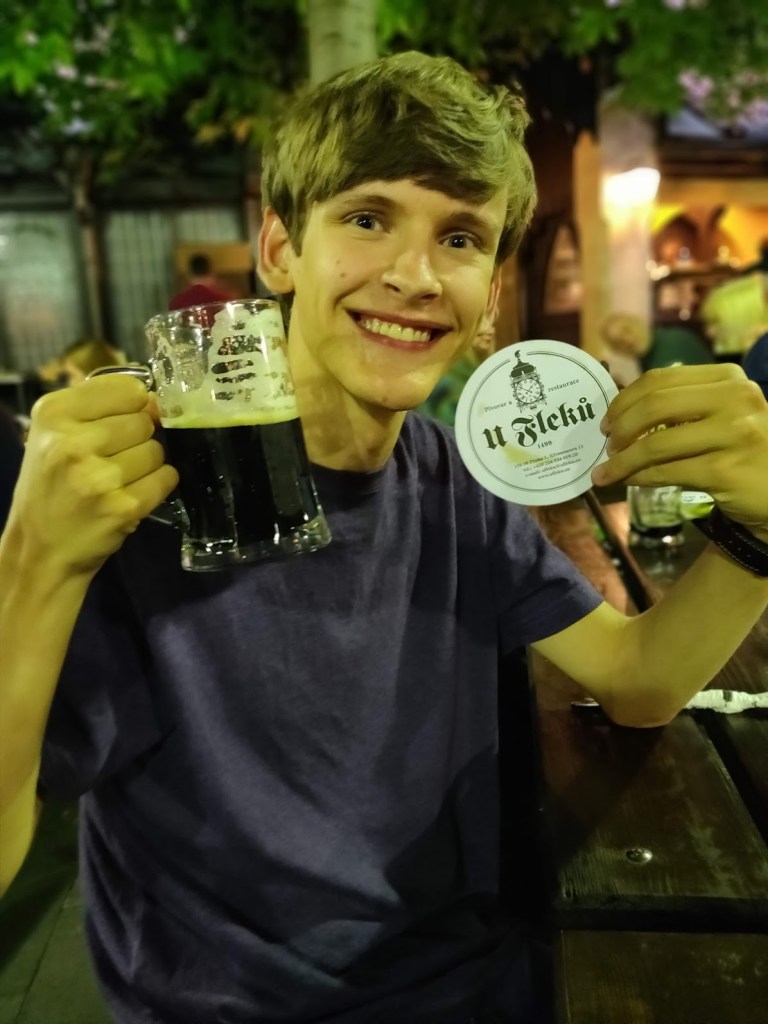
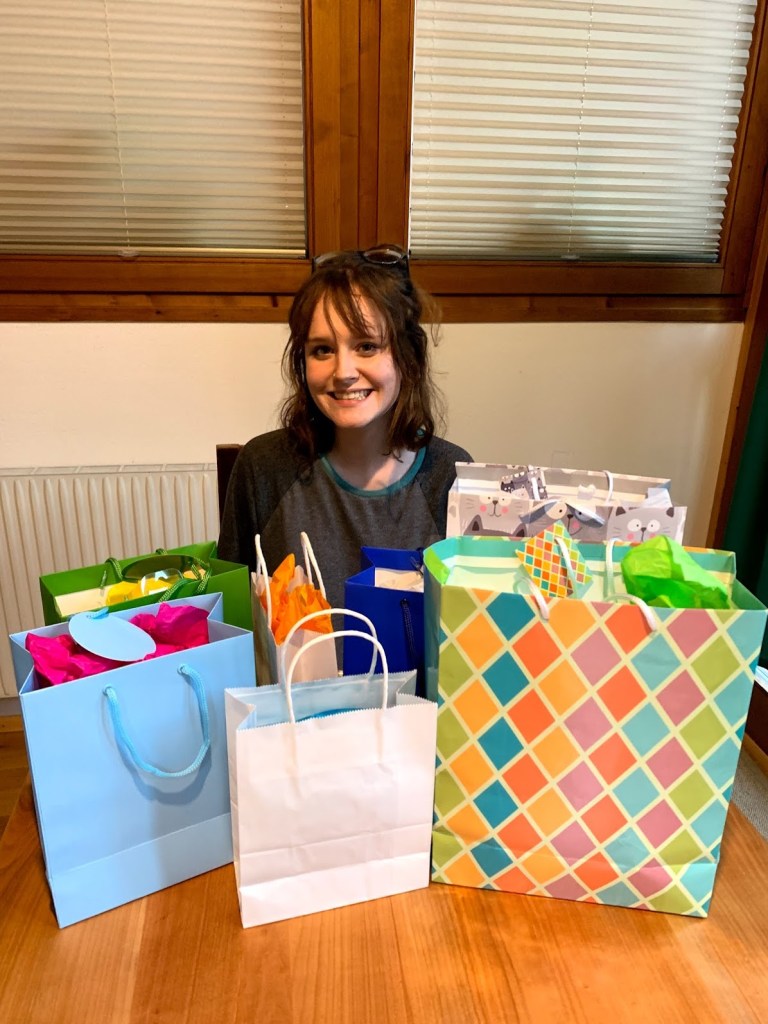
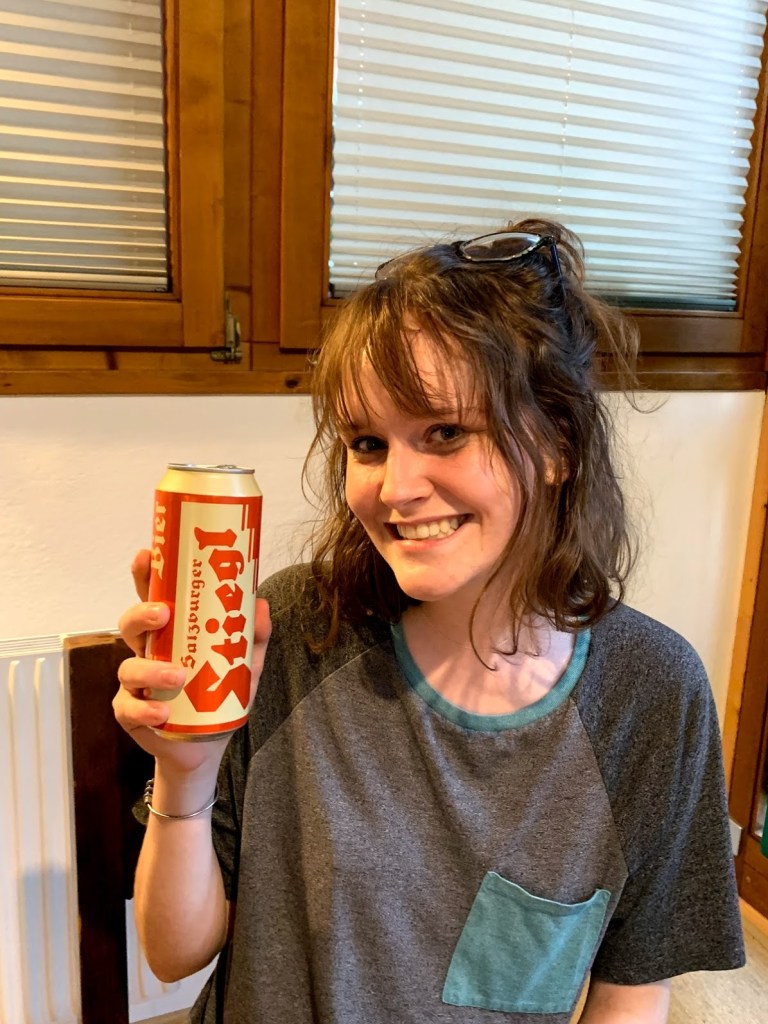
That evening we gave Turah all of her gifts that we had collected on our travels and she got to have her first beer, which Liam had picked out for her to drink.

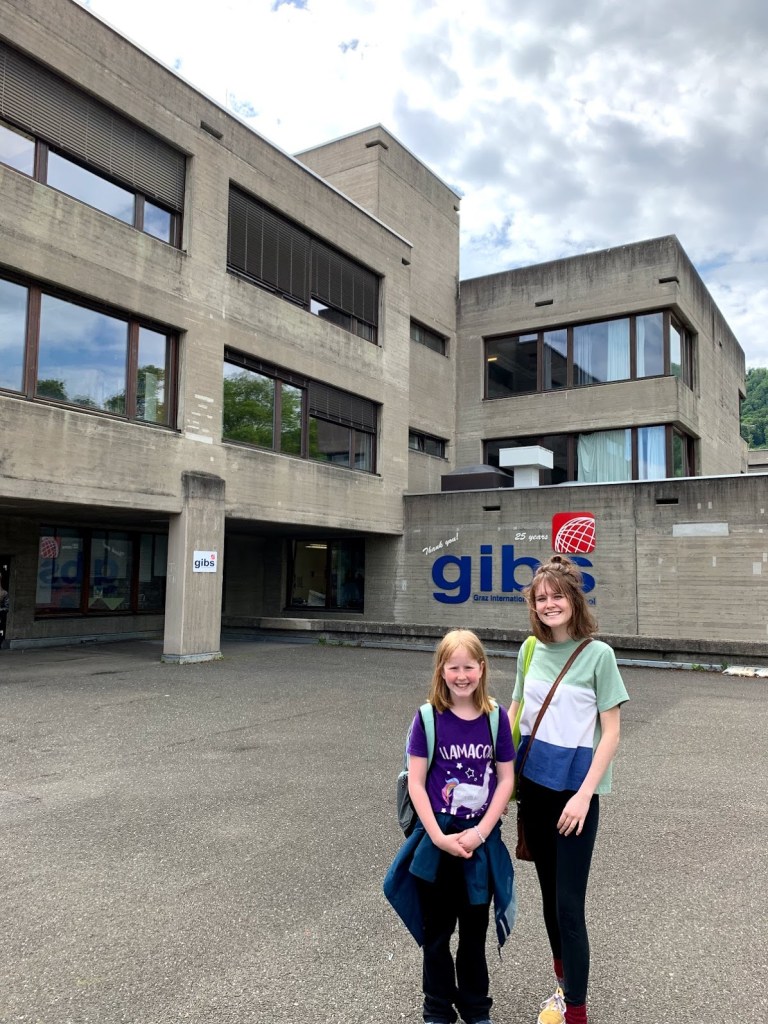
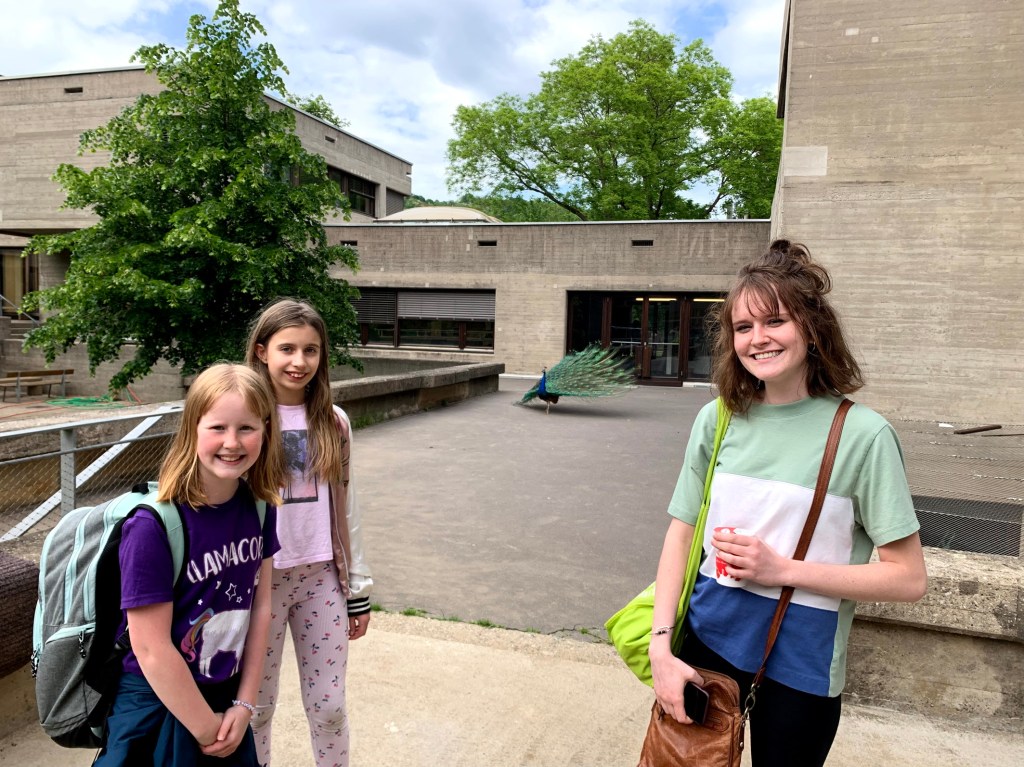
The next day Turah slept in a bit and had a little jet lag. I made her drink and eat and she felt a lot better. We then went shopping and she enjoyed picking out some new European clothes! After that we headed over to GIBS to meet up with Faywen, who wanted to show Turah around the school. Turah enjoyed seeing the school where her three younger siblings had been attending since late February. She also got to meet Faywen’s best friend, Manon, and as we chatted in the school courtyard one of the famous peacocks meandered into sight. Turah was a bit nervous at first, but then had a good laugh, as other kids casually walked by the peacock like it was no big deal!

Faywen, Manon, and Turah with one of the famous GIBS peacocks!

We all retired early because the next morning we would start our family adventure with Turah!

Did You Know Willy Wonka Was Austrian?

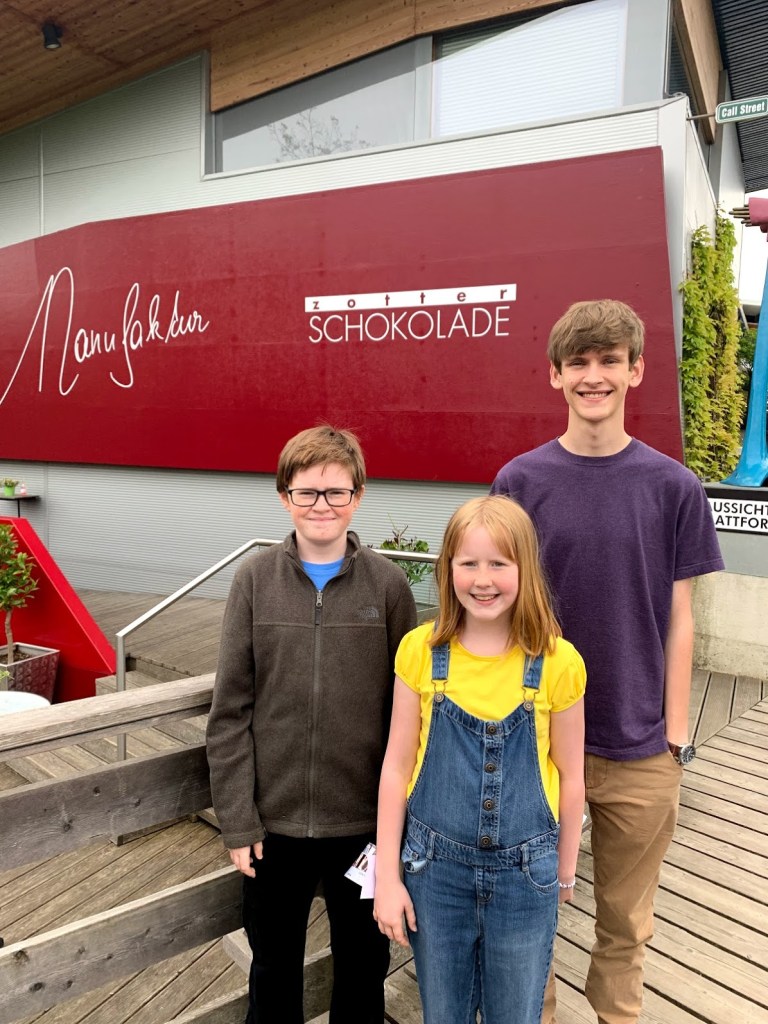
Yes, I think we found Willy Wonka’s Magical Chocolate Factory in Austria. Zotter’s Chocolate Factory lies about 1 hour east of Graz. Robert’s FH Joanneum colleague Franz Niederln and his wife Heidrum treated us to a day out on Saturday, 18 May.

They picked us up in their van along with Roger Ferguson, a GVSU colleague of Robert’s, who was still visiting, and took us to Zotter’s Chocolate Factory and Vulcano Hams.

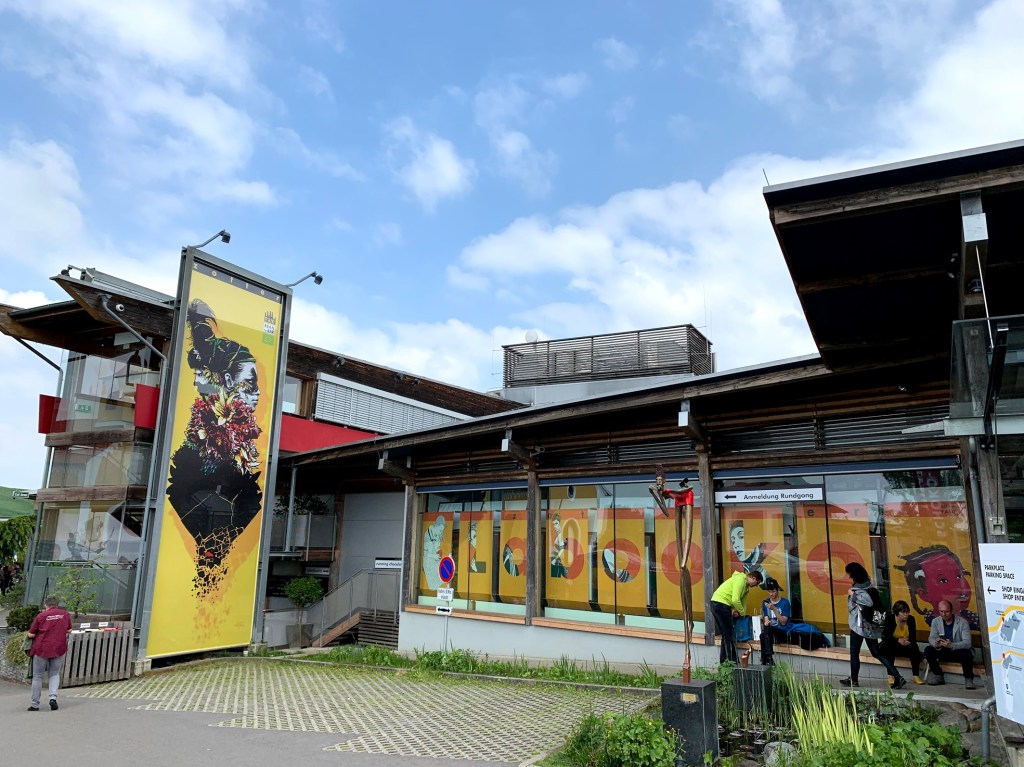
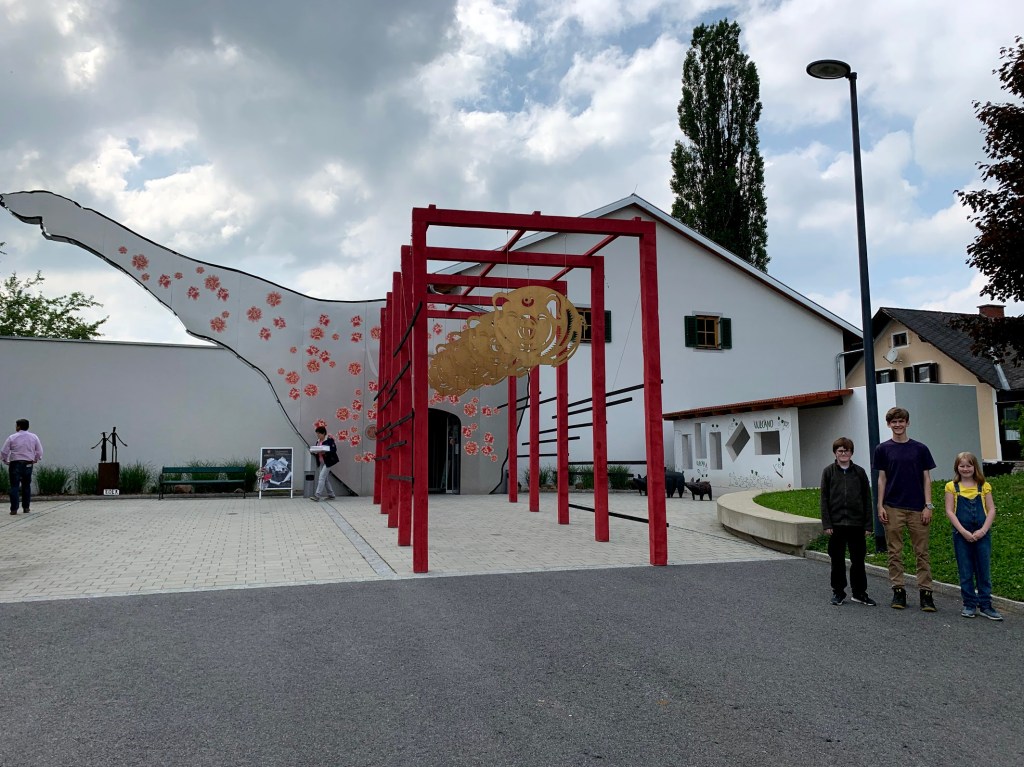
Zotter’s Chocolate Factory was a whimsical place!
Time to go eat chocolate!

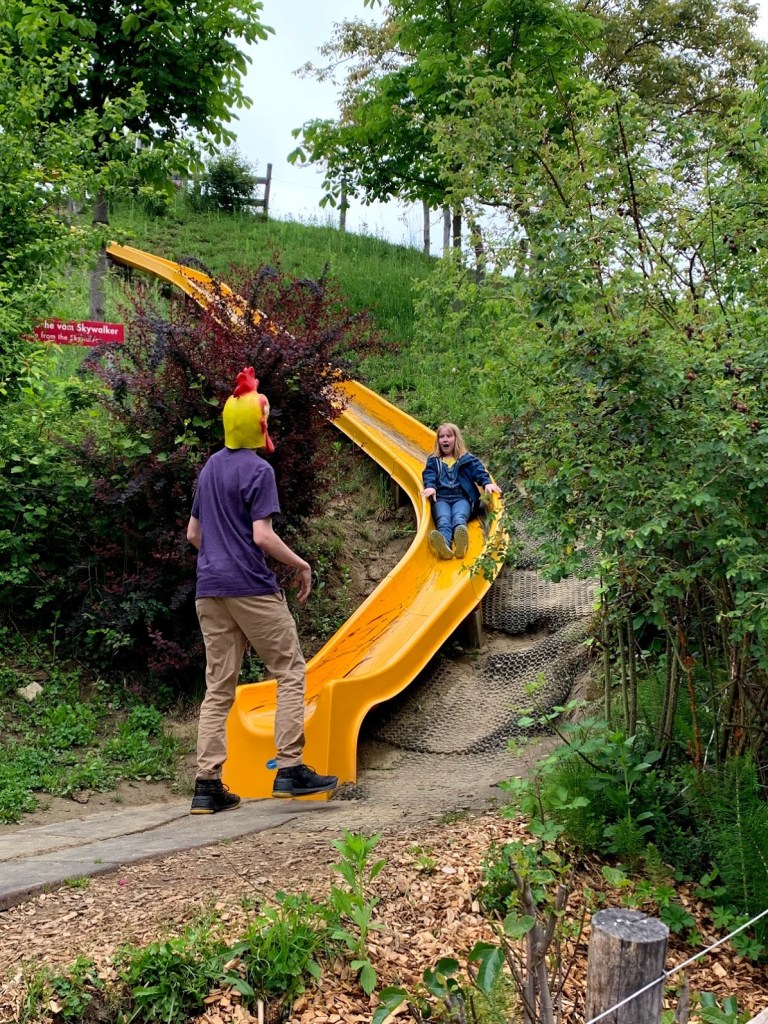
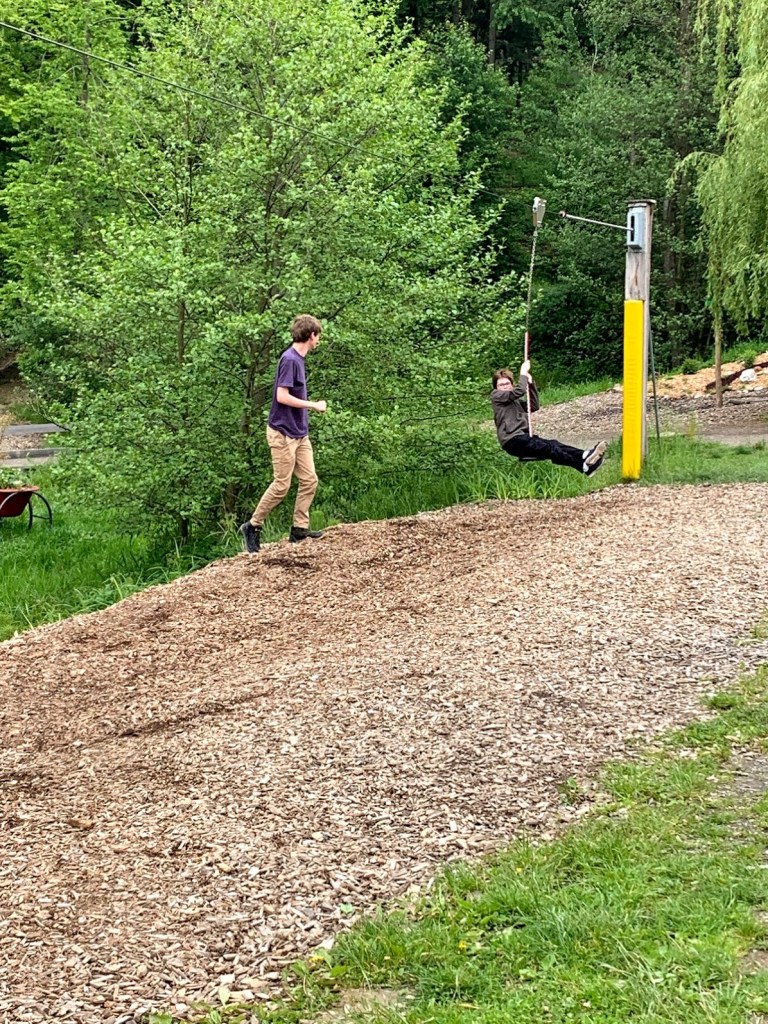
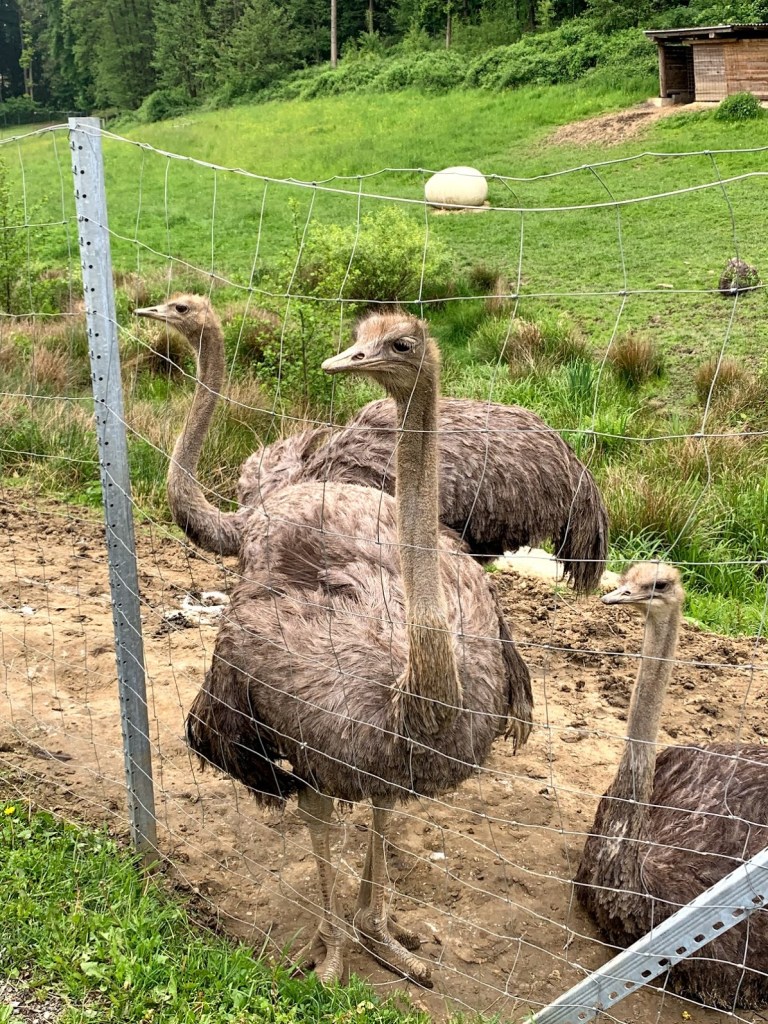
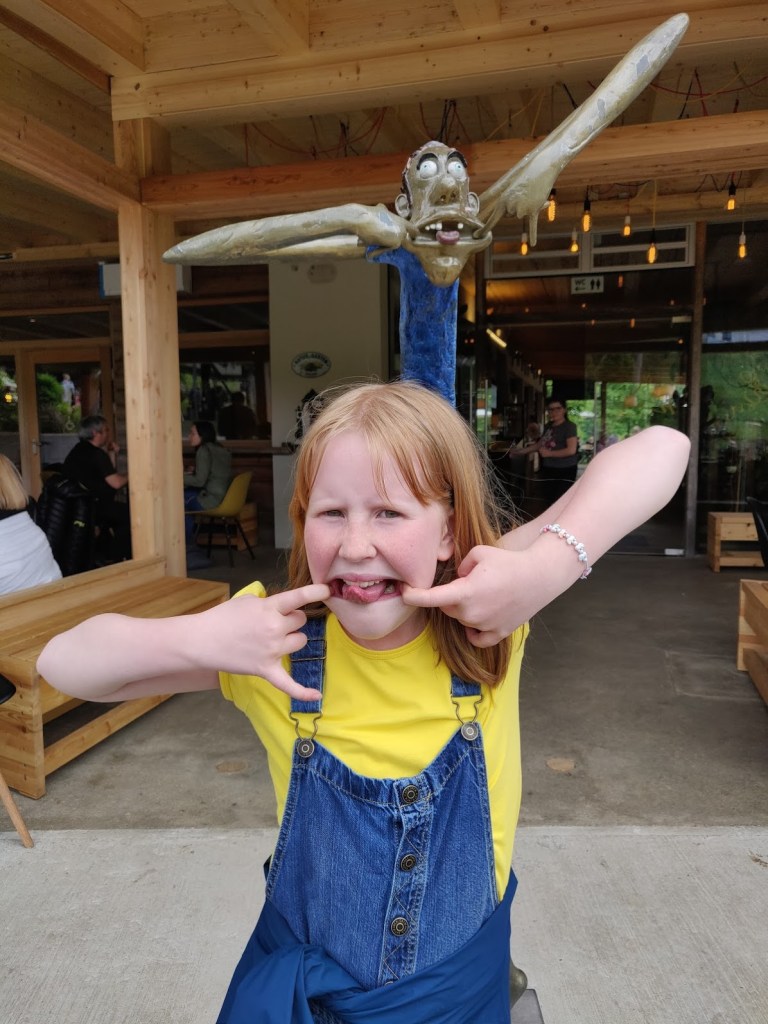
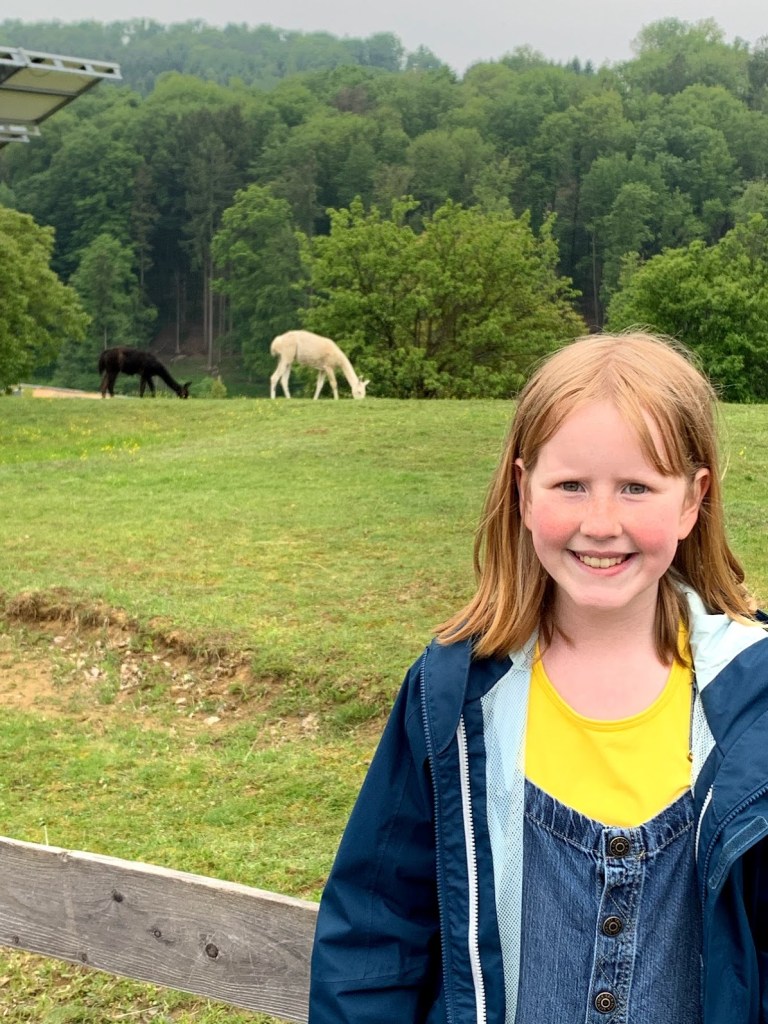
Zotter’s was a wonderland! Not only was there the chocolate factory, but also a farm and edible garden with quirky statues throughout the grounds. We had fun meandering around the gardens and the farm. There were all kinds of animals from rabbits, llamas, to ostriches! Multiple areas had “danger” playground equipment, which meant of course our children were ecstatic to go and play!

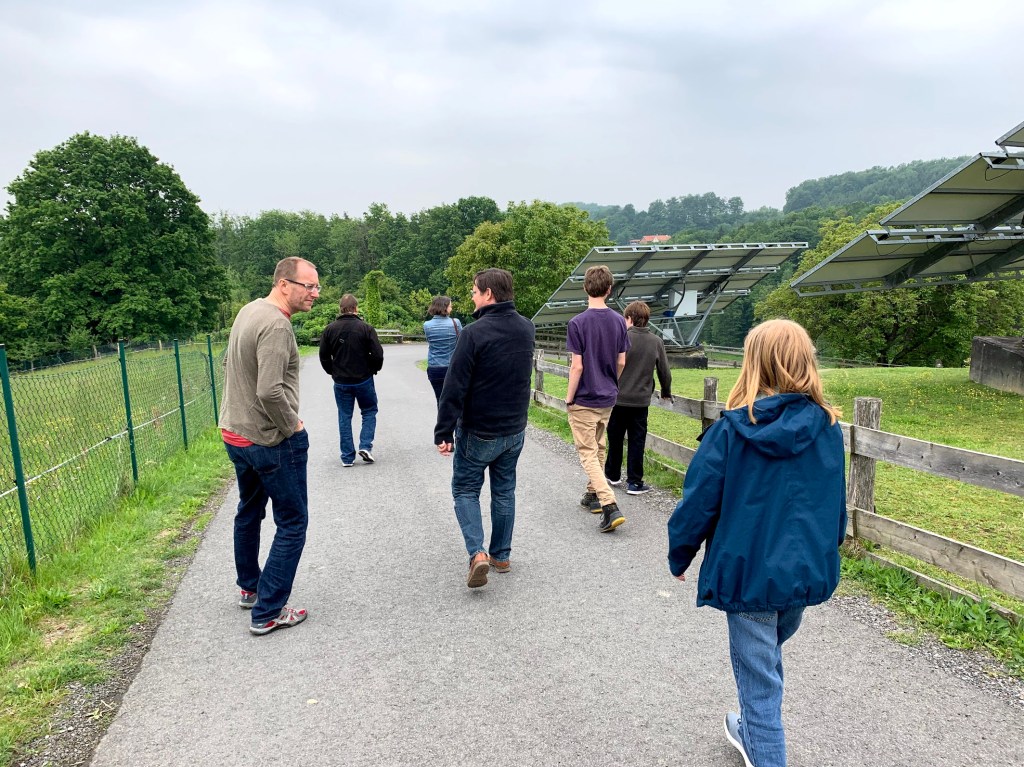
Walking in the farm at Zotter’s with the Niederln’s and Mr. Roger

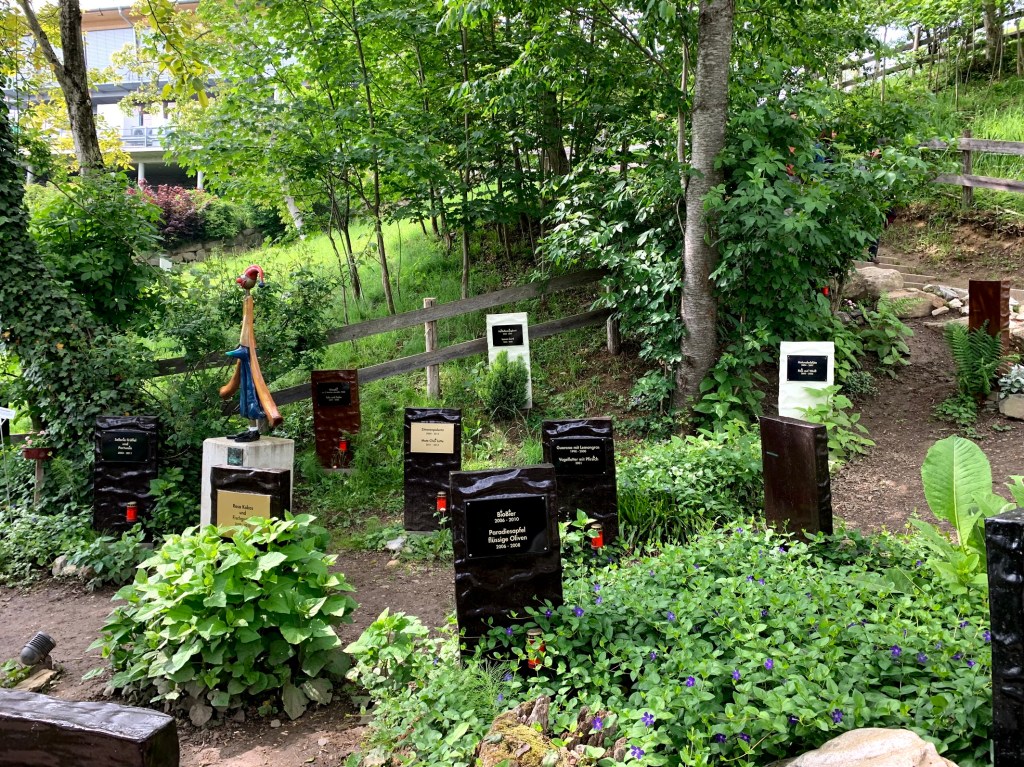
I personally liked the chocolate graveyard. There were full size headstones in brown and white to designate what kind of chocolate had been “laid to rest”. There were all kinds of interesting chocolate combinations including pig blood with ginger, or lemon and fish, and hazelnut and lettuce! There were even little candles in front of the buried chocolates. I asked a clerk and she said that the “not so good recipe ideas” or “retired” chocolates are actually buried under the stones!

Chocolate Graveyard

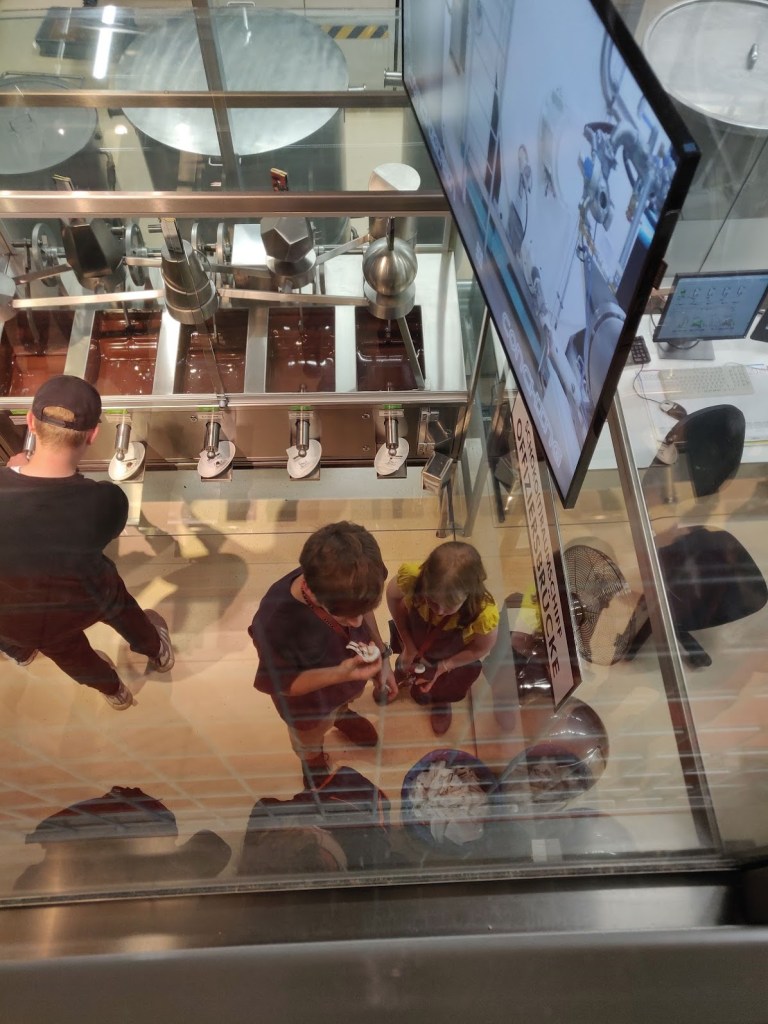
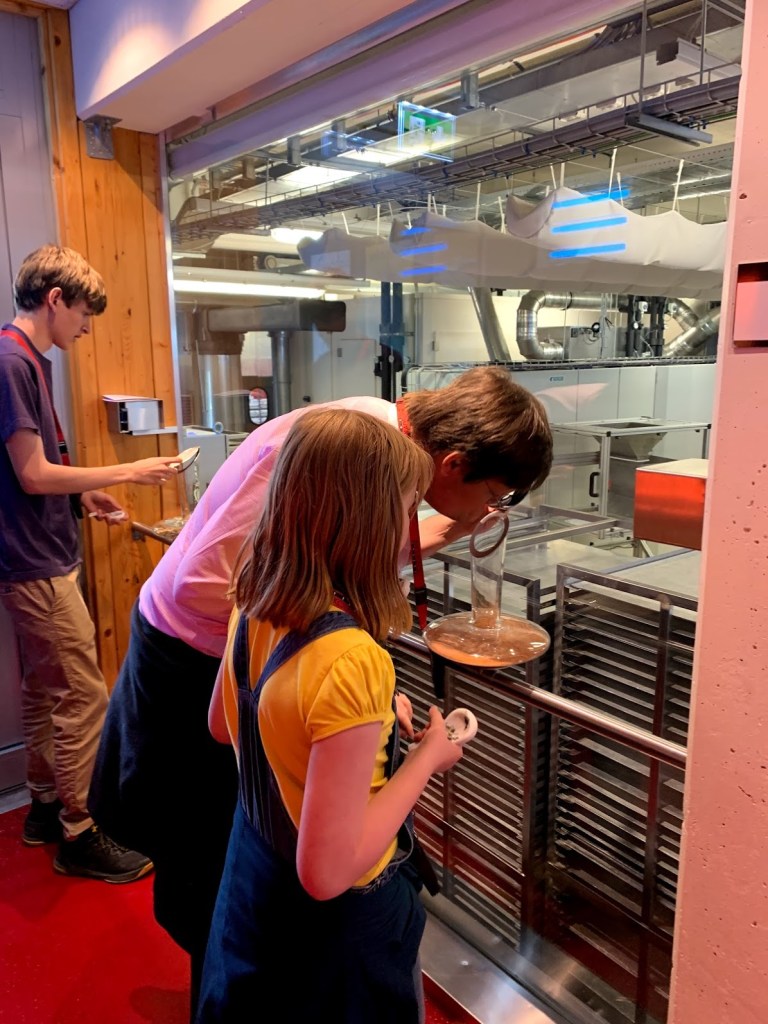
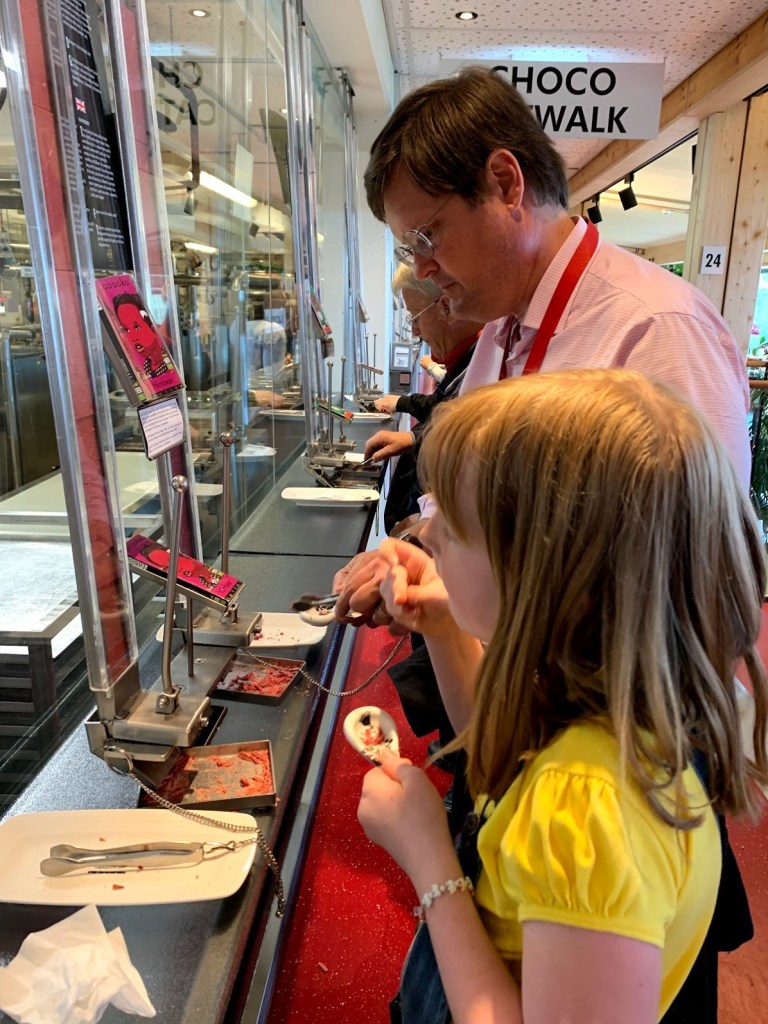
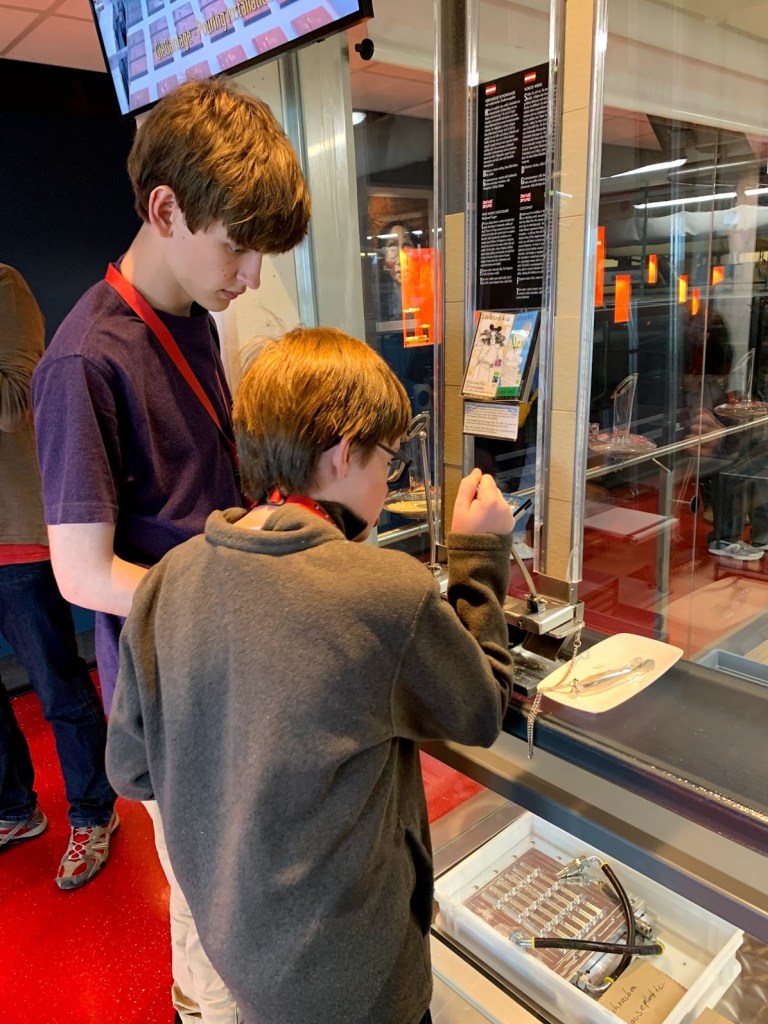
Inside we took the factory tour and there was a wonderful video about how Zotter’s actually works with cacao famers in Peru and Ecuador to get the best Free Trade chocolate available. We were given a little ceramic serving spoon to try all the different chocolates they make. It was an endless ordeal with 200+ samples of chocolates, sauces, and fillings used in chocolates.

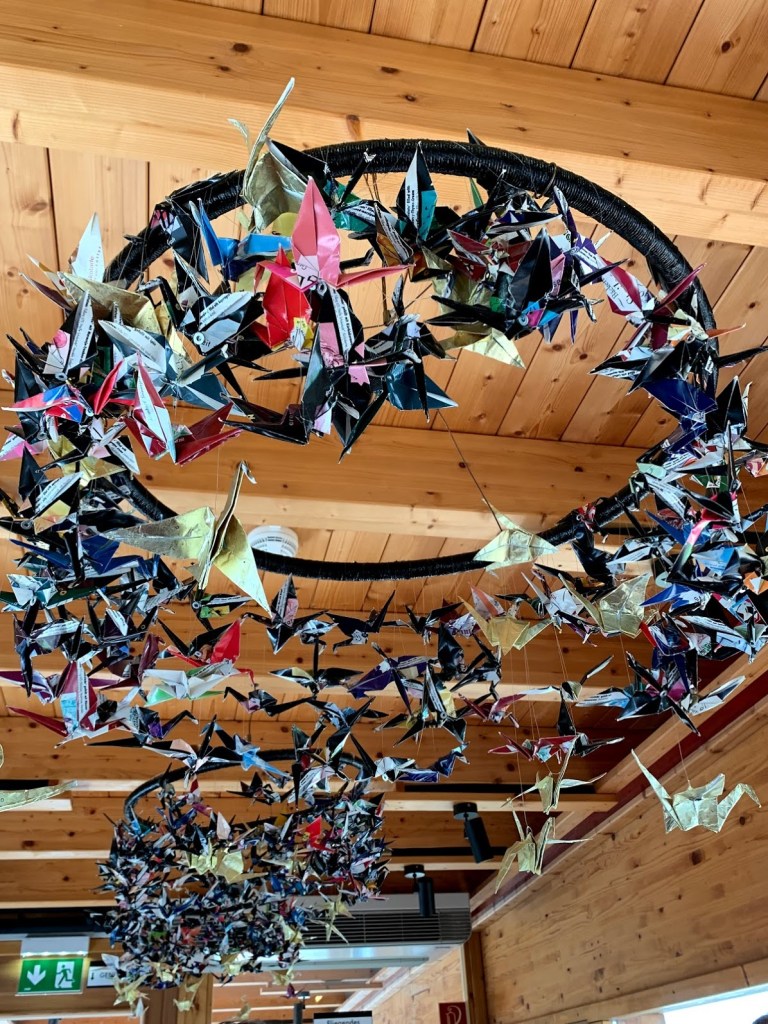
Paper cranes made out of Zotter’s Chocolate wrappers

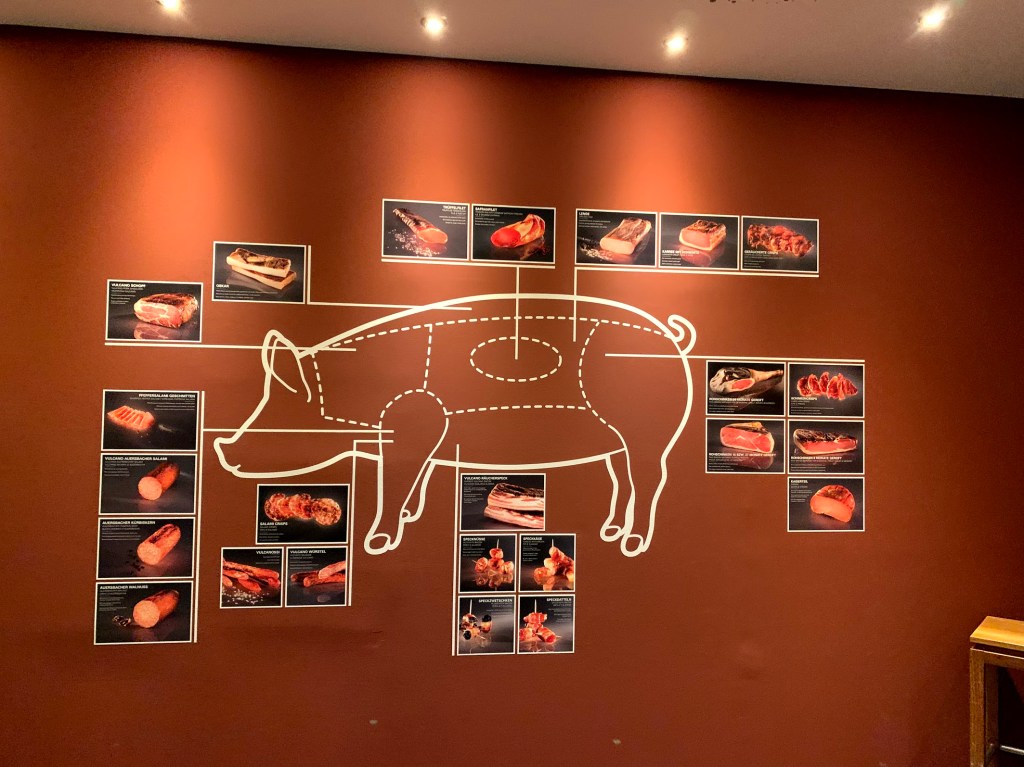
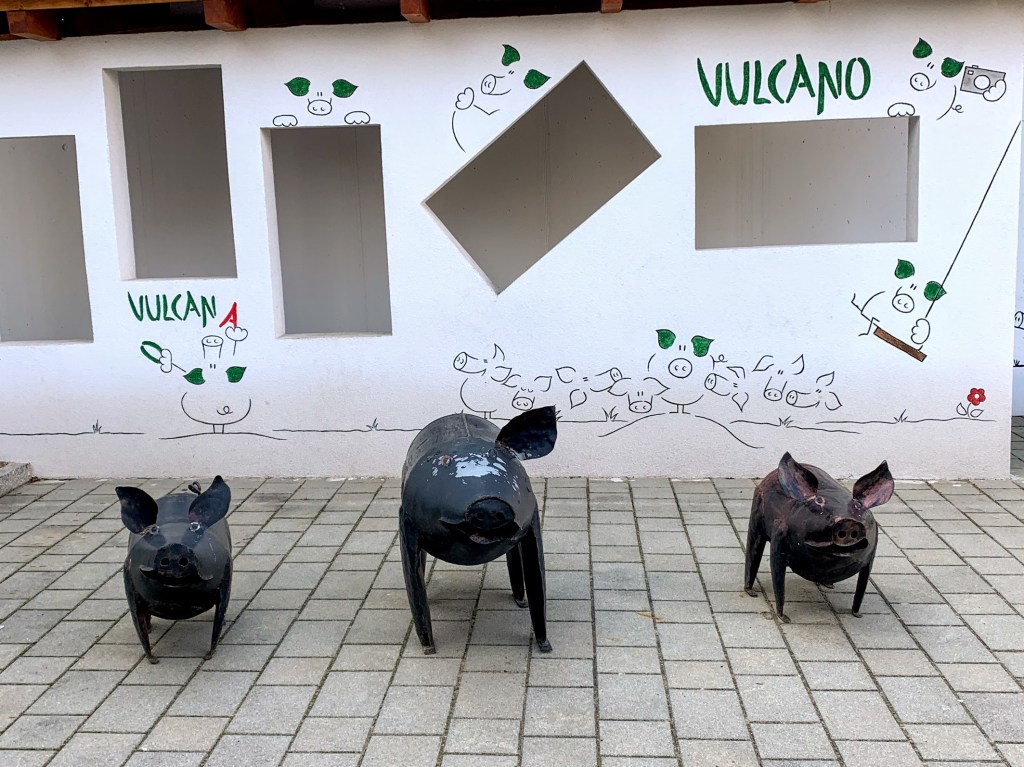
After eating ourselves sick with yummy chocolate, we had a nice simple lunch and then spent the afternoon at Vulcano Hams, a local family run business. We took the tour about the history of  ham production in Austria and at the end they gave us free samples of the various ham and pork items made at the facility.

Vulcano Hams