Paris Day 2: Versialles

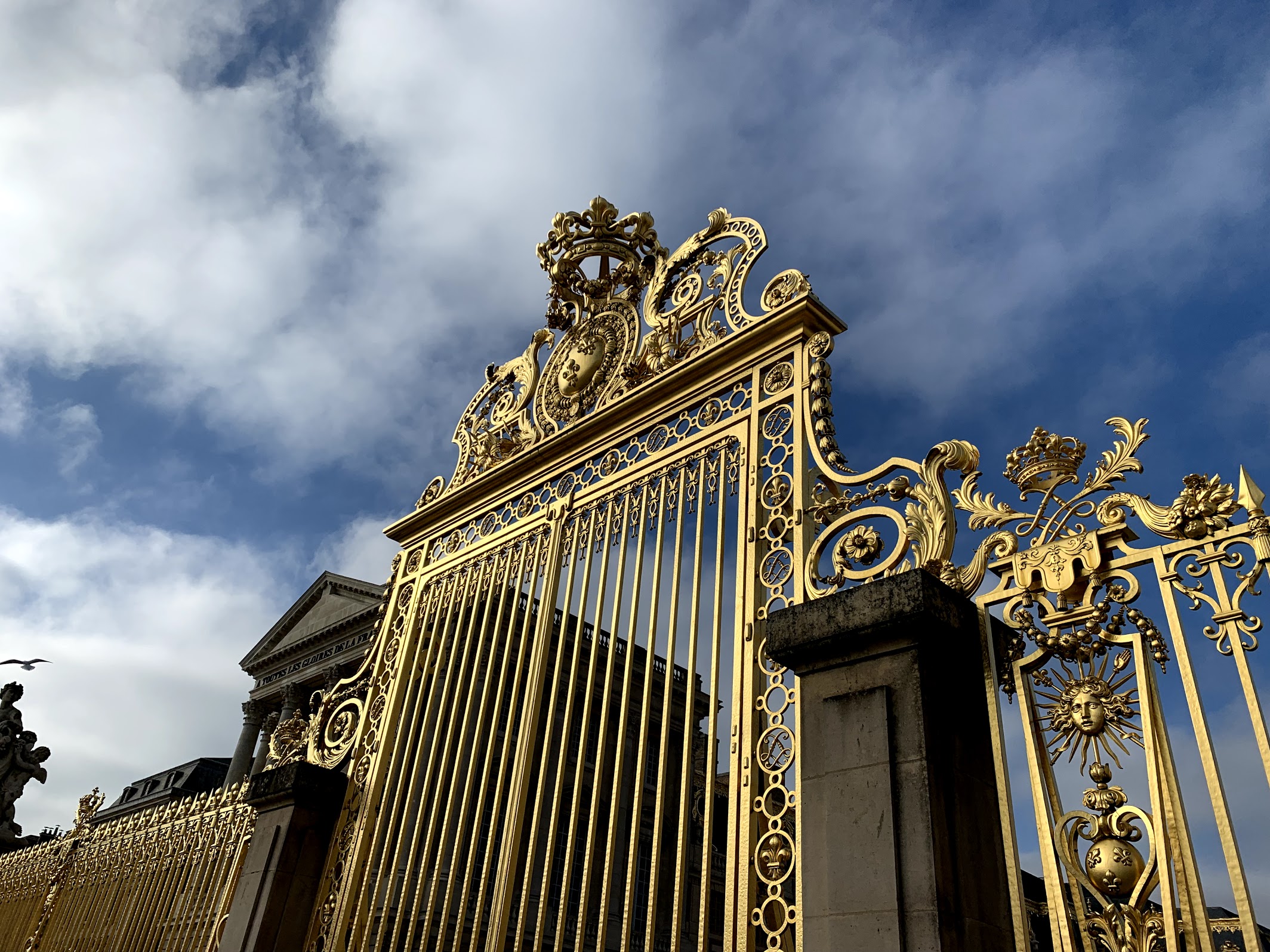
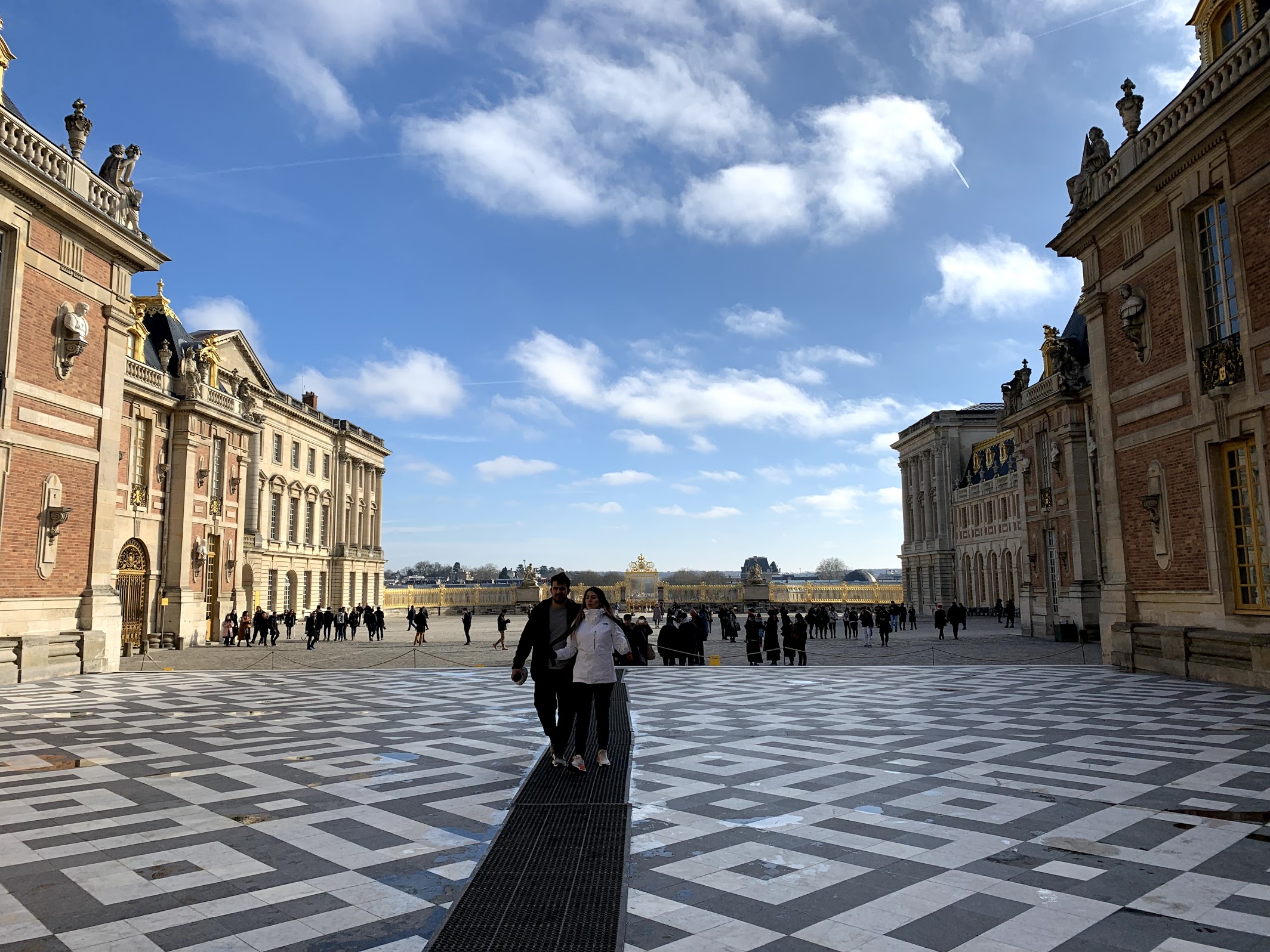
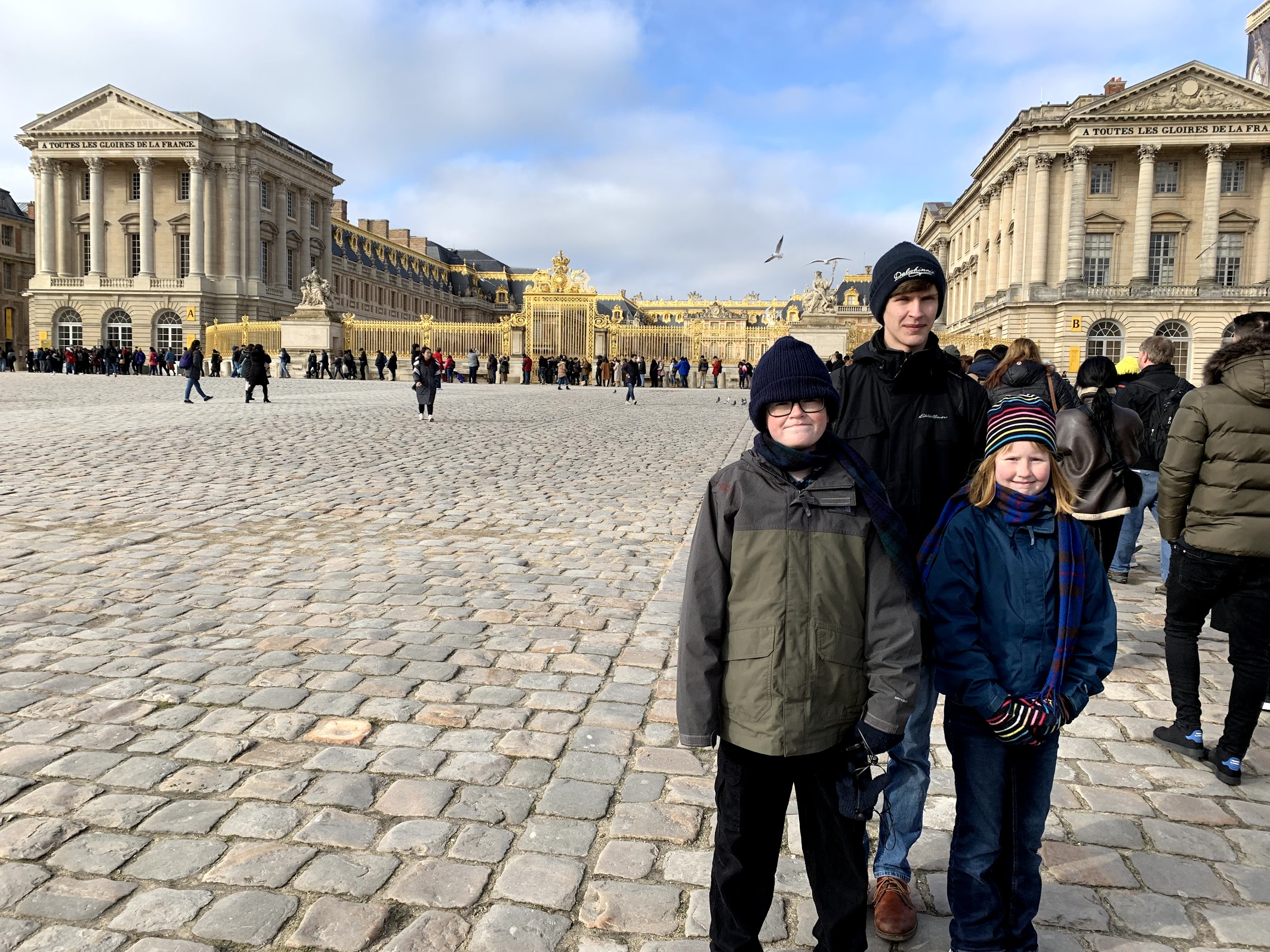
A quick jaunt down the street and we boarded our first double decker metro train, which took us out to Versailles. Located about 20 miles southwest of Paris, it took us about an hour to reach our destination. We enjoyed seeing all of the Parisian suburbs and little villages outside of town every time we stopped. Once we arrived at the town of Versailles we walked down the main double boulevard up to the gates of Chateau Versailles. It wasn’t hard to miss with its stunning golden gates and large black and white marble square. The palace itself is three sided with the most opulent building in the middle.
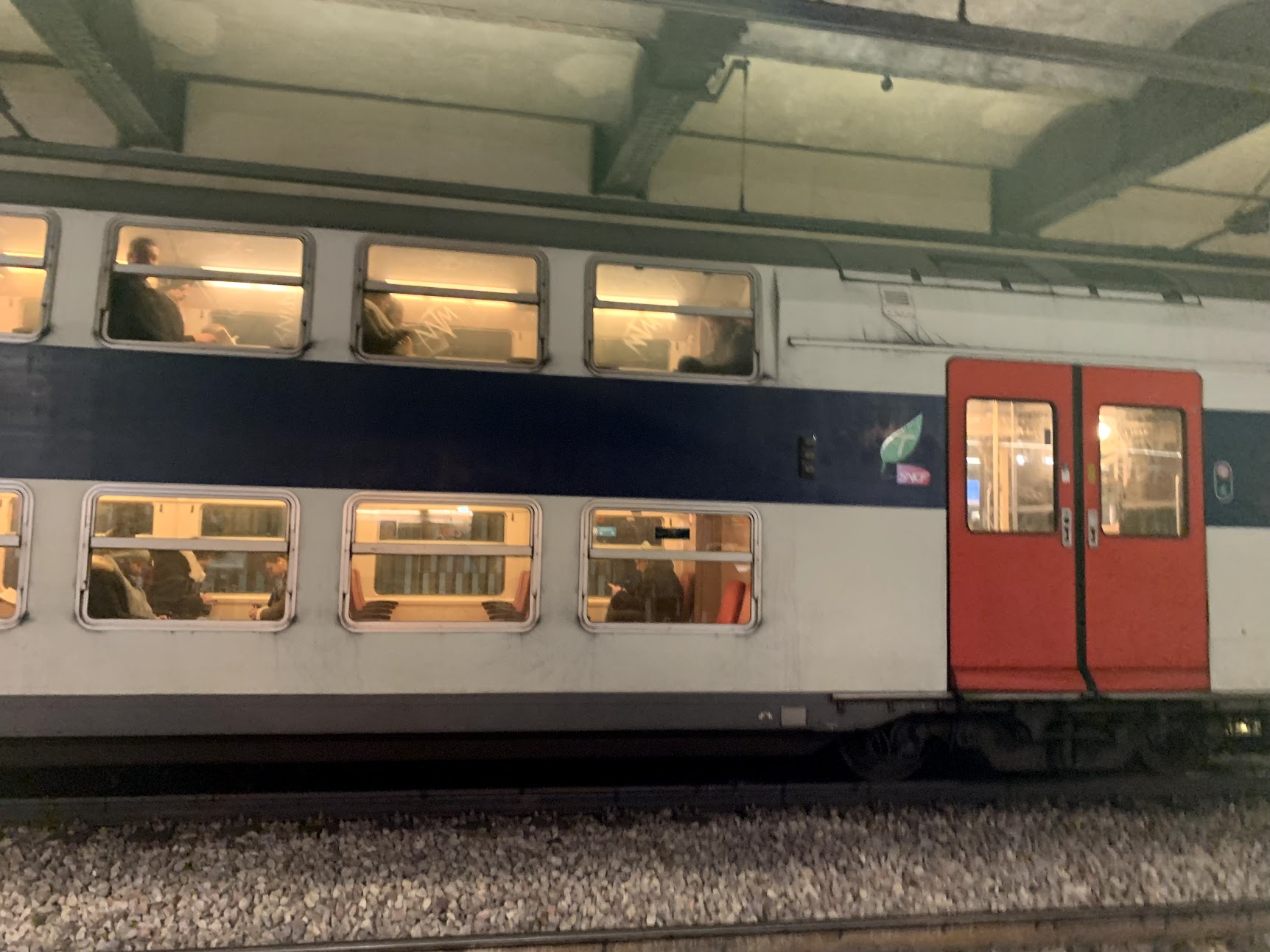
Double decker train that travels underground and above ground!
Chateau Versailles in France
The famous golden gate of Chateau Versailles
Looking back across the front courtyard. I’m standing in the main entrance to the palace.

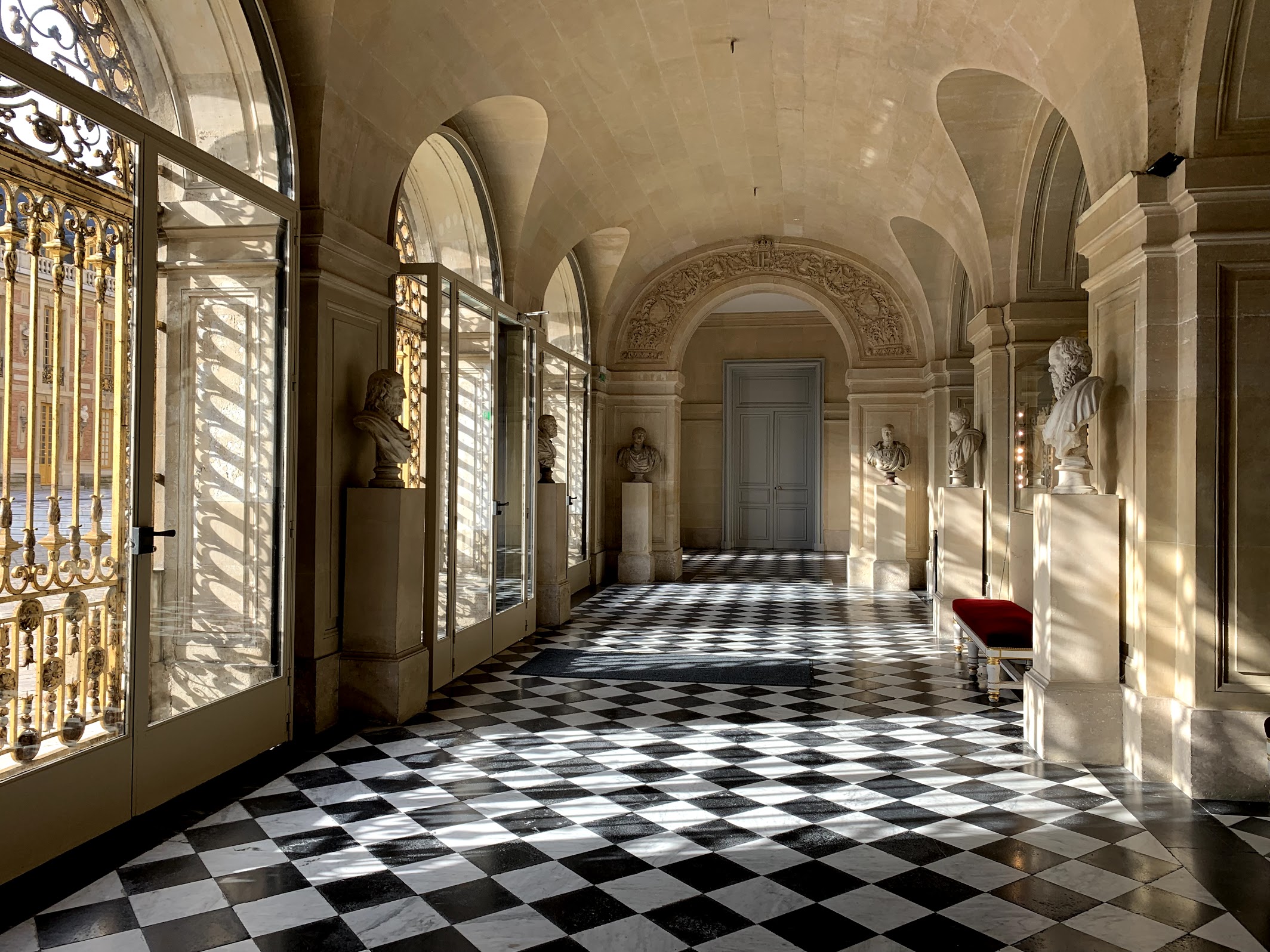
It was a bit busy and we had to wait about 20 minutes for entry into the palace, but it was worth the wait! Once inside our eyes were met with elegant marble columns and a long open hall with large doors that brought in the light from the gardens beyond. This was the least decorated part of the palace. Then it was time to put on our anti glitter goggles and head into the royal apartments!

We stepped first into the apartments of the daughters of King Louis XIV the Sun King! Louis XIV built Chateau Versailles starting in 1682 and it was completed (including the gardens) 40 years later. It started off as his favorite hunting lodge, a place to get away from the busy life and lights of Paris. Louis commissioned the first middle palace and later added on the two wings for family and courtiers. He often held elaborate masquerades in the square behind the glittering gold gates!
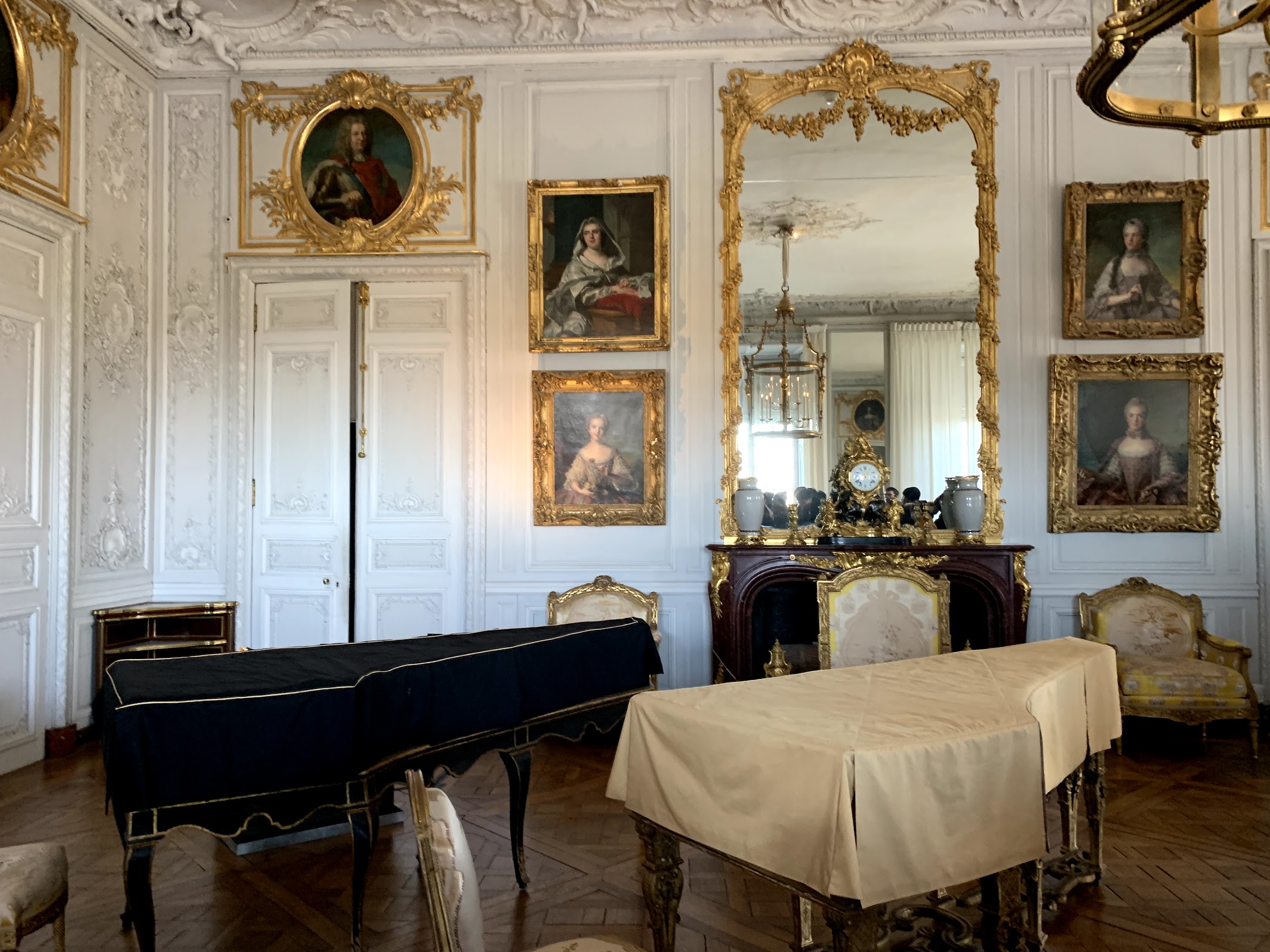
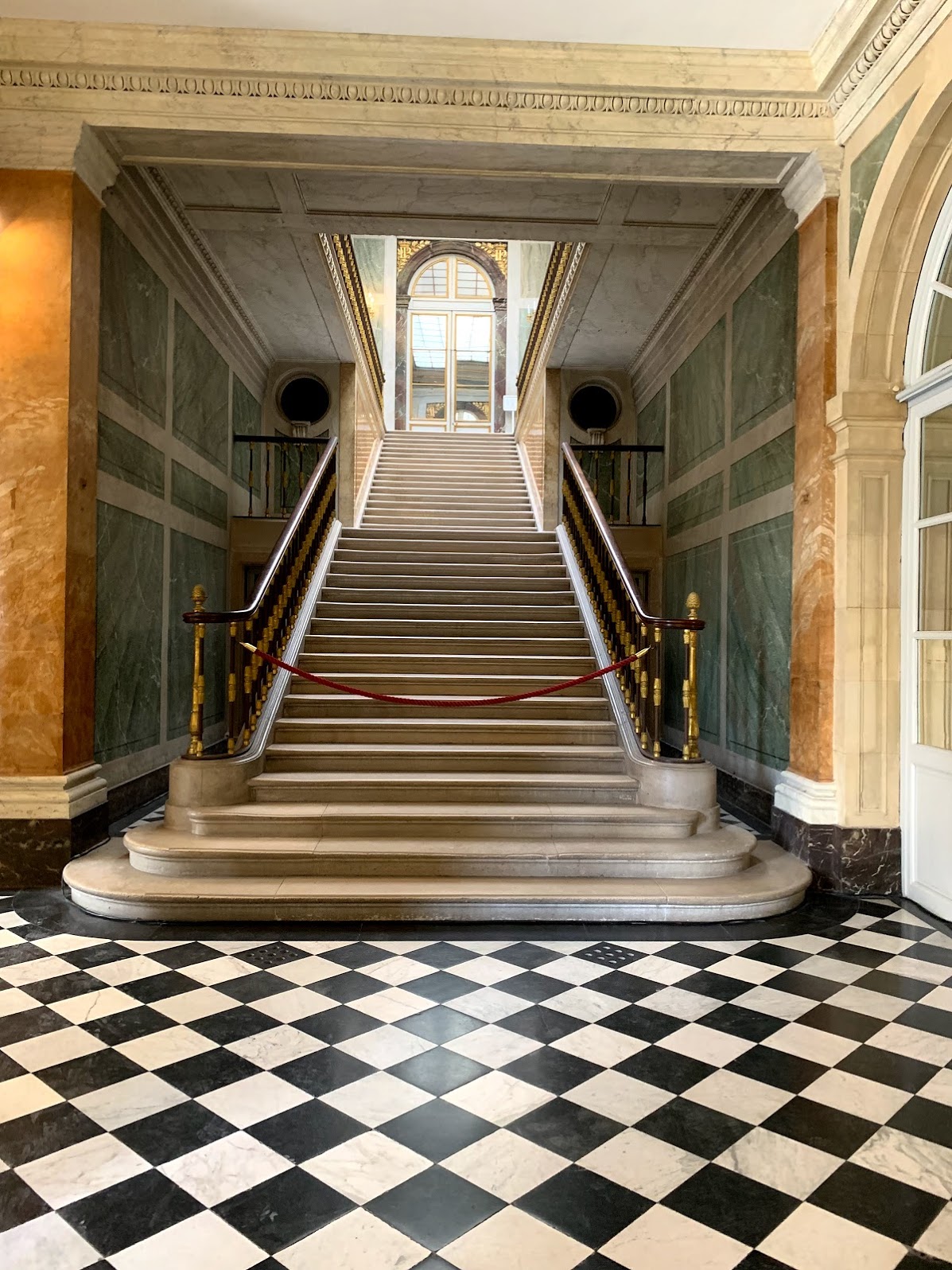
Music room in the daughters’ apartments. All of Louis daughters were accomplished musicians.
Staircase at the end of the daughters’ apartments
Rounded the corner from the grand staircase above and saw the light streaming into this little corner of the palace.
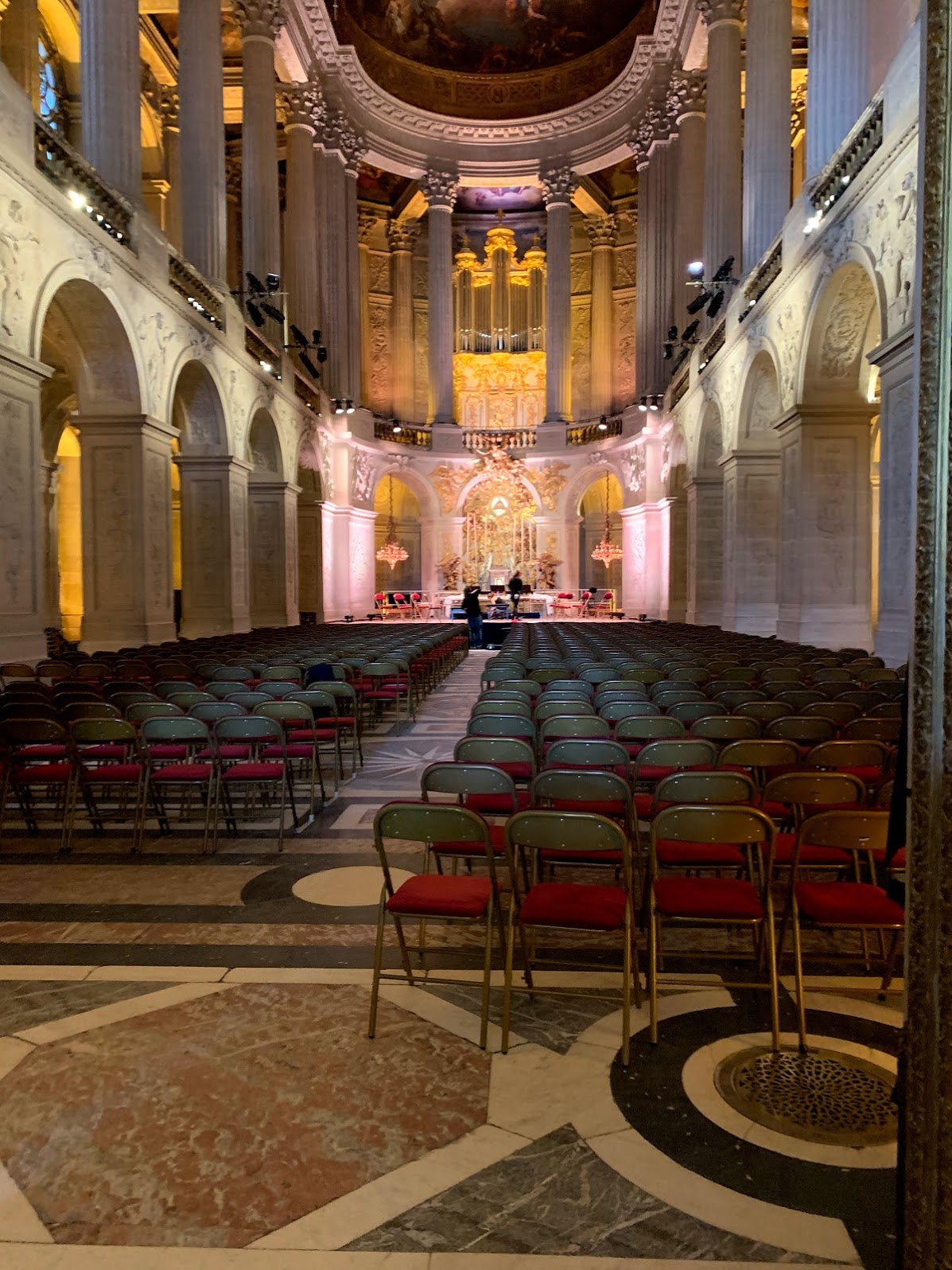
The Chapel:
They were setting up for a concert later that evening.

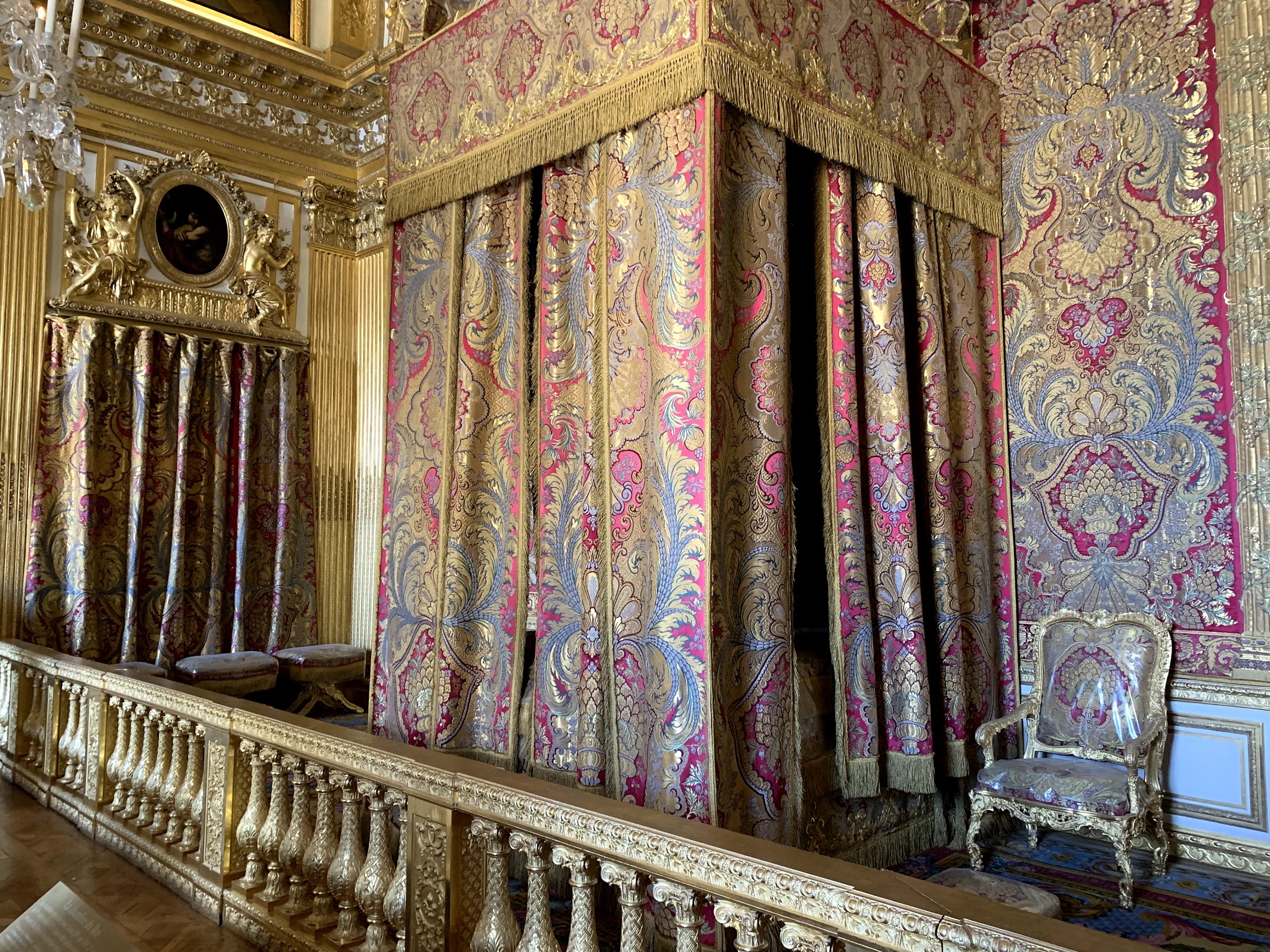
The opulence of his daughters’ apartments was breathtaking, but came nowhere near the gilded glory and voluptuous velvets that met our eyes in the King and Queen’s own private apartments. It was customary at the time that as one progressed down the hallway each room in the apartment became more and more grand and also private too. By the time we reached the King’s private bedroom not one inch of the wall was left plain. Paintings on the ceiling and walls, gold carved trim, grand mirrors, and fine tapestries made the room overwhelmingly beautiful! It was almost too much to take in at one viewing!
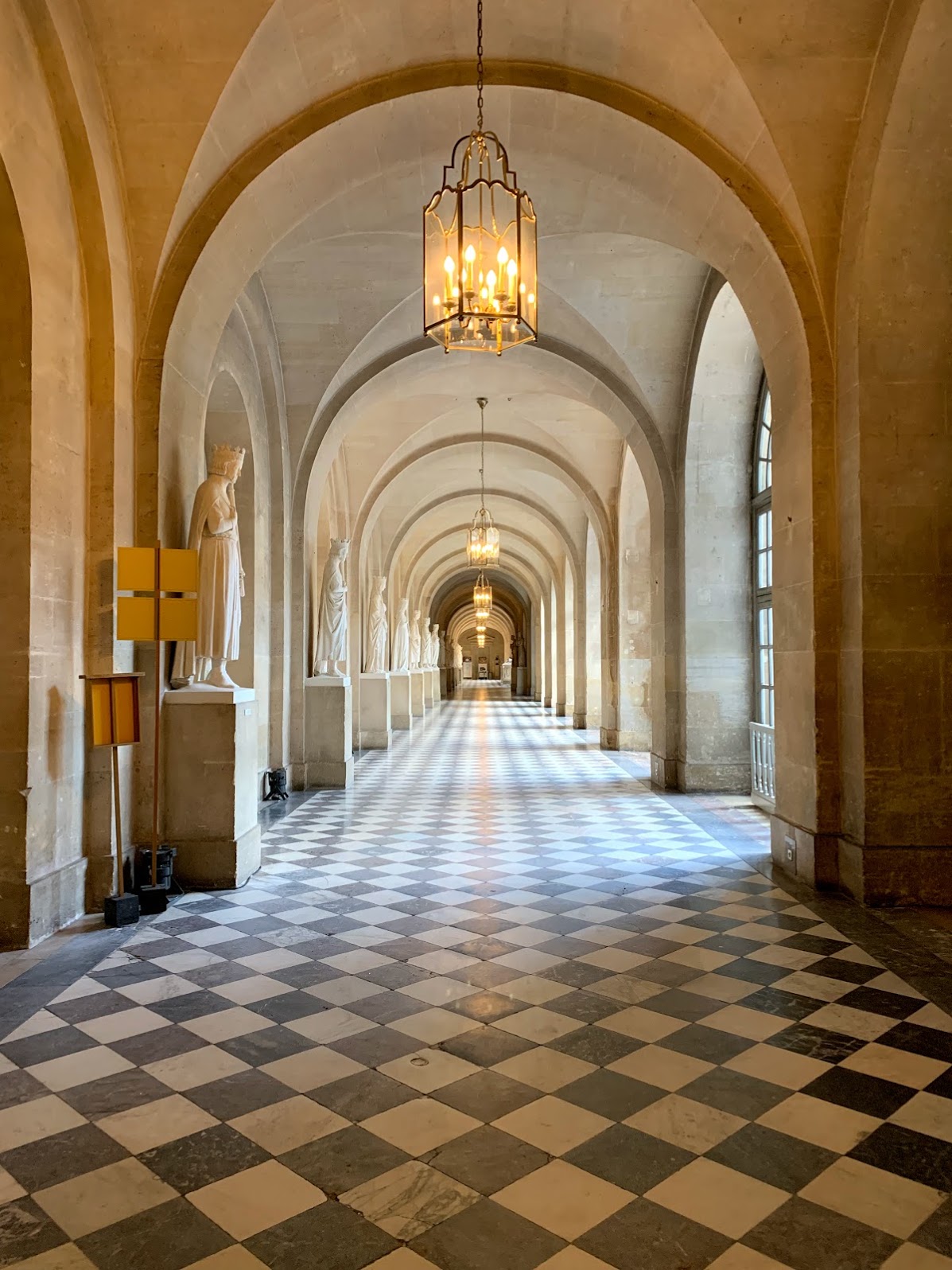
Corridor of marble statues
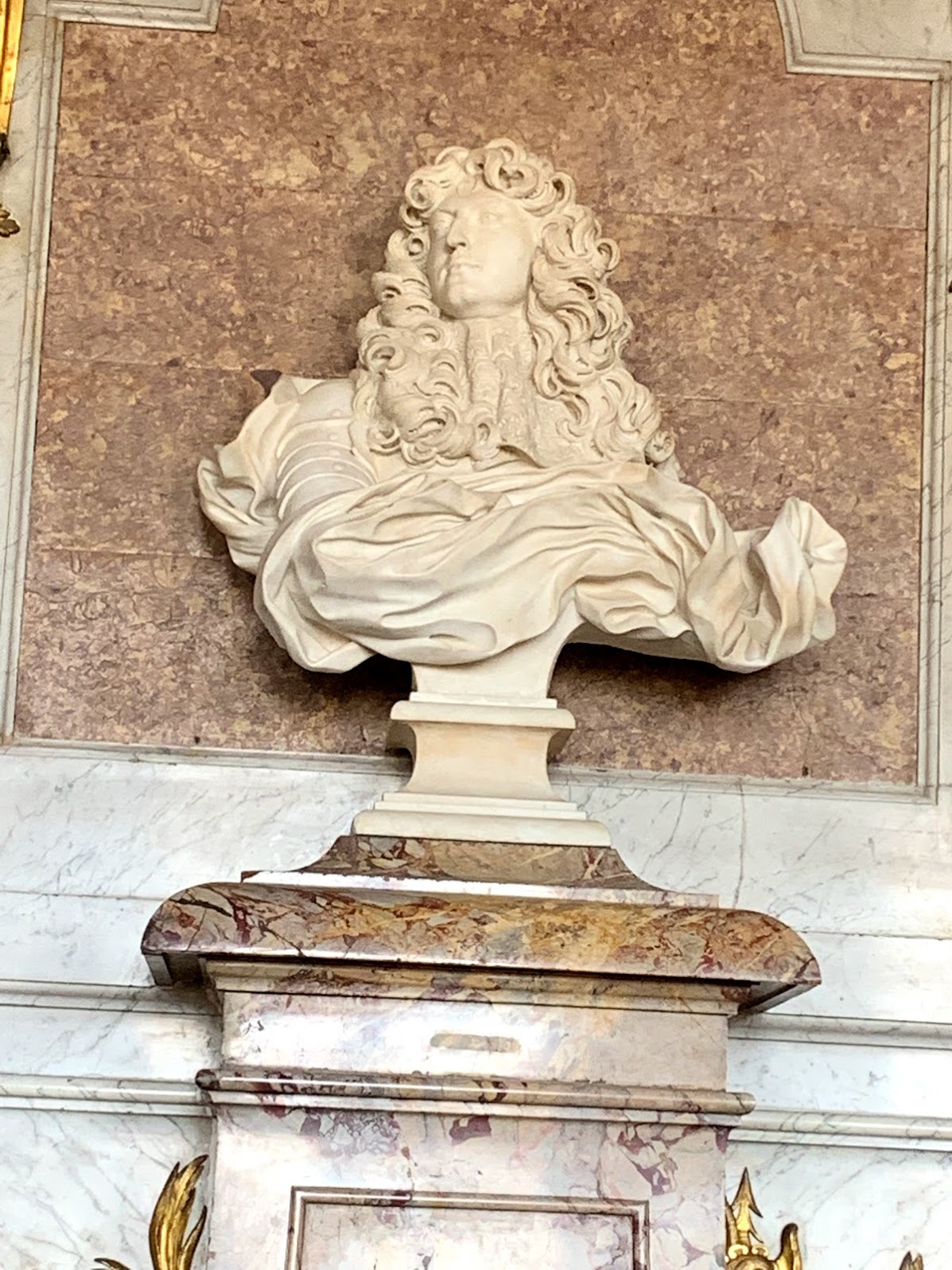
King Louis XIV ca 1680’s
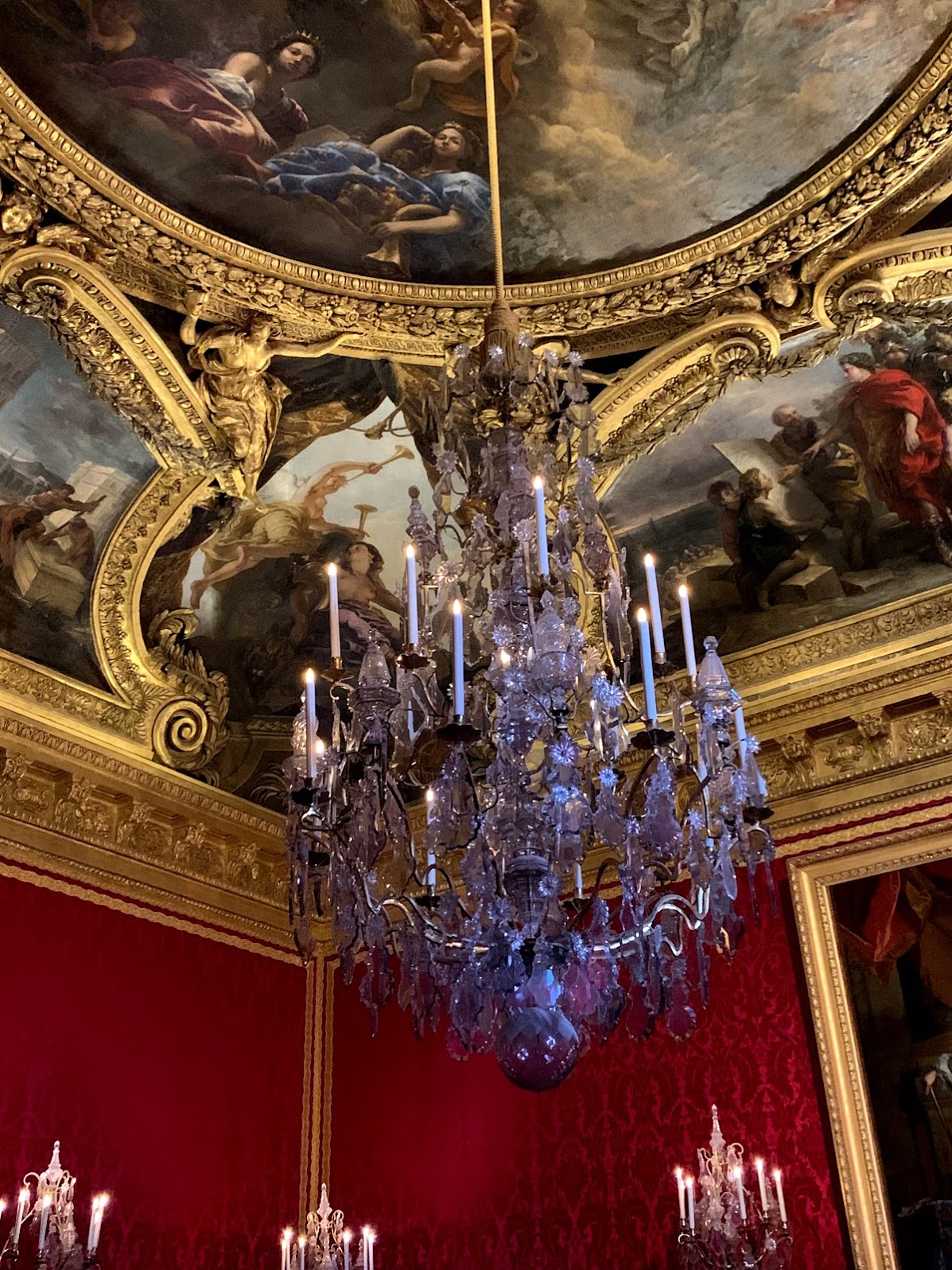
Chandelier in the red velvet throne room
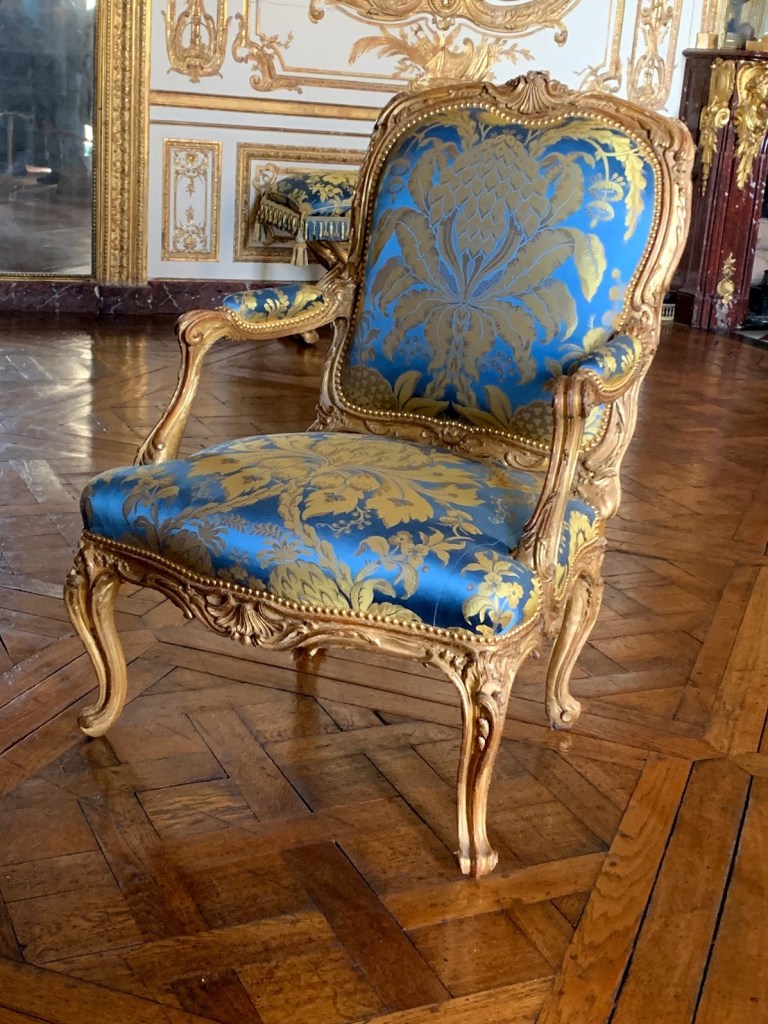
I love this beautiful blue chair!
Private bedroom of King Louis XIV the Sun King

Believe it or not we were in for a further shock to our optical sensors. After a quick pass through another tame looking black and white marble antechamber we went into the famous Versailles Hall of Mirrors! This long salon is where Louis “shined” as the Sun King. 17 gold and fine glass floor length mirrors stood opposite 17 corresponding windows. Massive candlelit chandeliers hung up and down the 25+ foot tall salon where Louis hosted banquets and balls!
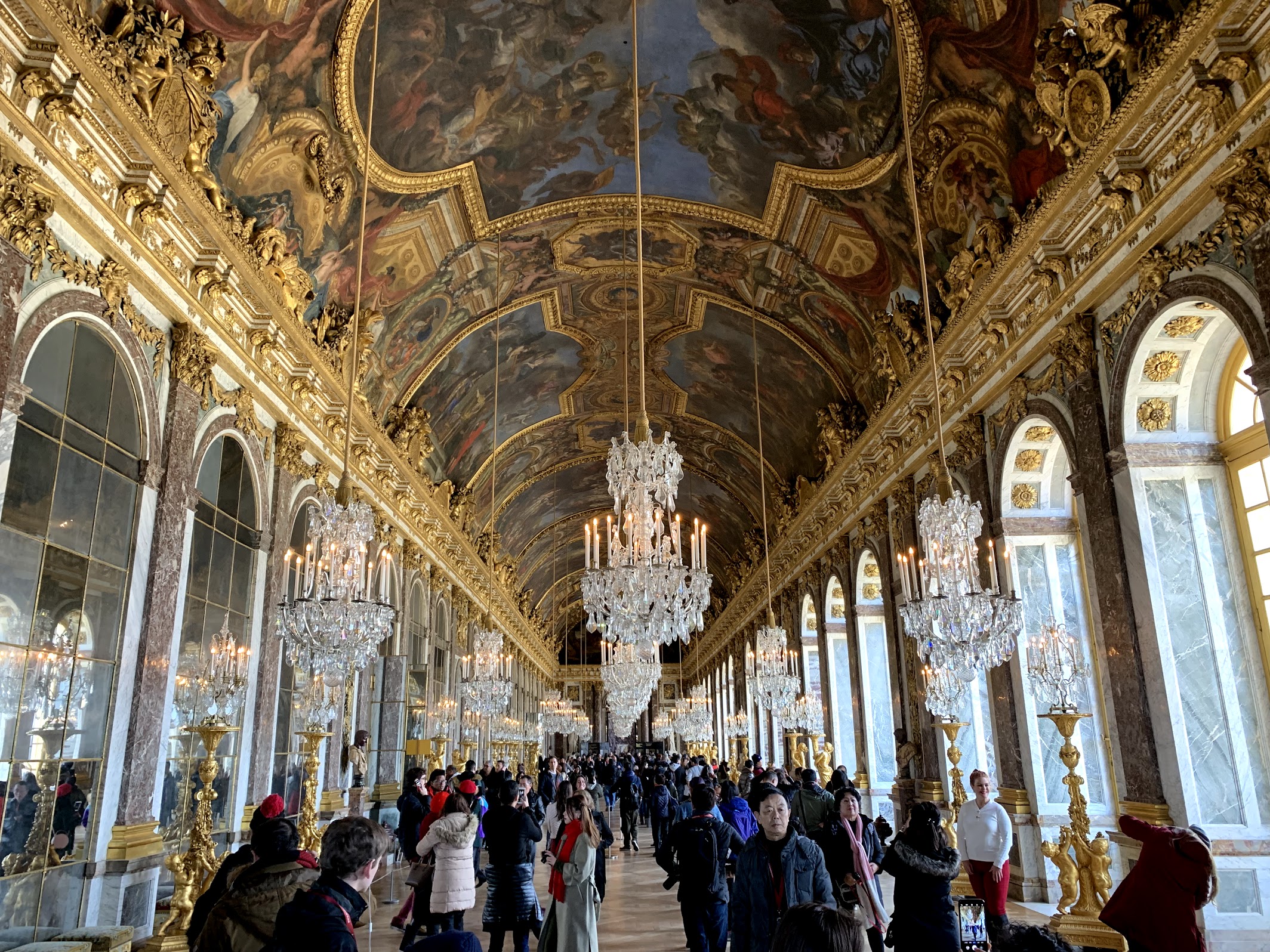
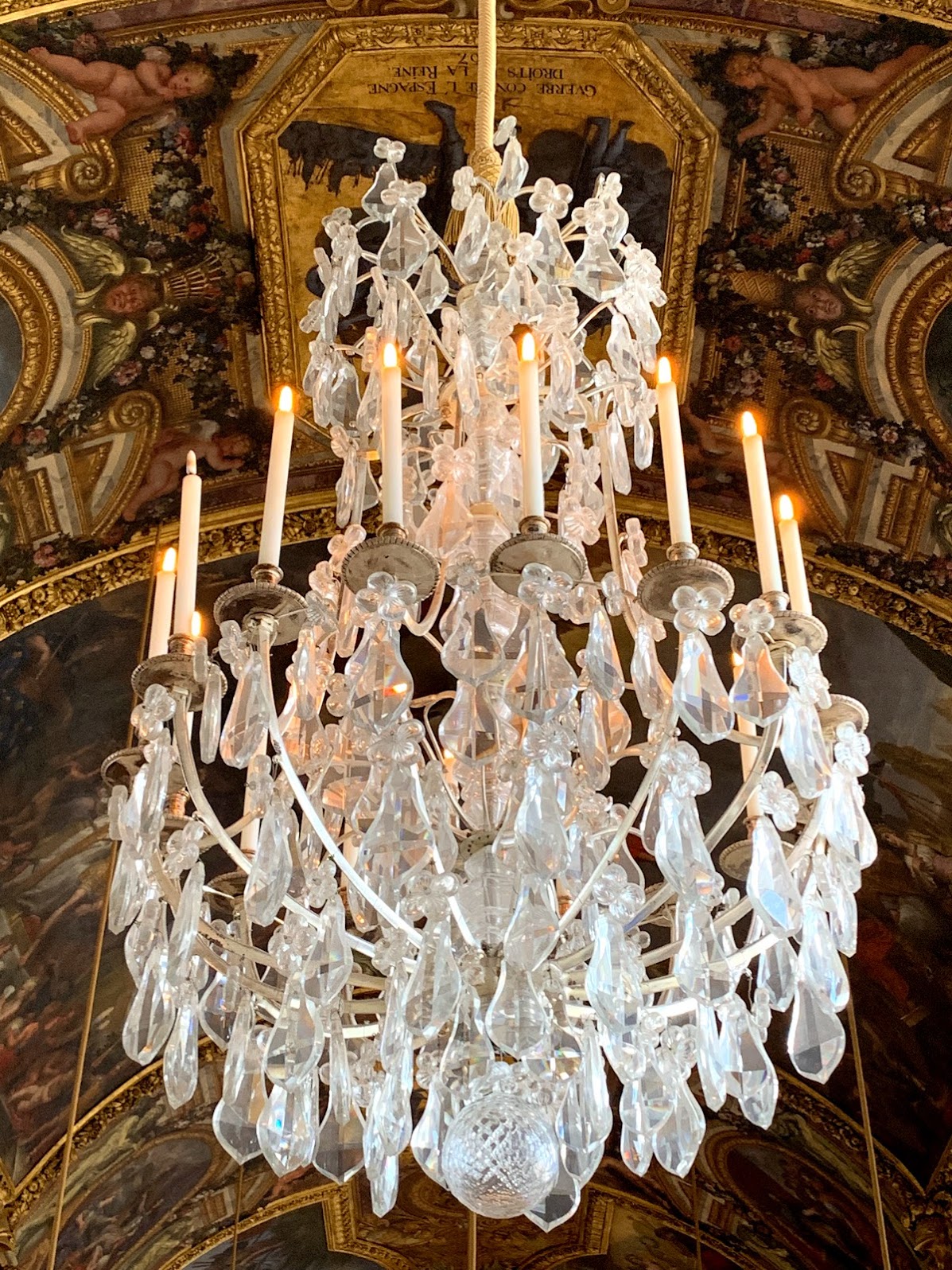
Hall of Mirrors
My favorite chandelier at Versailles. It was in the Hall of Mirrors.
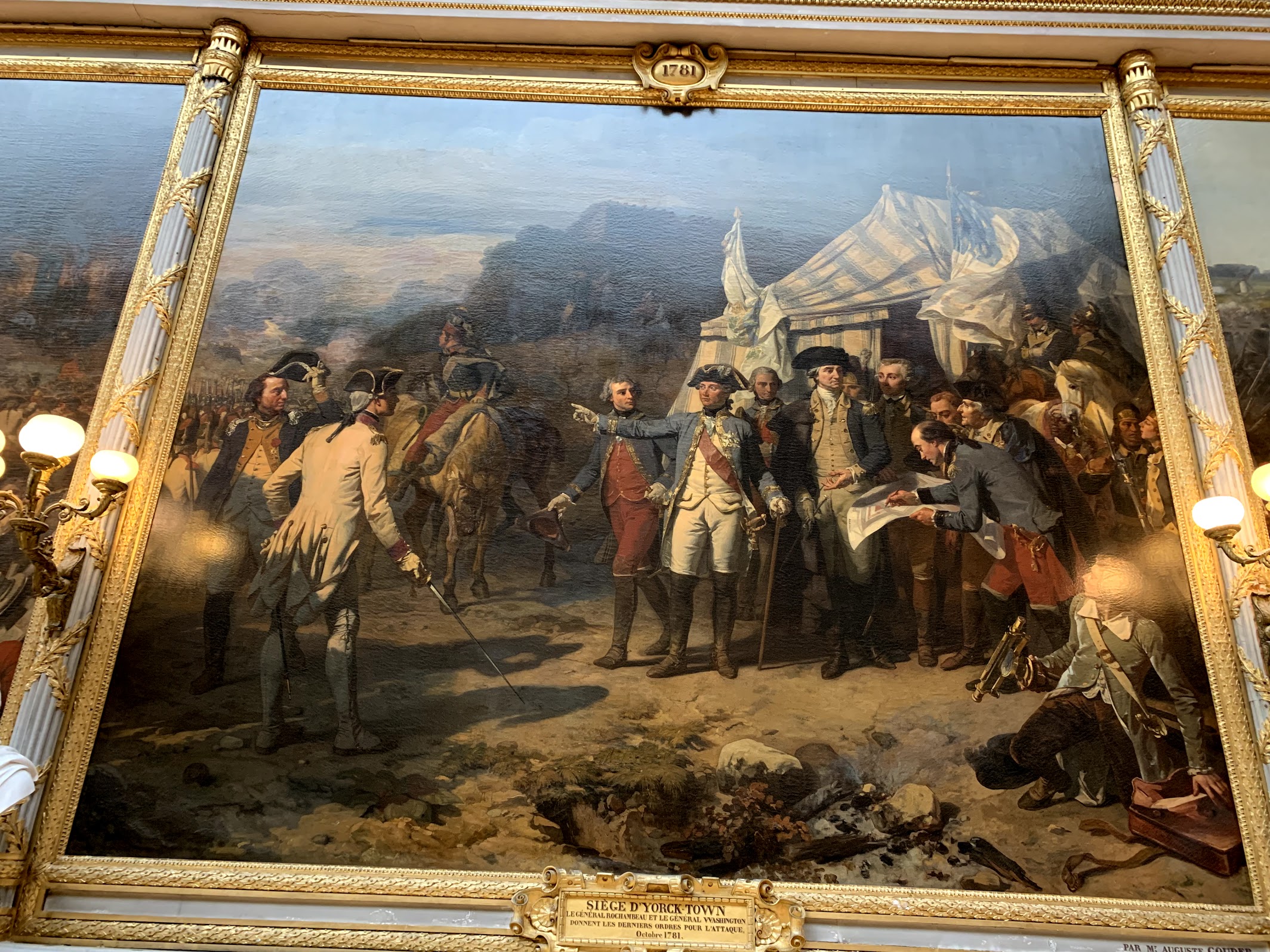
What is this? George Washington at Versailles? Yes, this is the famous portrait of the Battle of Yorktown. The French supported the Colonies during the Revolutionary War.

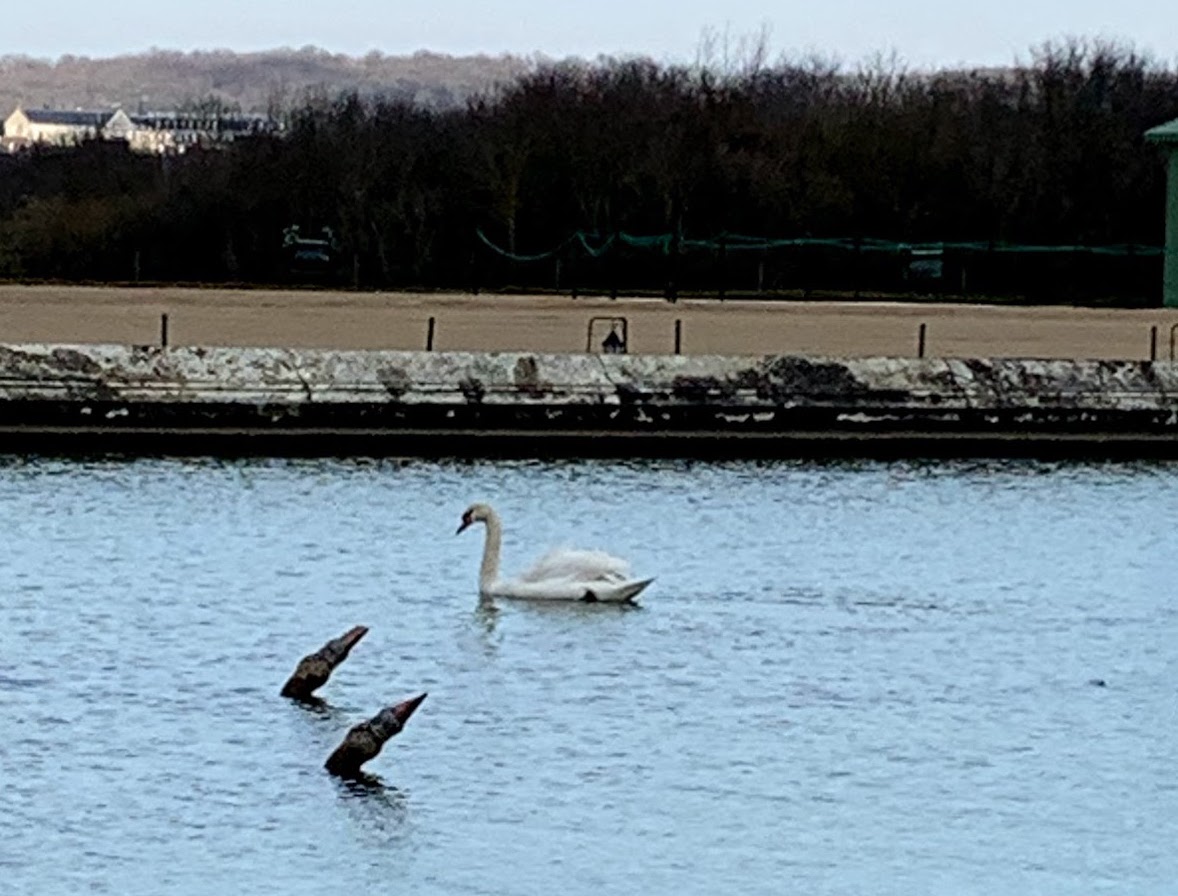
In the gardens our eyes had a chance to readjust to “non-blingy” spaces. The gardens though not in bloom were still lovely to walk around in because you could see the formal hedges with reflecting pools. Even a lovely white swan glided past as we gazed out onto the shallow oblong pool where the ornamental evergreen shrubs softened the gravel paths and the stone carvings.
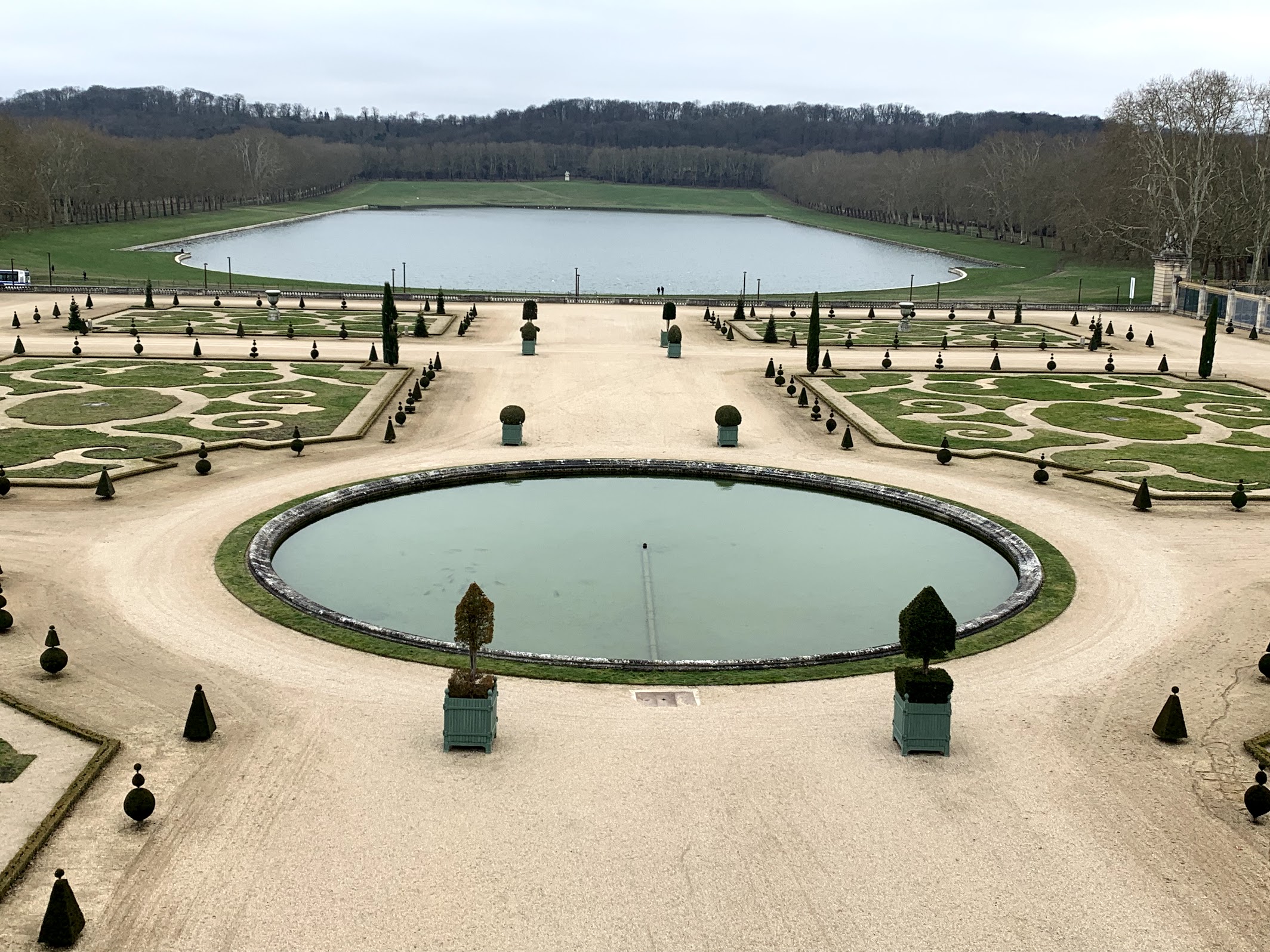
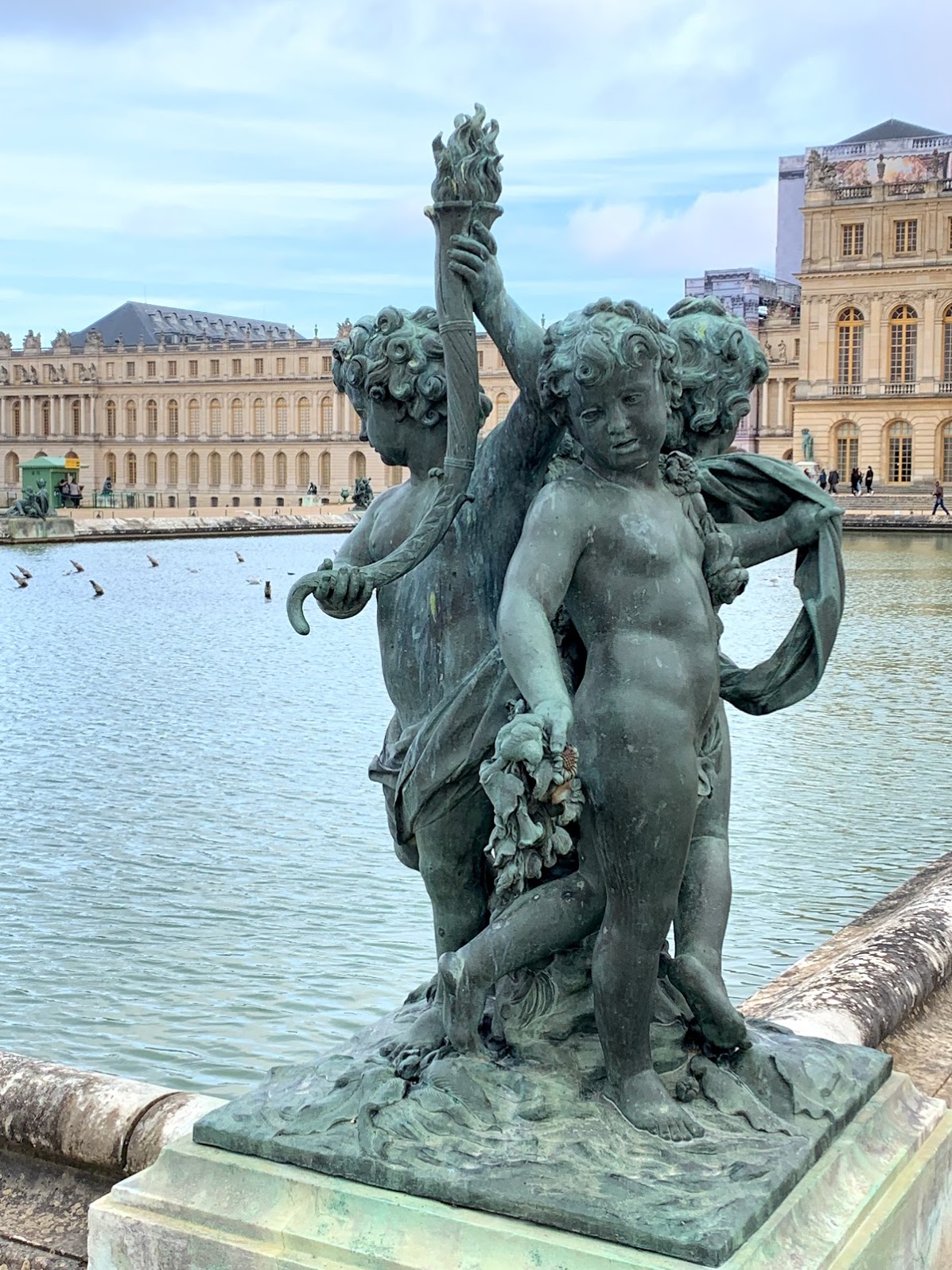
Gardens at Chateau Versailles

Statue in the garden

Swan swimming by two fountain spray jets at Versailles

Lulled into a restful nap by the commuter train back to Paris we all dreamed of gold and silver, velvet and fine linens harking back to a time when France was at the height of it’s imperial wealth. Within a few generations after Louis XIV’s death France would be rebelling against such opulent wealth, high status, and the monarchy.
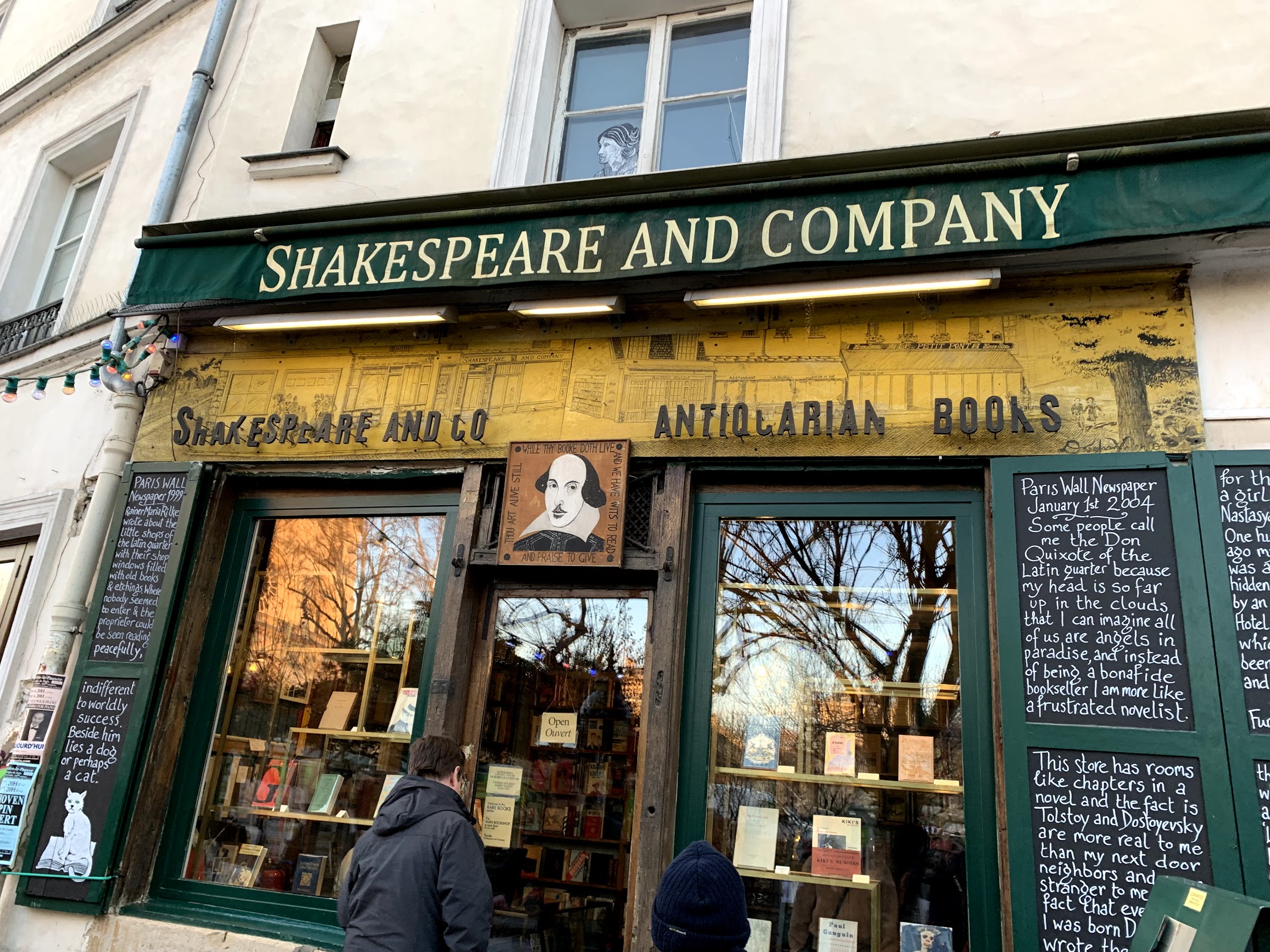
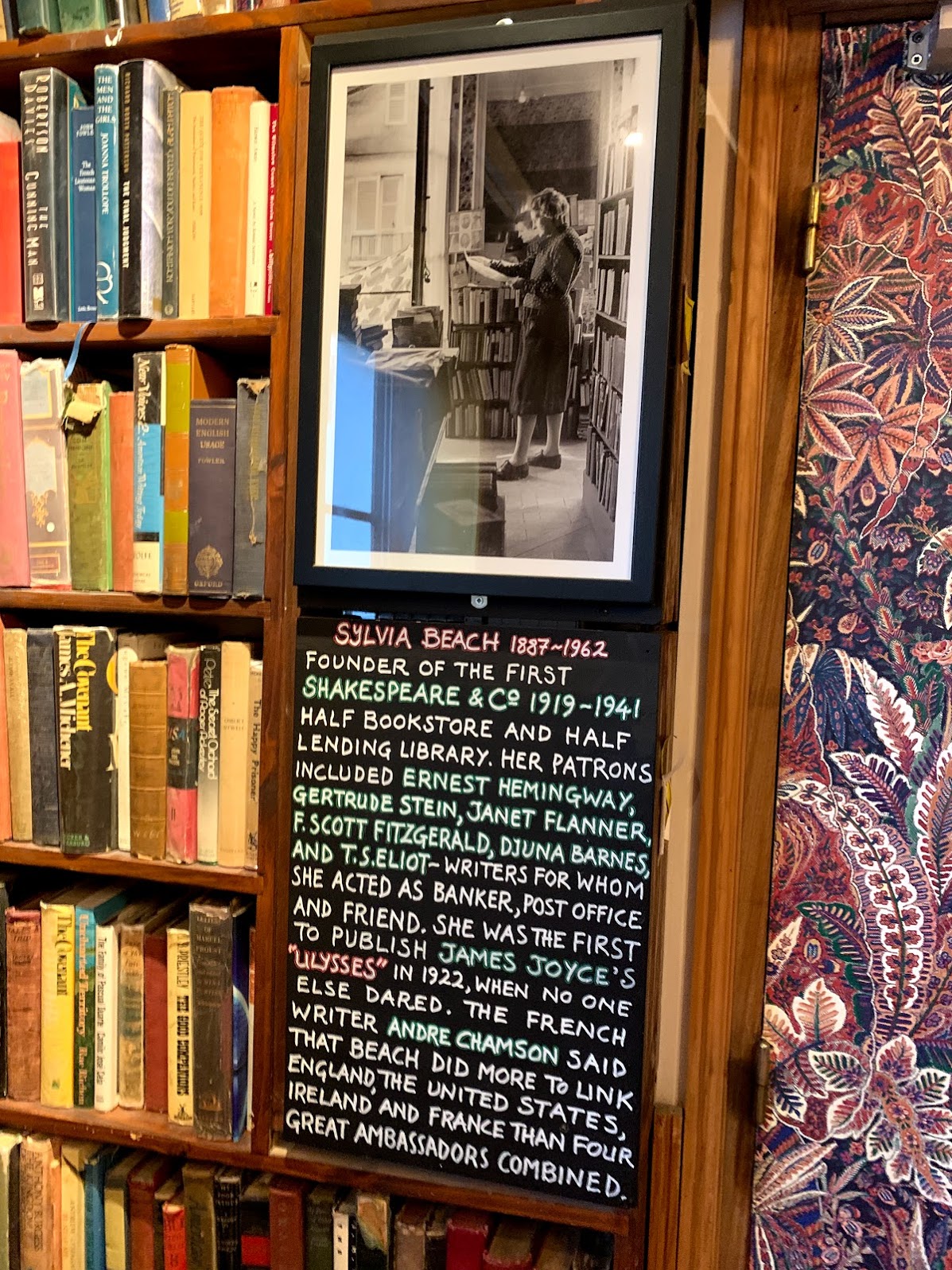
Famous Parisian Bookstore
Sign in the bookstore

Once back in Paris we had a bit of time until the shops closed so we did a little shopping and visited a famous Parisian bookstore. Ironically it is called Shakespeare and Company and is located along the Square of Notre Dame. It was founded by a Mrs. Beach who encouraged such writers as Elliot , Fitzgerald, and Hemmingway to sit in her bookstore and write, inspired by the comings and goings of people, animals, and boats upon the Seine River just outside the bookstore window. Today the bookstore offers large collections of modern and antiques books. I found a lovely little leather bound copy of my favorite Shakespearean play Much Ado About Nothing. It was printed in 1913. Unfortunately Faywen didn’t find a nice old copy of any of her favorite plays, but she enjoyed looking at all the old books on the shelves. We stopped by the local market and grabbed some food for a nice dinner back
Paris Day 1: Our Lady and Saint Louis

I can see the puzzled looks on your faces at the above title! Perhaps the following will clarify the title. So grab some good cheese and a baguette and I’ll unfold today’s adventures in Paris!

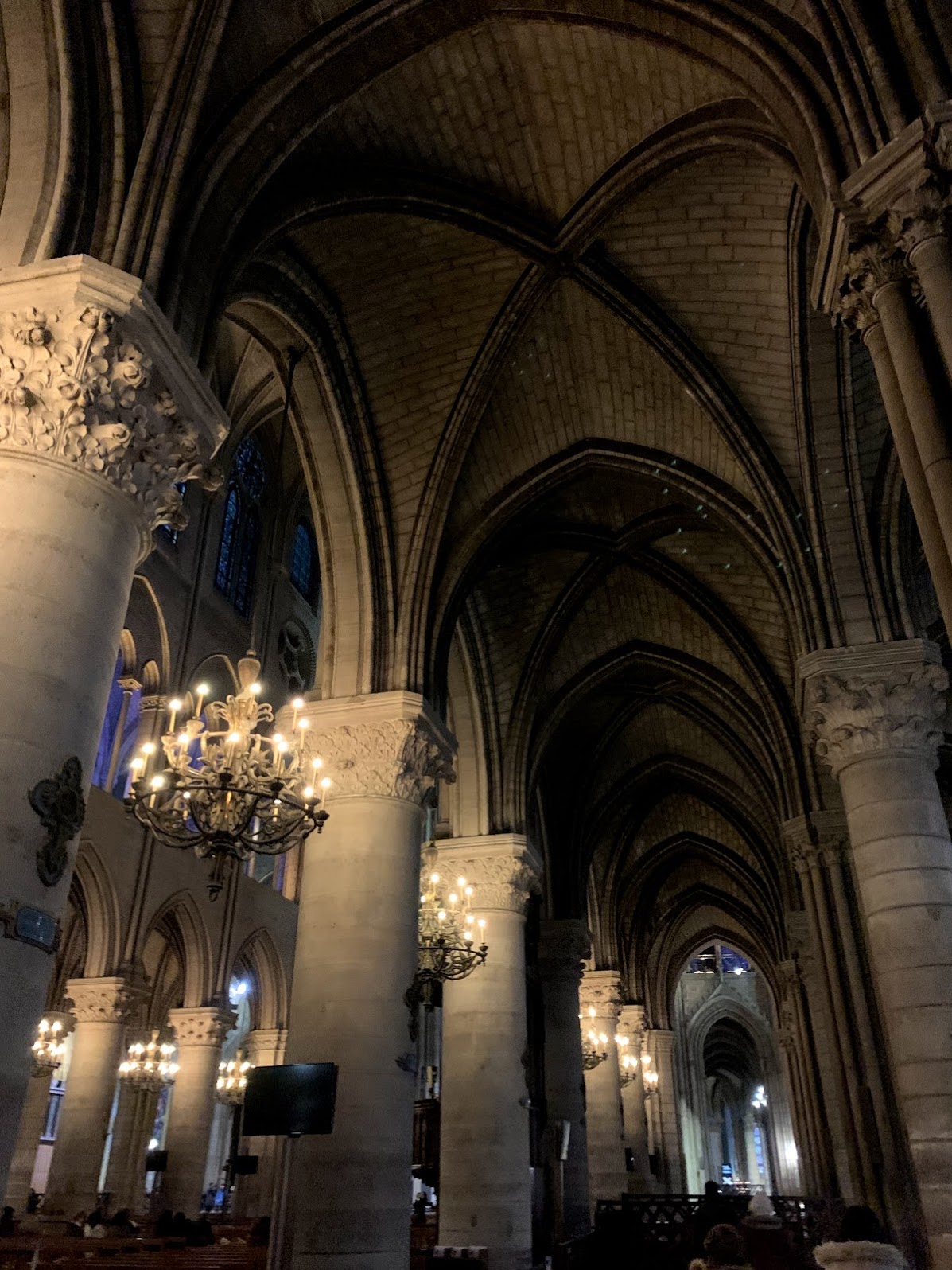
First there are no longer heavy English breakfasts to fill our bellies. We are on the continent now and that means bread, yogurt, cheese, butter, and jams for breakfast. Of course there’s always room for coffee, tea, and juice! Though cloudy and cold in Paris today our spirits were high as we walked yet again the seven minutes up to Notre Dame. We entered this iconic cathedral and had to adjust our eyes to the low lighting. It was a cathedral primarily lit by the sunlight streaming through the stain glass windows and by candles burning in the various chapels of prayer. The interior was made of dark stone and wood, but sumptuous! Photos were allowed everywhere but in the choir and high altar area of the cathedral.

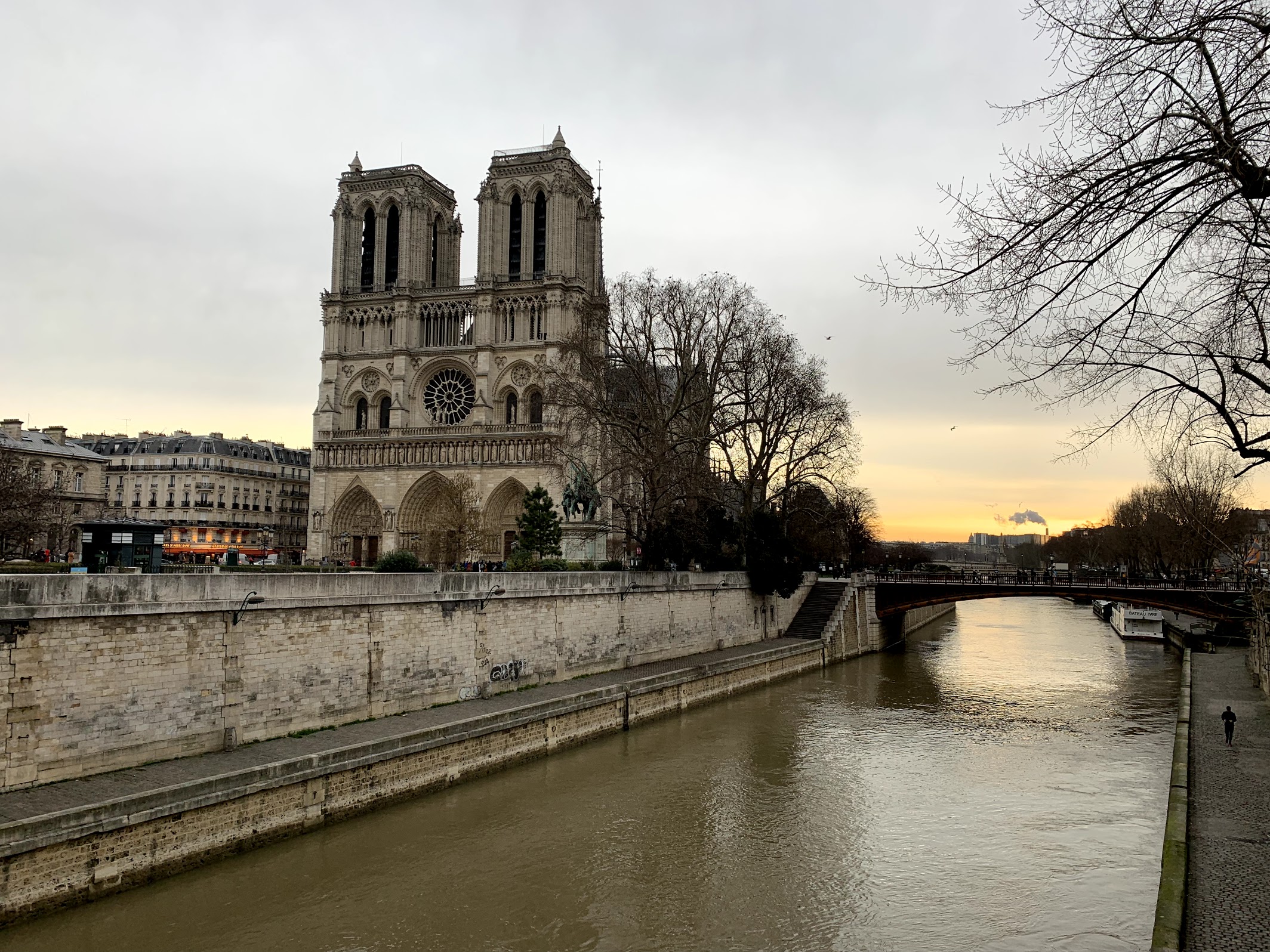
Notre Dame, Paris, France
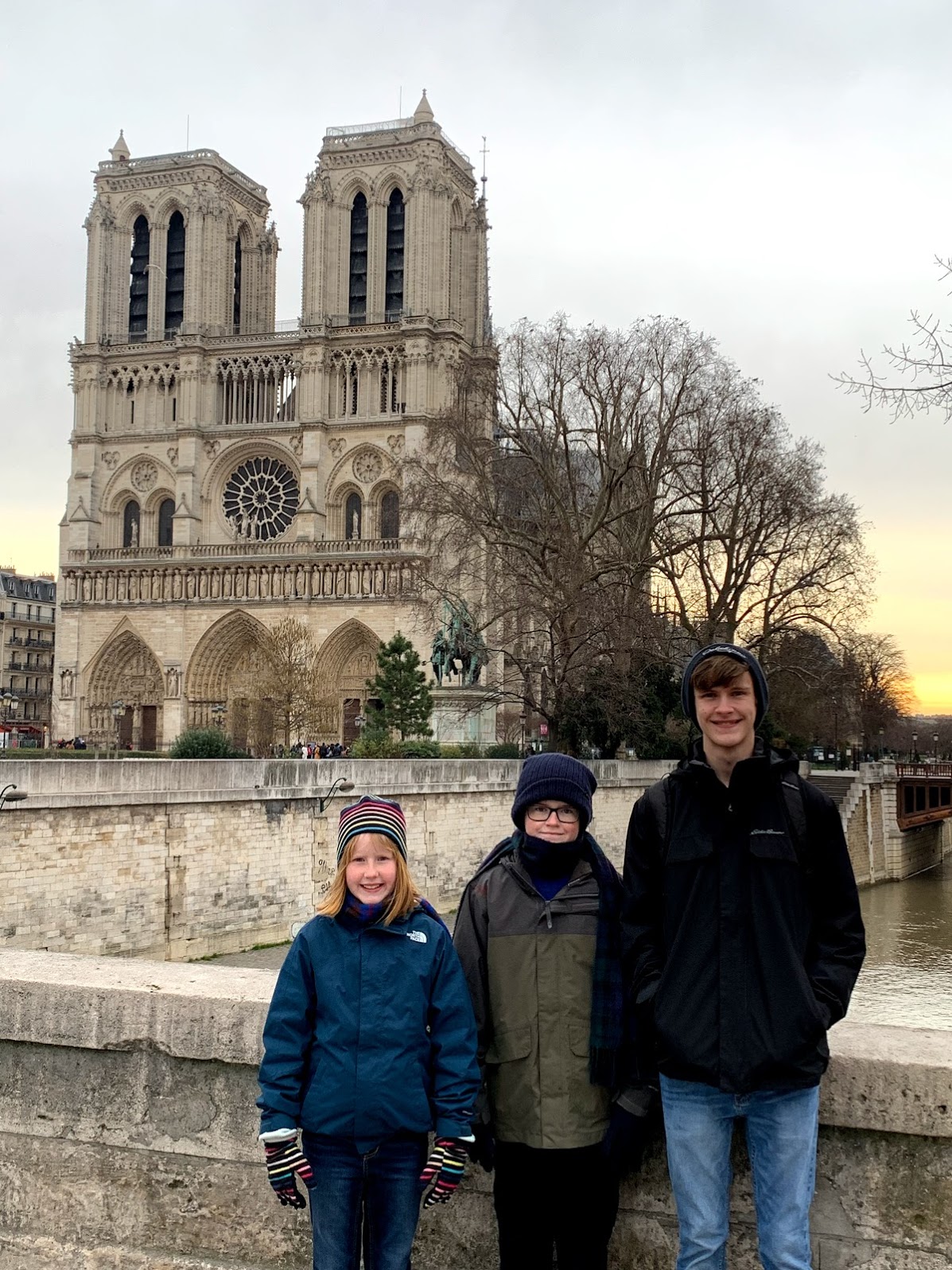
Standing on a bridge over the Seine River in front of Notre Dame
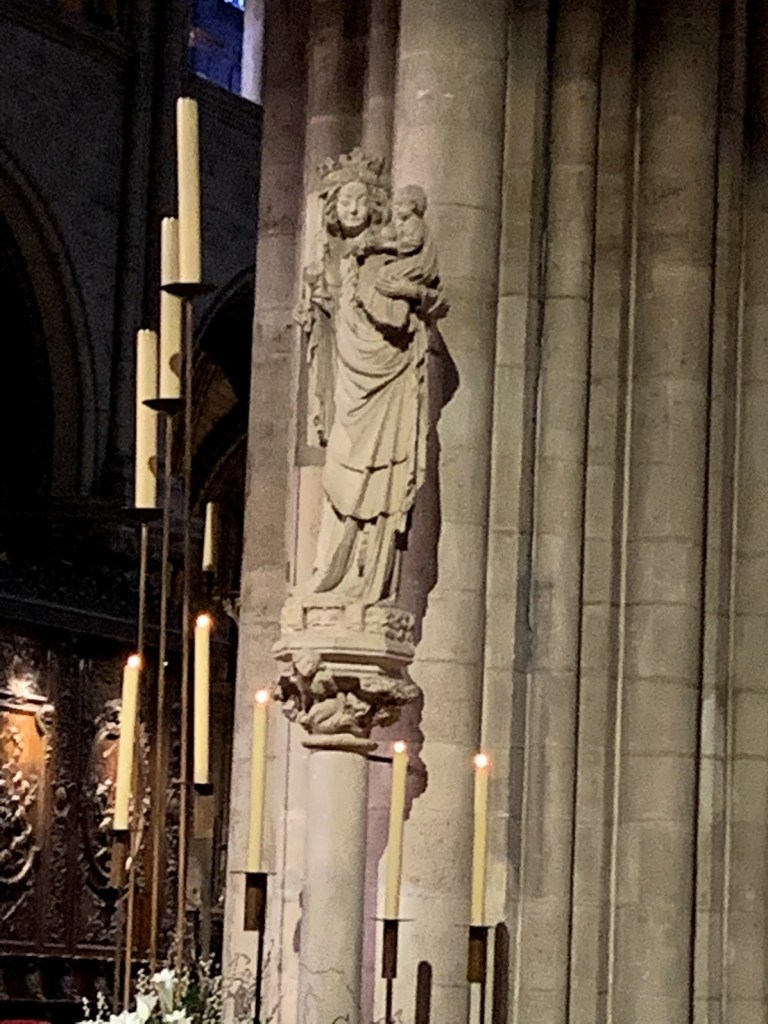
Madonna and Child (Mary and Jesus) on the side of the High Altar
Notre Dame means “Our Lady” in reference to Mary

Inside Notre Dame
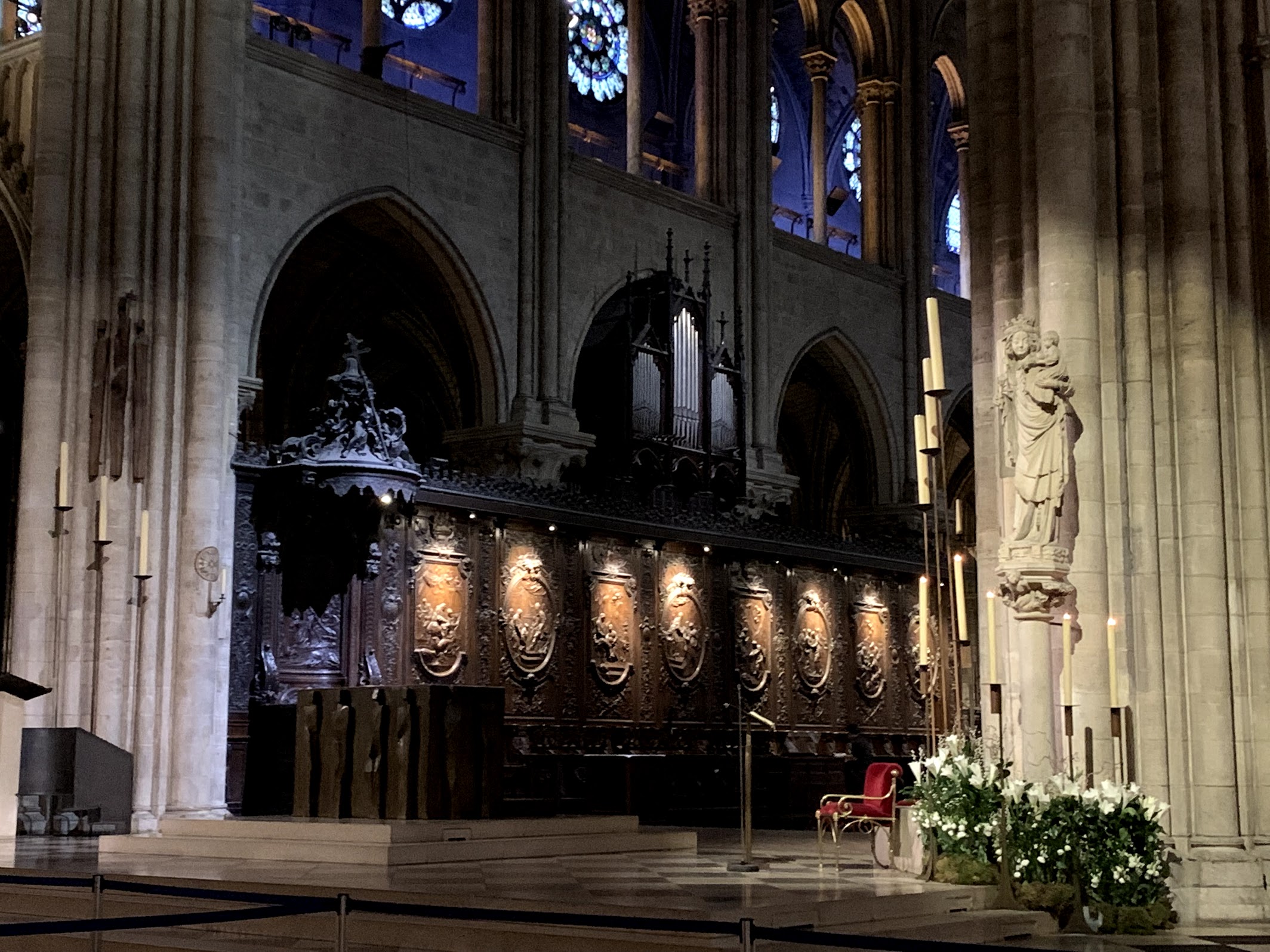
A glimpse of the choir stalls with the “Our Lady” statue

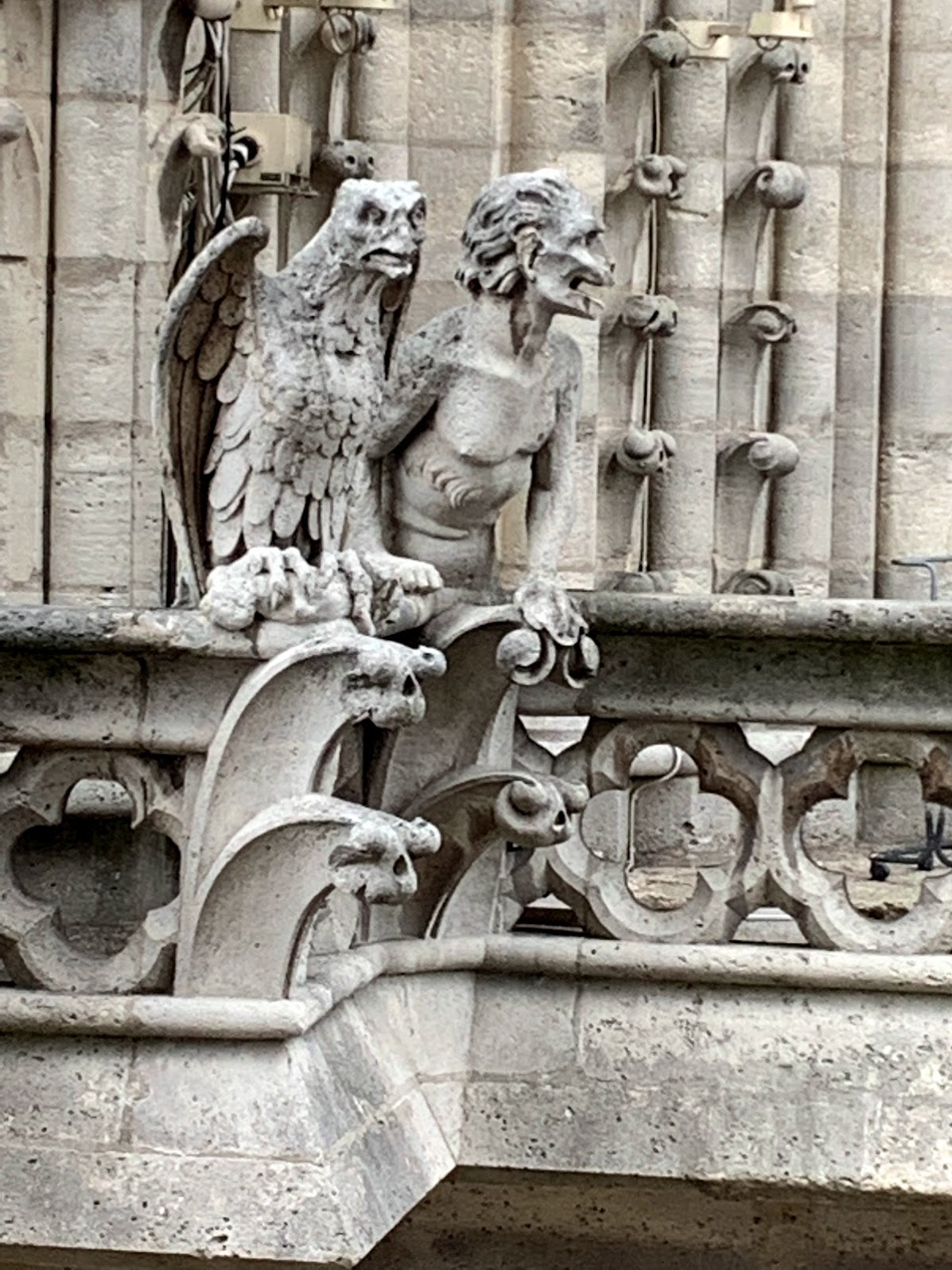
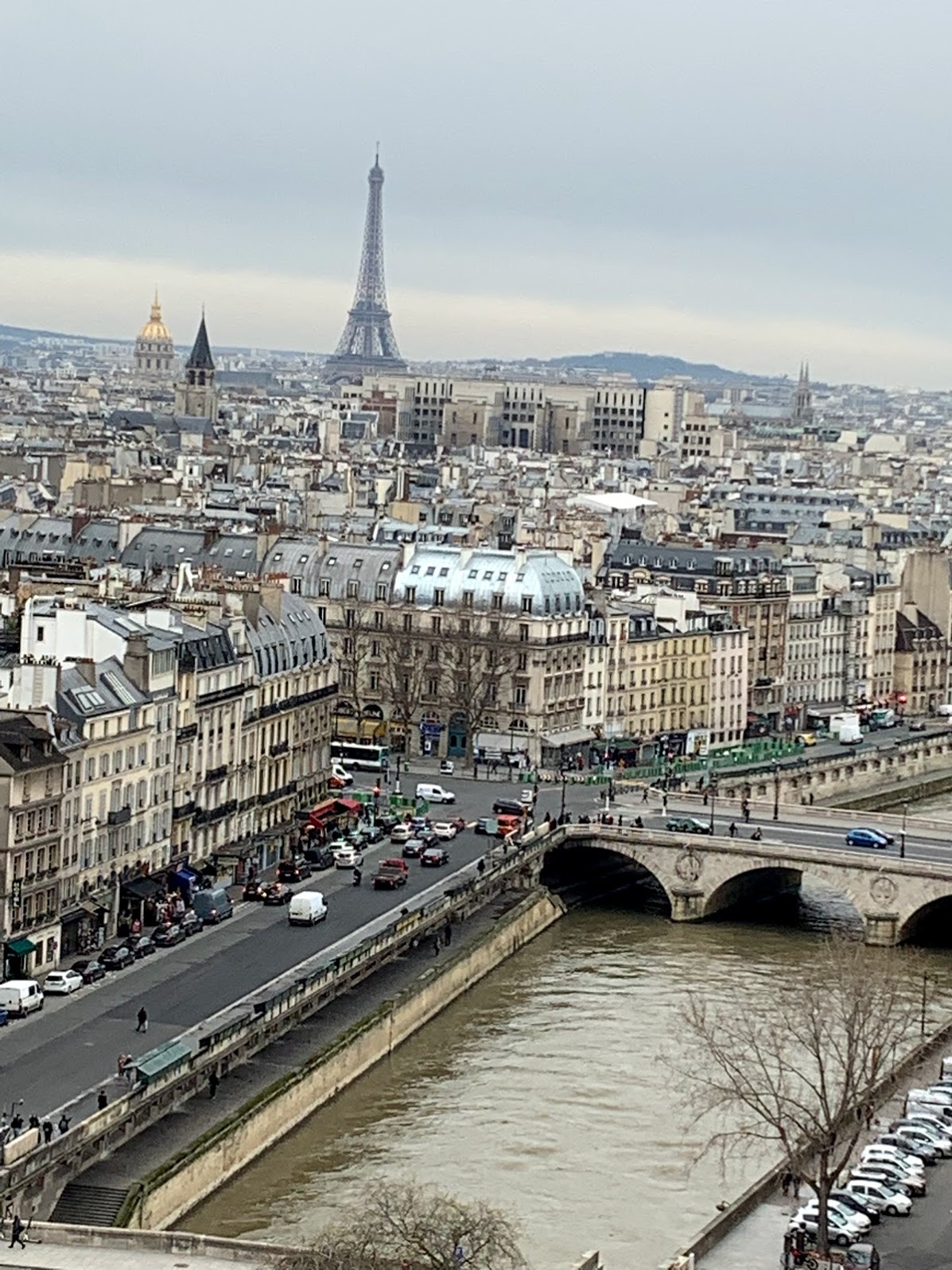
Notre Dame was built between 1163-1360 with upgrades as recent as 1860 when they put in a new floor. Notre Dame is considered one of the greatest gothic style cathedrals complete with large stain glass windows, floor to ceiling paintings, statues, and even little gargoyles lining the rooftop. The kids immediately inquired if we could climb to the top of this cathedral too! And of course we did… all 422 steps! The views of Paris from the top were stunning. The city sprawled out endless miles below with the Seine River winding it’s way down the middle. You could even count many of the Seines famous bridges from the top.

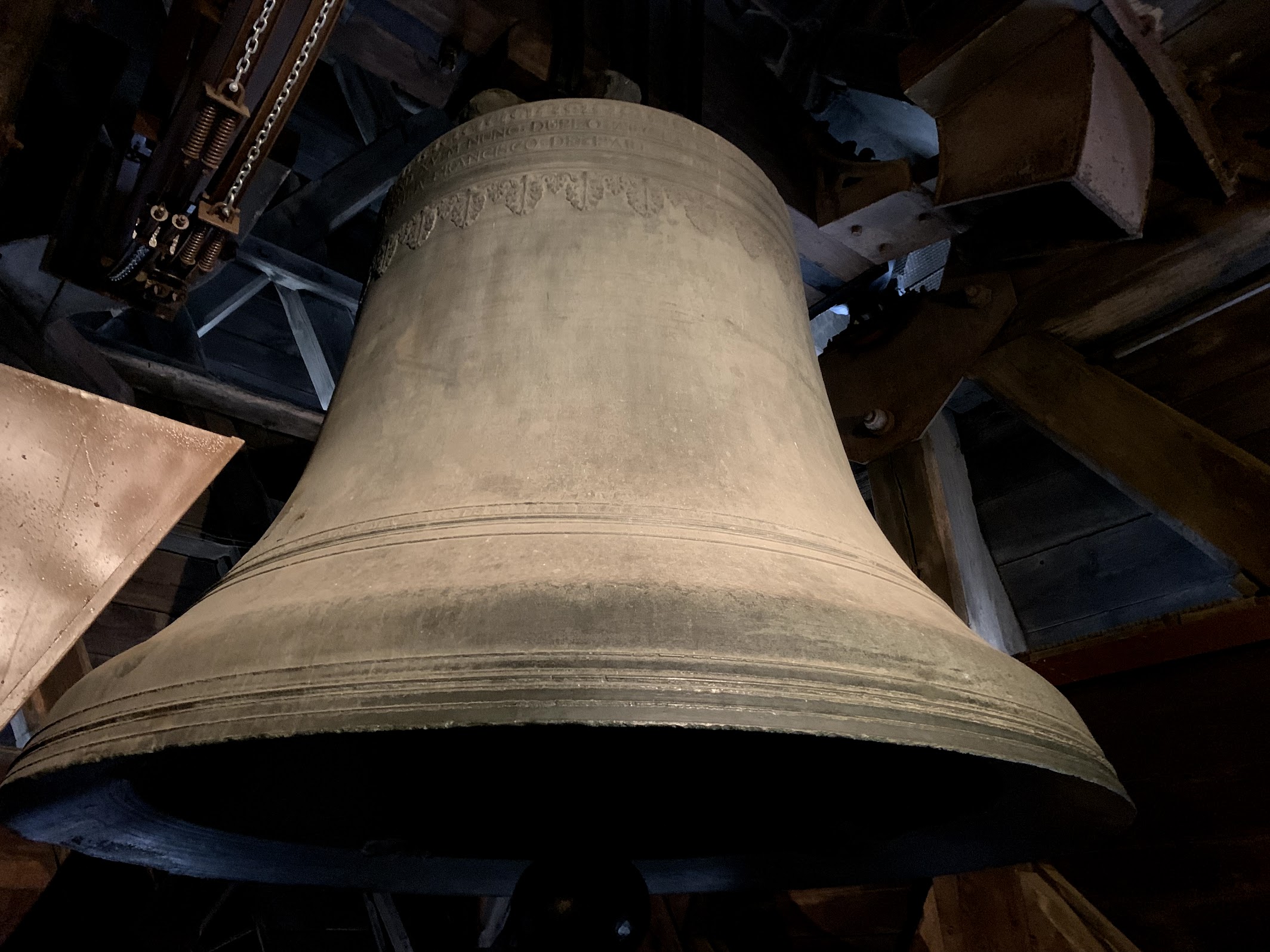
One of the bells of Notre Dame:
Yes it did ring while were up on the roof. Thank goodness we weren’t in the bell tower proper!
Rooftop gargoyles at eye level!
View from the top of Notre Dame

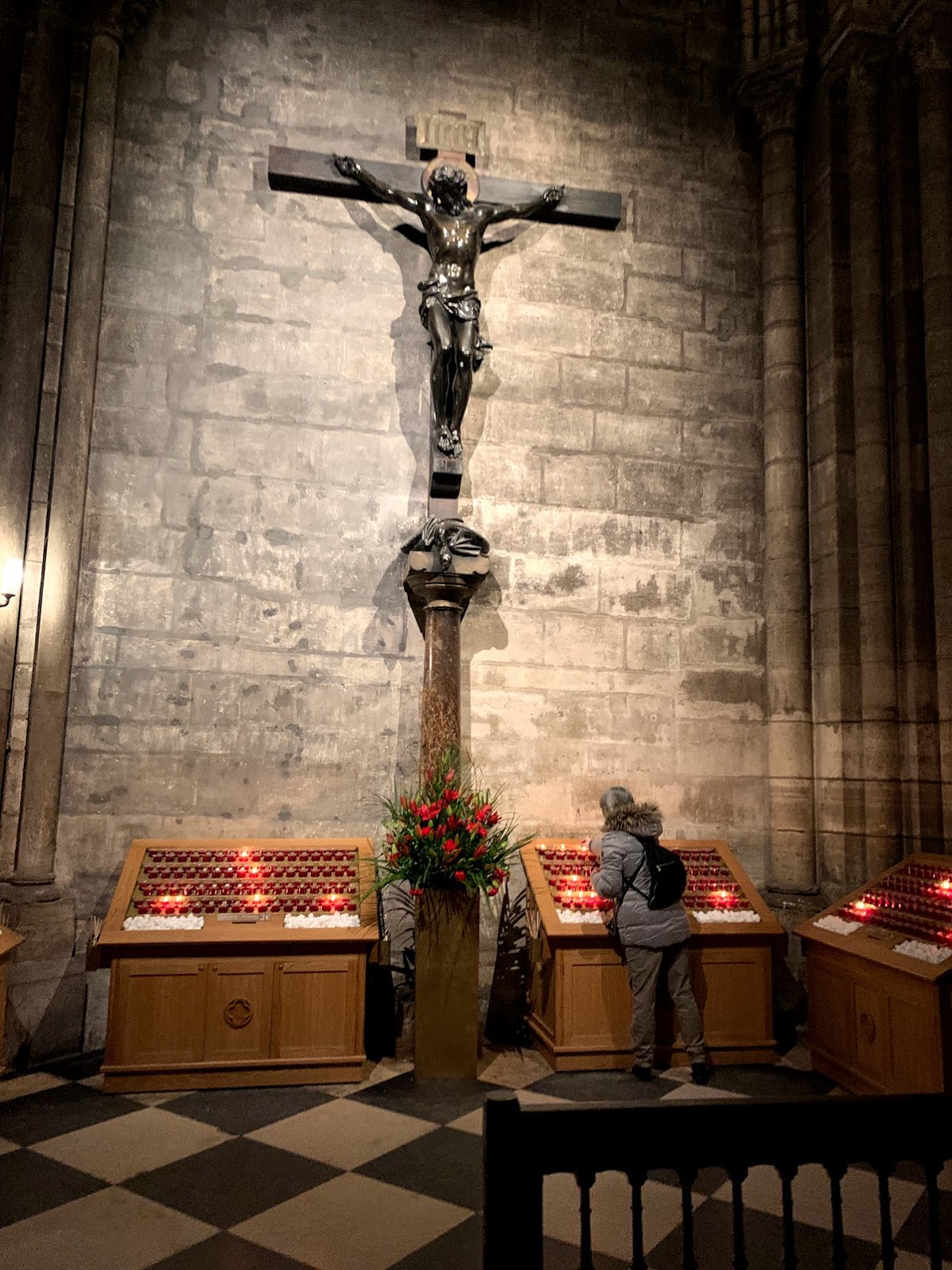
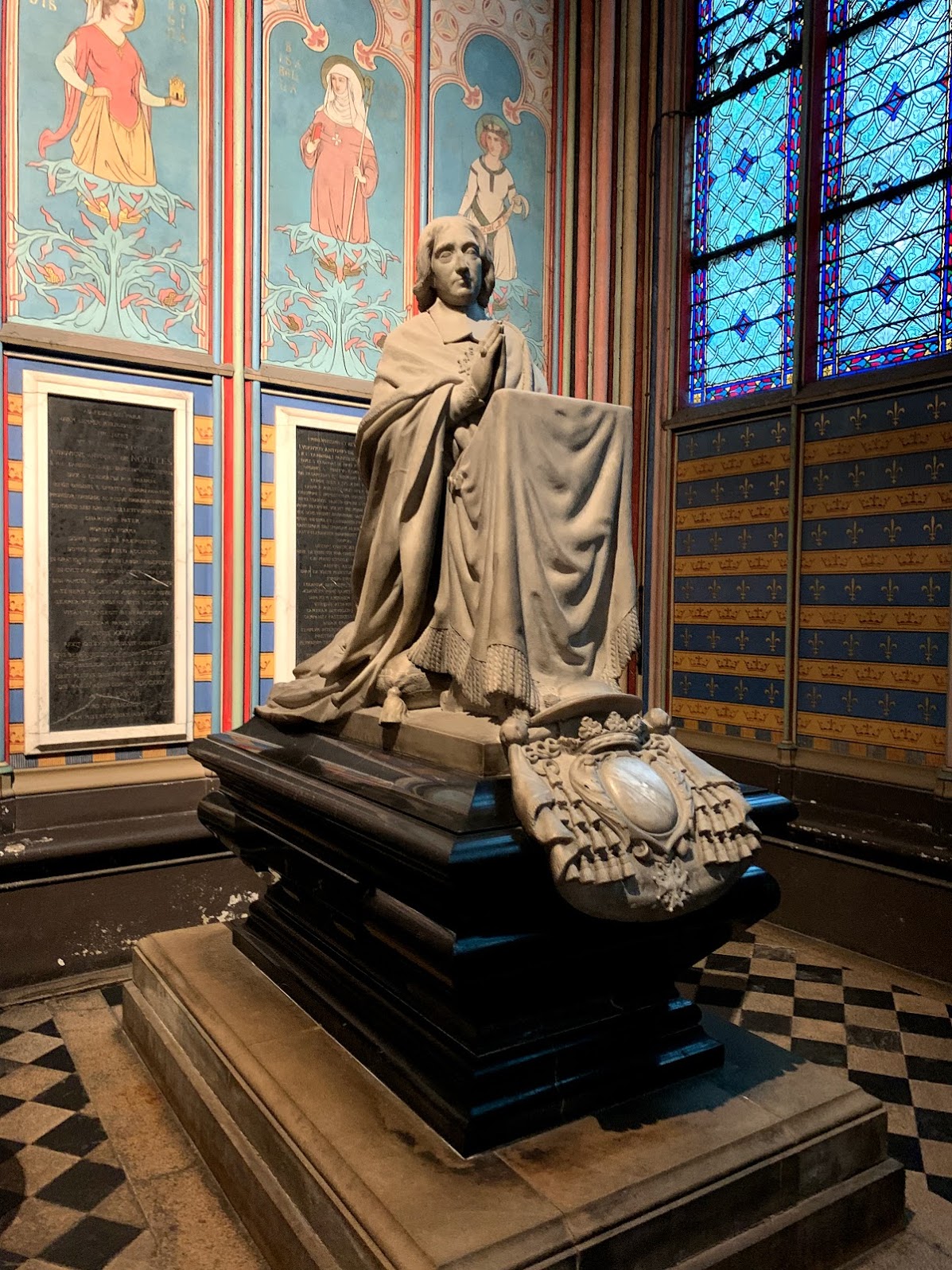
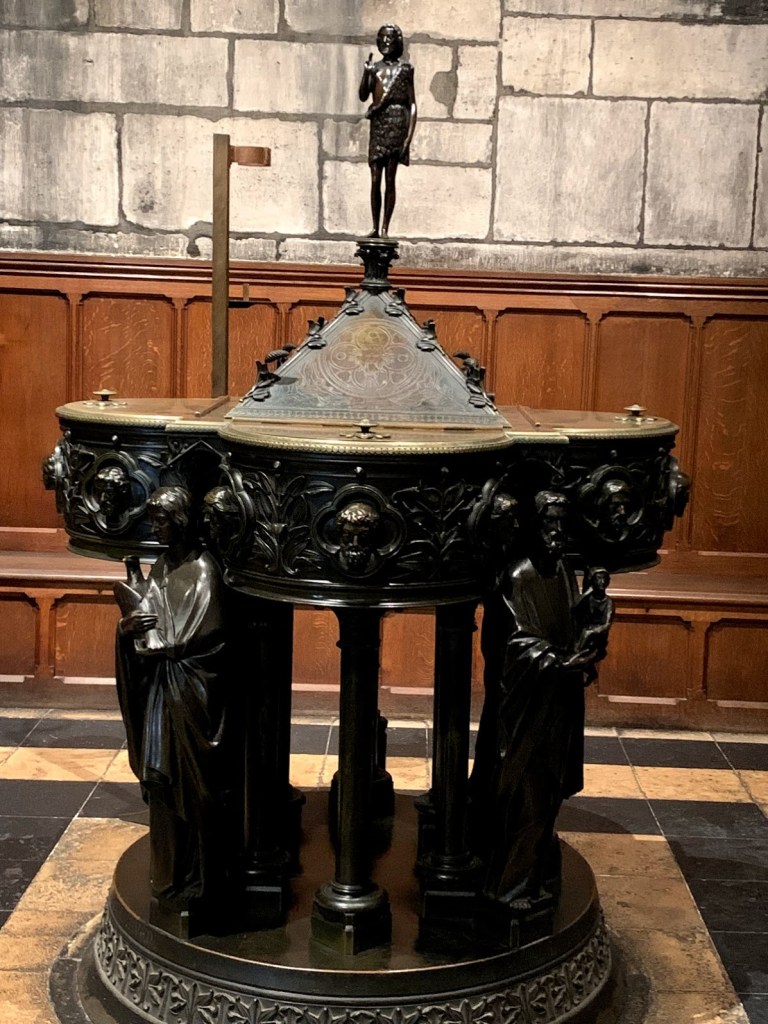
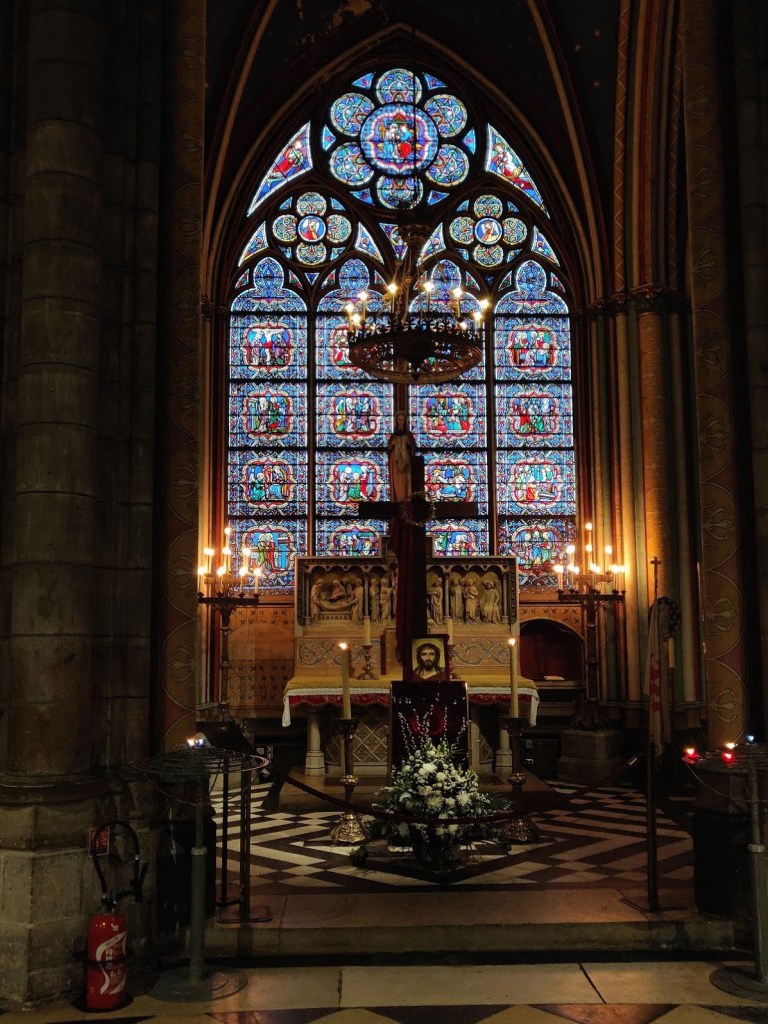
Once back down the spiral staircases we meandered through the various chapels whose saints were venerated with statues and paintings. I liked the baptismal font and the chapel where Louis IX of France was buried in the 13th century. He is also known as St. Louis. Yep, that’s where the American city of St. Louis, Missouri gets its name… after good ole King Louis IX! A beautiful chapel nearby was called the Crown of Thorns Chapel. Inside this little alcove stood a large wooden cross with a crown of thorns hanging around it. St. Louis (King Louis IX of France) is said to have walked the streets of Paris barefoot in true repentance while wearing the crown.
Crucifixion Chapel
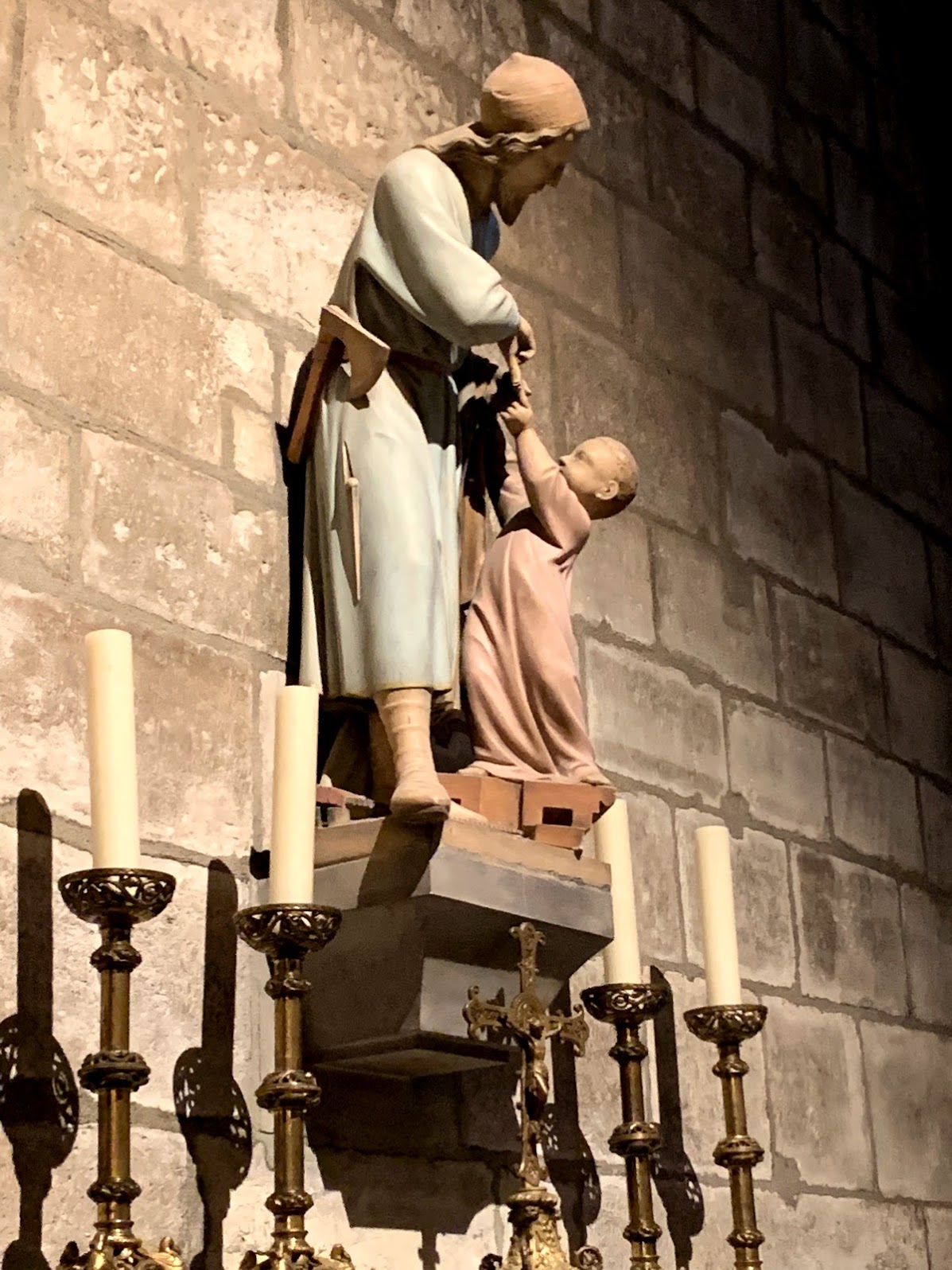
St. Joseph and Jesus:
This was my favorite chapel and statue. So often Joseph is overlooked in the church. It was nice to see such a touching portrayal of him and his son.
Grave of King Louis IX:
This is his chapel since he was made a saint.

Baptismal font
Cross of Thorns Chapel

As we walked around the bells struck noon and midday Mass began. We watched as the clergy and choir processed solemnly down the side aisle and into the choir stalls and high alter. Their voices resonated off the old stone of the cathedral. We stayed for a bit of Mass and then left listening to the congregation singing the liturgical responses as we passed through the massive oak doors into the square.

By this time we had worked up a grand appetite and found a nice restaurant across the street from the cathedral. Tucked away in a corner of the crowded restaurant we admired the charming 1920’s décor. Our waiter was very attentive and we all enjoyed dishes of classic French food, Croque Monsieur and Quiche Fontaine.

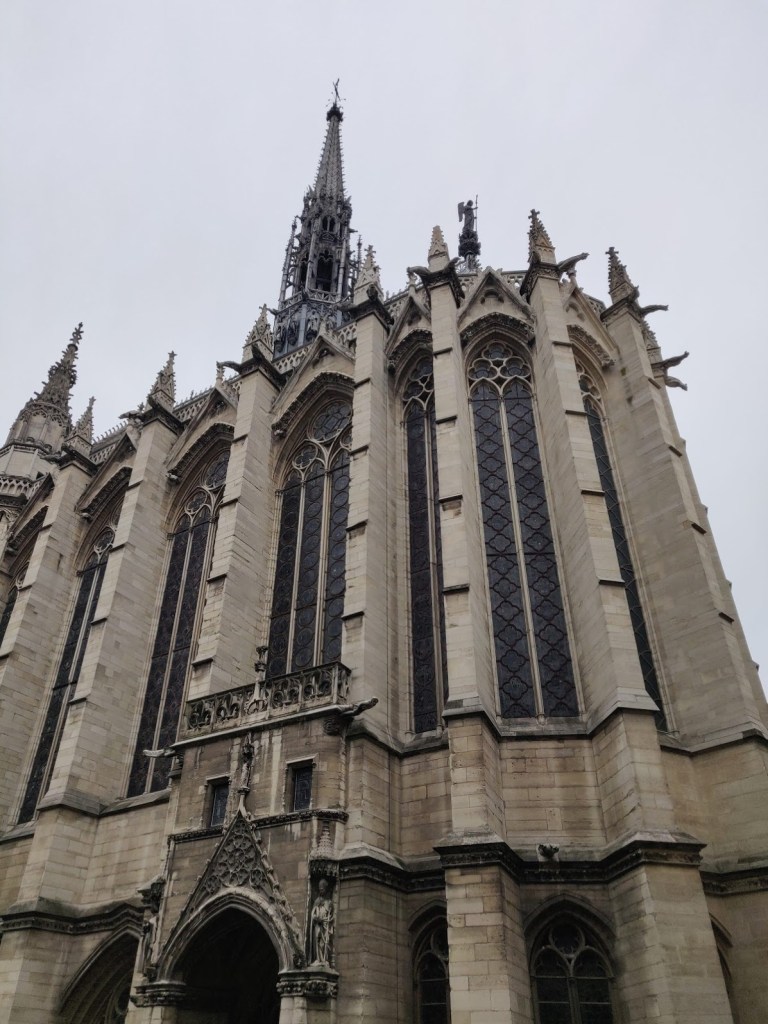
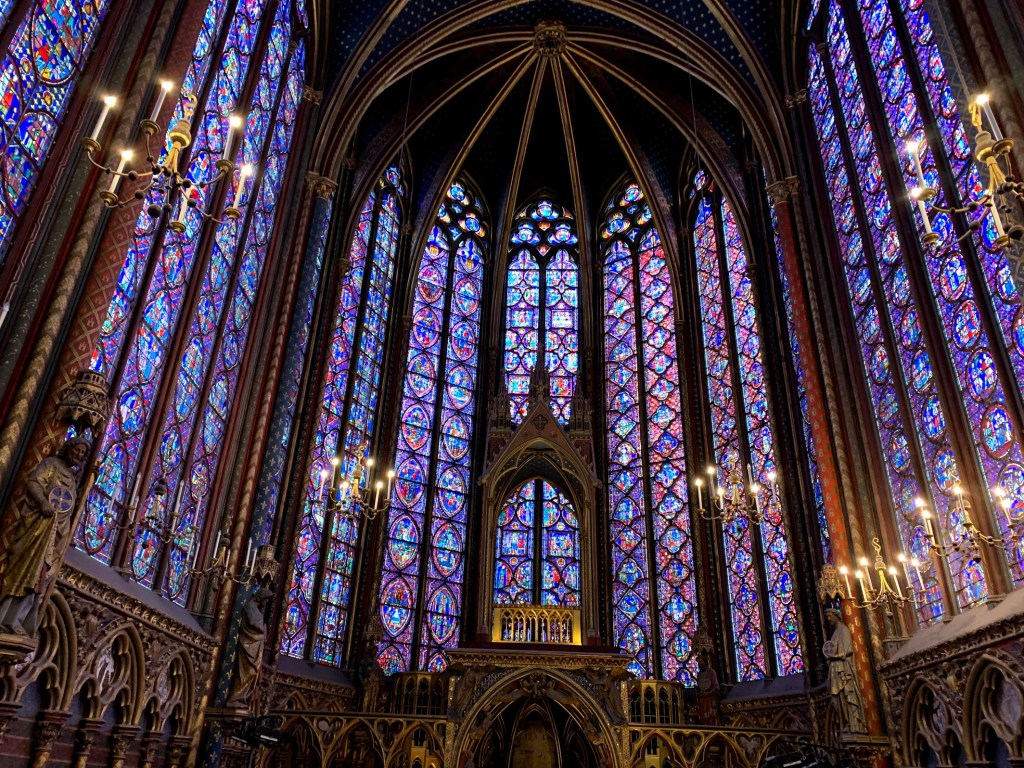
Feeling revived after the morning’s exploration of Notre Dame we walked about 5 blocks and found the Sainte Chapelle. Built by King Louis IX (same guy mentioned above) as a tribute to Christ in the 13th century, it is one of Paris’ hidden jewels. Louis was France’s most pious and religious king. He became so after failing at a crusade. His lifelong self-inflicted penitence made him humble and kind to his people. He often went amongst them dressed in rags and served the poor food and drink. He was canonized a saint just a few decades after his death. Sainte Chapelle is the exception to his vow of poverty, because he wanted to build a heavenly royal chapel for Christ to reign from after his return to earth.

Sainte Chapelle
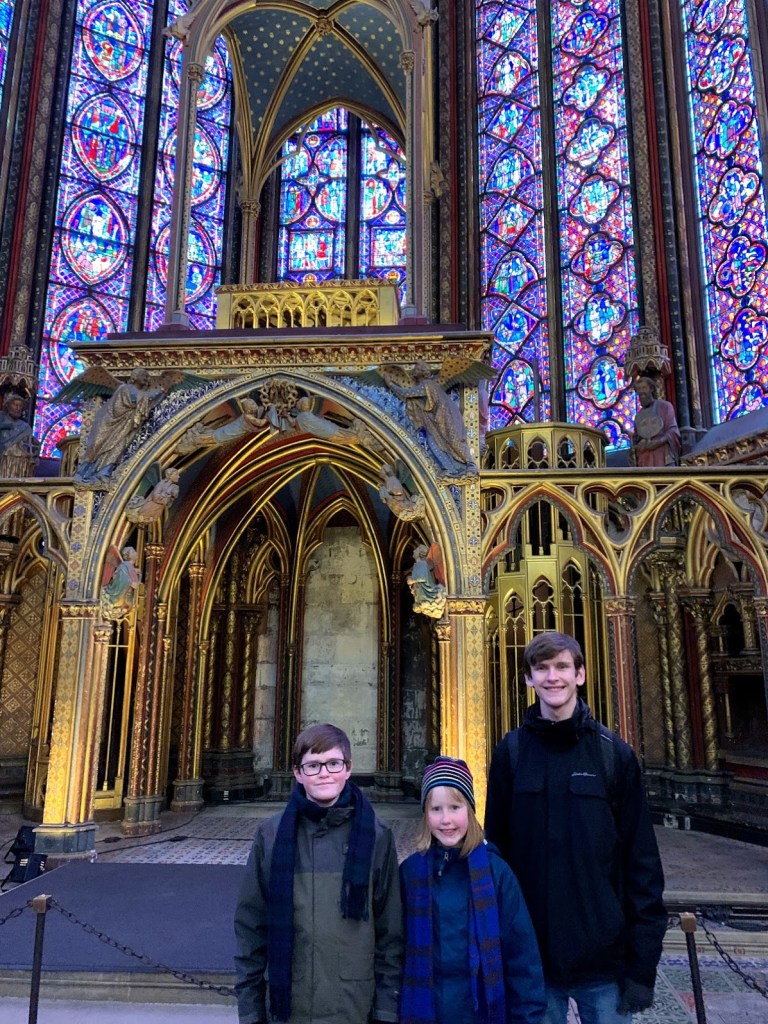
In front of the high altar
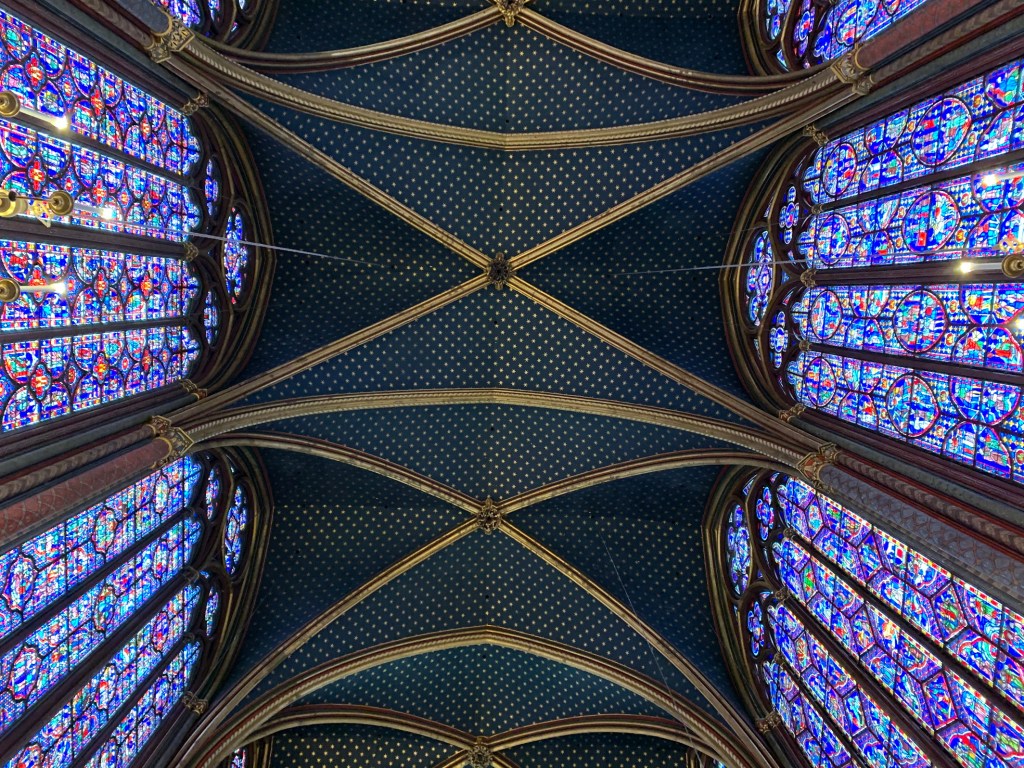
The magnificent ceiling of Sainte Chapelle

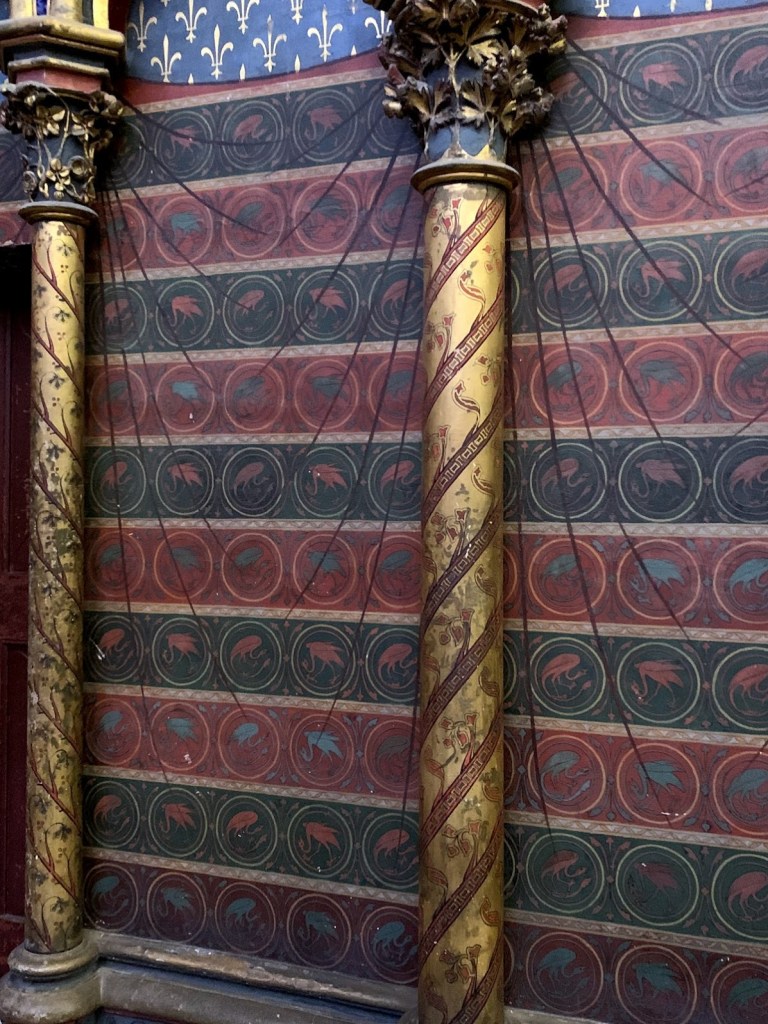
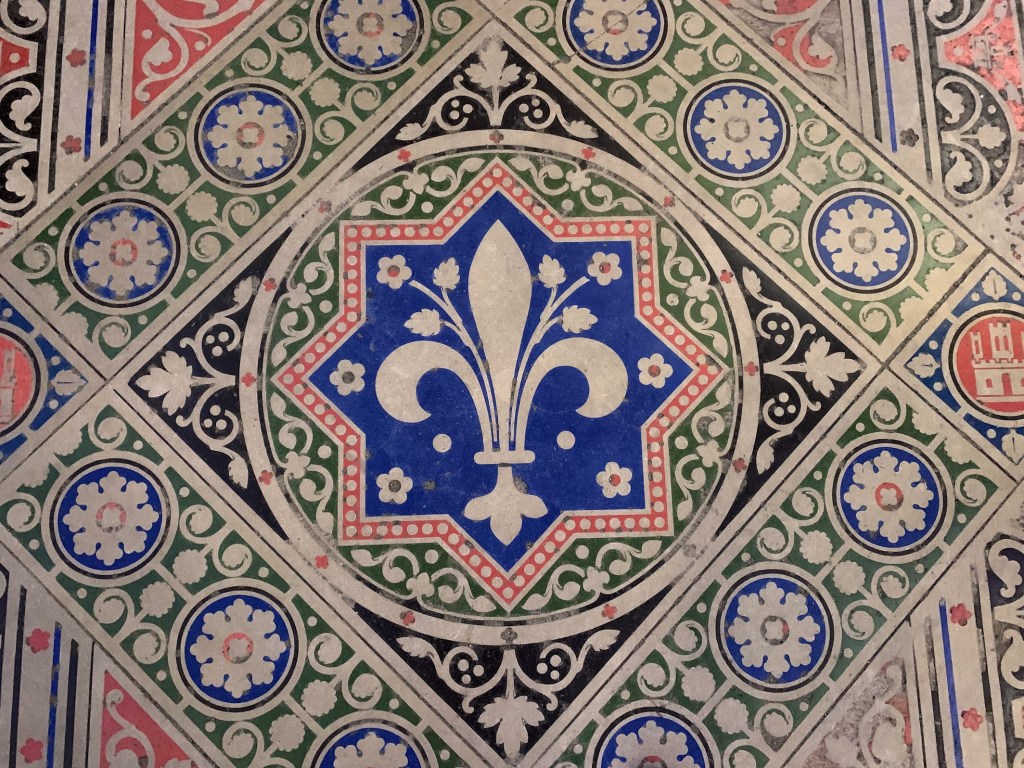
I will say if this was Louis aim he and the craftsmen accomplished the feat beautifully! The Chapelle was stunning with its long stain glassed windows depicting complete books of the Bible, including the book of Job, Genesis, Kings, Numbers, Esther and even Revelations. Behind the high altar were the four Gospels. The patterns on the walls were painted to look like draperies and the floors painted in brilliant colors. The entire Chapelle was inlaid with gold leaf. The ceilings soared above and crisscrossed in roman arches painted blue and set with tiny Fleur de Lis. There was a small hall like chapel underneath the main Chapelle that was also decorated in the same beautiful manner.

Walls painted to look like drapes
Sainte Chapelle
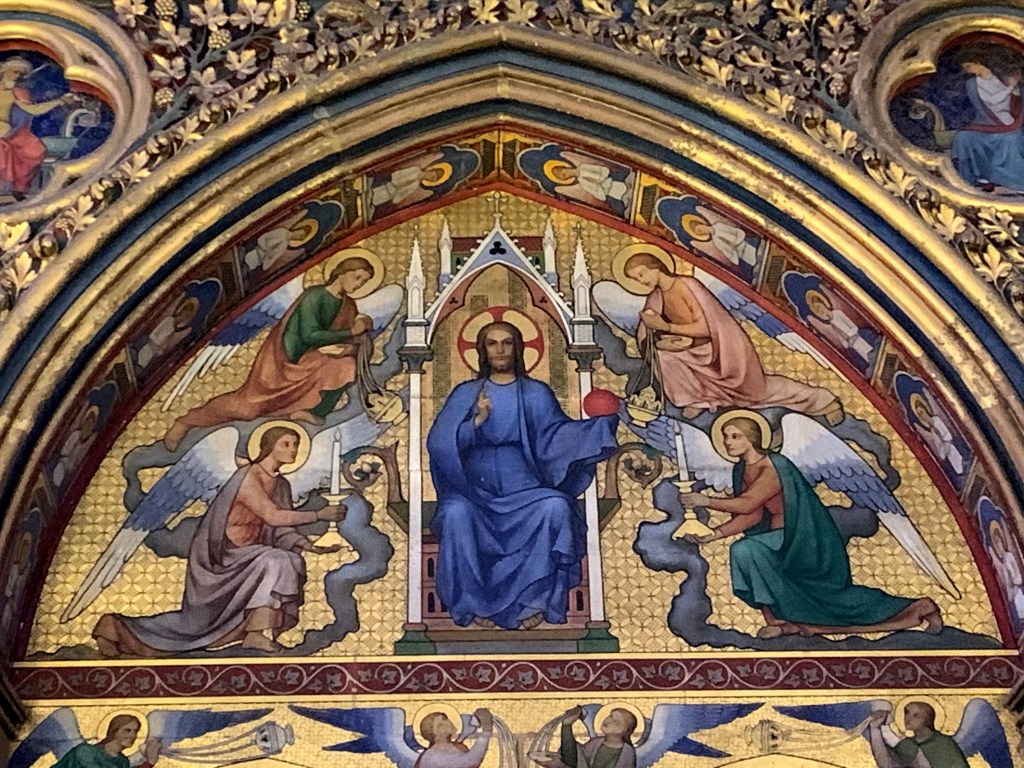
Christ on his throne!
Fleur de Lis

We left the Chapelle and went to do a little shopping in the quaint shops in the narrow winding streets around Notre Dame. Finally, we ended up at a Marks and Spencer where we bought some various cheeses and meats, olives and candies. After dropping the kids off at the hotel, Robert and I went out and found a local wine shop and bakery for fresh baguettes!

Through the Chunnel

Once we finished eating our last full English breakfast, we took the Underground over to St. Pancras/Kings Cross station were we boarded the Eurostar train to Paris, France. This special high-speed train started operating soon after the Chunnel (tunnel under the English Channel) opened in May 1994. The kids were very excited to get to travel on the Eurostar. We cleared security and then had to pass through International French customs before leaving England, because once at the Gare du Nord train station in Paris there is no customs or international checkpoint. It was busy, but everything went smoothly and we made it in plenty of time to board our 11:31am train.

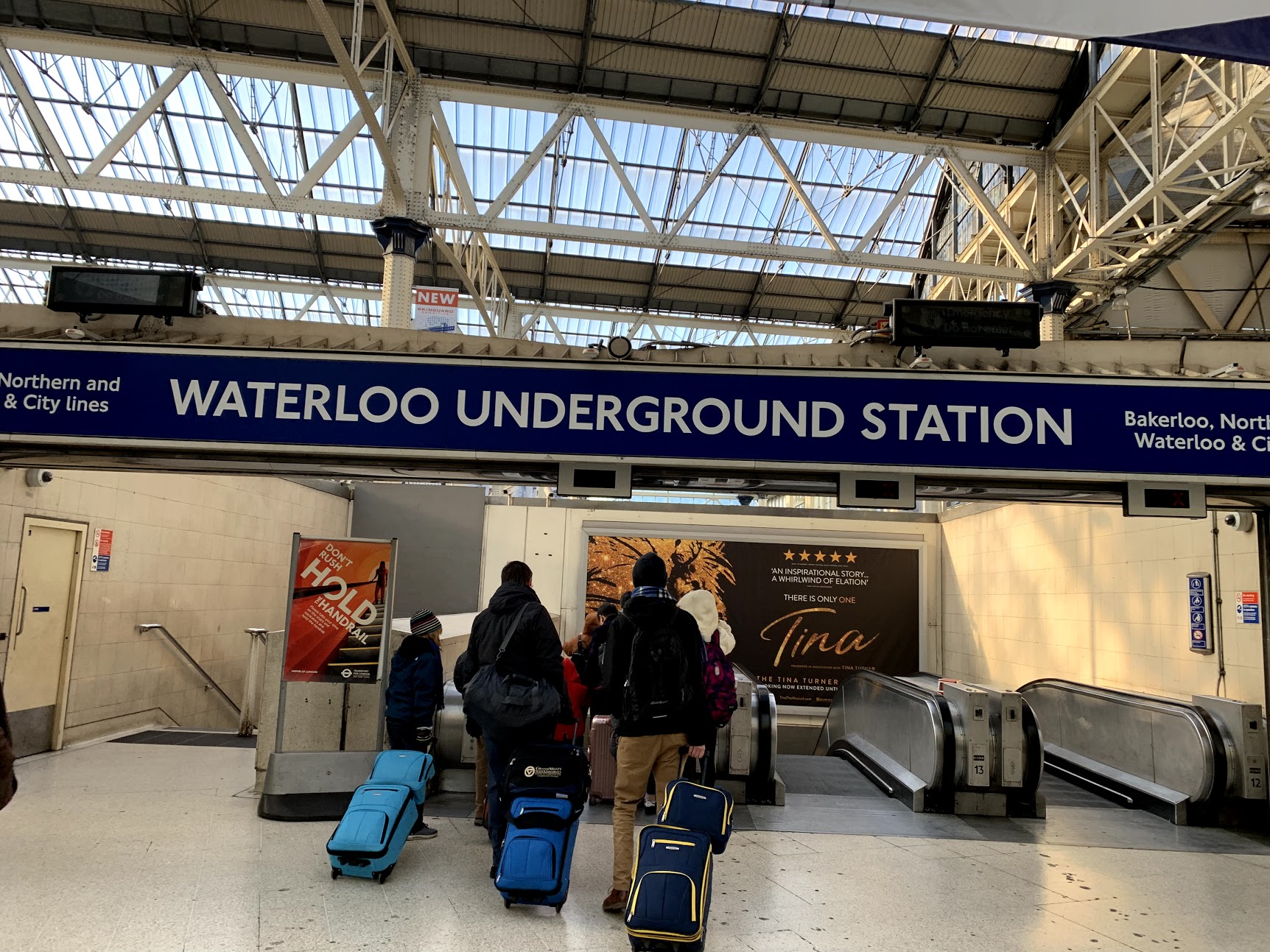
Waterloo Station was only 2 blocks from our London hotel.
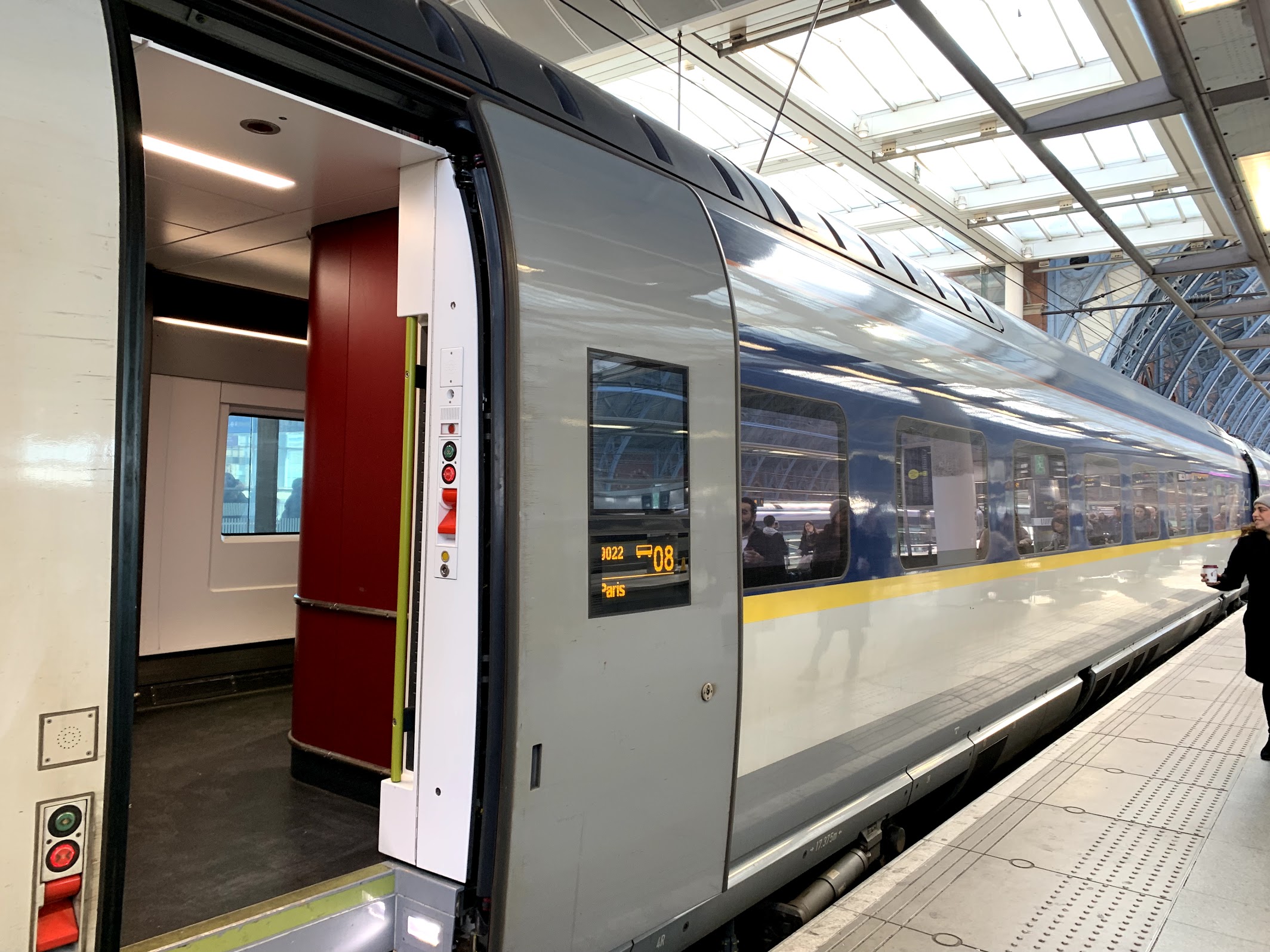
Door to the Eurostar

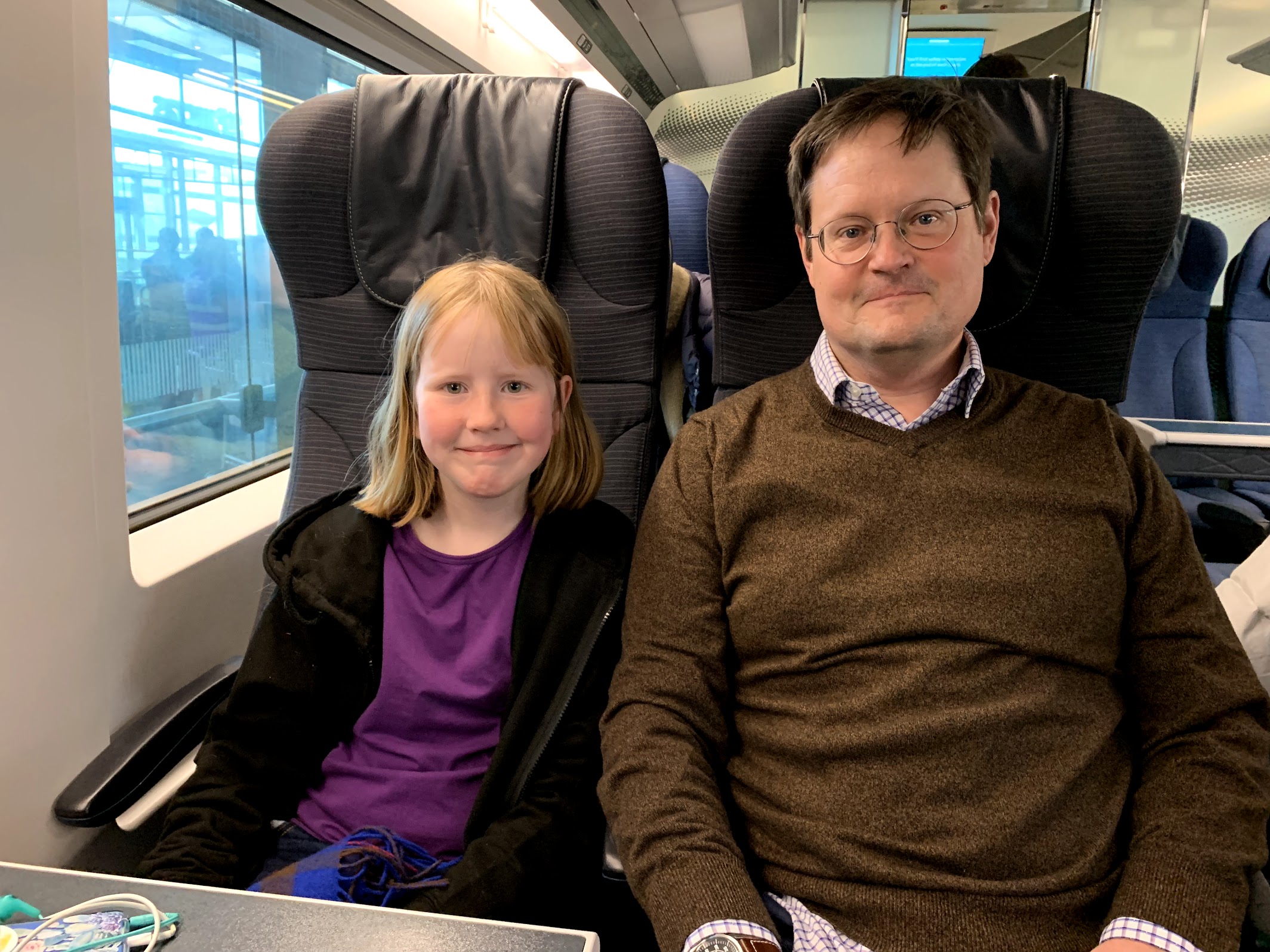
Once on board we stored our luggage and took our seats, which were two facing two. Liam sat across the aisle in another grouping of four. The train took off and but for a little rocking motion occasionally, the ride was smooth. We were traveling over 300kph (186mph), yet within the channel tunnel it reduced to 160kph (100mph). The whole train ride lasted about 2.5 hours. Paris is actually one hour ahead of London so we set our clocks forward an hour when we arrived in the Central European Time zone. We are now 6 hours ahead of Grand Rapids, MI.  

Liam sat across the aisle next to me. He was able to still play Uno with us.
My travel companion on the Eurostar
Seats in the Eurostar: I sat directly across from Robert and Seamus is across from Faywen

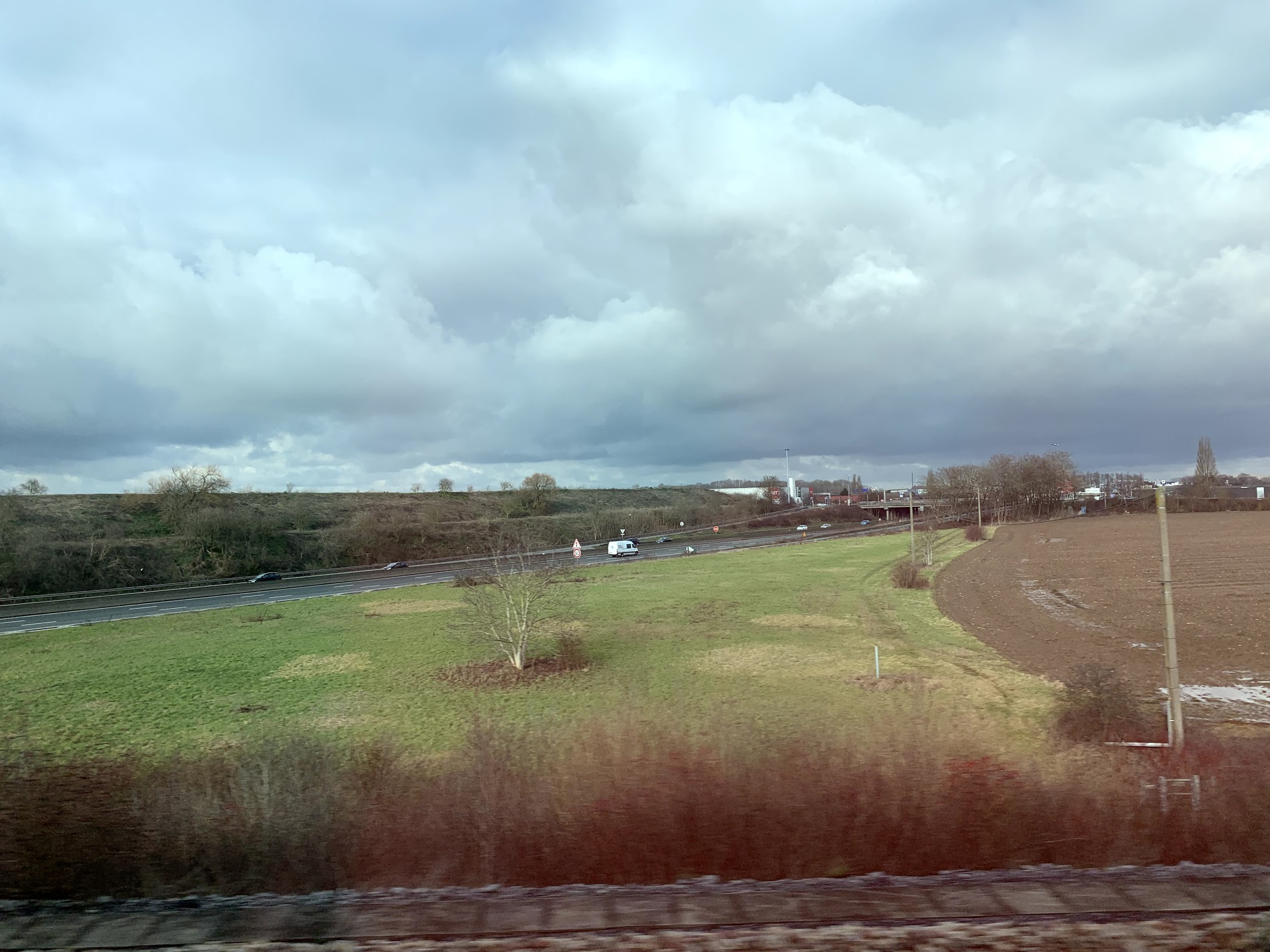
Faywen was very excited when we popped up out of the Chunnel and the French countryside spread out before us! As we traveled through the Chunnel we munched on snacks and played the card game Uno to pass the time.

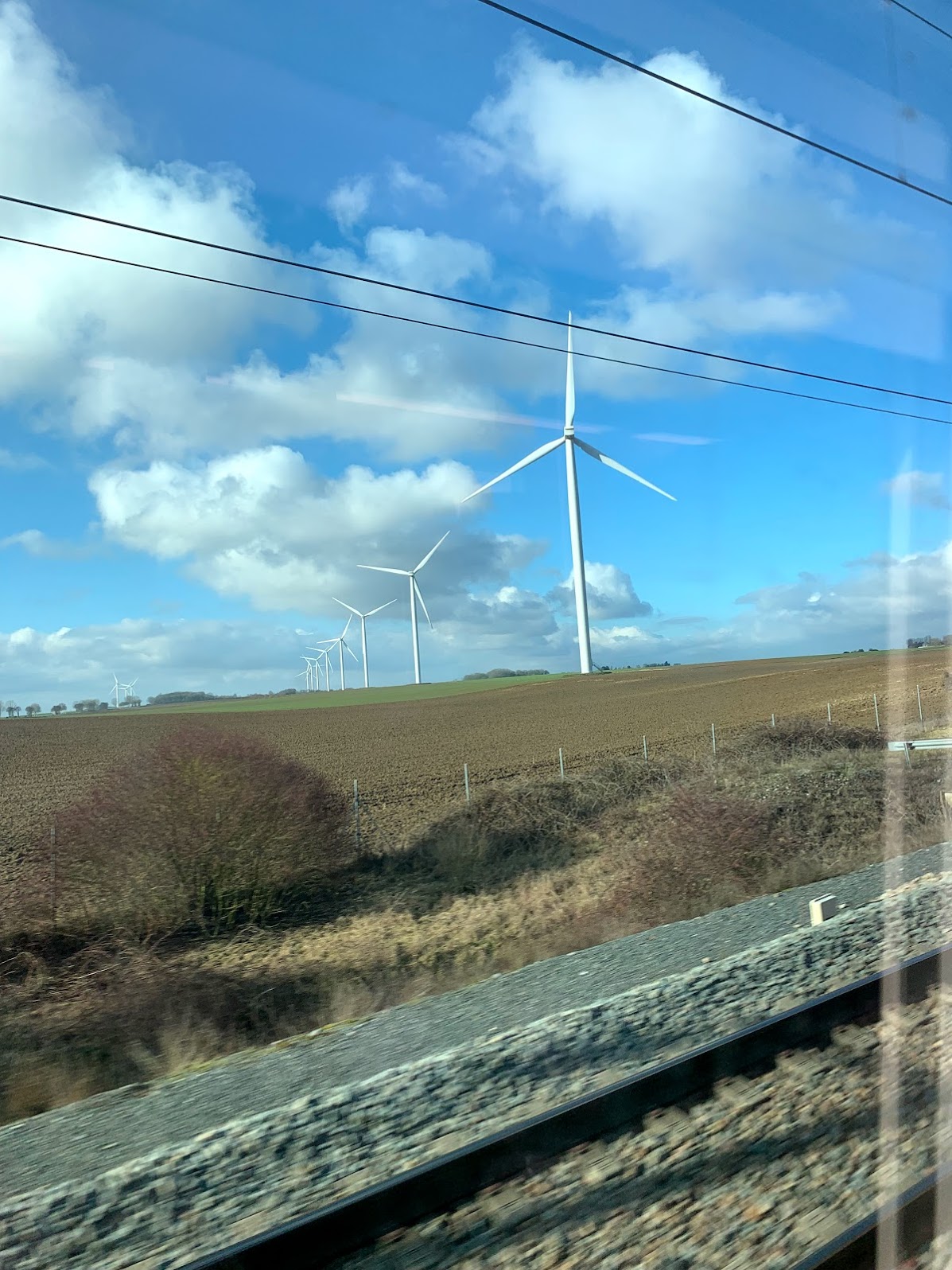
French countryside as seen from the Eurostar. I’m amazed I was able to get these pictures since the train was traveling at 300kph
The French countryside
Liam reading the Metro map. I know conversational French, but Liam has had 2 years of high school French. He’s been very helpful while in Paris!

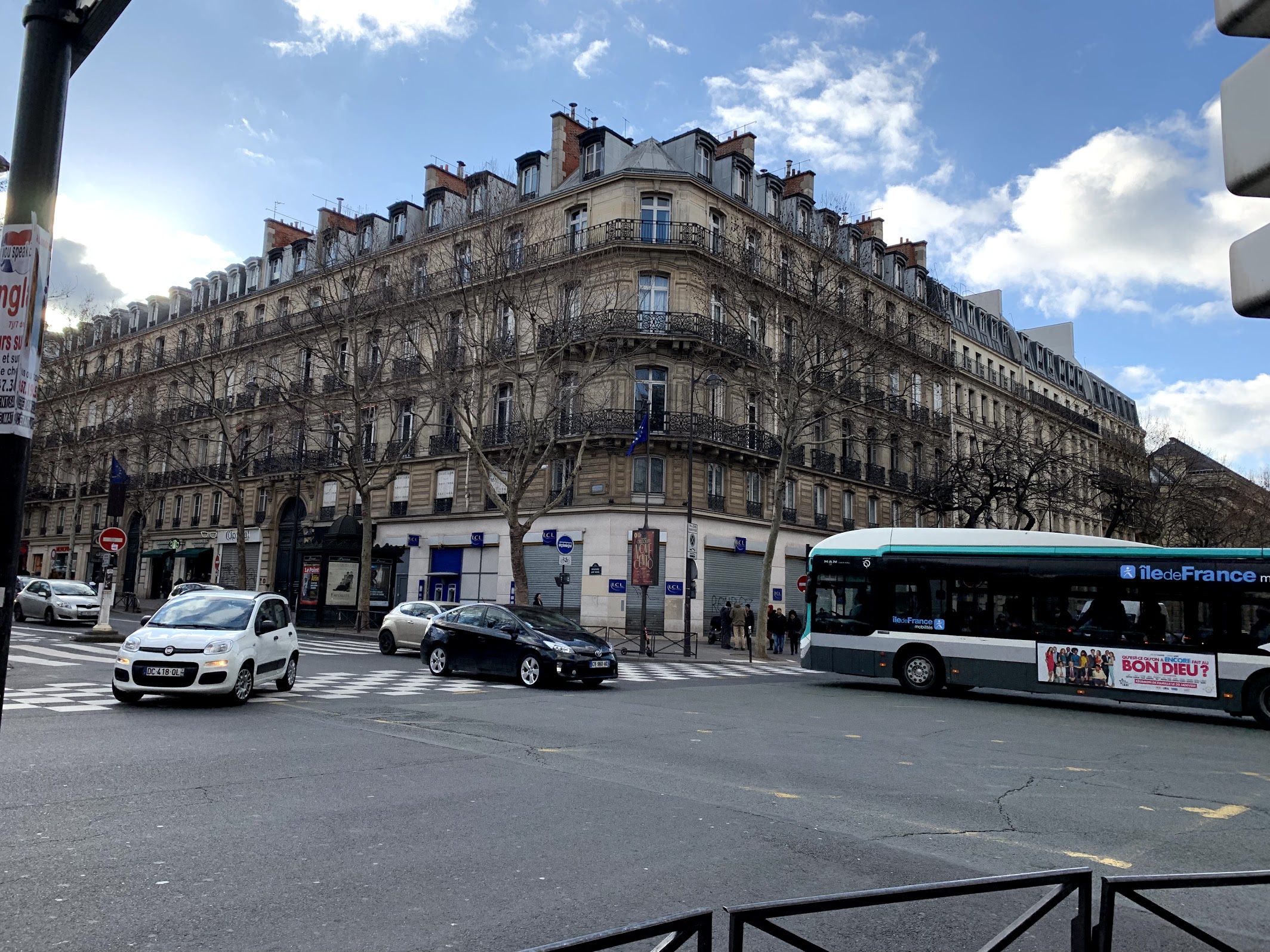
Once inside the Gare du Nord it was time to figure out which Metro line would take us close to our hotel. The RERB line was just right with only 2 stops before getting off at Sainte Michelle. After ascending the various escalators from the Metro subway we were greeting with a lovely first view of Paris! The stunning stone 4 story buildings with wrought iron balconies shimmered in the sunlight. Robert aend Liam had both downloaded a street map of Paris and soon we were on our way with our little rolling luggage bouncing on through the stone sidewalks and streets of Paris!

First View of Paris
First view of Paris
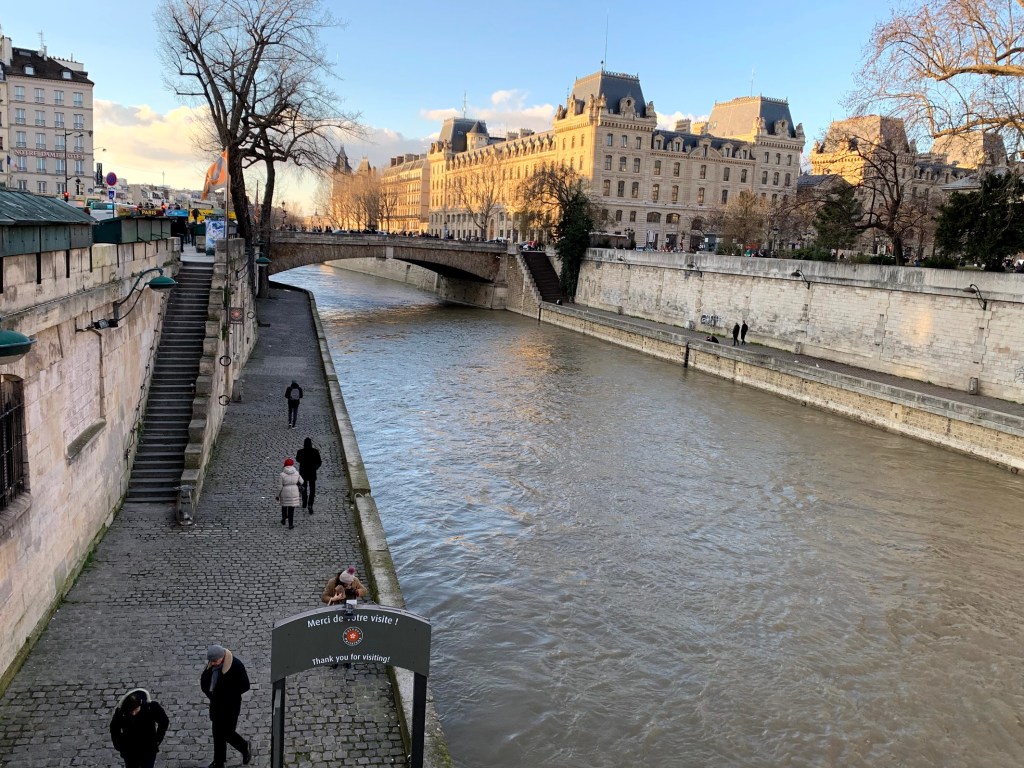
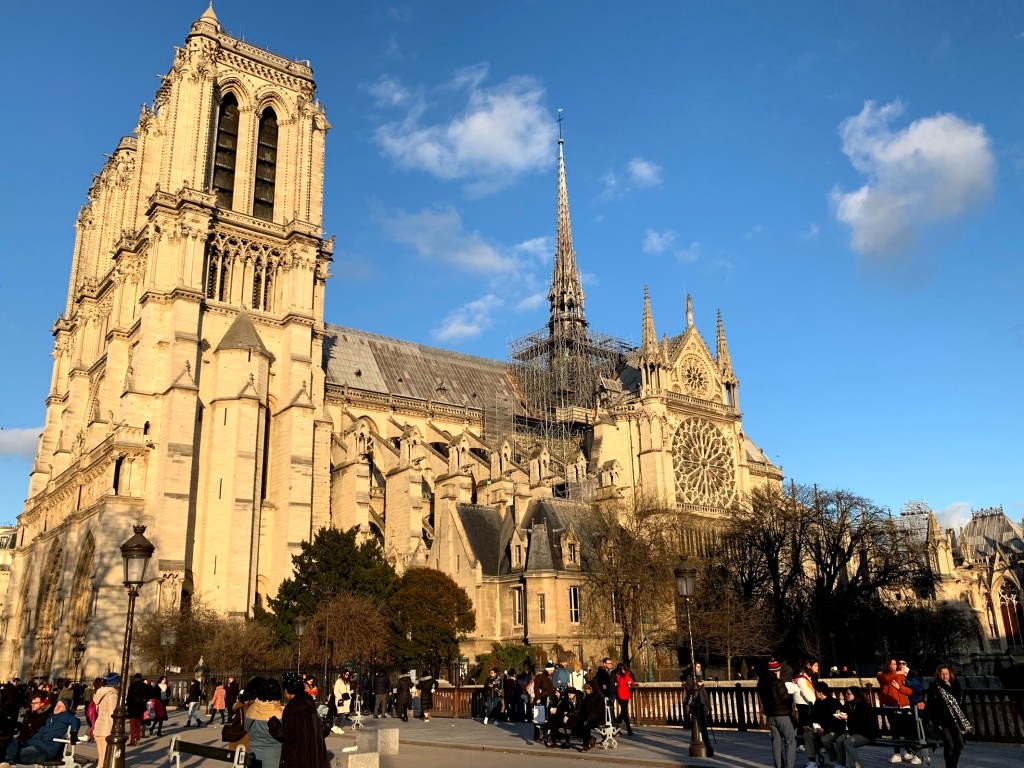
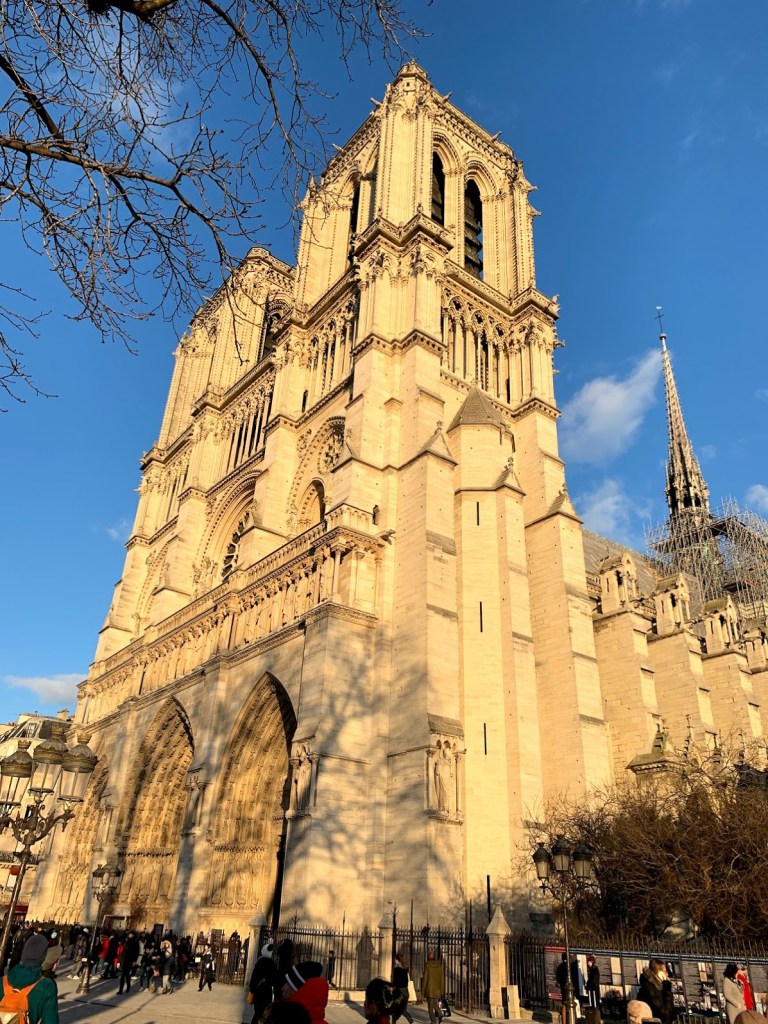
Seine River next to Notre Dame
Notre Dame in the sunlight
Notre Dame in Paris, France
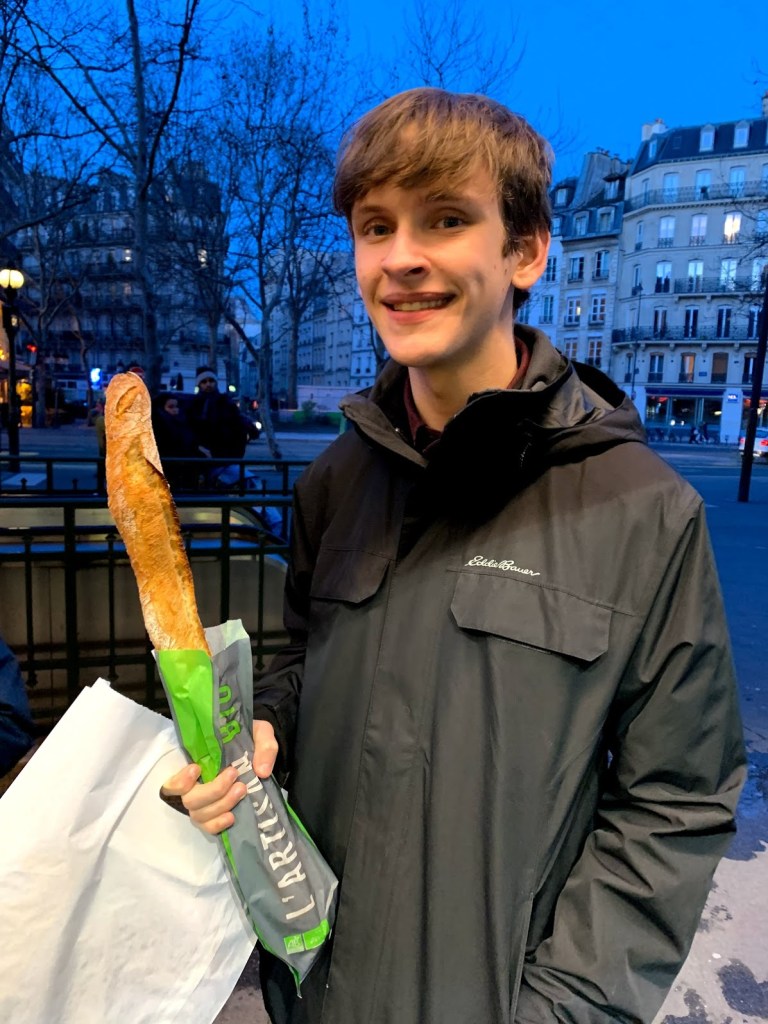
Our first real French Baguette
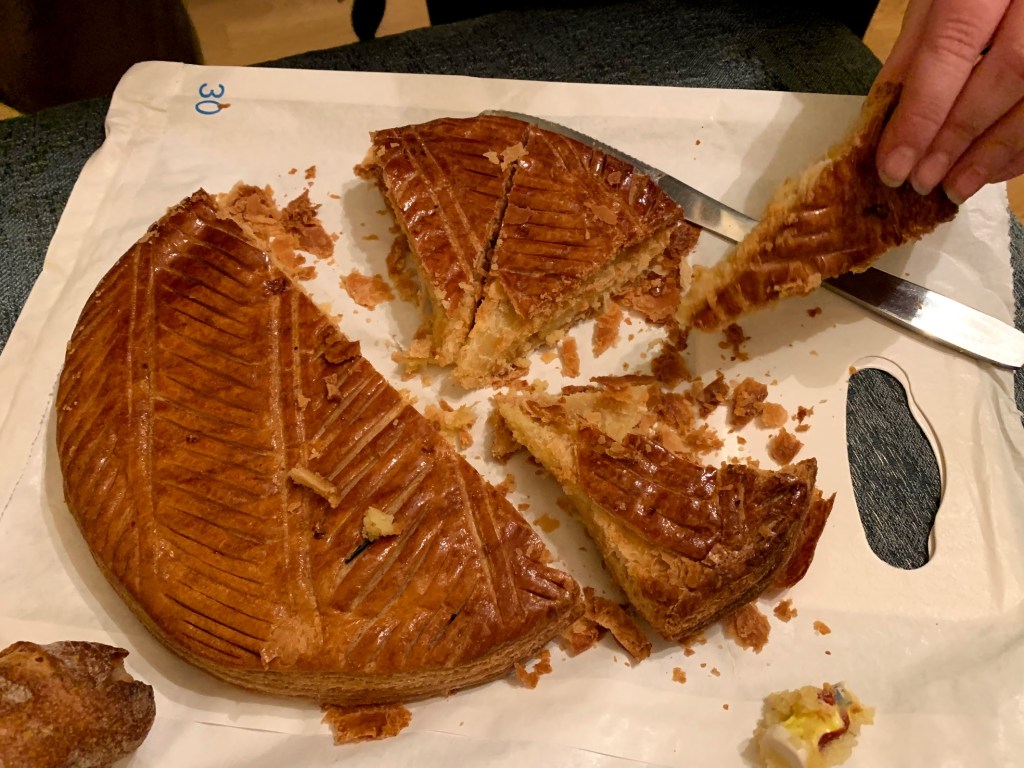
Traditional Epiphany Galette

The Hotel Marignon is actually more like a European Inn than a large hotel. There are only 36 rooms and our just happened to be on the first floor. After a rest and some refreshment we took to the streets and meandered our way down to the Seine River and Notre Dame. This iconic cathedral is only about a 7 minute walk from our hotel. The sun was low and brilliant in the sky. The stonework of Notre Dame reflected the warm orange hues of the setting sun. Though the air was crisp, one’s soul felt the warmth of the sun reflecting on the mighty façade of such an elegant lady, Notre Dame. After walking around we found a nice little restaurant and ate dinner. We found a classic baguette and galette to munch on back in the room. A galette is a traditional pastry eaten in French countries only during the season of Epiphany. It is the Three Kings Cake and often little toys are found inside. We did find a little porcelain Wise Man in ours!
London Day 5: Ravens and Reverence

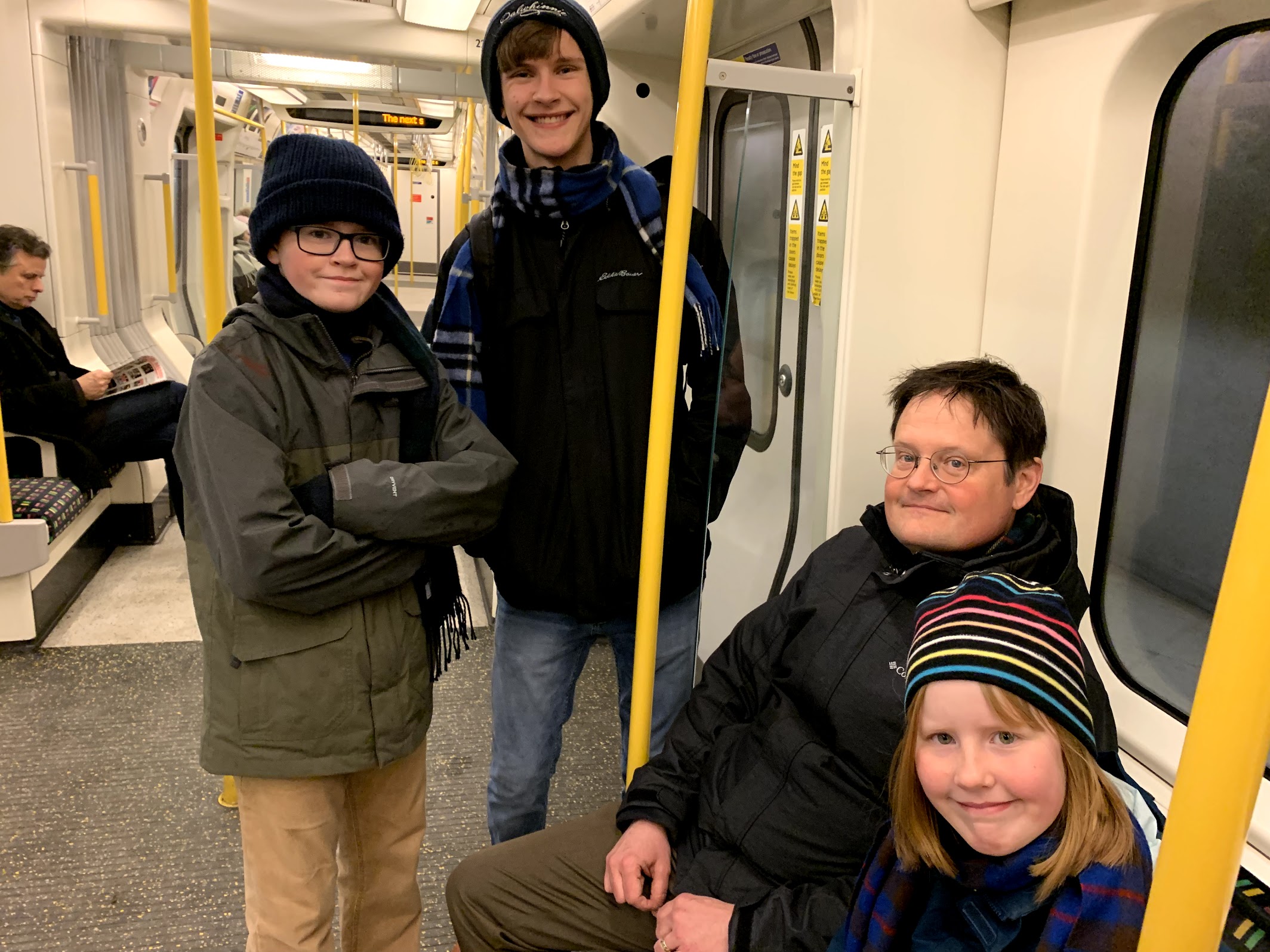
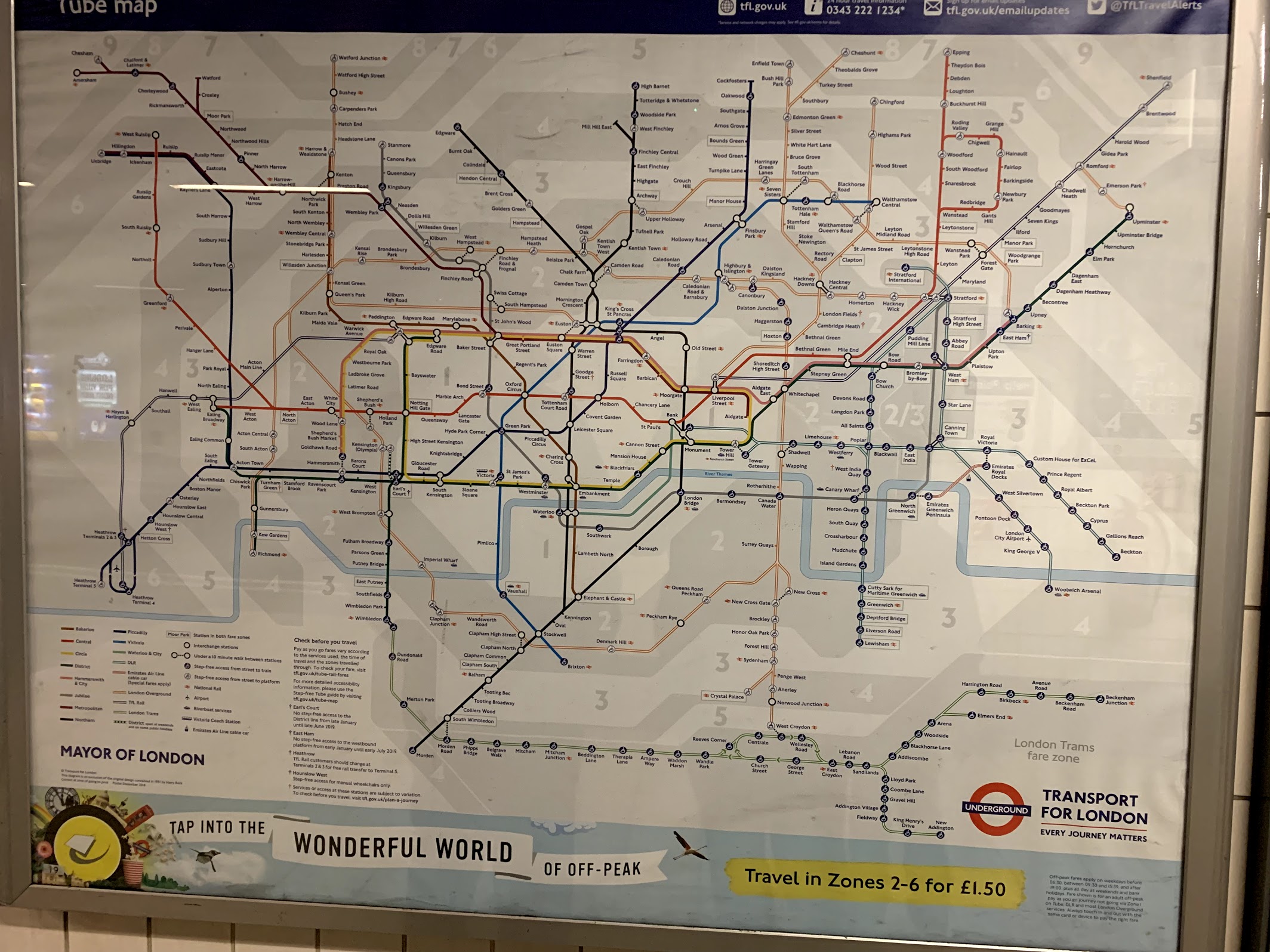
Time to go underground! The kids and Robert had their first experiences riding the London Underground or Tube, as the locals call it. The Tube was exactly how I remembered it from 2 decades ago, clean and efficient. Though it did have some nice modern upgrades! We entered at Westminster and popped out at Tower Hill.

Riding the Circle Line on the Underground Tube
Map of the Underground
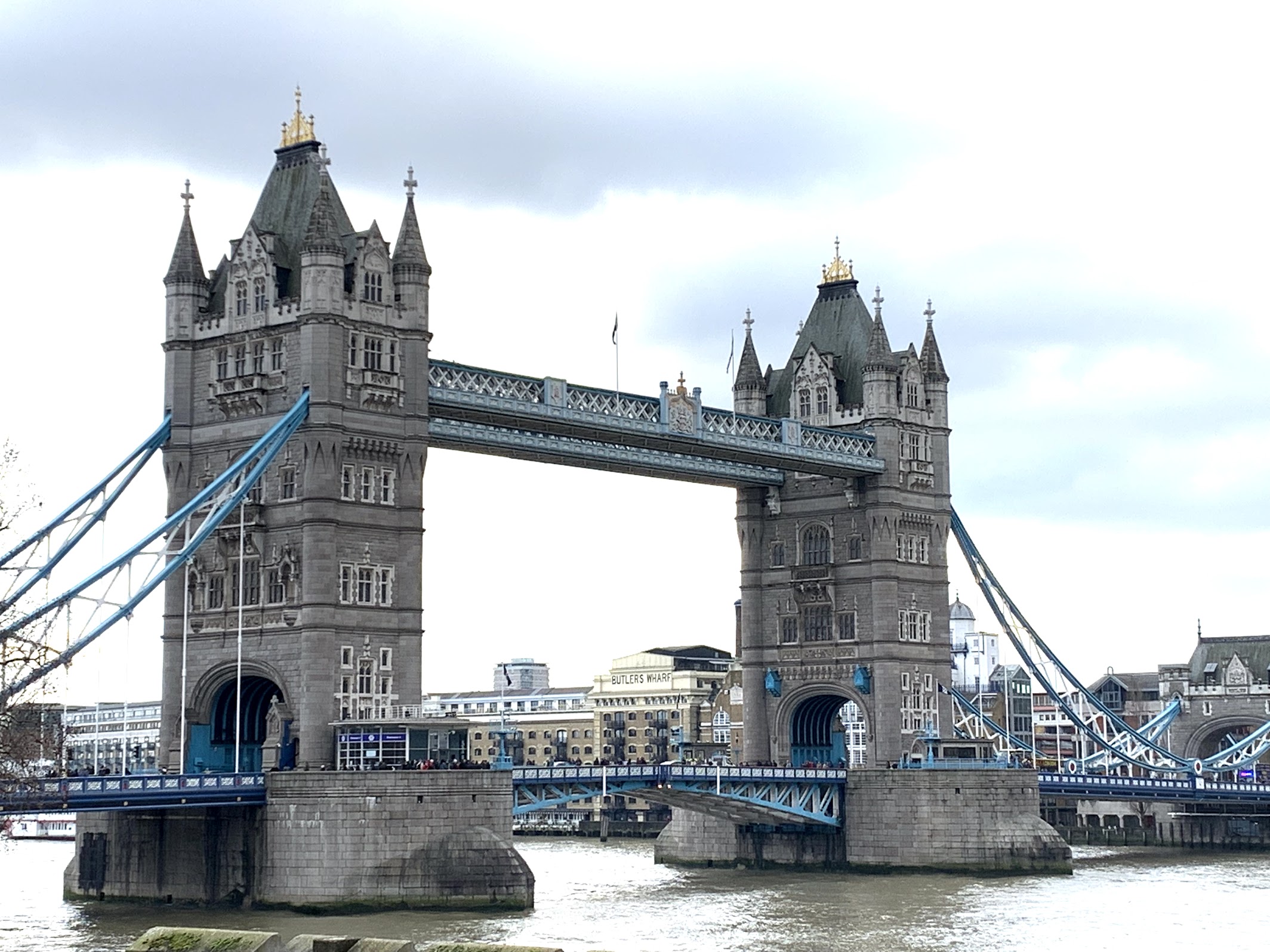
Tower Bridge as seen form the Tower of London

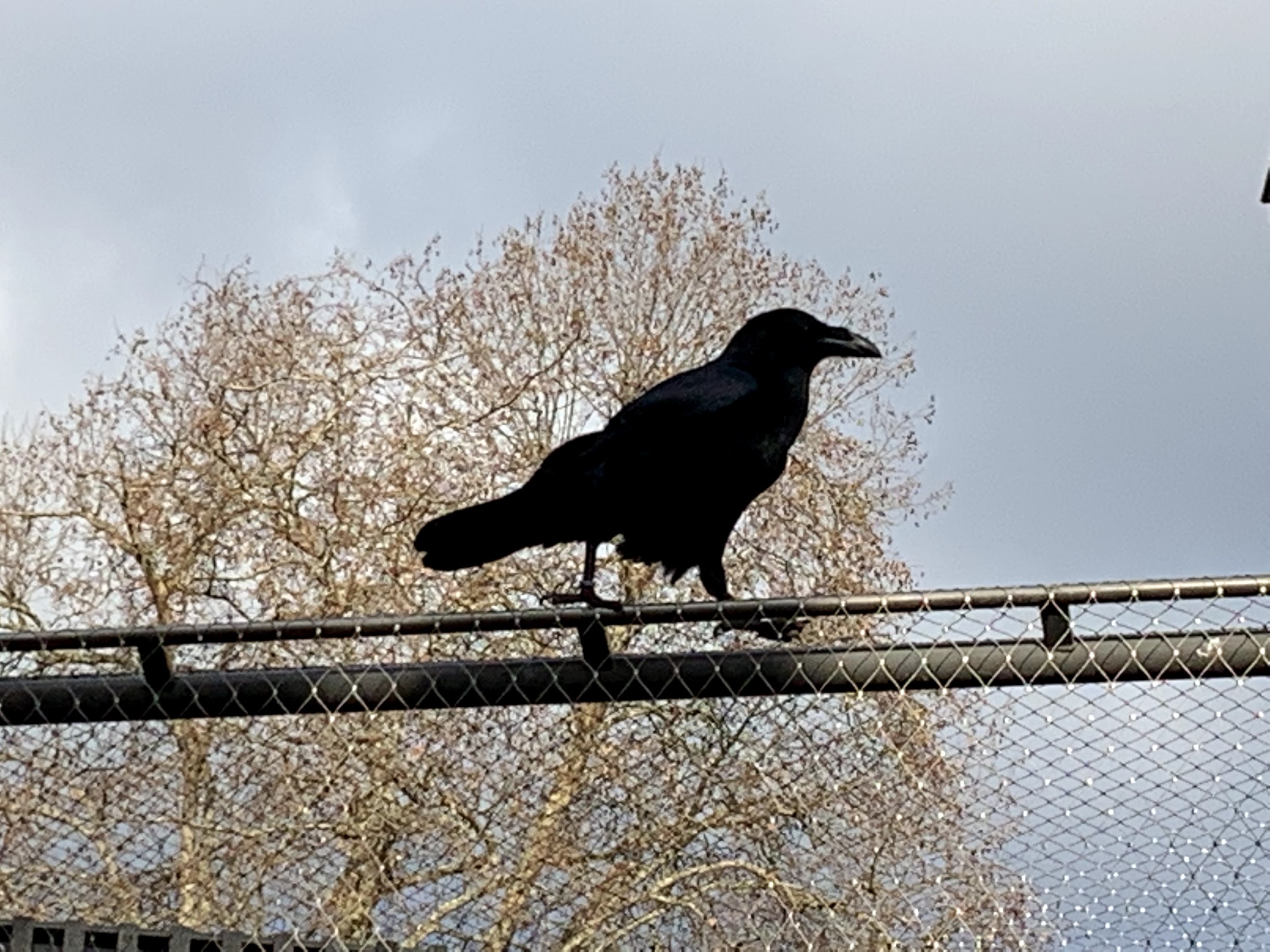
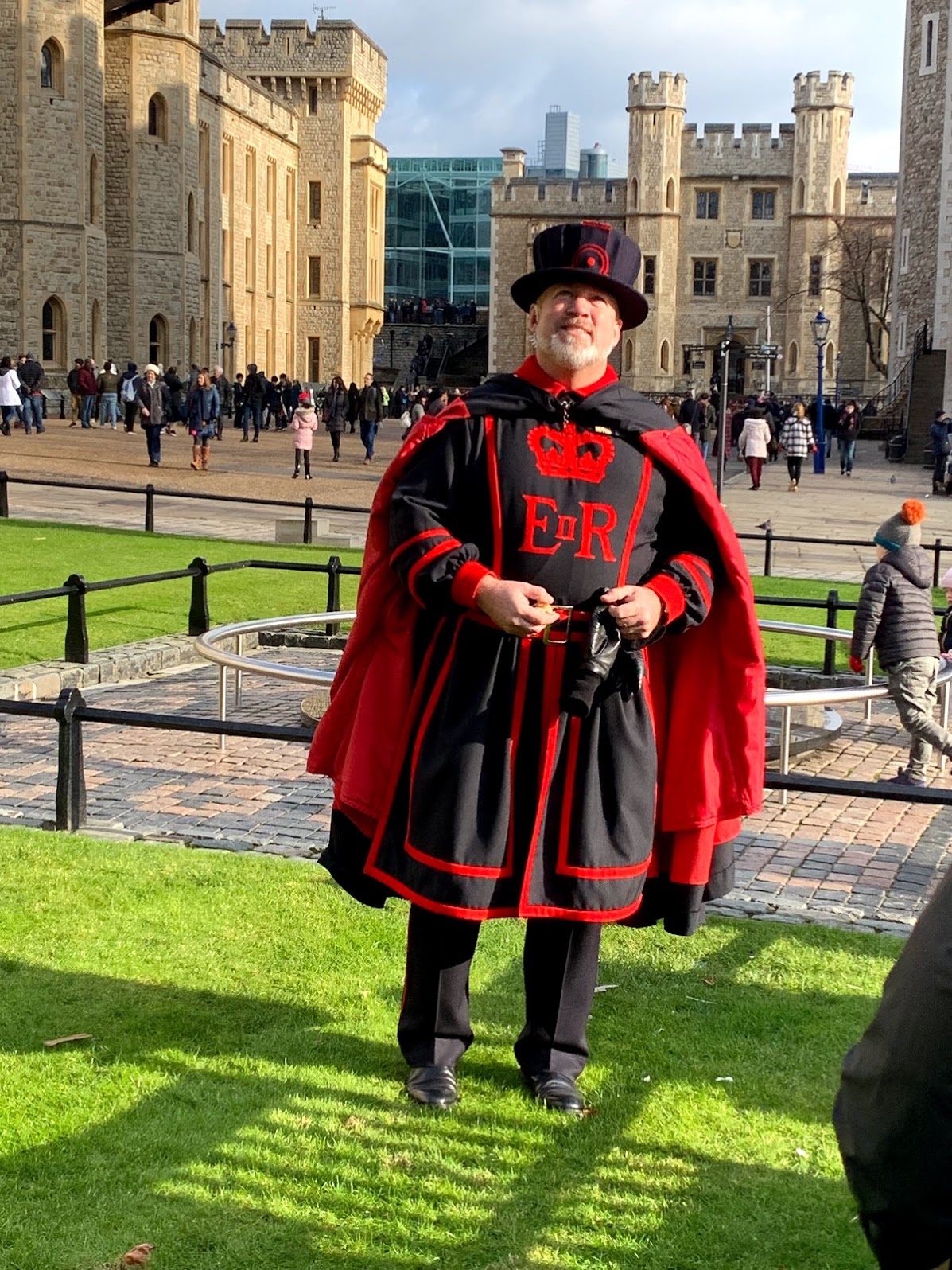
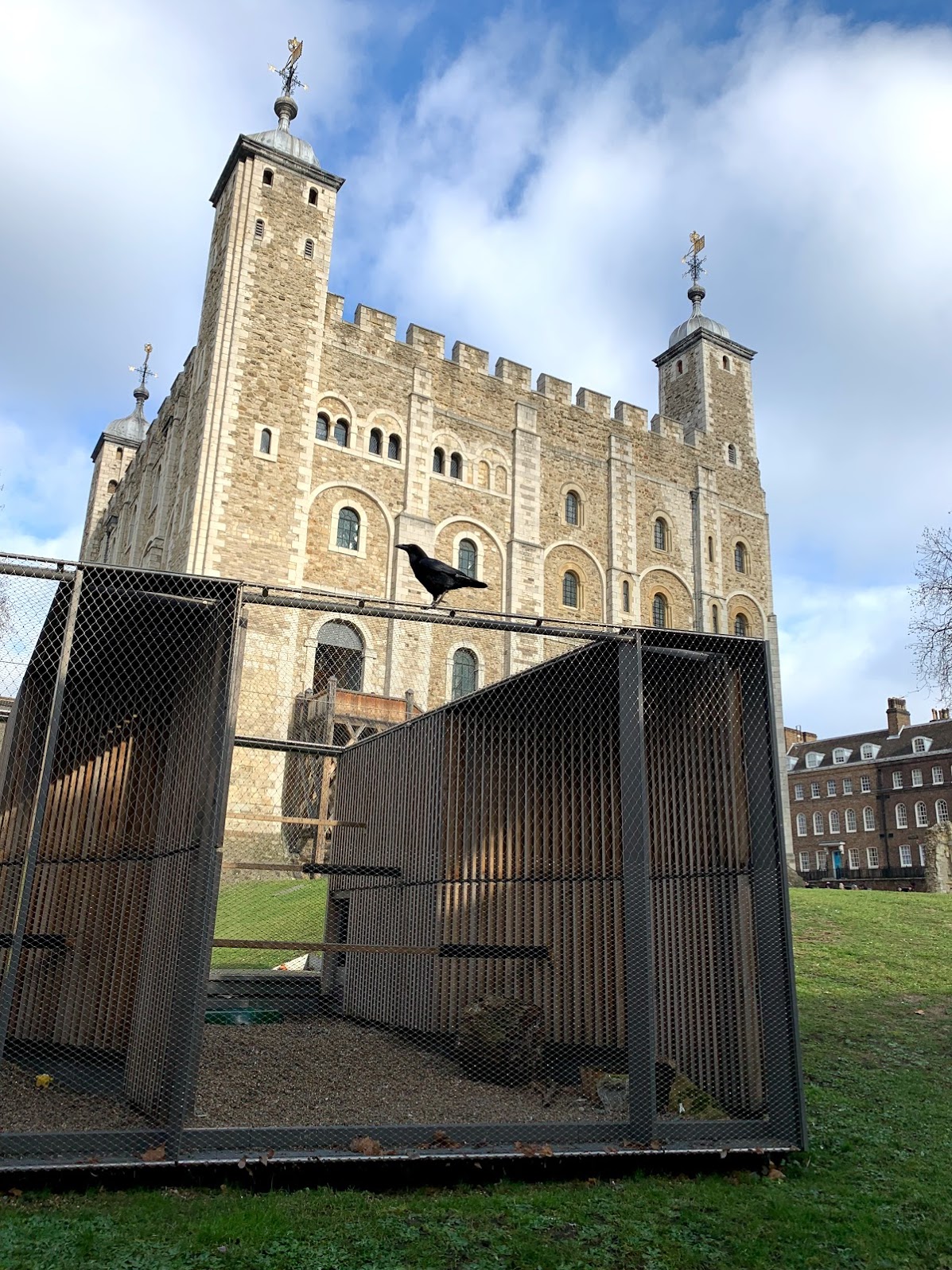
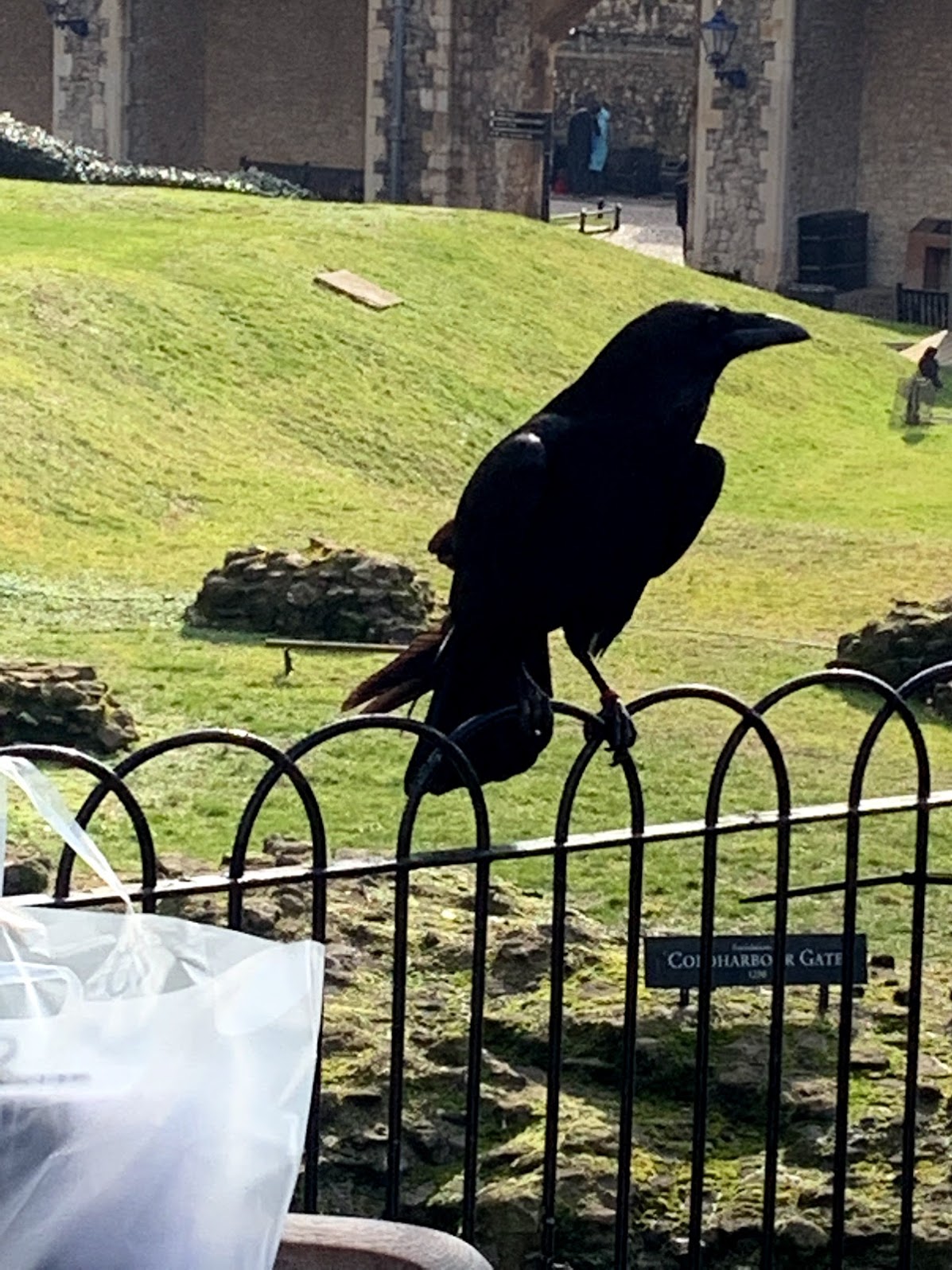
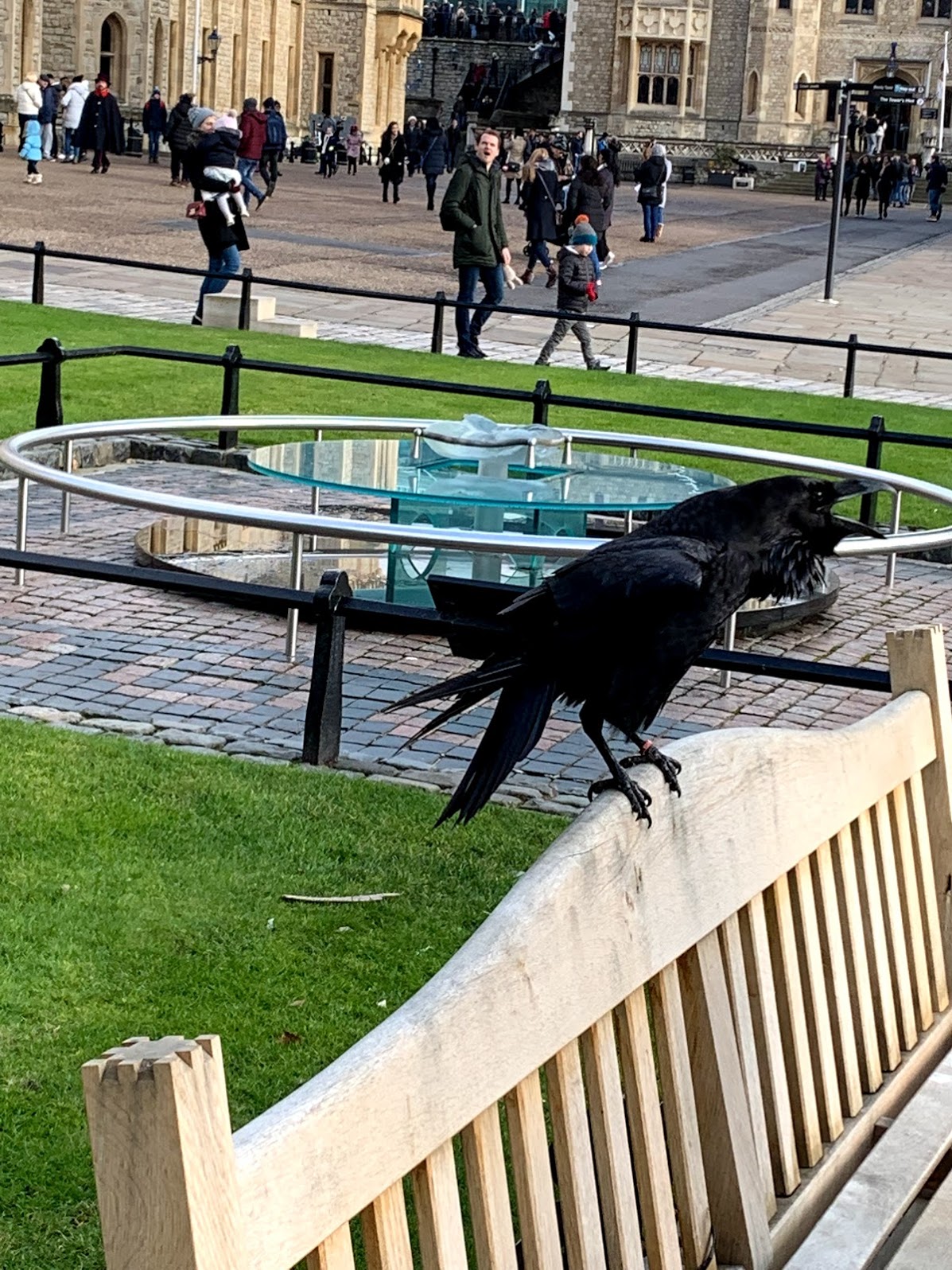
Once out of the subway system we crossed the road and entered The Tower of London. Soon after entering Faywen got very excited when she saw and heard her first raven! The Ravens of Tower Hill are icons of London. Legend tells that 6 black ravens must at all times reside in the Tower of London or else the kingdom will fall! Currently there are 7 ravens that protect the tower and monarchy. They are taken care of very well… actually they’re spoiled! The legendary Beefeaters are appointed by the Queen to watch the birds and they reside in and protect the Tower. While at the Tower we met a Beefeater named Henry who had serviced in the Royal Navy for 22 years and then was appointed for life as a Beefeater at the Tower. He told us there are 3 boys and 4 girls and his favorite two were Poppy and Melinda.
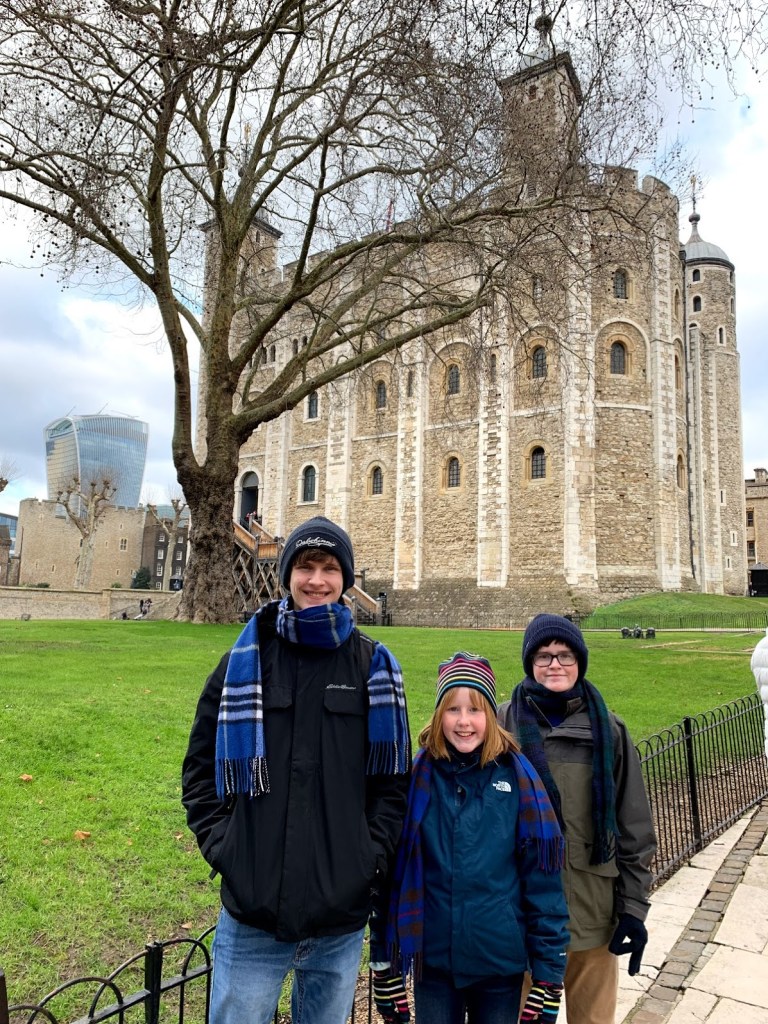
Standing in front of the White Tower
Raven on his cage
Mr. Henry a real Beefeater
The 7 ravens have luxurious accommodations and fine dining at the Tower. They even have toys to play with!
Poppy the raven keeping an eye on the visitors. Each bird has a color band on their ankle. Mr. Henry said they all have very distinctive personalities too!

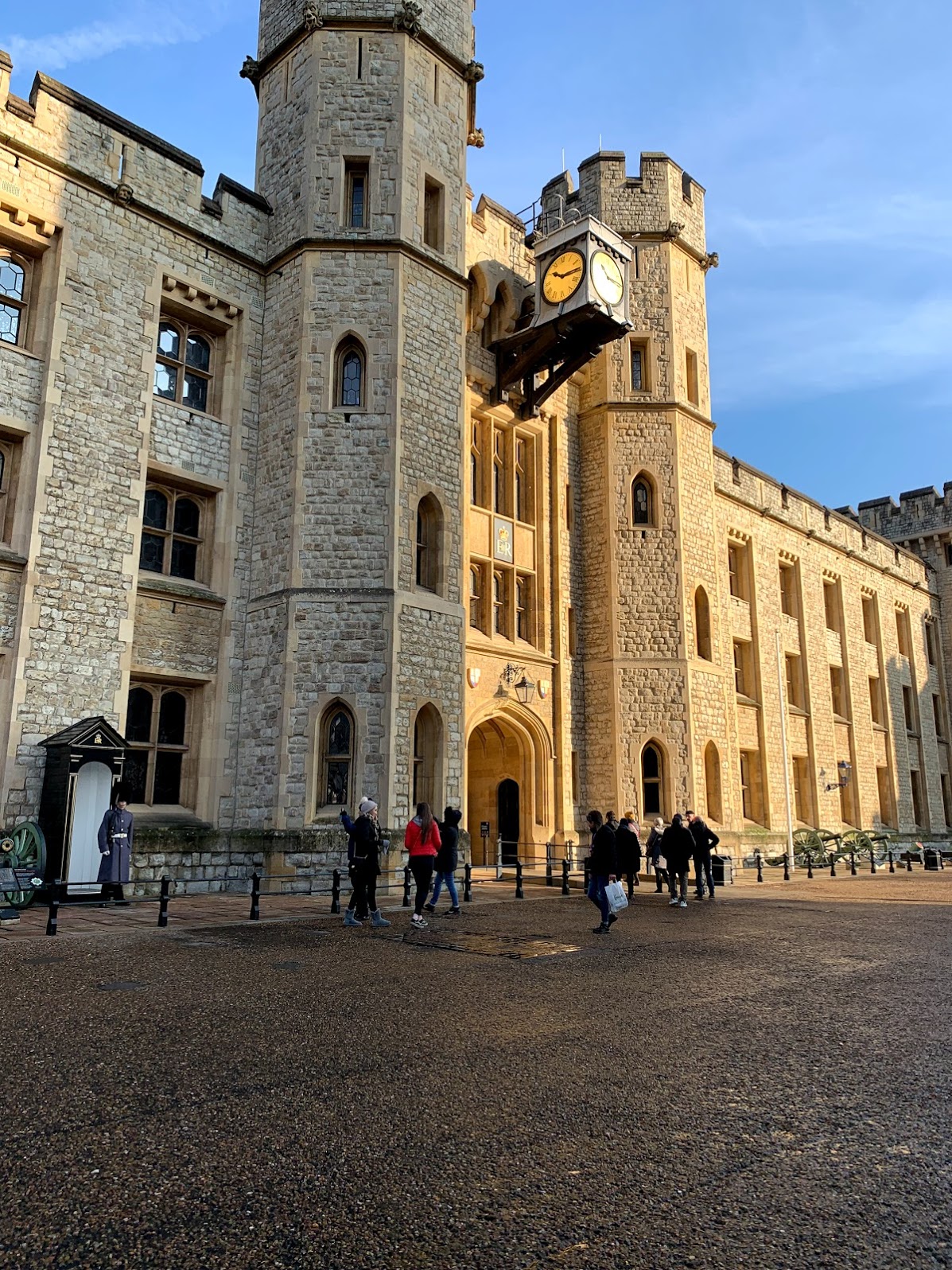
Our first stop within the Tower of London was the building where the Crown Jewels of the United Kingdom are housed. It was lovely seeing all of the stunning scepters, orbs, crowns, ceremonial religious items, and royal robes. The last case contained the crown, which was used at Queen Elizabeth II coronation in 1953. Liam asked the guard in the Crown Room about the massive metal security doors. He was very nice and told Liam a bit about the security, remarking that it’s kept in this state of the art modern vault, but when taken out once a year for the Queen to wear at the opening of Parliament, it’s only carried in a double thick leather box with minimal trained escort!
Place where the Crown Jewels are kept
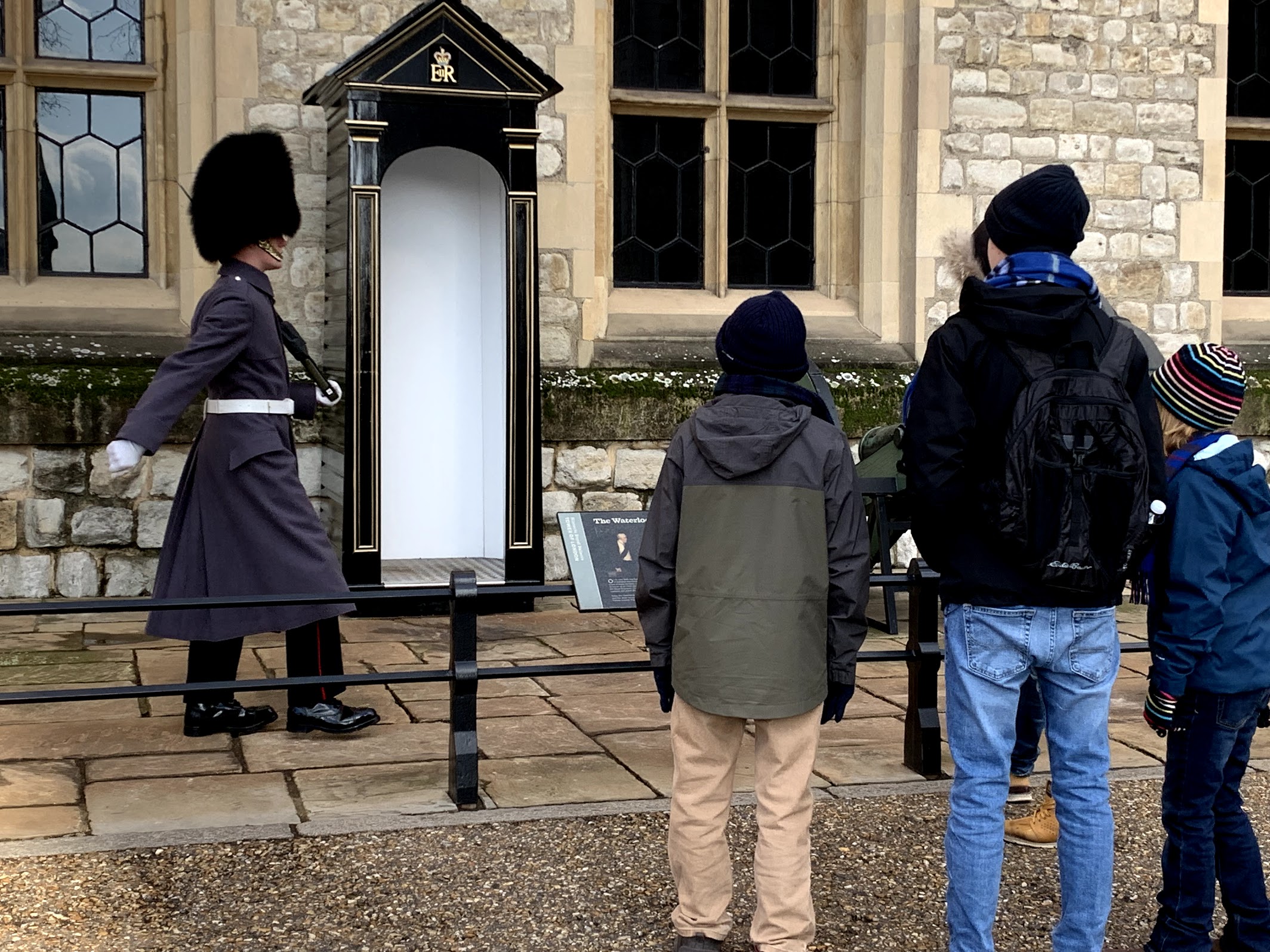
Guards outside the Crown Jewels.
The kids tried to get them to laugh. Liam got close. The guard in front of him kept averting his eyes and twitching his mouth as if suppressing a giggle.
In this photo the same guard is marching and the kids were respectful and didn’t bother him while he was marching.

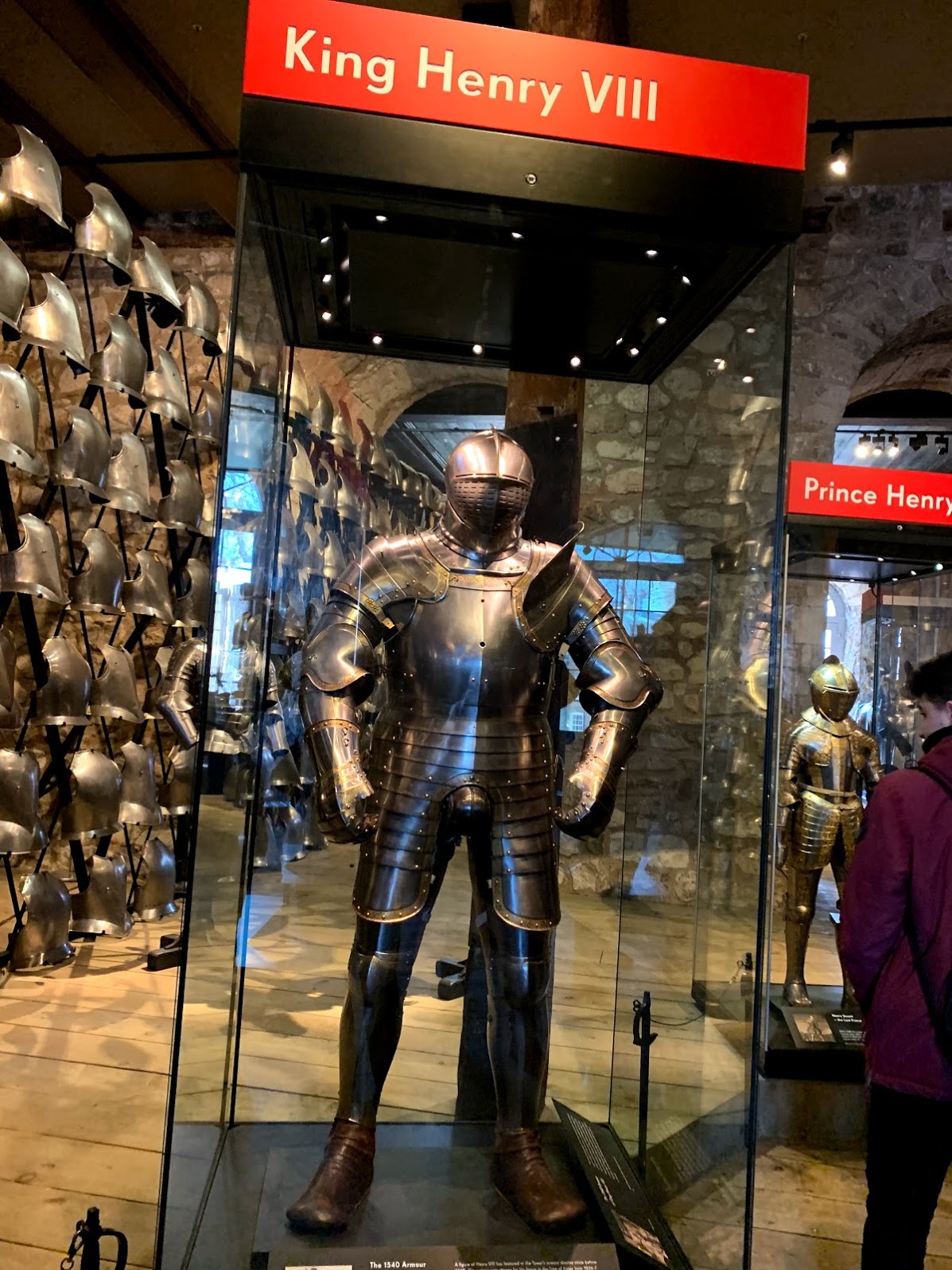
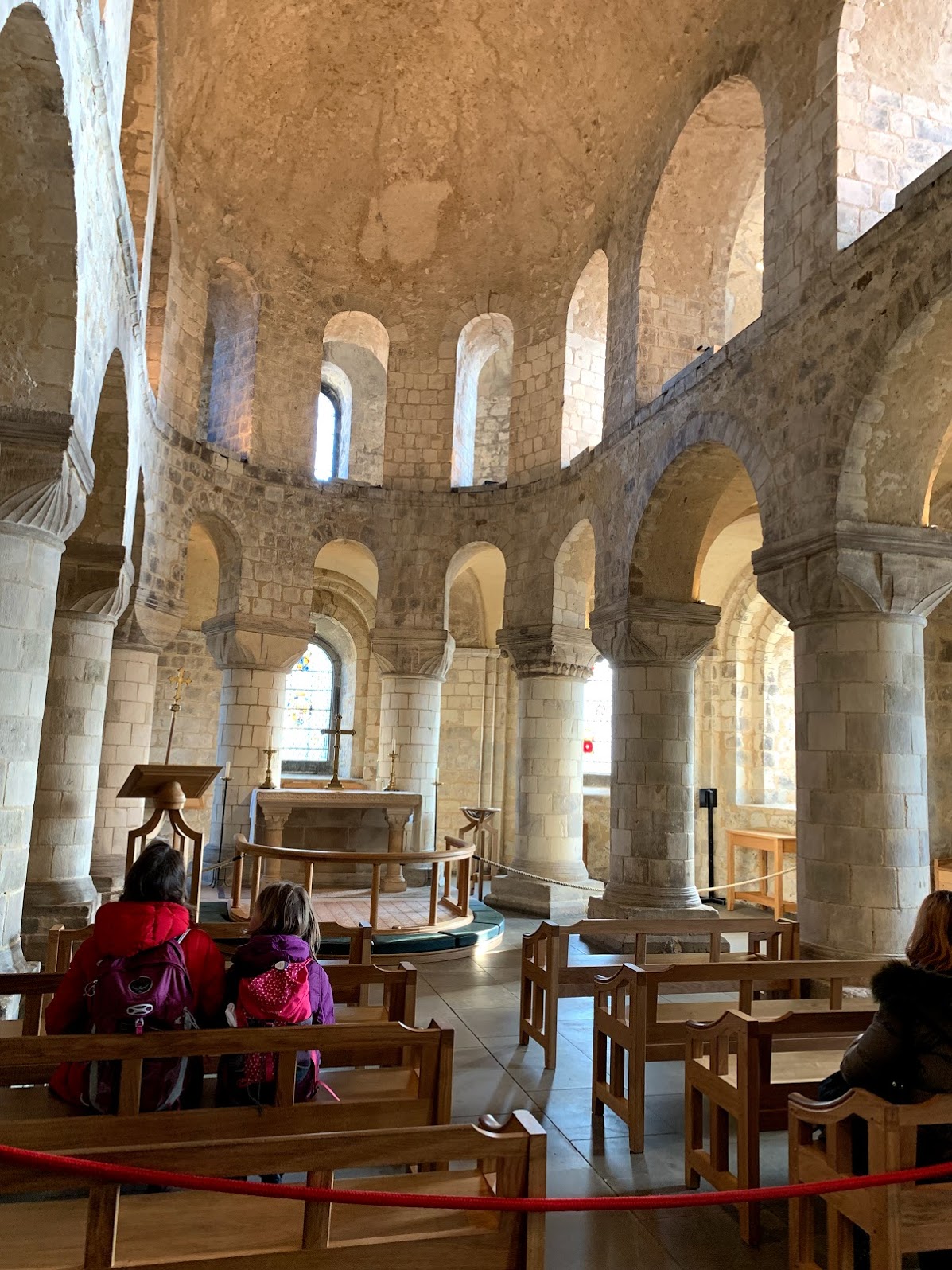
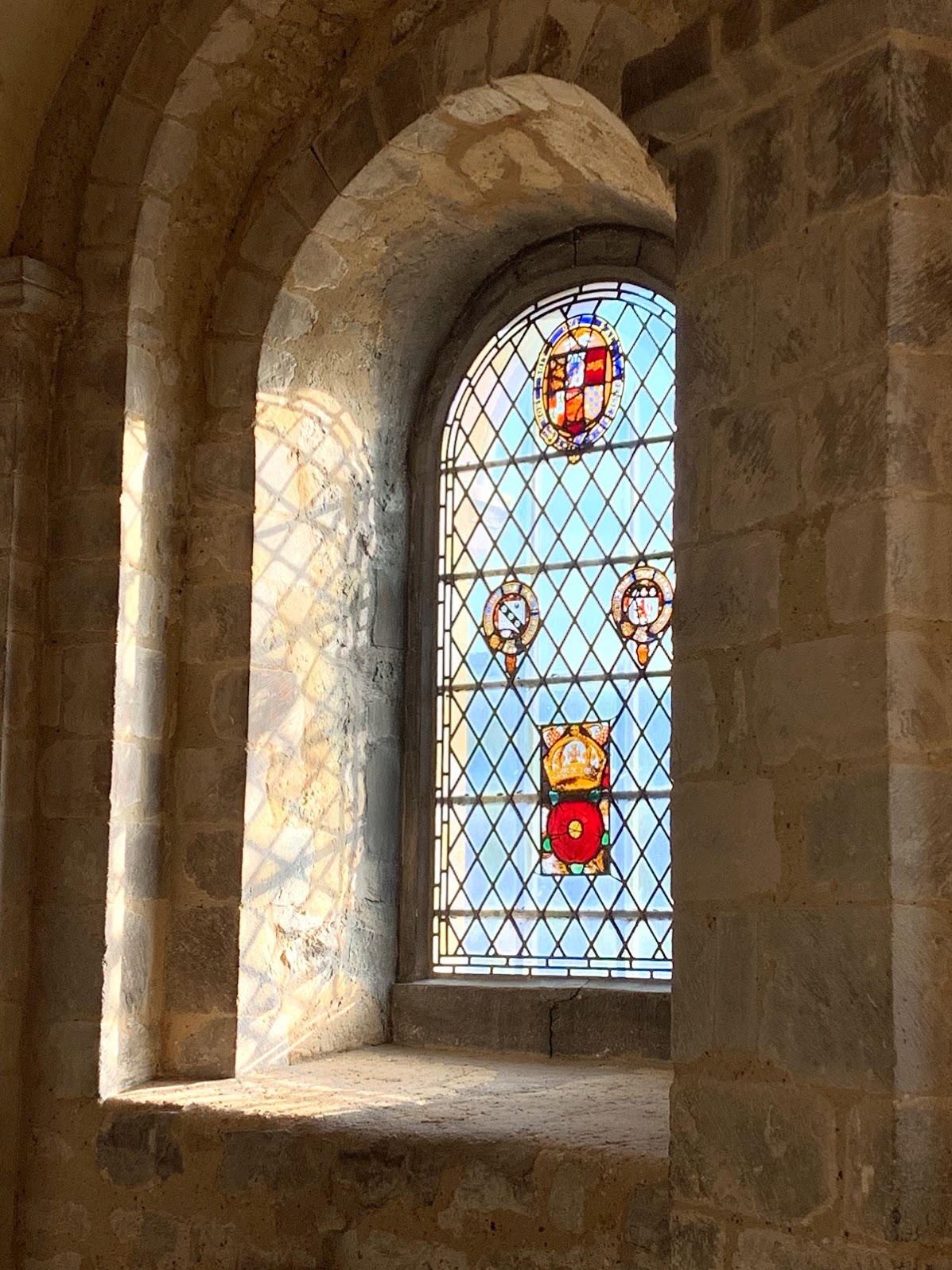
Across the courtyard from the Crown Jewels exhibition stands the 1000yr. old White Tower. This was the original Tower of London and was commissioned by William the Conqueror. As one gazed up the White Tower’s formidable size was impressive. Not to mention it sparked white in the sunlight! One must ascend a set of wooden stairs in order to reach he main door to the medieval fortress. Upon entering the boys’ mouths dropped opened as a wall of medieval and renaissance “heavy metal” met their eyes! Yes, we were in the armory with all its glorious sets of knight’s armor and weaponry! I distinctly remember the room from 2 decades ago, especially the armor of King Henry VIII and his warhorse! Up the great spiral staircase we found the first chapel built by William the Conqueror in 1068-70, St John’s Chapel. The sunlight streamed in through the stain glass windows into the simple light stone chapel making the whole place dance with rainbows!

Kings liked Heavy Metal too!
St. John’s Chapel
Simple beauty

Then the tides turned, from angelic harmony of chapel and royal apartments to the seedier darker side of the Tower of London…a place of imprisonment, death, and murder (cue creepy music). However after touring Bloody Tower and Tower Green, we were surprised to find out that most of the Tower’s prisoners were kept there during the 1500’s. This was probably due to the unrest of the Catholic and Protestant upheaval. Here’s one prisoner I didn’t know about… William Penn was imprisoned for three years in the tower before being told to leave the country. He did so and led fellow Quakers who helped settle the state of Pennsylvania! Tower Green no longer has the “block” in the courtyard, but now has a nice memorial to the dead in its place.

Here’s Melinda cawing at us. Behind her is the memorial to the dead.

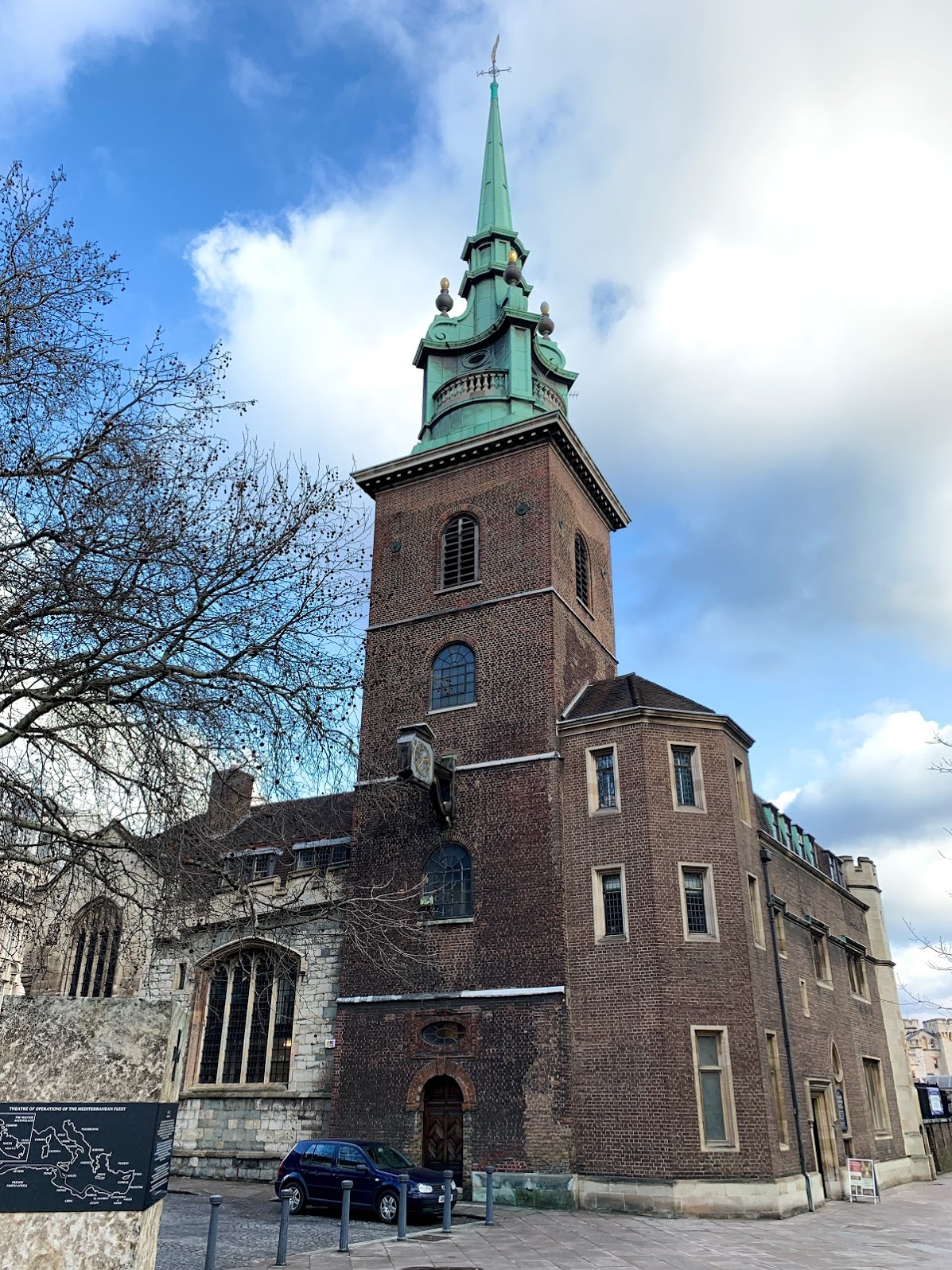
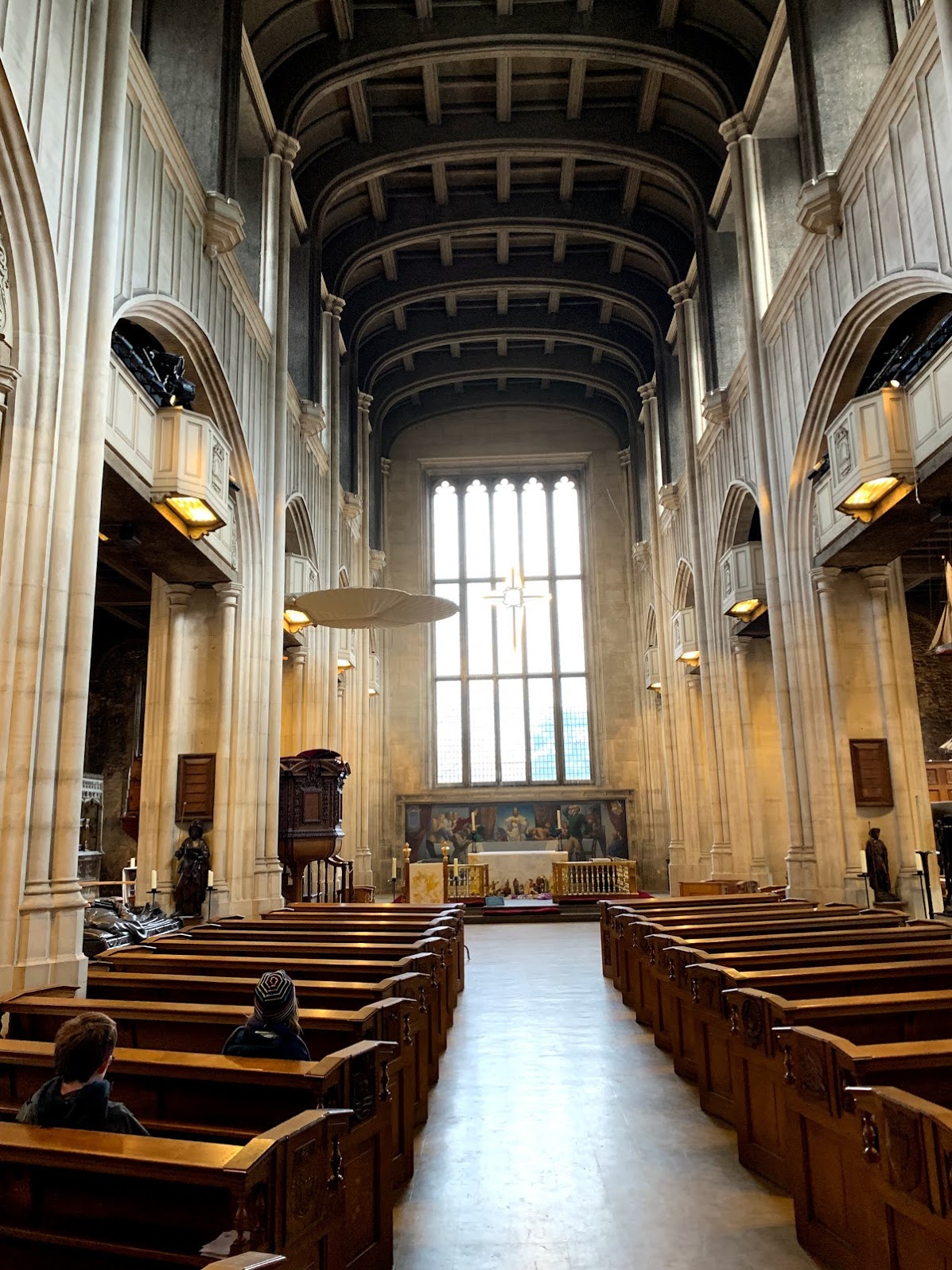
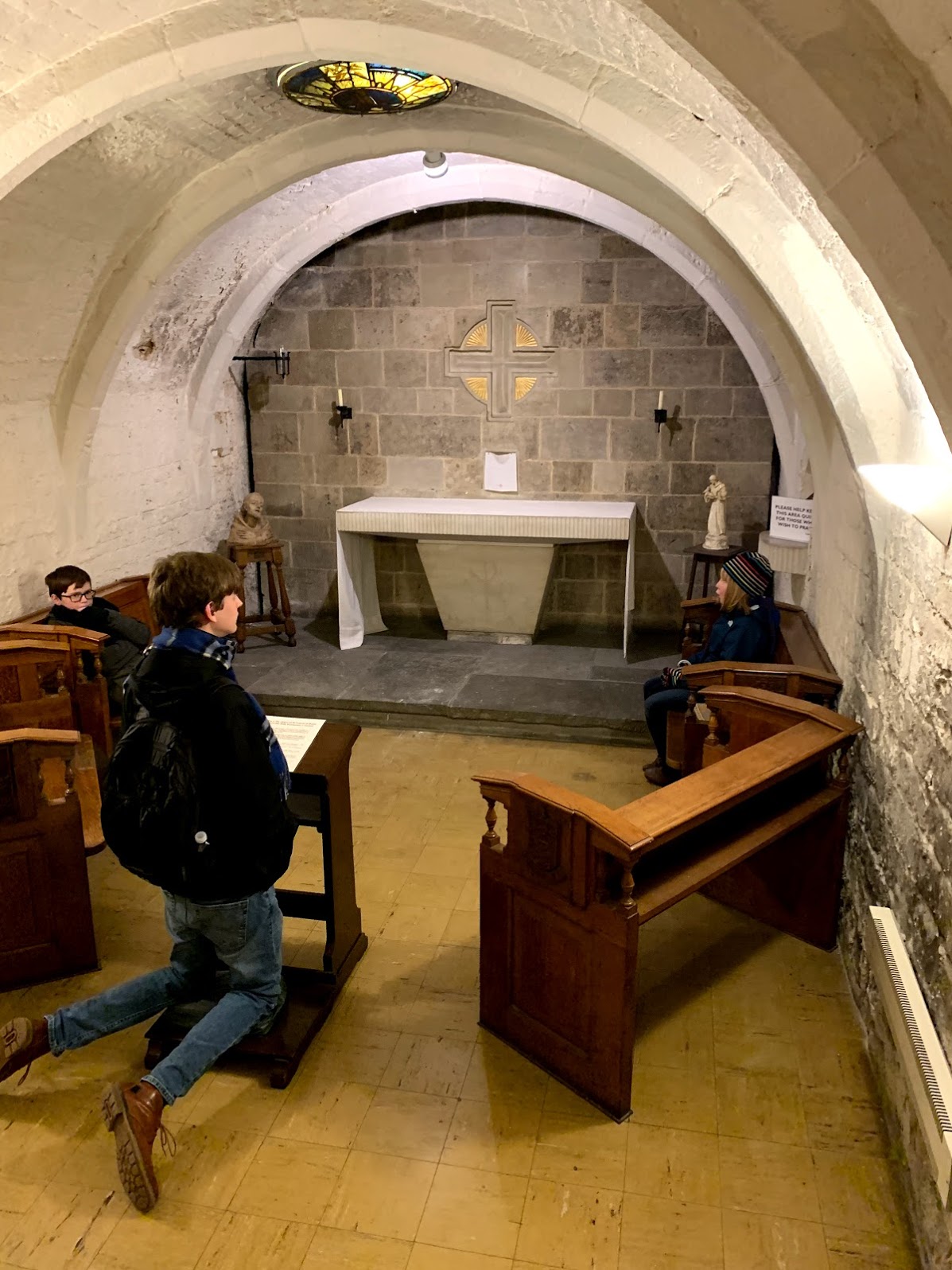
A quick tea and treats and we headed out of the tower and to All Hallows Church by the Tower. This little unknown church is the oldest in London. It was first built in 675AD out of wood, but parts of a stone church can still be seen from the 8th century. There was a lovely little chapel in the 8th-10th century undercroft called the Chapel of St. Francis and St. Dominic.  A little sign stated that it was the quietest place in all of London. The chapel also had incredible acoustics. Liam started singing in his deep bass voice and stopped when he and I felt the vibrations move through our bodies. It seems he found the exact pitch of the stone masonry within the little chapel… C3 to be exact! It was an eerie and amazing experience feeling the single C3 pitch vibrate off the ancient stones and through your body! This is also the church where President John Quincy Adams got married.
ALl Hallows Church by the Tower
Inside All Hallows:
It was remodeled in the 1800’s
Chapel of St. Francis and St. Dominic

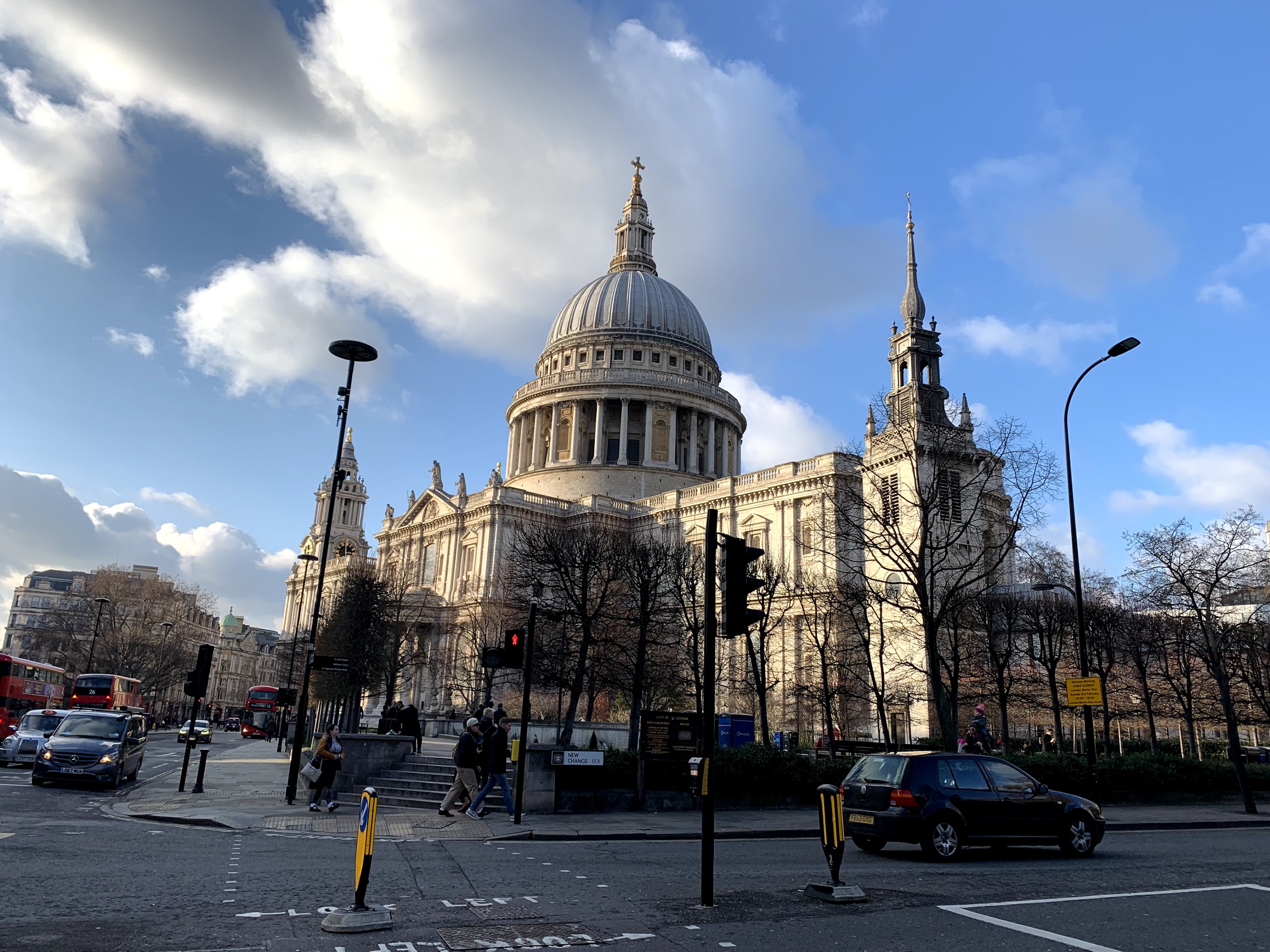
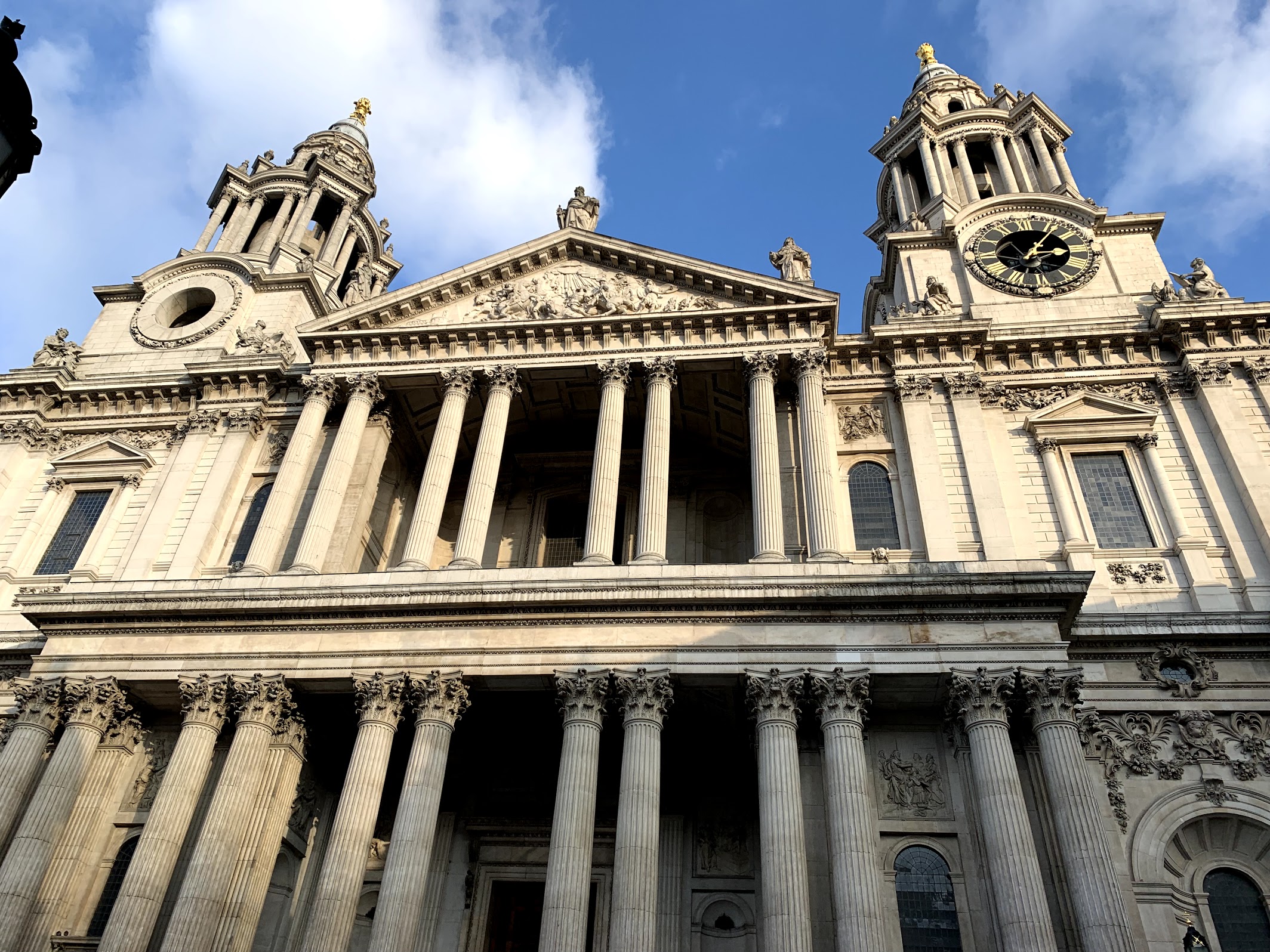
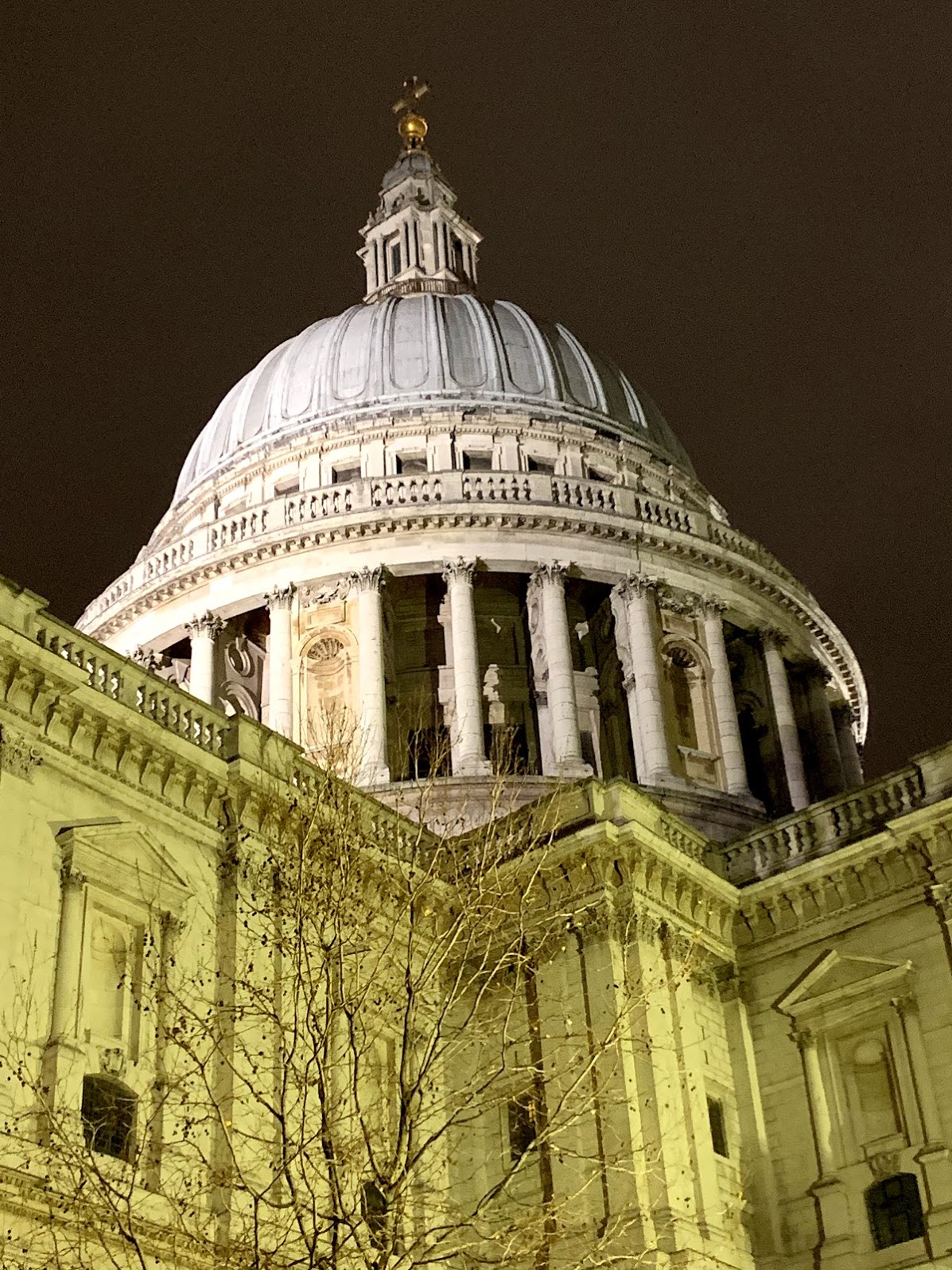
Following the bank of the Thames River we were greeted with the famous white dome of St. Paul’s Cathedral. Climbing the front steps we entered this other well-known church of London. Royal weddings and funerals have taken place here including the first State funeral of former Prime Minister Winston Churchill back in the 1960’s.
St. Paul’s Cathedral, London
Looking up from the stairs
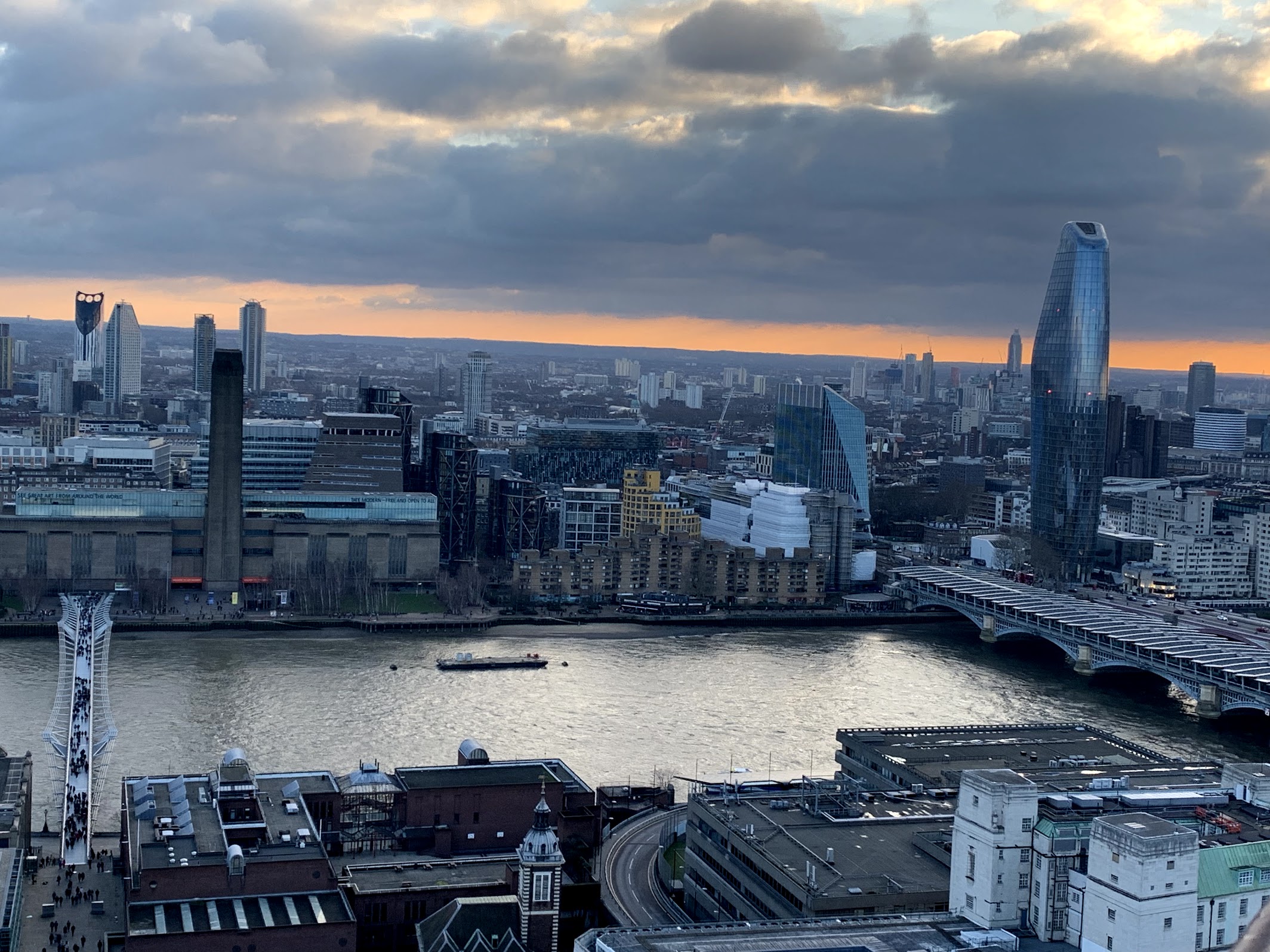
View of the Thames River from the Dome of St. Paul’s

St. Paul’s dome weighs upwards of 62,000 toms and bodes one of the best views of all London. We climbed the 579 steps to the top and carefully navigated the 2ft. wide walkway that surrounds the dome. The sun was low on the horizon and peeped out below the clouds. It made the city glow in a red-orange hue that danced upon the water of the Thames River. From tip top to the very bowels of the building we found ourselves in the massive undercroft looking at the magnificent graves of Lord Horatio Nelson (we can’t seem to get enough of this guy first seeing his ship, then monument, now grave) and also the graves of the Duke of Wellington and Arthur Sullivan (as in Gilbert and Sullivan).

After Mass

At 4:30 docents and church staff invited visitors to join in the Sung Eucharist for Candlemas. This is the service held on Feb. 2nd to recall and celebrate Jesus’’ presentation at the temple when he was 40 days old. We knew the service was going to take place so we gathered with the rest of the parishioners in the back of the sanctuary. We were given candles and had a nice time speaking with church members. At 5:00 the clergy and choir came and stood in front of where were were and Mass began. As the choir sang the candles were lit and we all processed up the majestic aisle of St. Paul’s Cathedral only with candlelight. Words alone cannot express the awe and beauty of this act of simple humble worship. Once at the front we filed into our seats and worshiped Christ. The voices of the boys/men’s choir echoed off the marbled walls and the incense ascended into the heavens of the dome. Since we are all professing communed Christians, we were able to take Communion. Singing the congregational responses and hymns was lovely! After Mass we got to greet the Vicar and he had a nice chat with us all. He immediately inquired if folks we knew in Michigan were safe and warm because the Polar Vortex. It has made the papers over here! We even saw an article in a newspaper the day before on the train to Hampton Court!
As we descended the great staircase of St. Paul’s we all felt spiritually fed. It was nice to go to church after traveling around for three weeks. God is still a central part of life in central London!

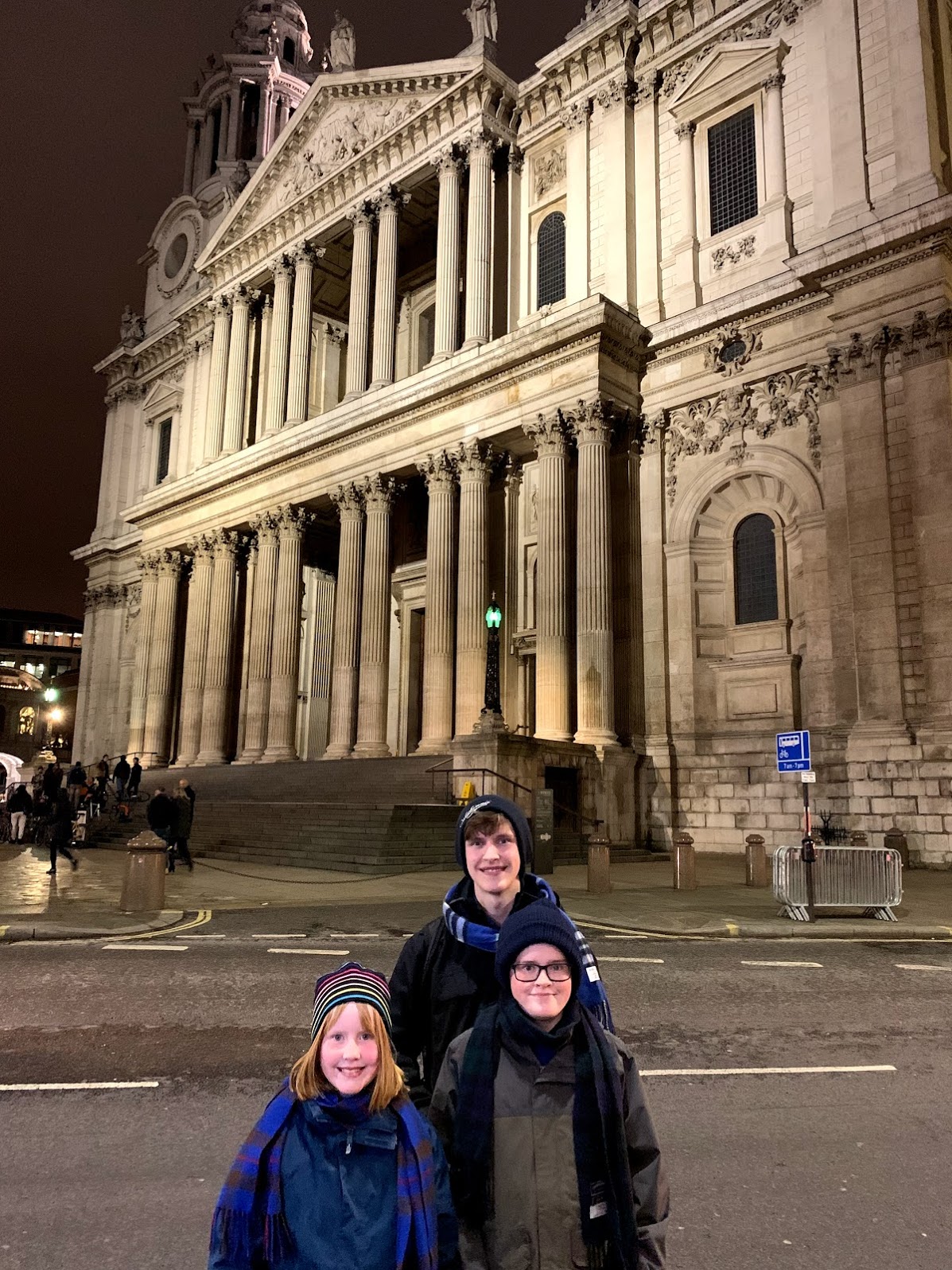
St. Paul’s at night

London Day 4: Hampton Court

“Ding ding” rang the bell as we boarded our train on platform 2 at Waterloo Station in central London. Southwest Rail is an above ground commuter train that services the greater London area and has a direct line to Hampton Court. This little town is home to England’s largest palace also named Hampton Court.

Waiting for our train at Waterloo Station

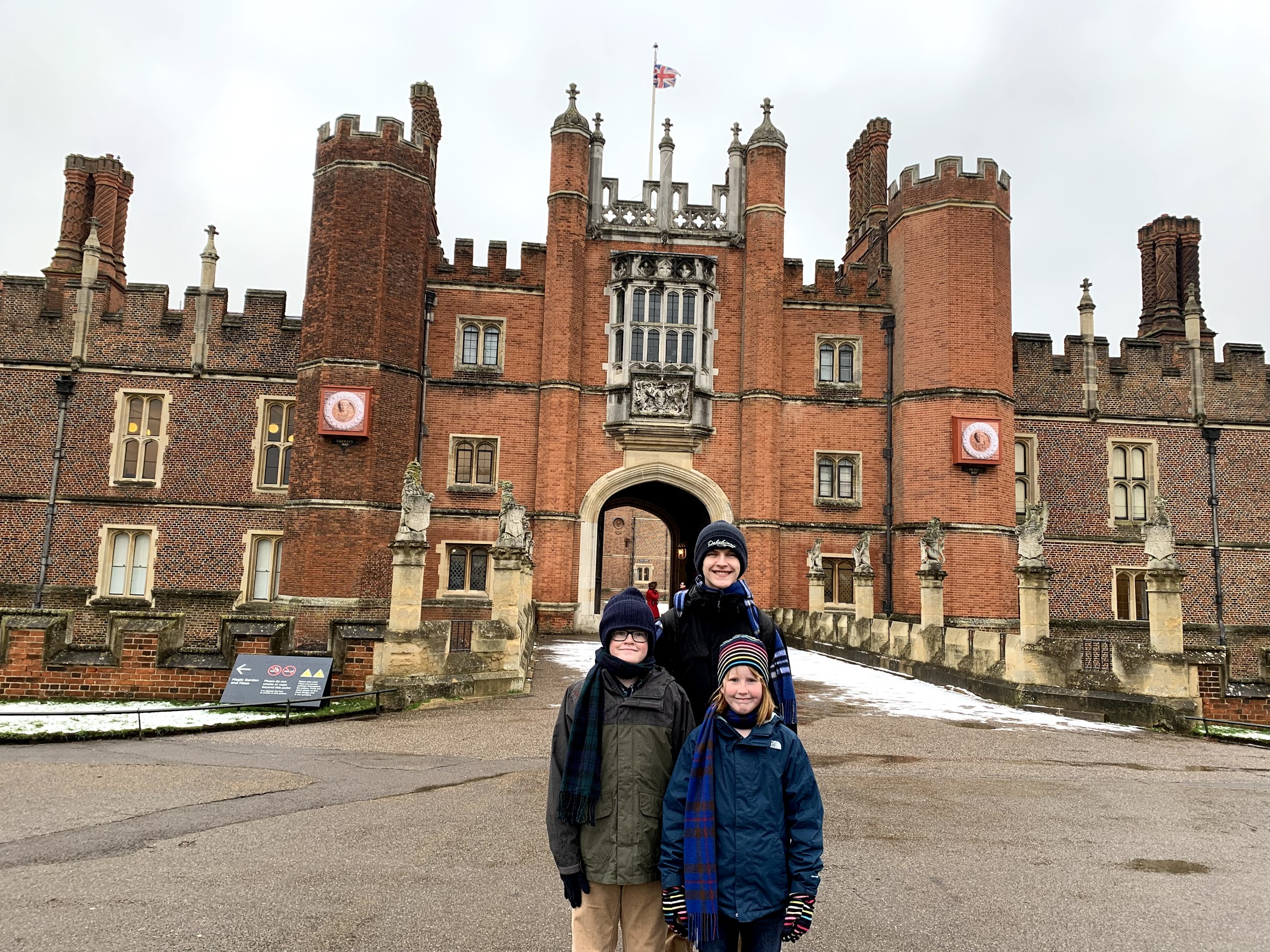
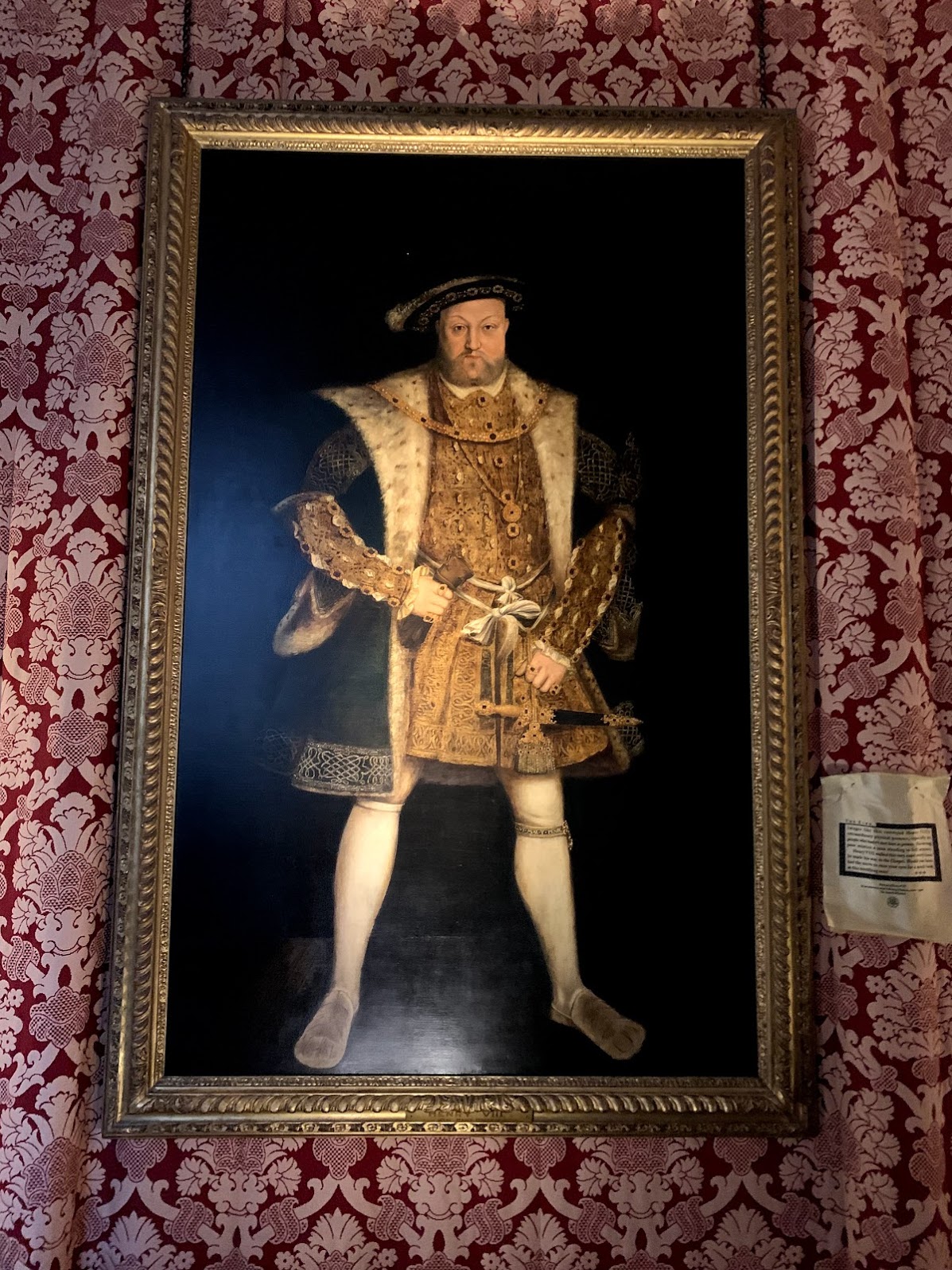
Wealthy aristocrats have lived in the area since the 12th century, but it wasn’t until Cardinal Wolsey, began construction on his own home along the Thames River that Hampton Court would become a favorite of British kings and queens. Young Henry VIII was advised by Wolsey and often visited him at Hampton Court. As Wolsey’s “palace” grew Henry became obsessed with the beauty of the place and wanted it for himself. He didn’t like the fact that a Cardinal had a grander house than the king! Eventually Wolsey was persuaded to hand over the palace to Henry, but allowed to still live on the premises. Years later Wolsey was forced out of the palace after he failed to petition the Pope for Henry’s divorce from his queen, Catherine of Aragon.

Hampton Court:
I have a photo of myself standing in this exact spot when I was 17 yrs. old.
King Henry VIII ca. 1550

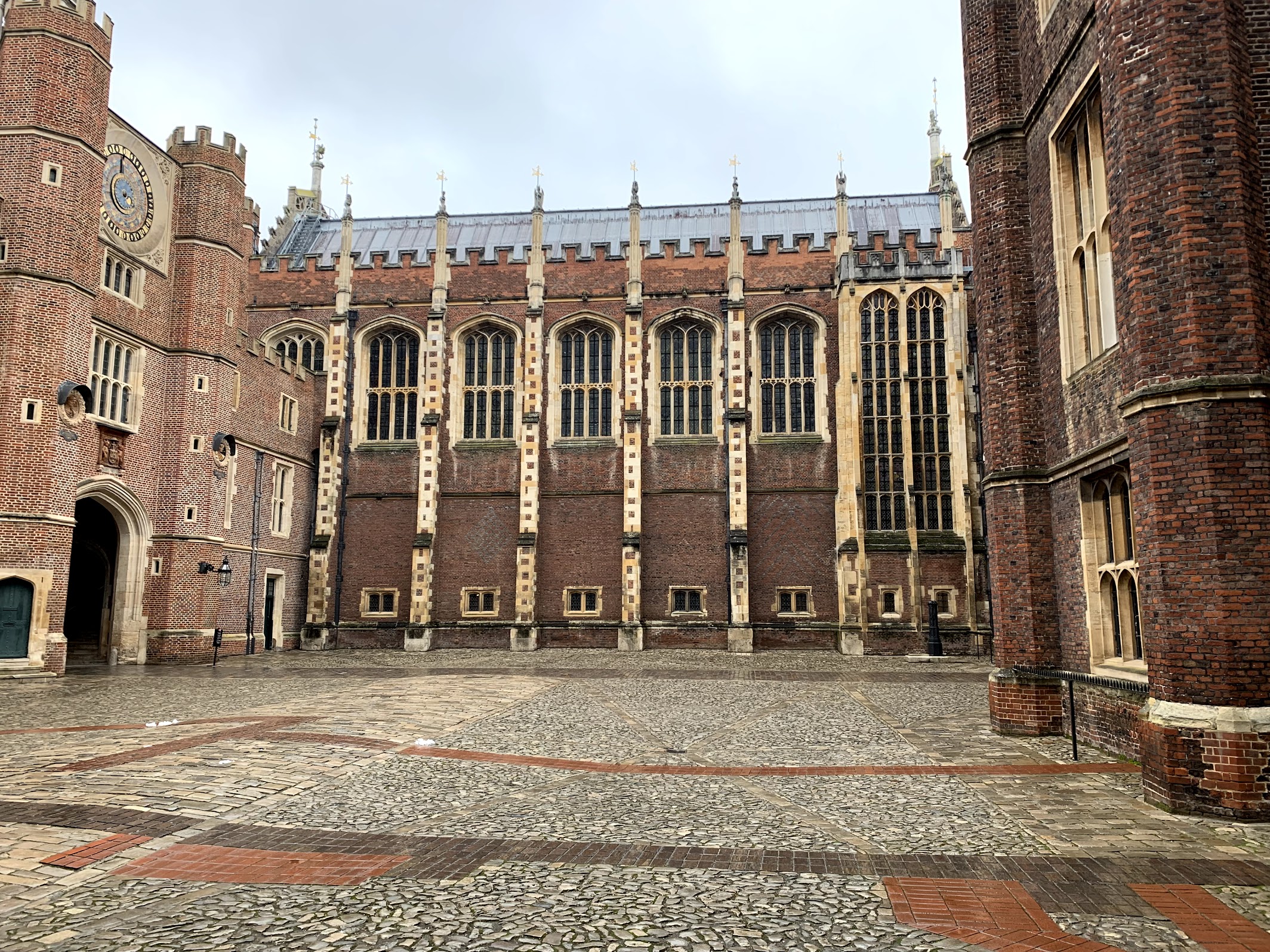
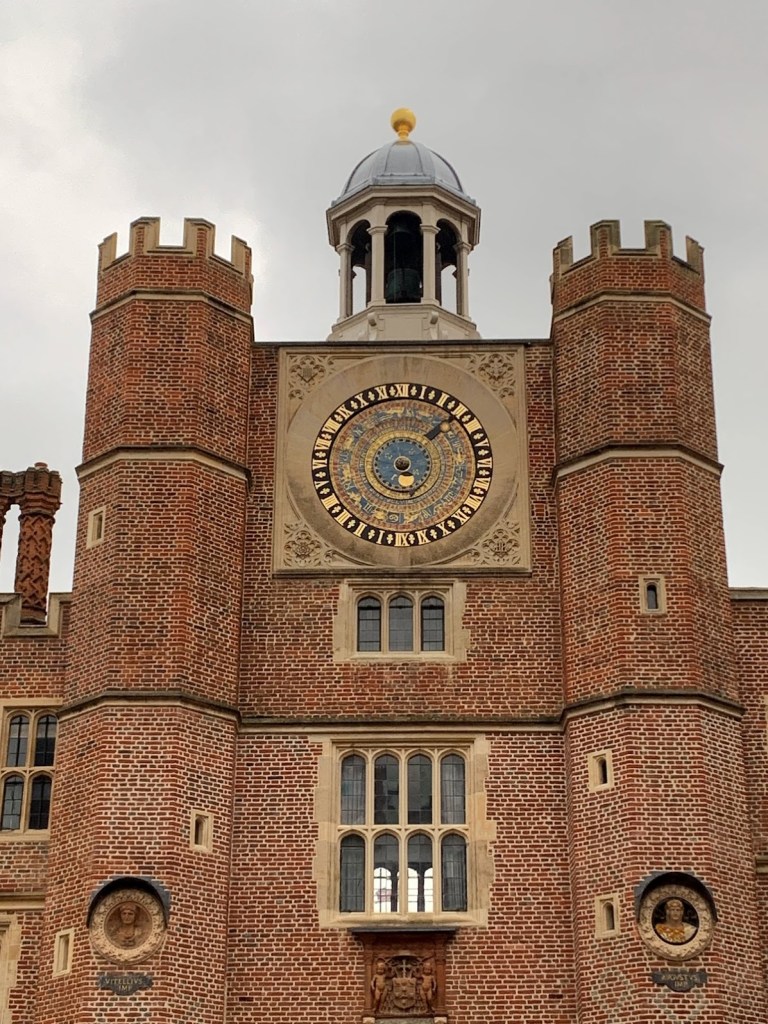
Henry built a Great Hall, surrounding royal apartments, and even installed an amazing clock in the main courtyard tower. This clock still chimes the hour and quarter hours faithfully today. It also depicts the zodiac, phases of the moon, and the tide of the River Thames. Henry enjoyed hunting on the grounds and holding lavish banquets in the main hall. Hampton Court was his favorite palace.

The Great Hall as seen from Clock Square
Clock Tower
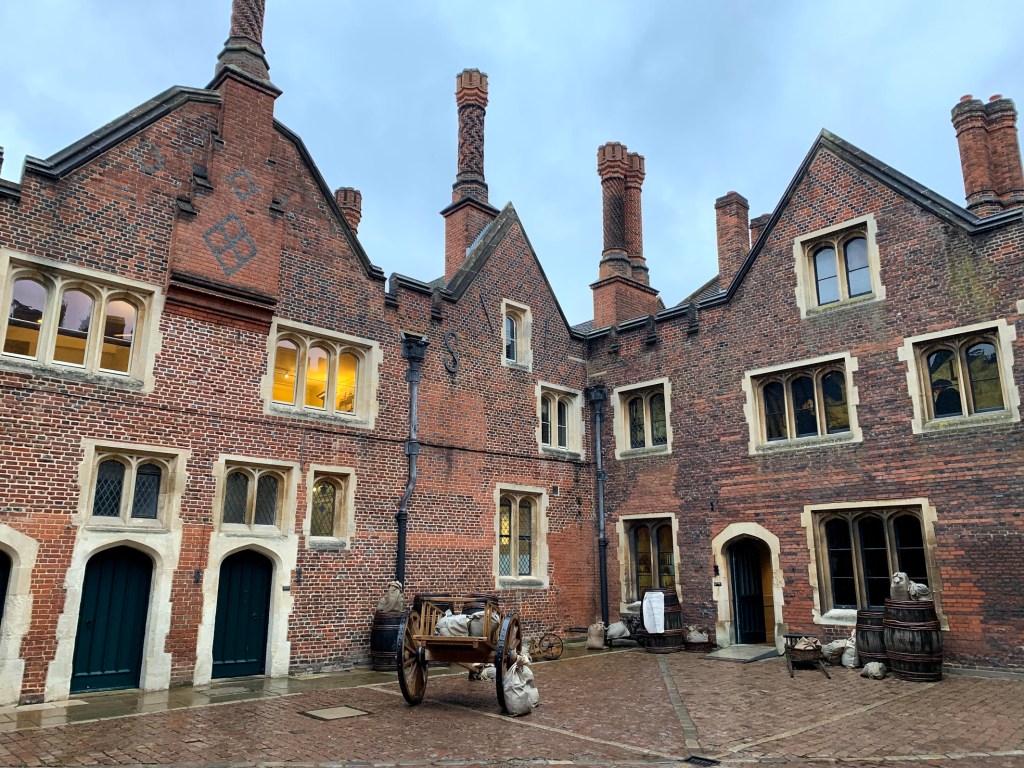
Servants rooms near the kitchens:
Hampton Court is so large that there is literally a village inside for all the servants and tradesmen who worked for the Court and Royal Family.

Henry’s son, Edward IV and later his daughter the famous Queen Elizabeth I, also loved the palace. British kings and queens all the way through George II and his wife Caroline used Hampton Court. William III and Mary II added onto the original Tudor aged palace, however Mary died before seeing the finished baroque style home that was inspired by Louis XIV’s Palace of Versailles. Queen Anne added a few more feminine touches after her sister Mary died and the upstairs apartments were eventually fitted with the tastes of George I and his son, George II. Stunning gardens were added and the hunting park was turned into a massive maze and arboretum. The Stuarts and Georgian royalty kept intact the original Tudor features from Henry VIII’s time as a “relic to bygone days”. Good thing for us they did so!

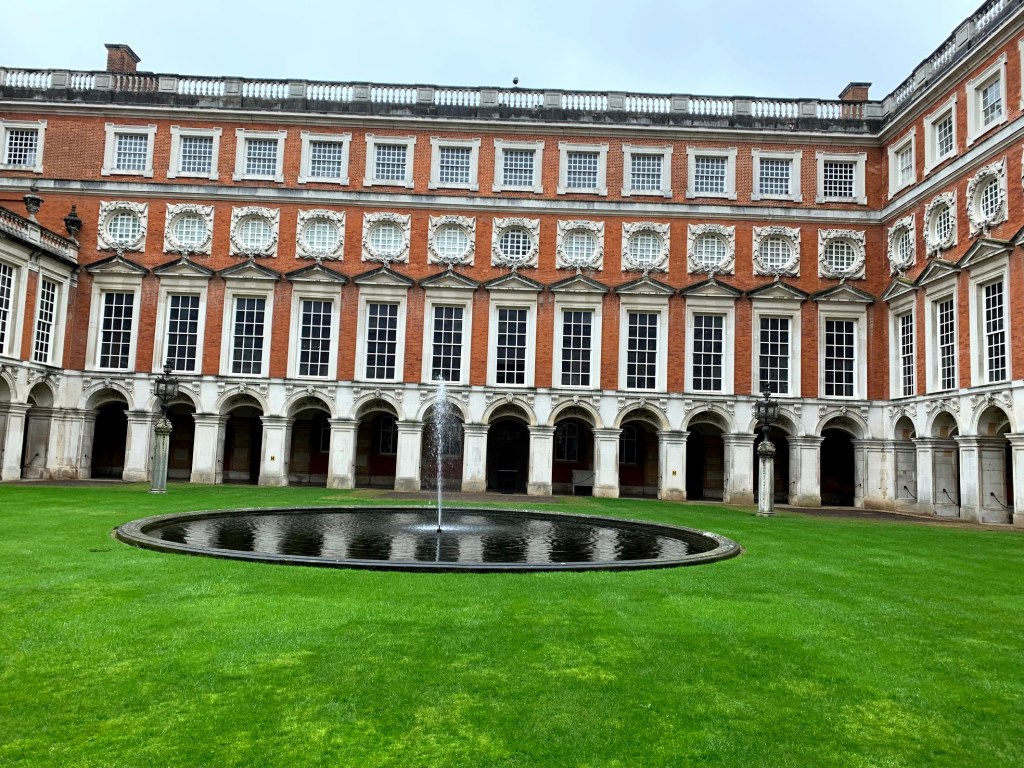
Baroque Palace of William III and Mary II:
It was completed in 1700 and connects to the the old 16th century Tudor Palace.
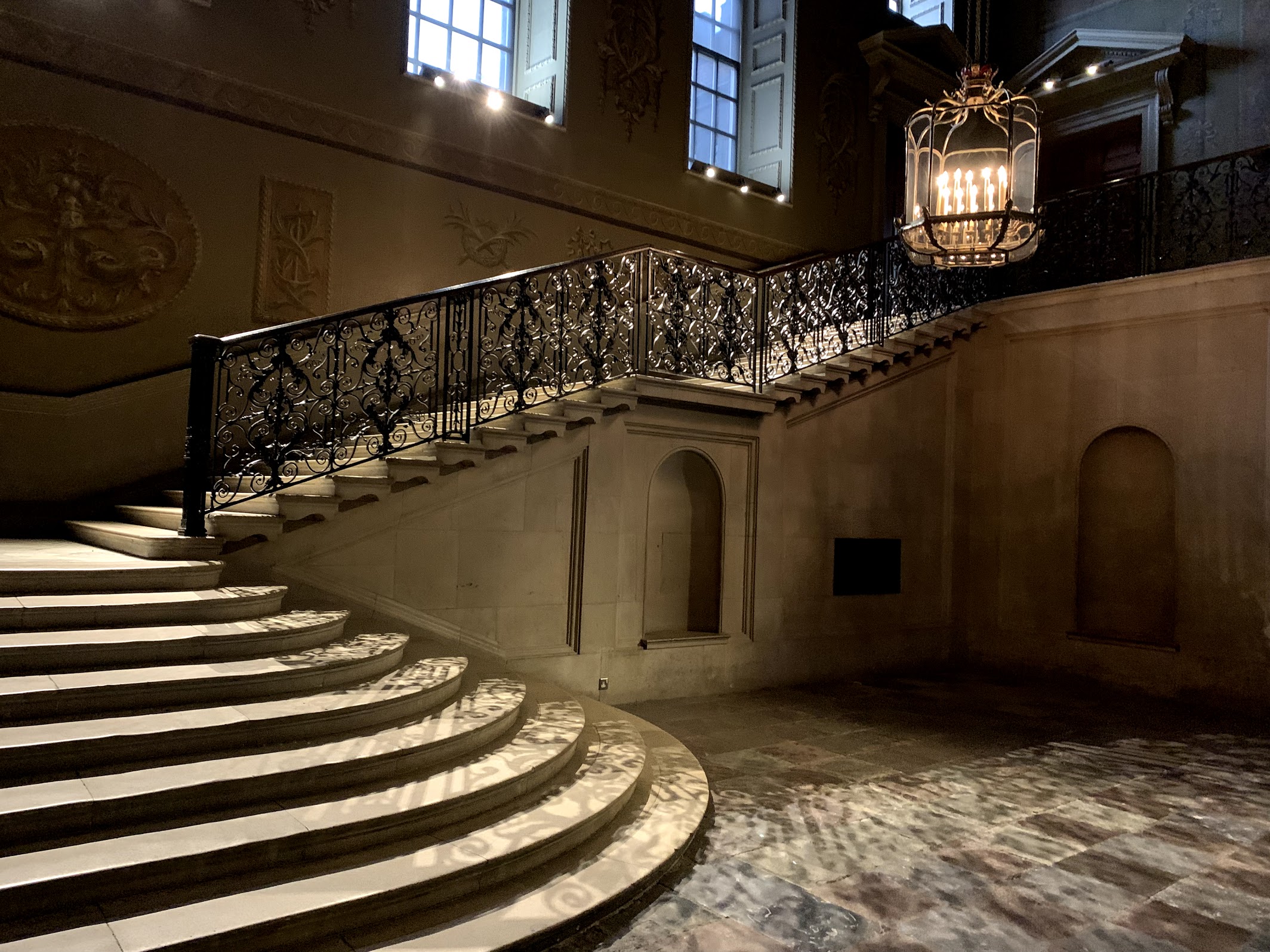
Queen’s Staircase in the Baroque palace.
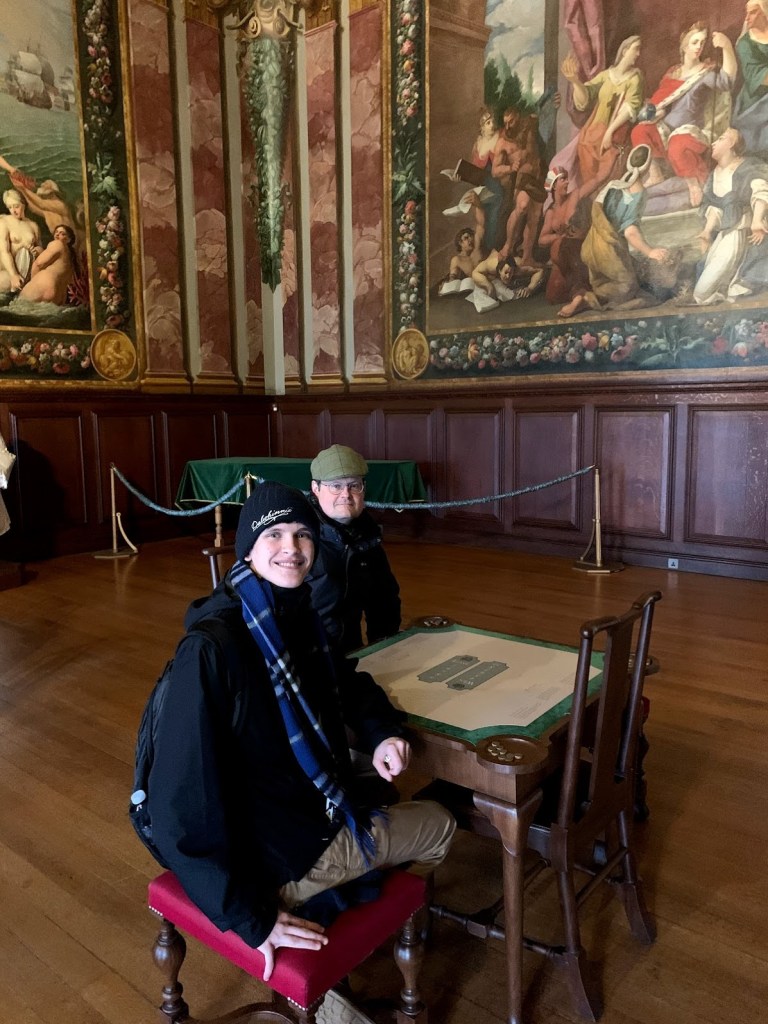
Playing games in King George 1st Drawing Room.
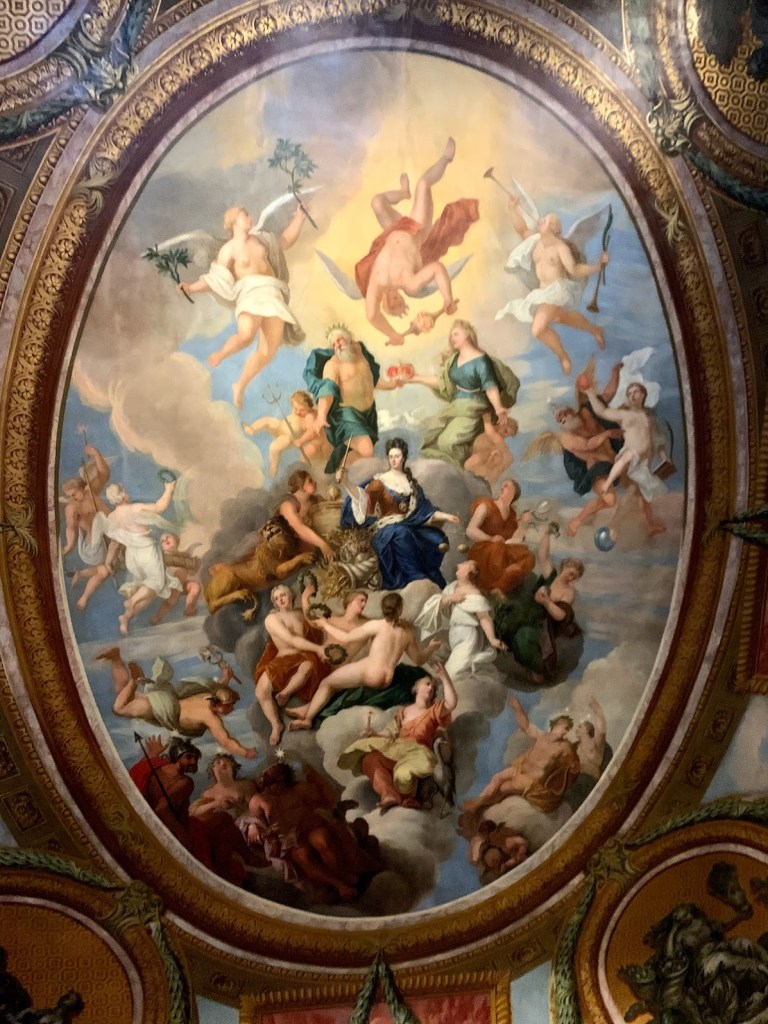
Ceiling of the Drawing Room
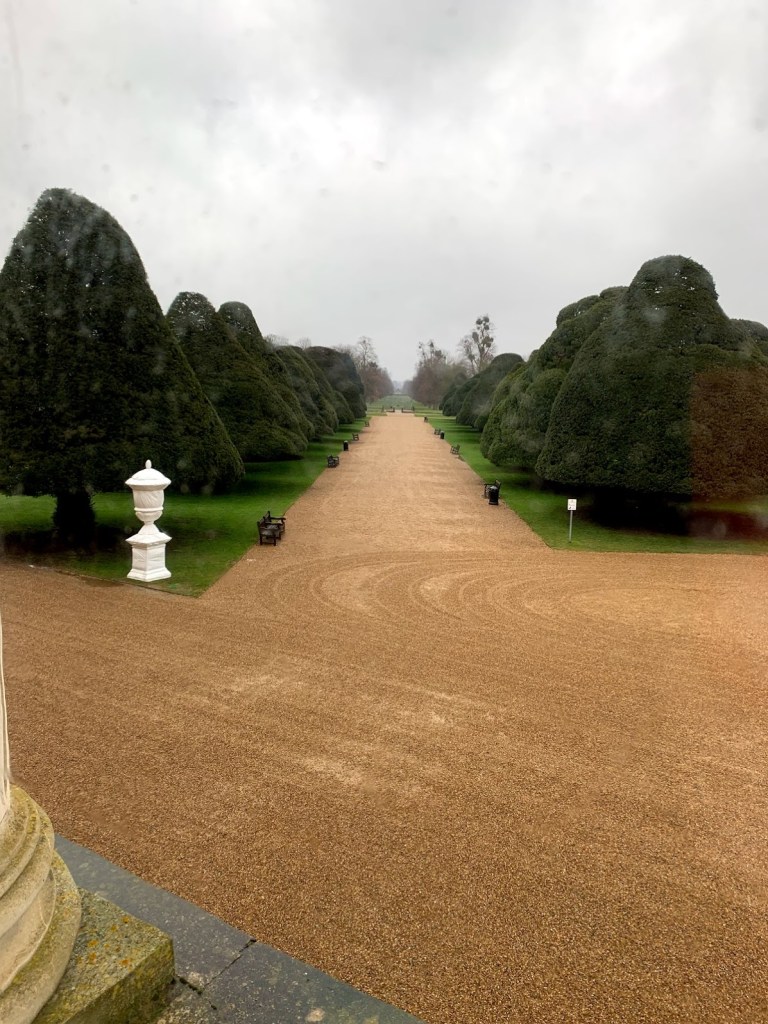
The arboretum
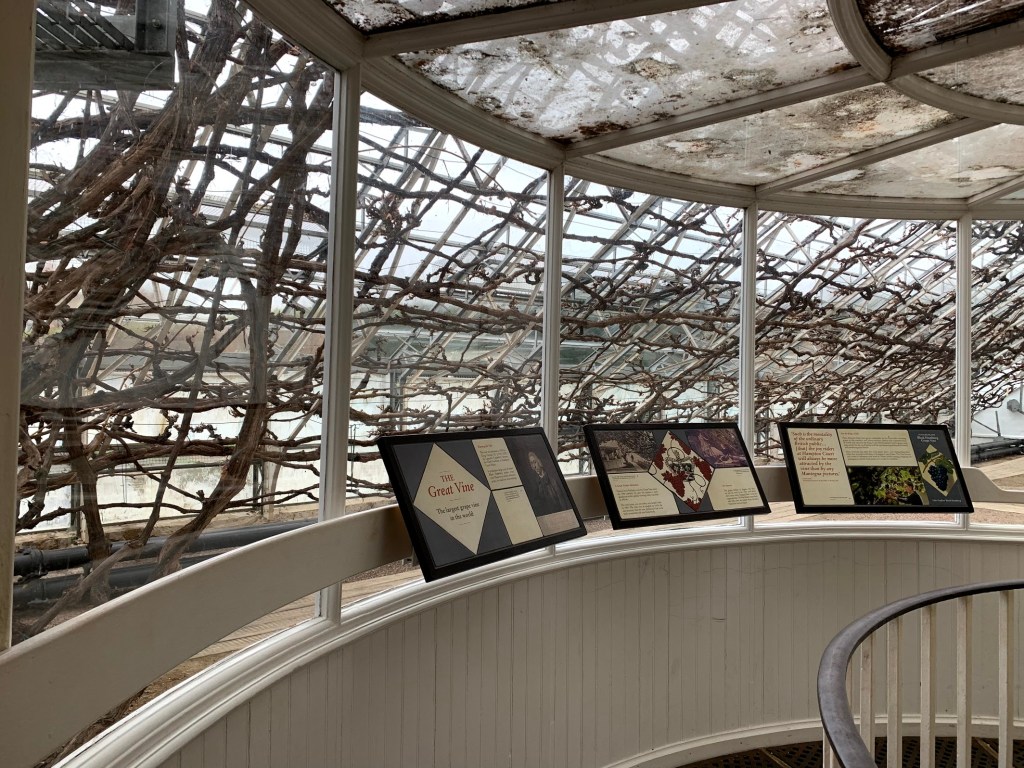
This is the oldest grapevine in the world. It was planted in 1768 and still produces a crop of sweet “eating” grapes in September.
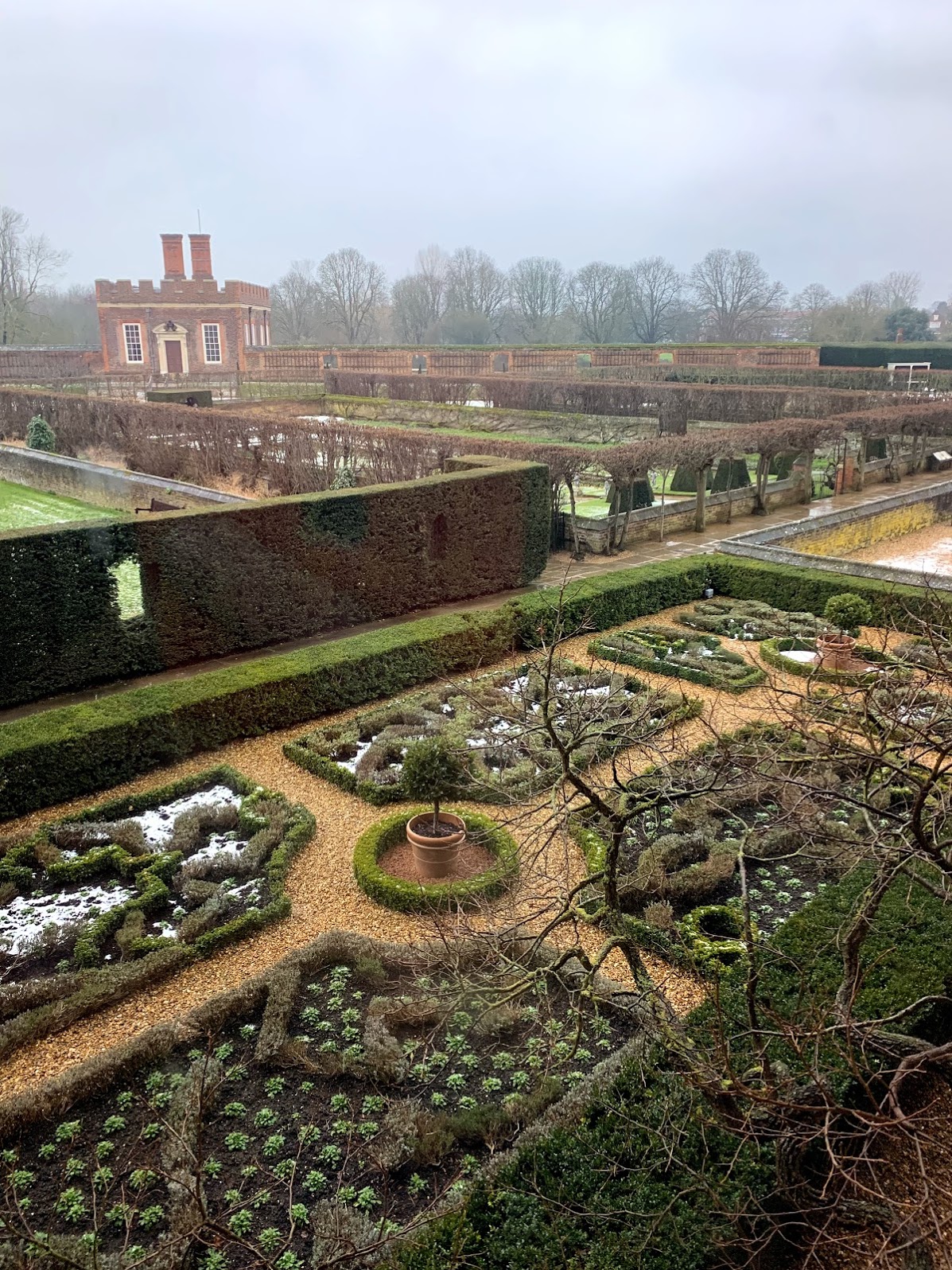
Tudor portion of the gardens

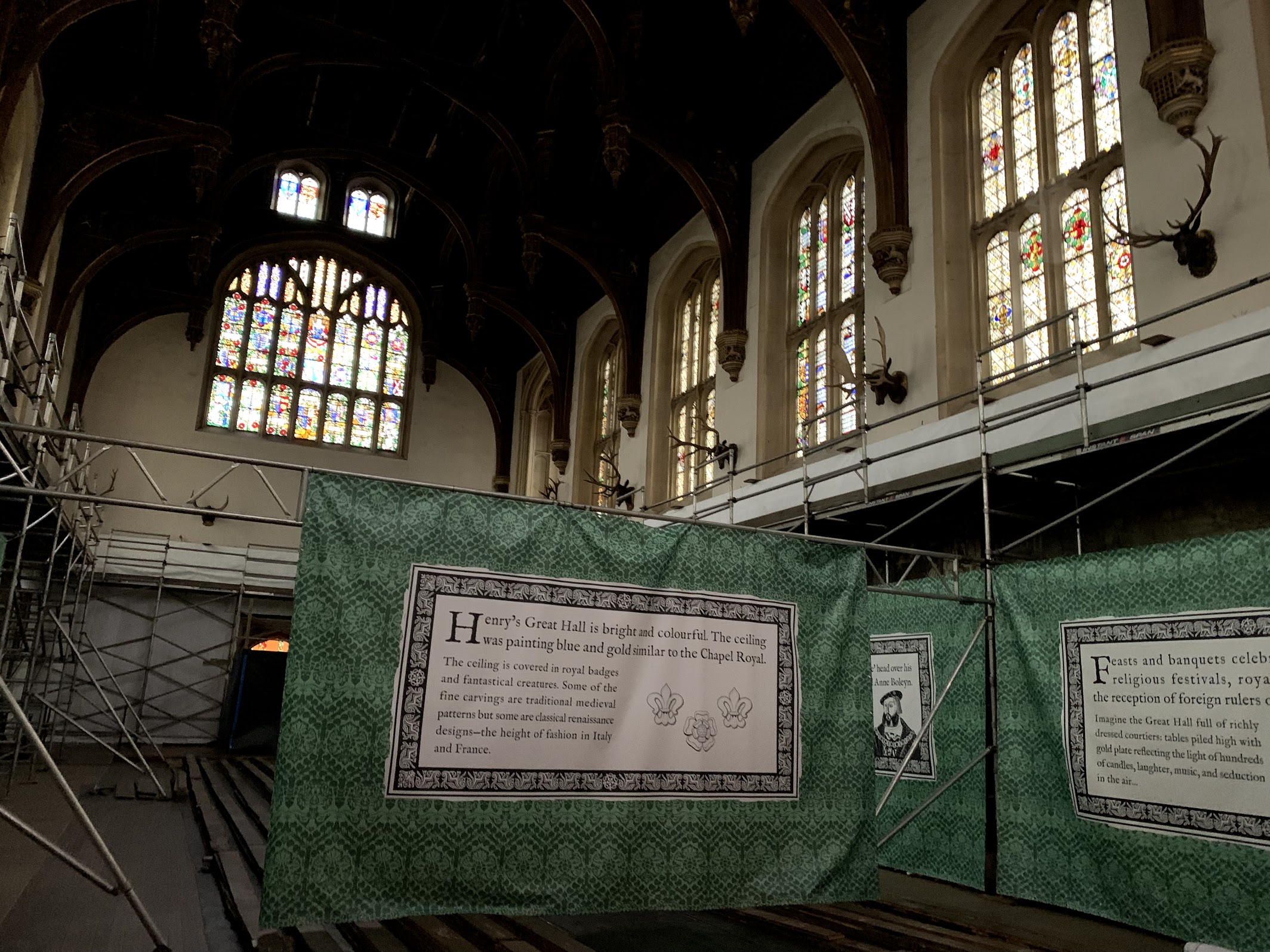
During the reign of Queen Victoria the two connected palaces were sublet to people of importance like war heroes or famous politicians. The last renters of a sublet apartment in Hampton Court moved out in the 1970’s. At that point it was turned over to the National Trust and turned into a museum. Extensive renovations and refurbishments have occurred over the last 40+ years. In fact while we were visiting they were removing old light bulbs and faulty wiring from the Great Tudor Hall of Henry VIII. It was nice to see the Hall diligently being taken care of.

The Great Hall under renovations

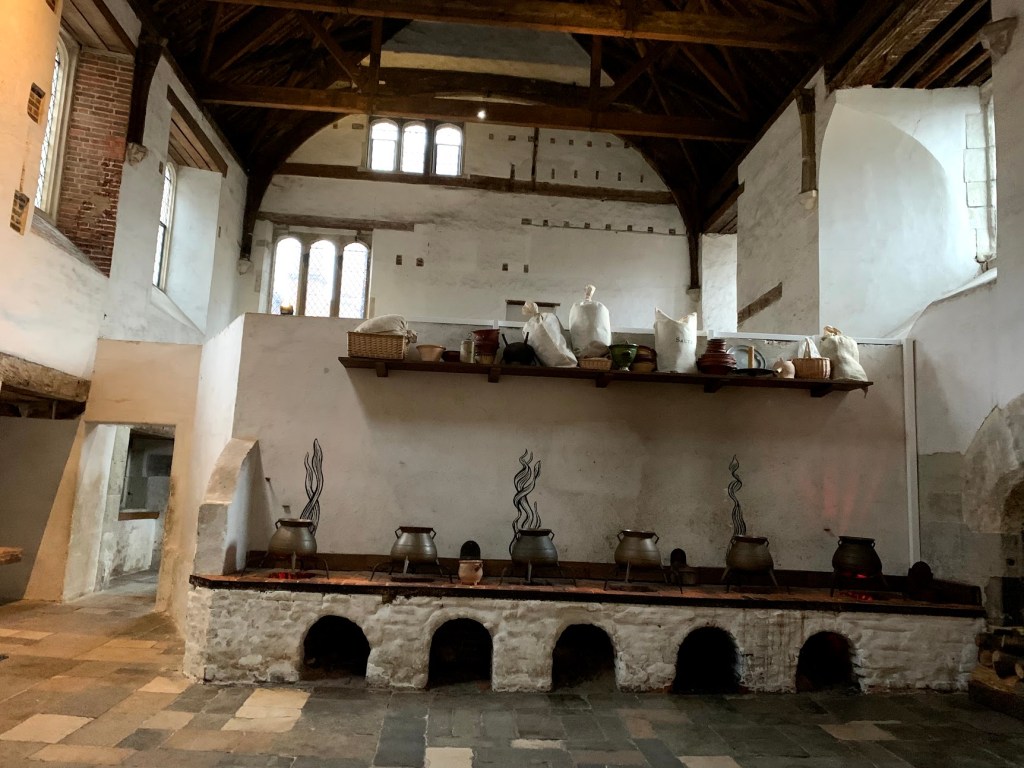
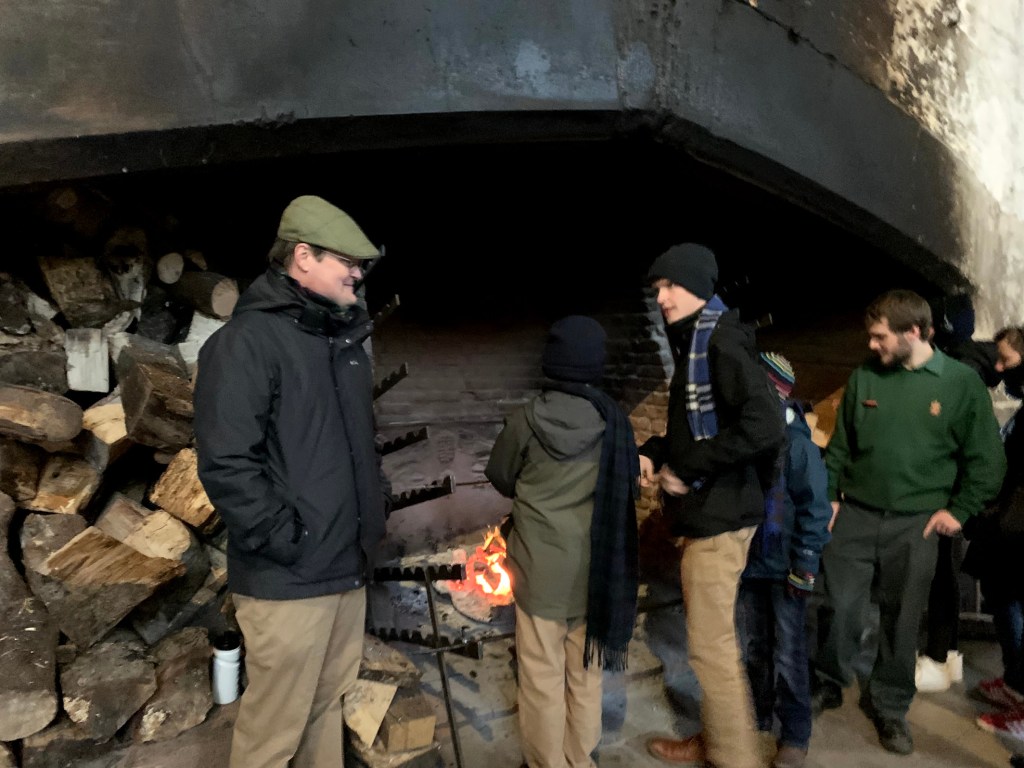
A family favorite from today’s day excursion included the 45 minute Queen Anne tour. Two women dressed in period costume acted as members of the queen’s staff and treated us as if we were visitors to the palace in 1702. This is when Queen Anne took the throne. Other enjoyable parts of the palace were The Great Hall, Chapel Royal which is still in use today as a place of worship, Georgian Drawing Room where we sat and played games as the couriers would, and the massive Tudor period kitchens! The kitchens in particular were a favorite because of the real fire burning in the huge fireplace. Very few of the palace rooms had heat and it was wet, drizzly, and chilly today. The docents all wore red wool knee length coats, which made them easy to spot as well as kept them toasty warm. We too warmed up on the 35 minute train ride back to Waterloo Station.
Tudor Kitchens
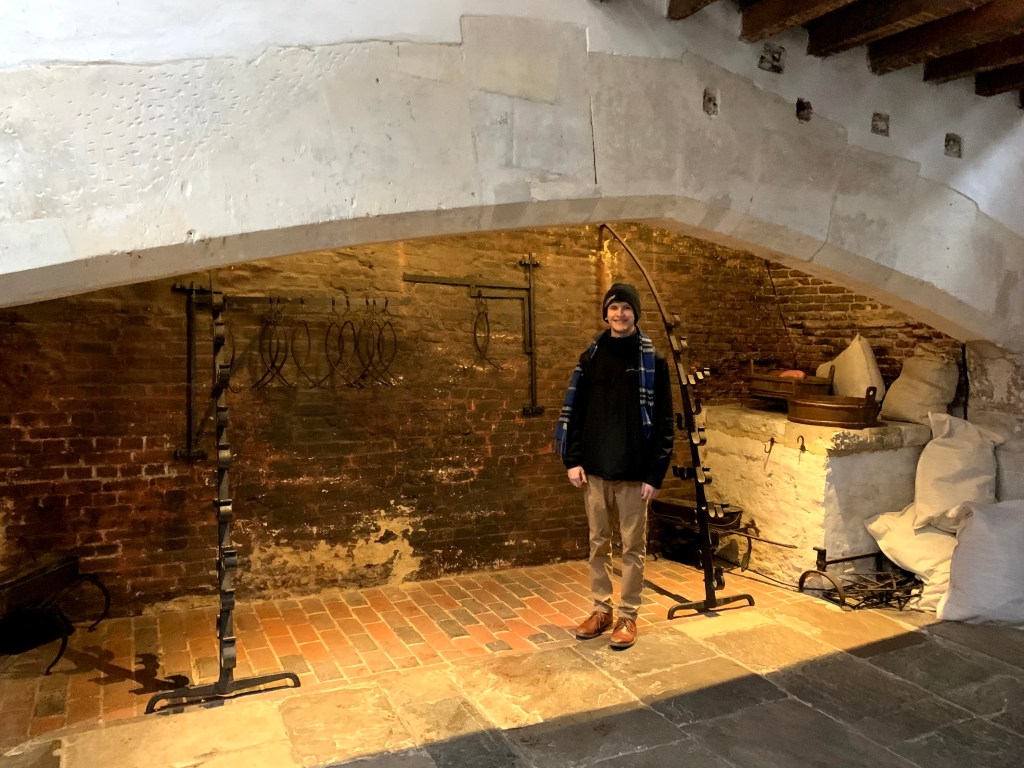
The great kitchen fireplace:
It has two large chimney flues.
Warming up by the kitchen fire!

London Day 3: Tomorrow and tomorrow and tomorrow…

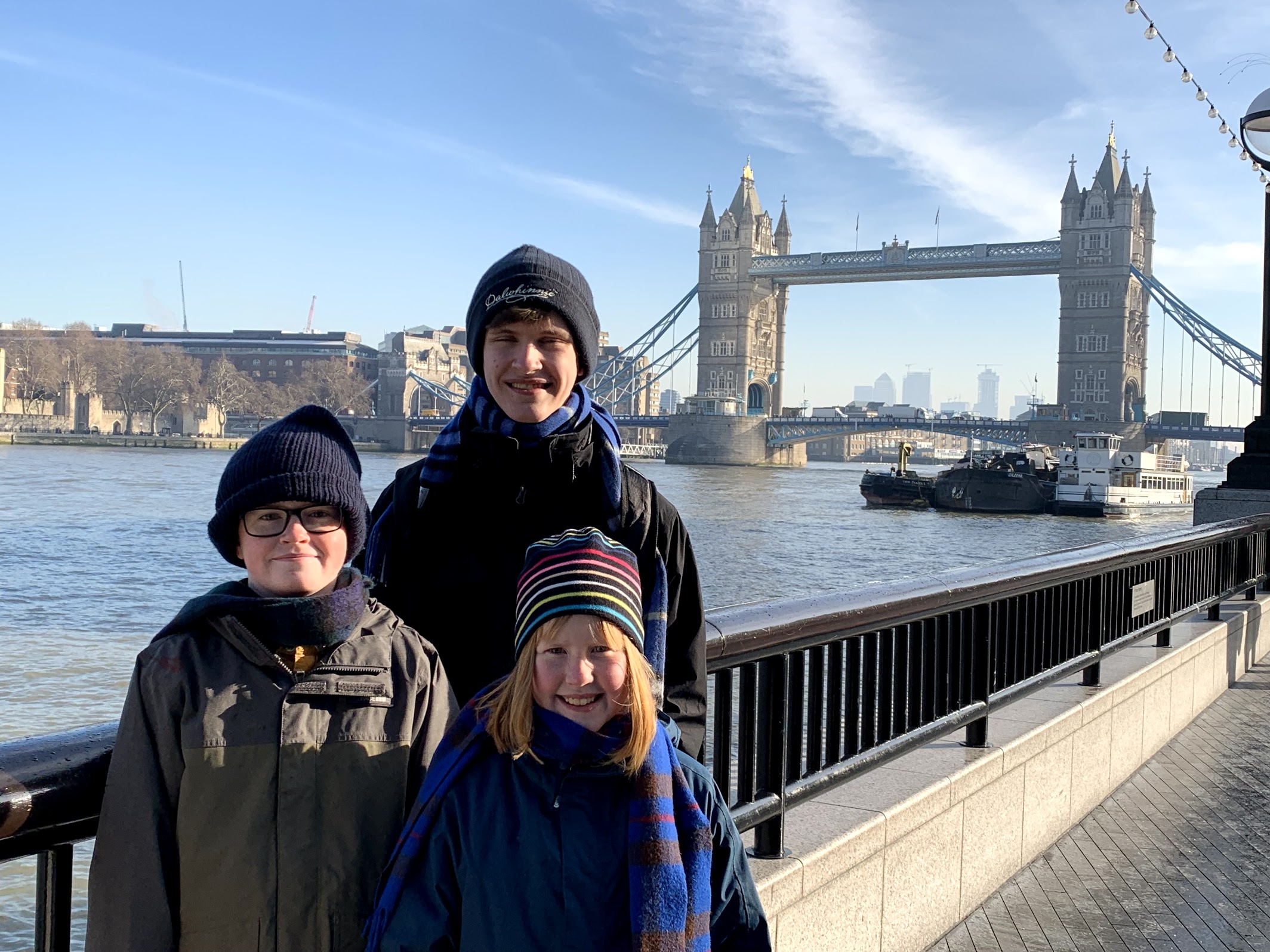
A brisk mile and a half hike along the River Thames is exactly what we needed after another delicious full English breakfast. The sun shown brightly and the gentle breeze was enough to keep us ever grateful for our scarves. We walked along the Queen’s Walk all the way to Tower Bridge. The Queen’s Walk took us past Black Friars Bridge, Southwark Church and Bridge, and London Bridge, which isn’t much to write home about. Smells from the river and local food markets filled the cool morning air.
Tower Bridge, London, England
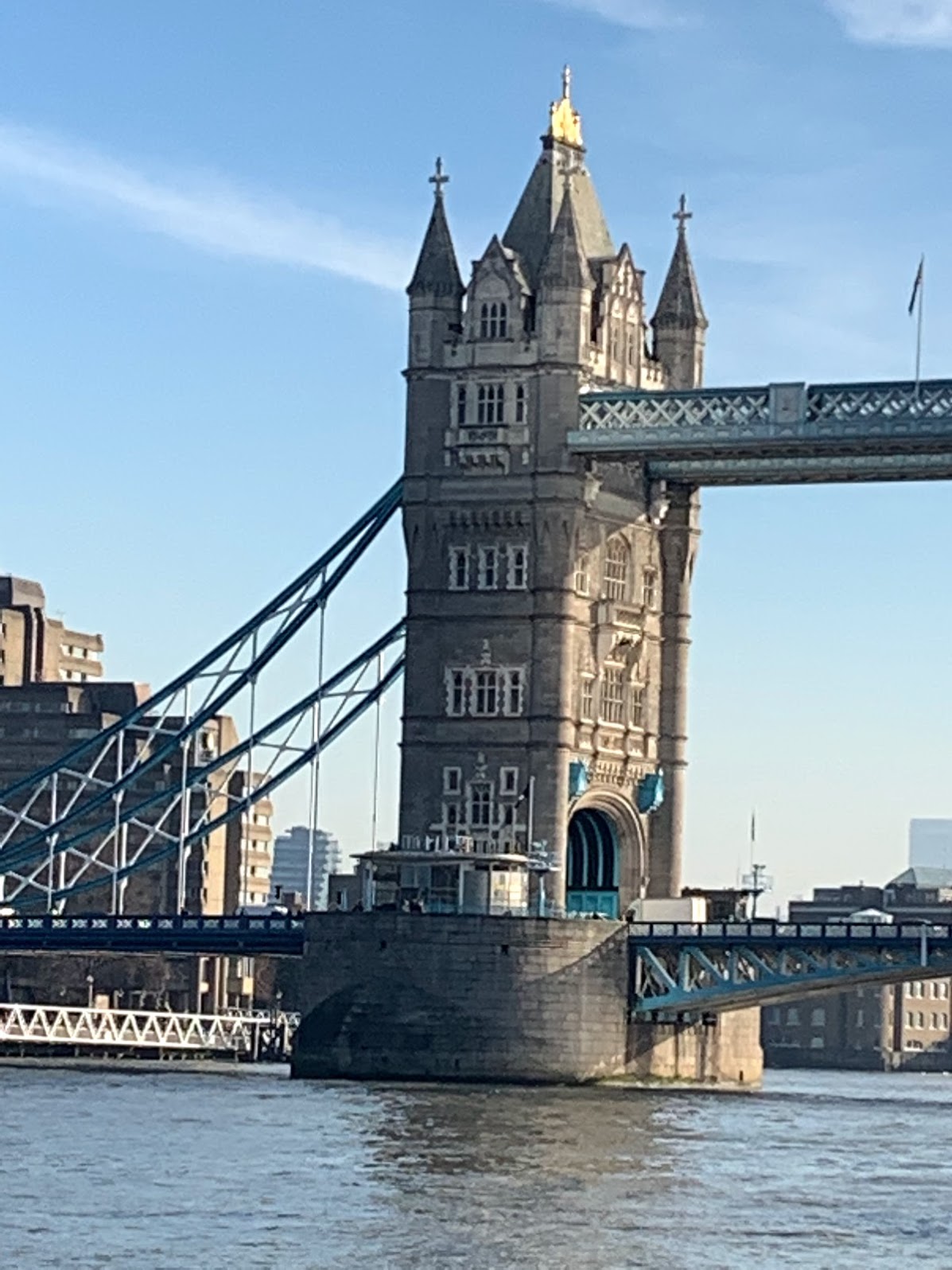
A close up of one of the towers in sunlight

Once at Tower Bridge we took a few photos and then headed back down the Queen’s Walk to The Globe Theatre, which we passed on our way to see the bridge. Faywen was very excited to go inside. We took the 11:00 tour and our guide Jonathan was very informative.

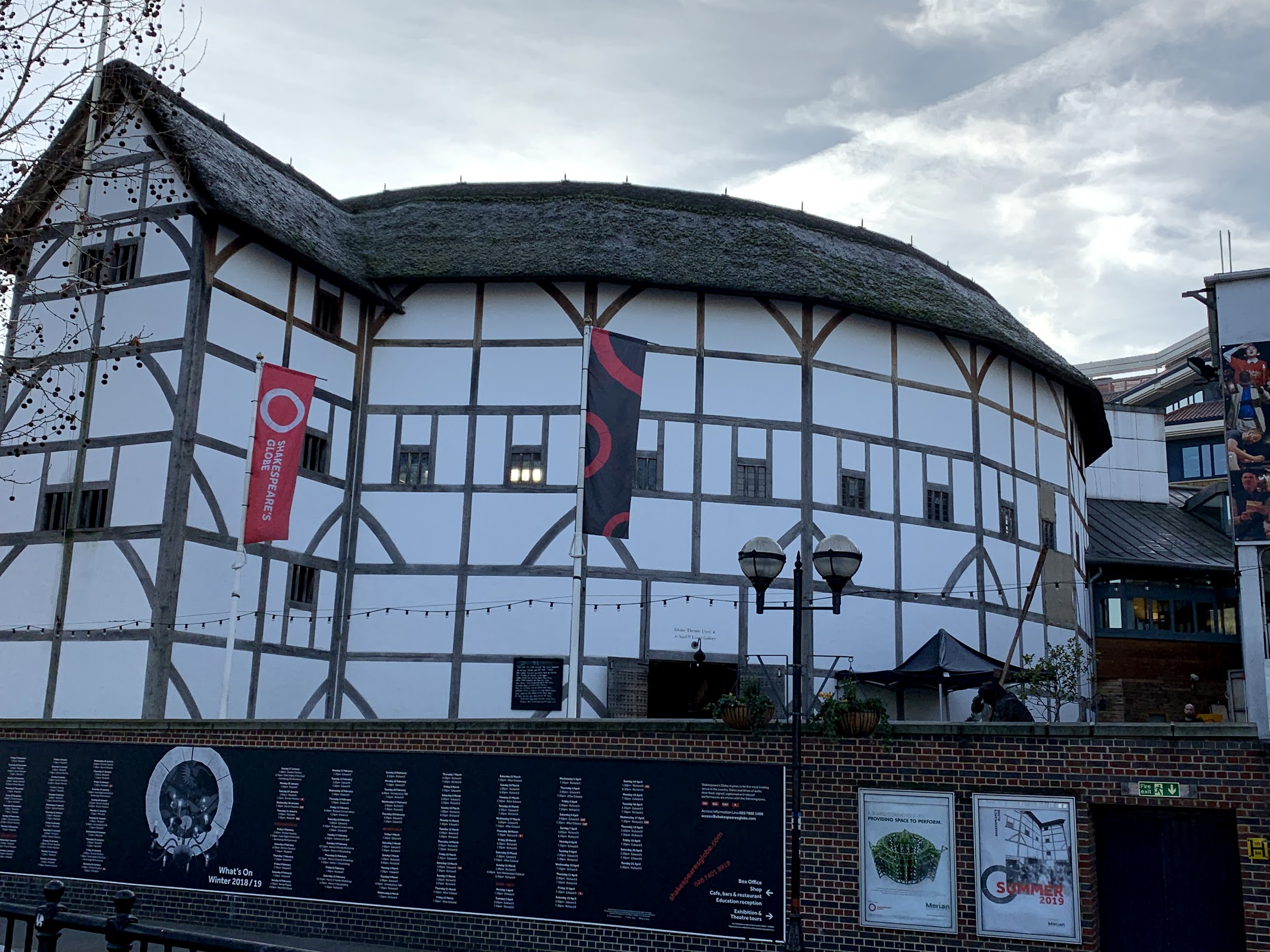
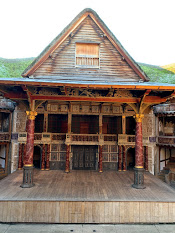
The Globe Theatre, London
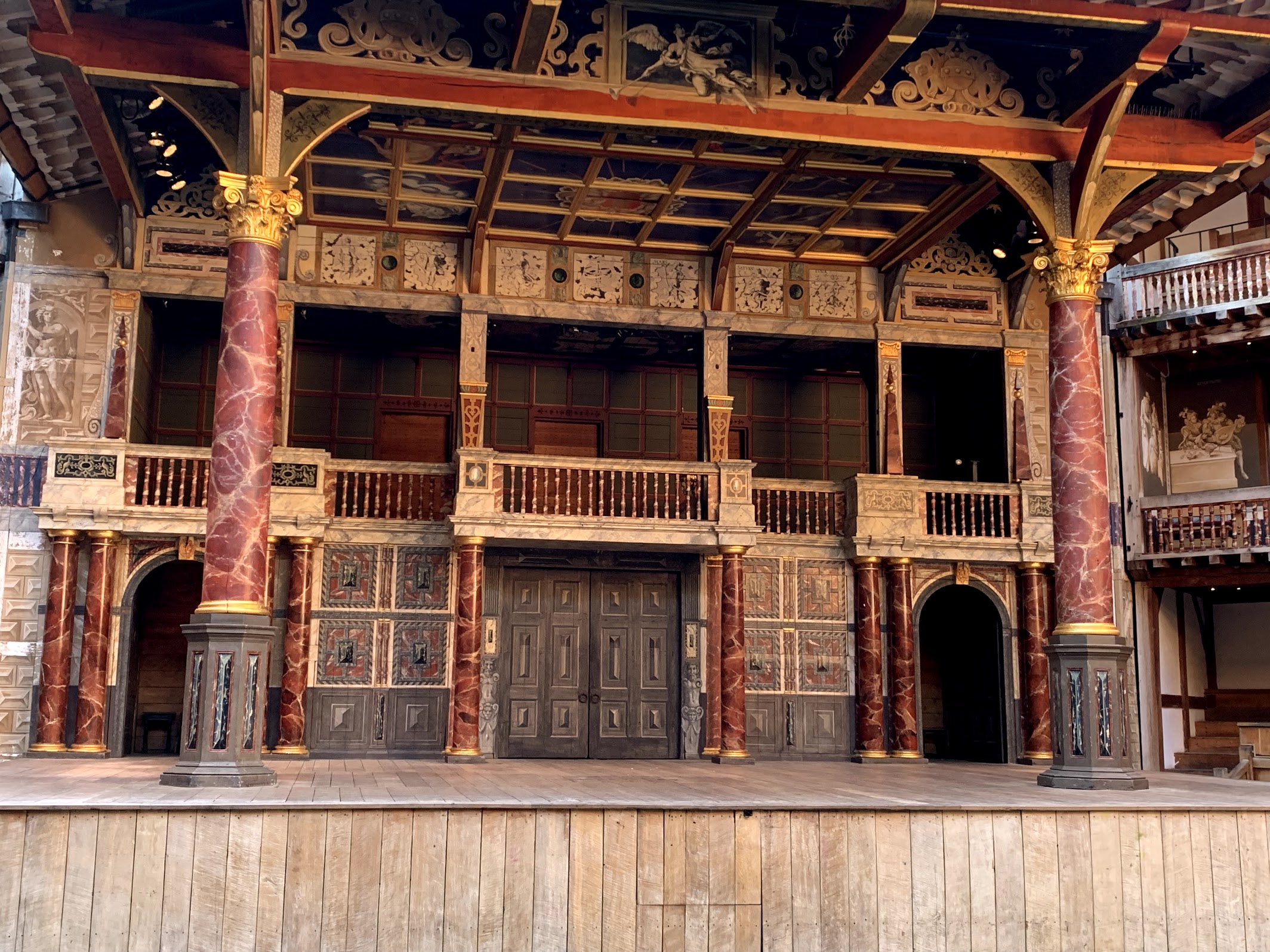
Main stage at The Globe
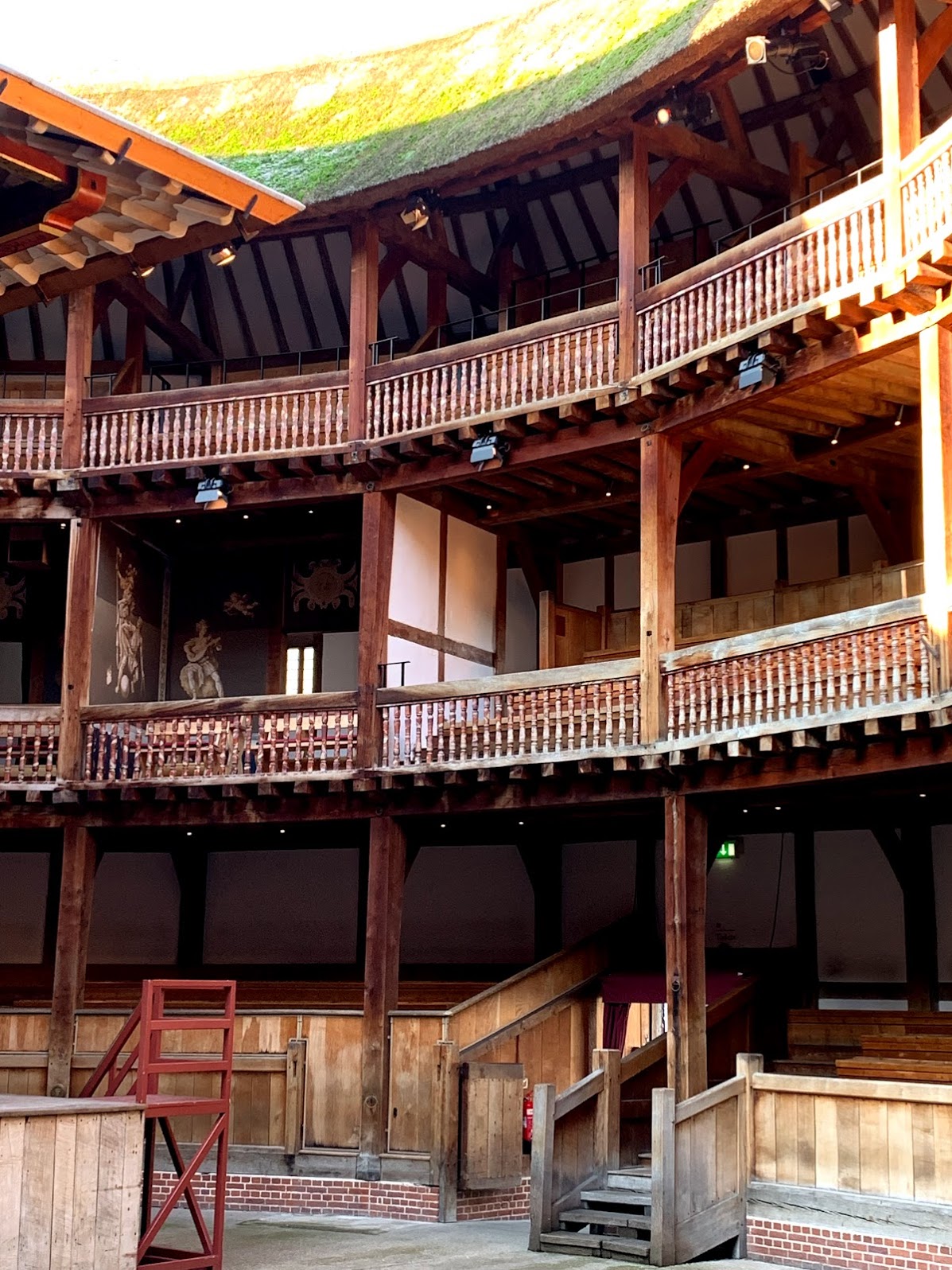
The audience seating: The Globe can hold up to 1600 people standing and sitting.

It seems that archeological digs had been done over the centuries, but nothing definitive was every unearthed until… 1949. In this year an American by the name of Sam Wannamaker came to London and wanted to know where the original Globe Theatre had stood. The local historians and authorities kind of had an idea, but weren’t really sure. Sam wanted to rebuild the theatre. The politicians were leery at first saying to themselves “this upstart of an American wants to make a theme park in the middle of London.” Sam went and gathered support from British history and literature professors. Eventually they were able to convince the authorities that this was truly an archeological and historical undertaking. By the 1970’s the bass of The Rose, an older playhouse, and artifacts and written descriptions of the Globe Theatre had been found and thoroughly researched. It was time to rebuild Shakespeare’s iconic theatre.

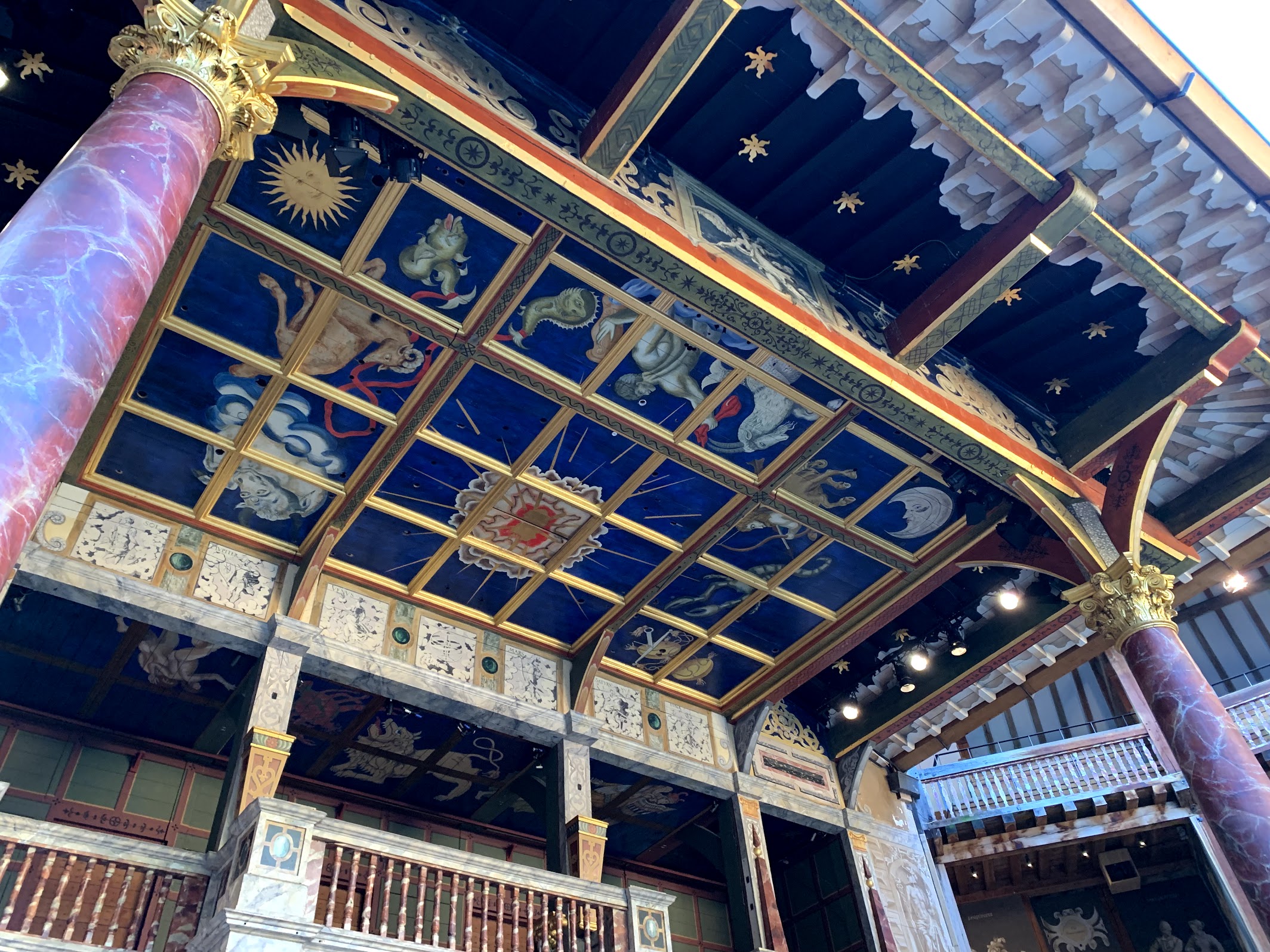
Ceiling on stage depicts the heavens with a secret trap door to let down actors from above. There’s also a trap door onstage for access below stage.
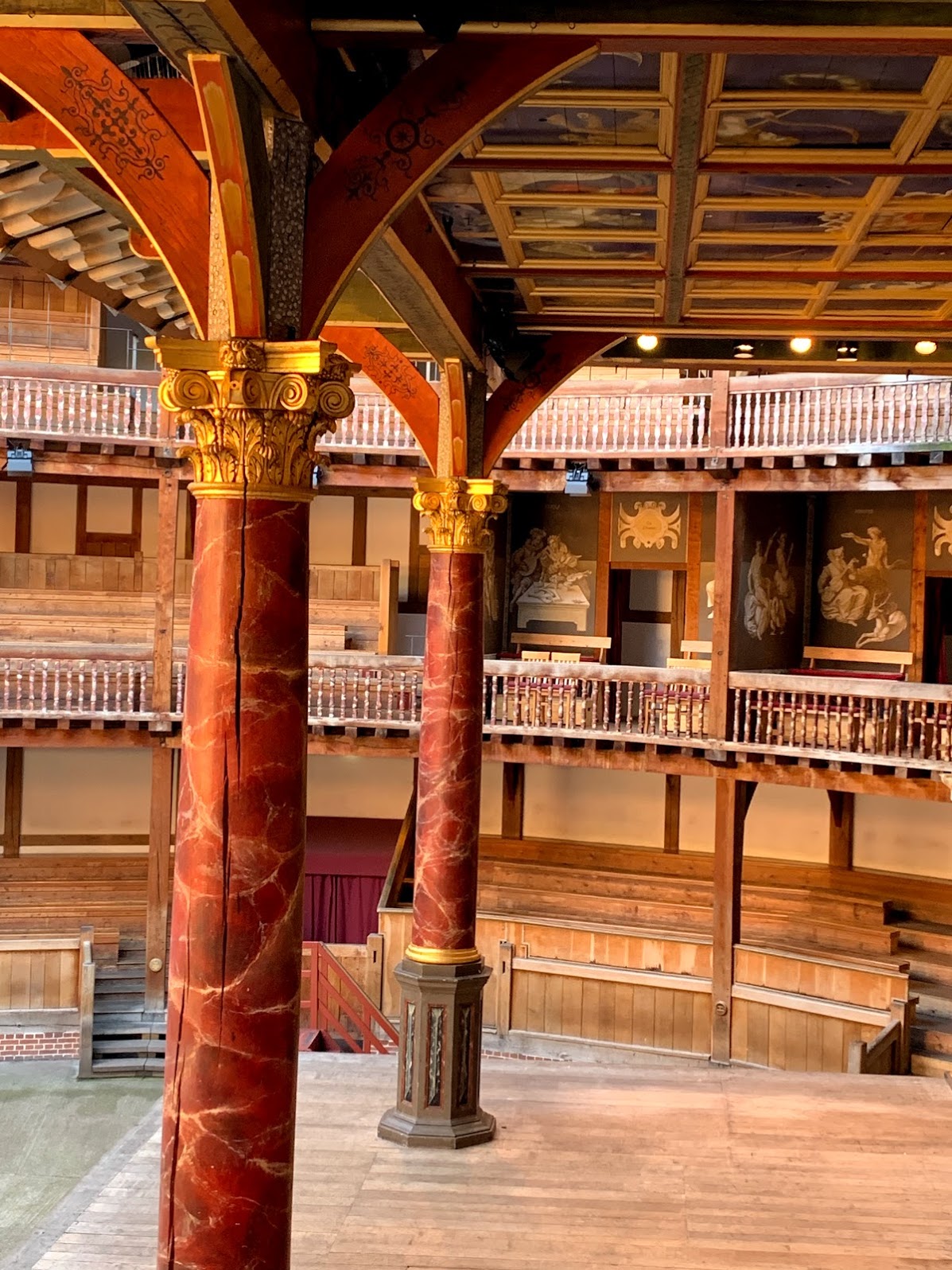
View from a posh side box:
The columns are not marble, but painted oak beams!
View from center upper balcony: From these seats you are only 50ft from the stage.

Built with the same materials and techniques as would have been available in the late 16th century, the new Globe Theatre was officially opened to the public in 1997. It is now a centre of theatrical education as well as a real working theatre putting on not only Shakespeare’s plays, but also other plays by his contemporaries. The Globe is an outdoor theatre and seats nearly 1600 people. They do not hold plays in the man theatre during the winter.

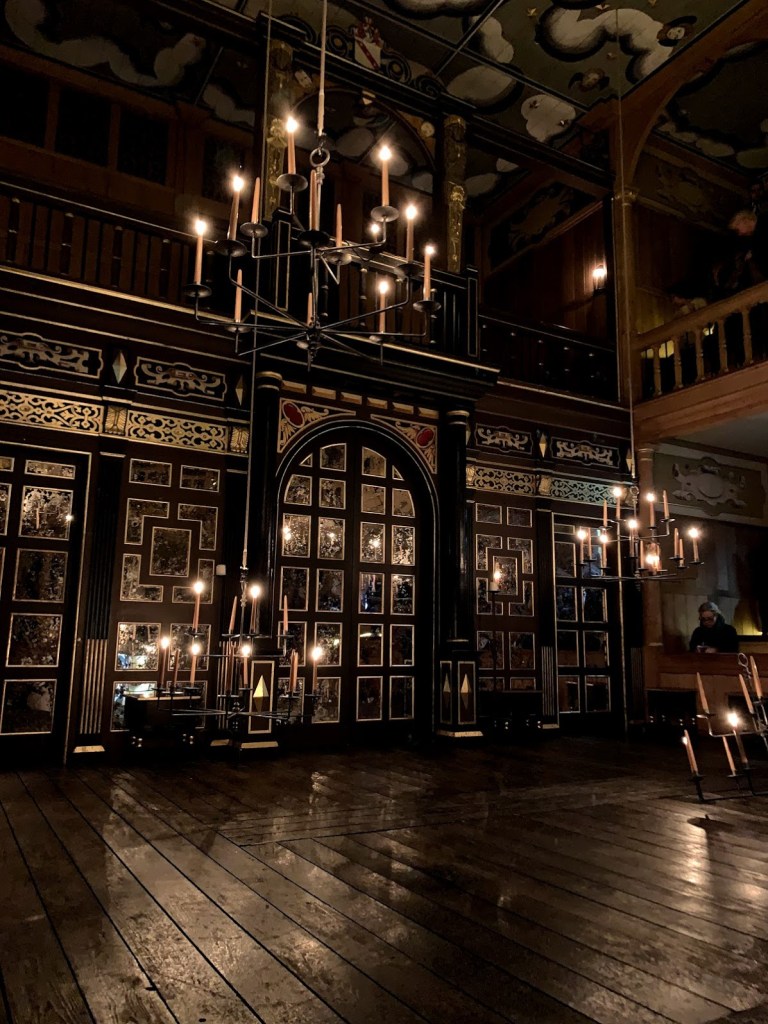
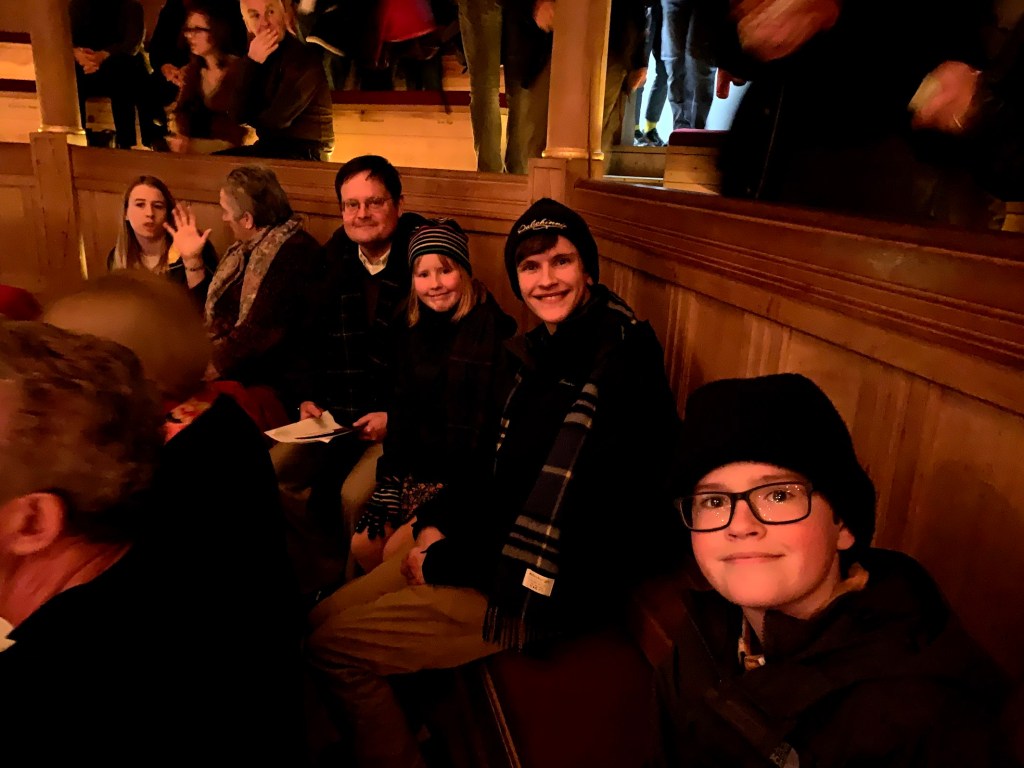
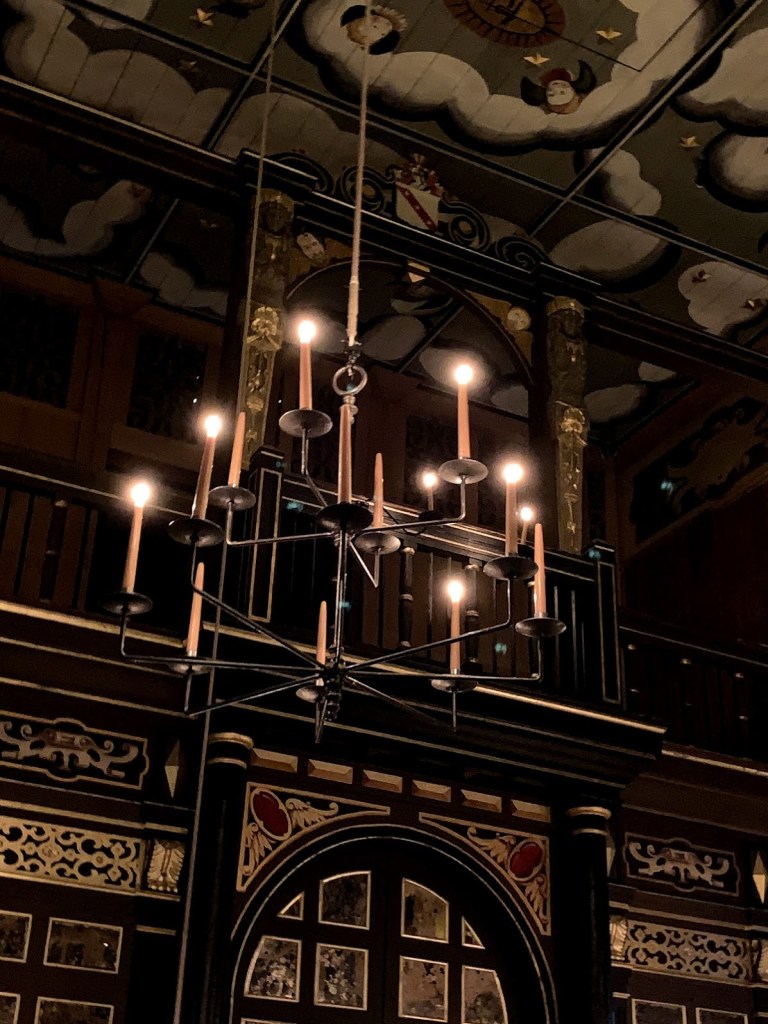
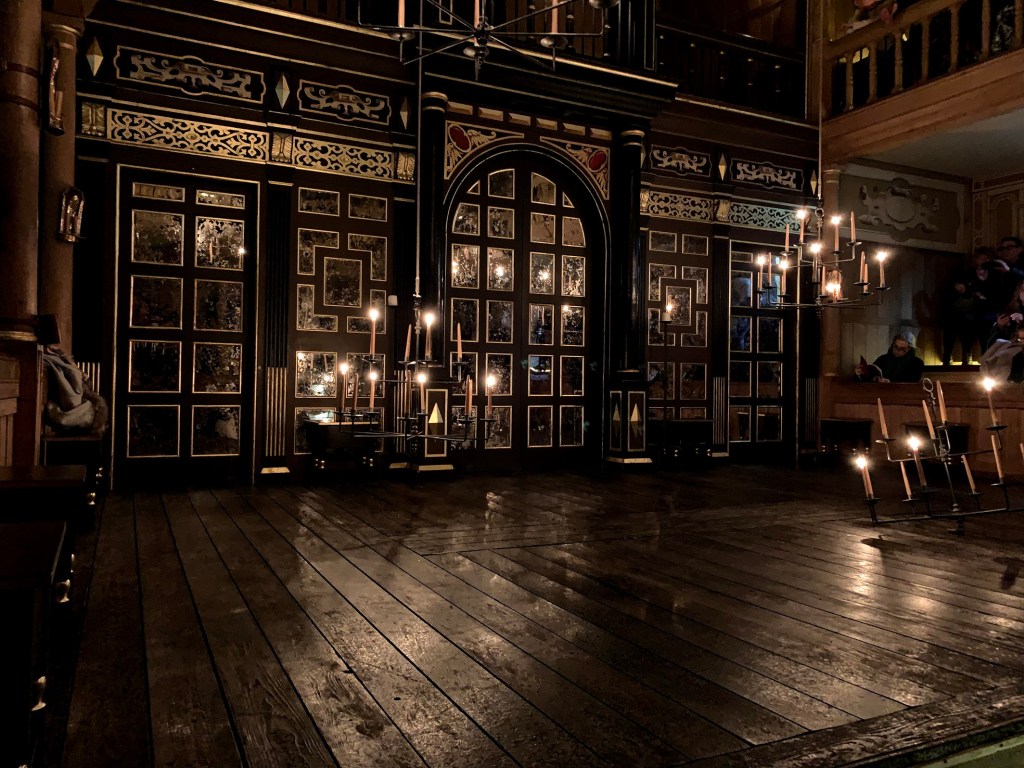
At 2:00 pm we walked into a candlelit room inside the Globe Theatre Exhibition Hall. It was a small 300 seat Jacobean (late 1600’s) period theatre. It was completed in 2013 and is named the Sam Wanamaker Theatre after the American who had a dream to bring Shakespeare’s Globe back to life! Inside we sat in the pit, a small area just in front of the stage at ground level, on red cushioned benches. Seamus and I were on the end seats and could literally reach out and touch the stage. The actors often used the small staircase in the pit area. The play we say was MacBeth!

Sam Wanamaker Theatre
Ready for MacBeth! I took this picture standing on the steps used by the actors. It was a very intimate theatre.
The whole theatre was lit with beeswax candles. Many scenes were done with only one or two candles held by the actors lighting the entire theatre!
From our seats Seamus and I could reach out and touch the stage!

During the famous Porter scene, he actually came over and sat down next to Seamus and I and delivered his lines directly to us. After the show many folks told Seamus he did a great job “acting” with the Porter! Even MacBeth interacted with Faywen. At one point in the play MacBeth delivered an intense speech. He delivered it while looking directly at Faywen. When the audience’s attention was directed to another character he winked and gently waved to Faywen. A few members of the audience caught this and remarked to us how they enjoyed seeing it. I didn’t see it, but I thought it was wonderful of him to make Faywen feel a little more at ease after speaking an intense dialogue right at her!

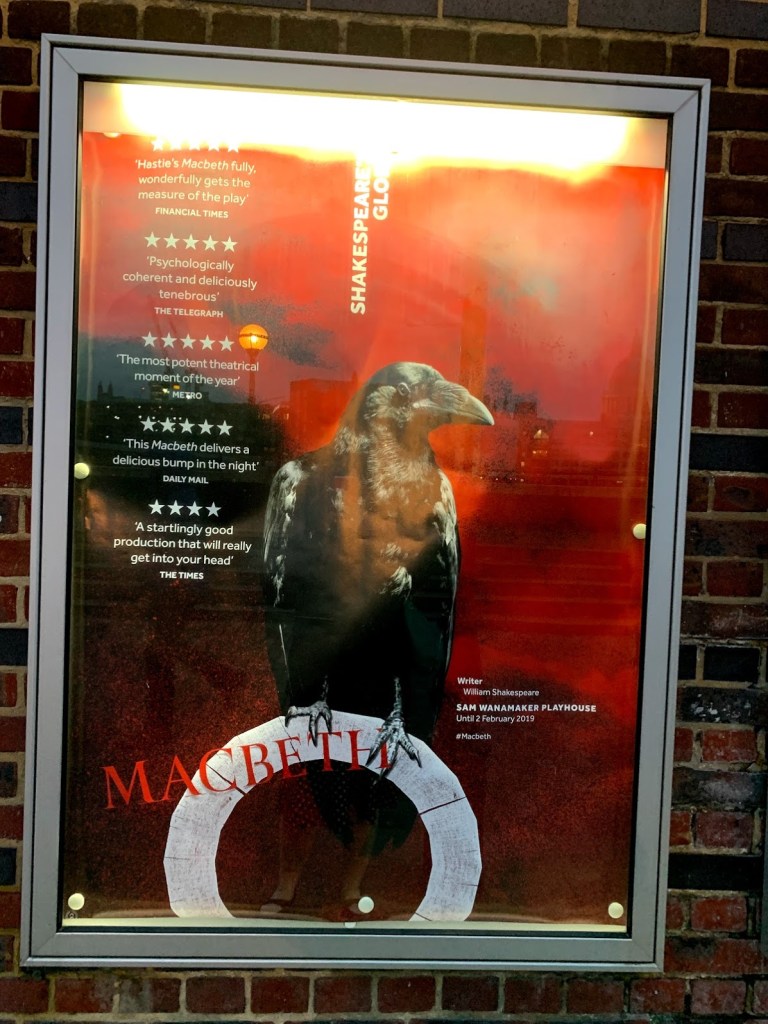
The only words to describe this powerful adaptation of MacBeth are psychological thriller and eerie. The three musicians in the music balcony added to the mysticism with bells, vocals in Latin, and percussion. Seeing MacBeth in that intimate, candlelit space is an experience no one in our family will ever forget!

Publicity poster for the play

Our walk back down the Thames was full of conversation about the play. What were our favorite characters and scenes etc? Once back at the hotel, the kids wanted Robert and I to go out and have a special quiet dinner. We picked up some subs for them and they ate in the hotel room. Robert and I went across the street to a lovely Italian restaurant. Today is our 21st wedding anniversary and I dare say it won’t be one we will ever forger. How many folks can say they had an anniversary in London and went to see a play put on by the actors of the Globe Theatre!

London Day 2: Royalty and Leaders

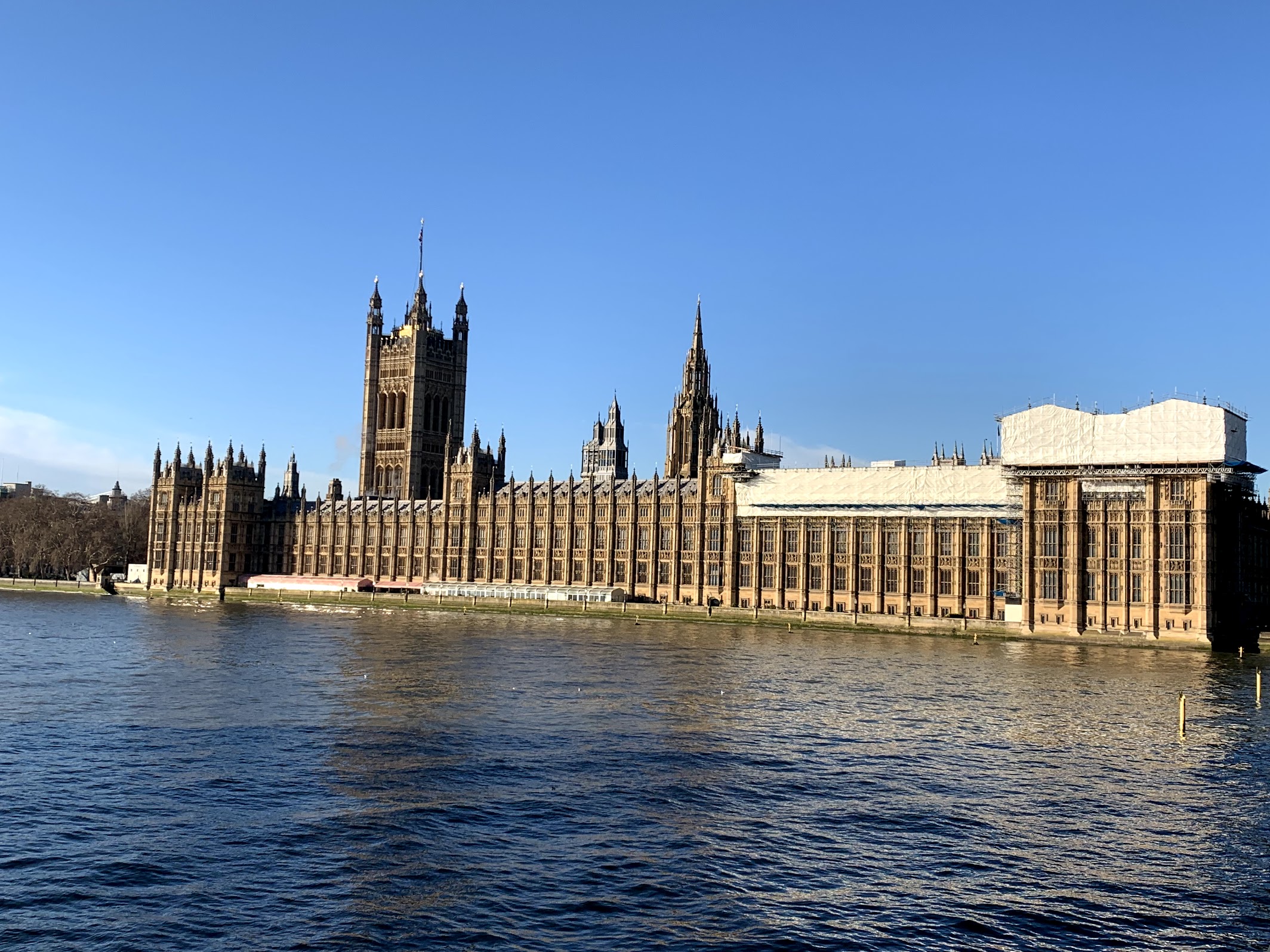
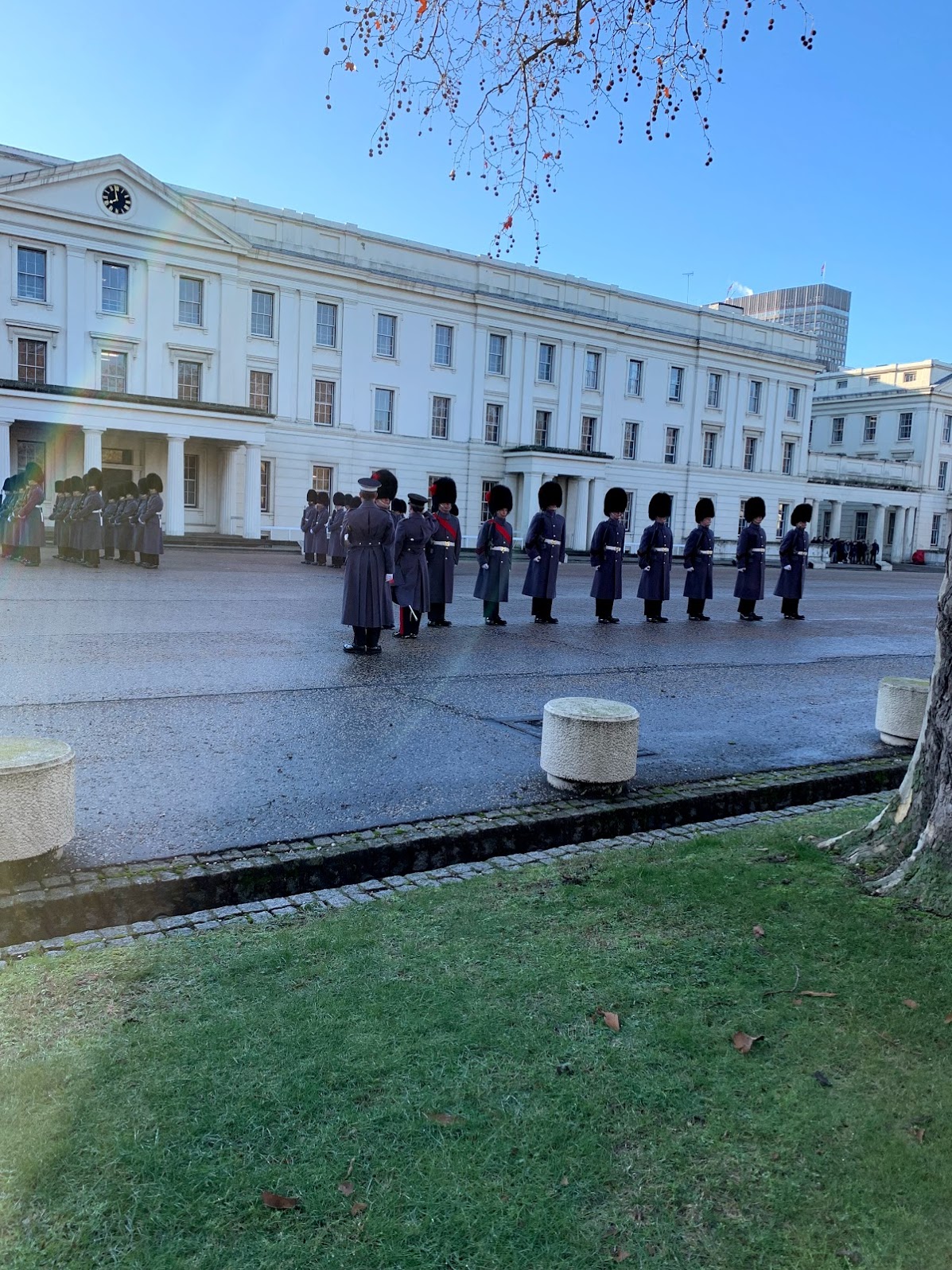
Crystal blue skies shown overhead making all the grey and white buildings of old London crisply outlined by contrast. Today we walked one block south and then west across Westminster Bridge. The Parliament buildings at Westminster sparkled in the sunlit reflection off the water. Unfortunately Big Ben is under restoration and was covered in scaffolding, but you could still see the clock face. Parliamentary buildings are only open on Saturdays to the public so we kept on our path west until reaching Wellington Barracks. We arrived just as the1st Battalion of the Queen’s Coldstream Guard was under inspection. Within a half hour they would go on duty protecting the Queen at Buckingham Palace. The Band of the Scots Guard accompanied them during the inspection.

Houses of Parliament at Westminster
1st Battalion Coldstream Guard: Faywen spotted a women in the ranks. She is the guard wearing the red sash on the right.
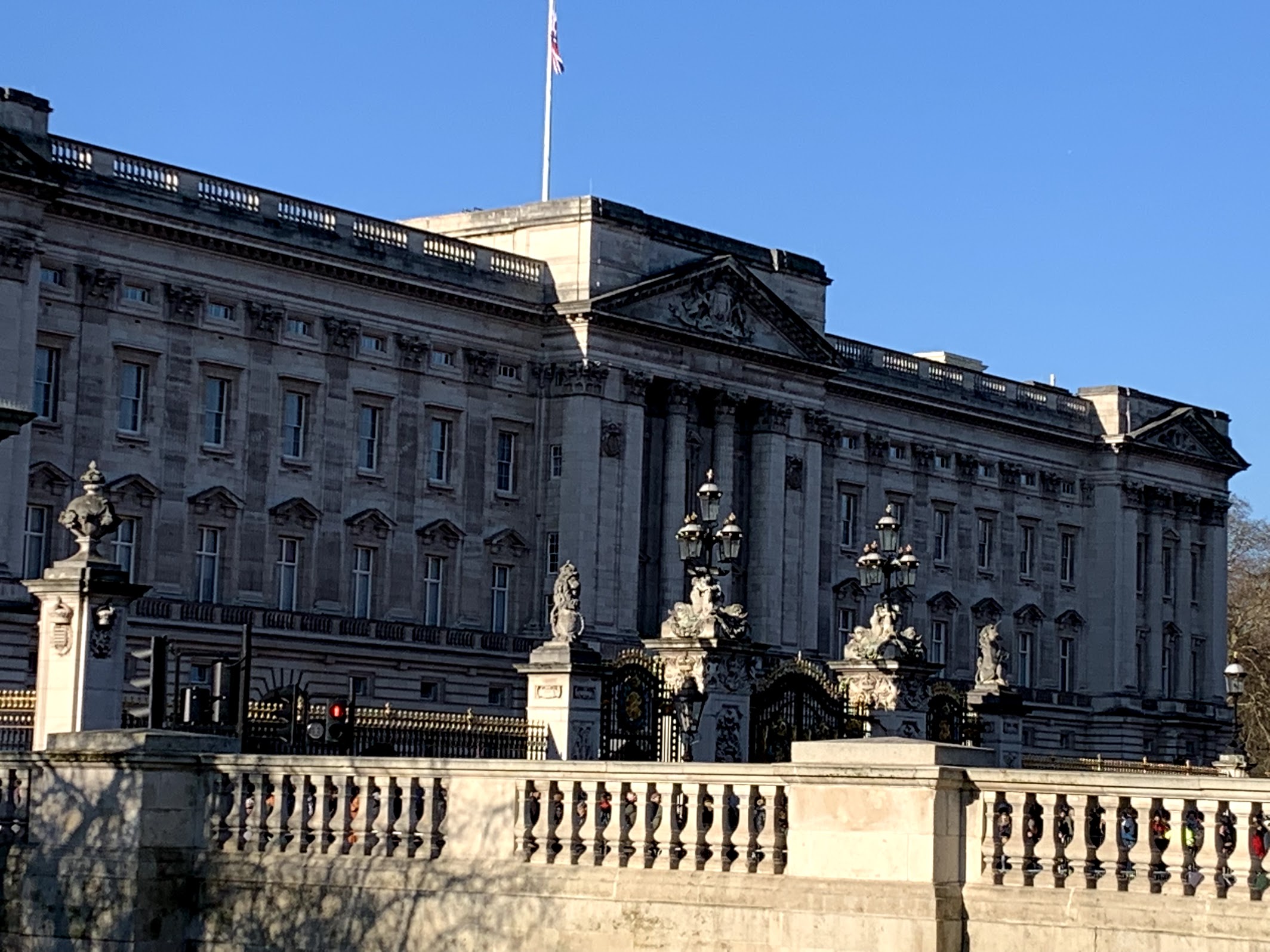
Buckingham Palace

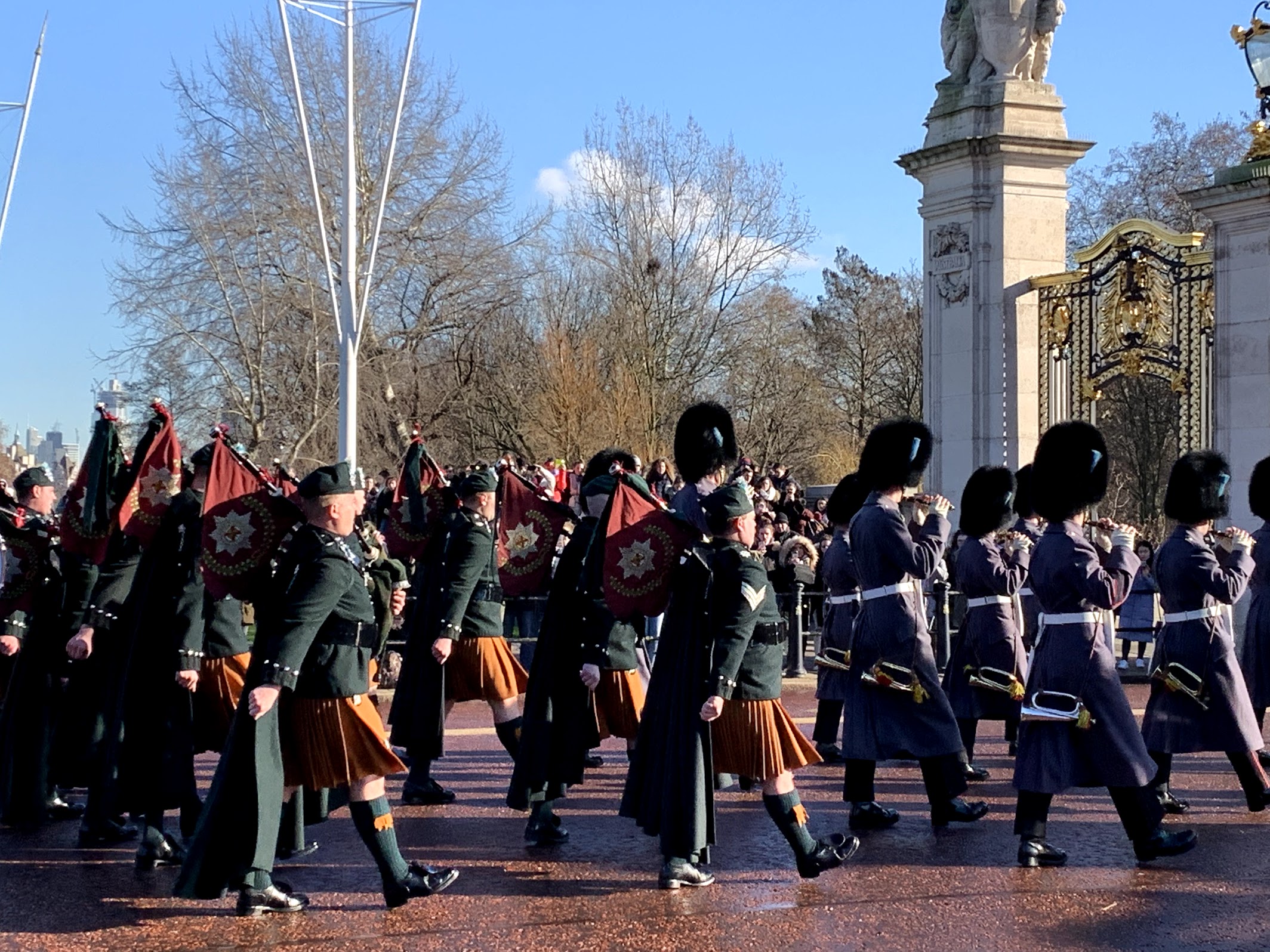
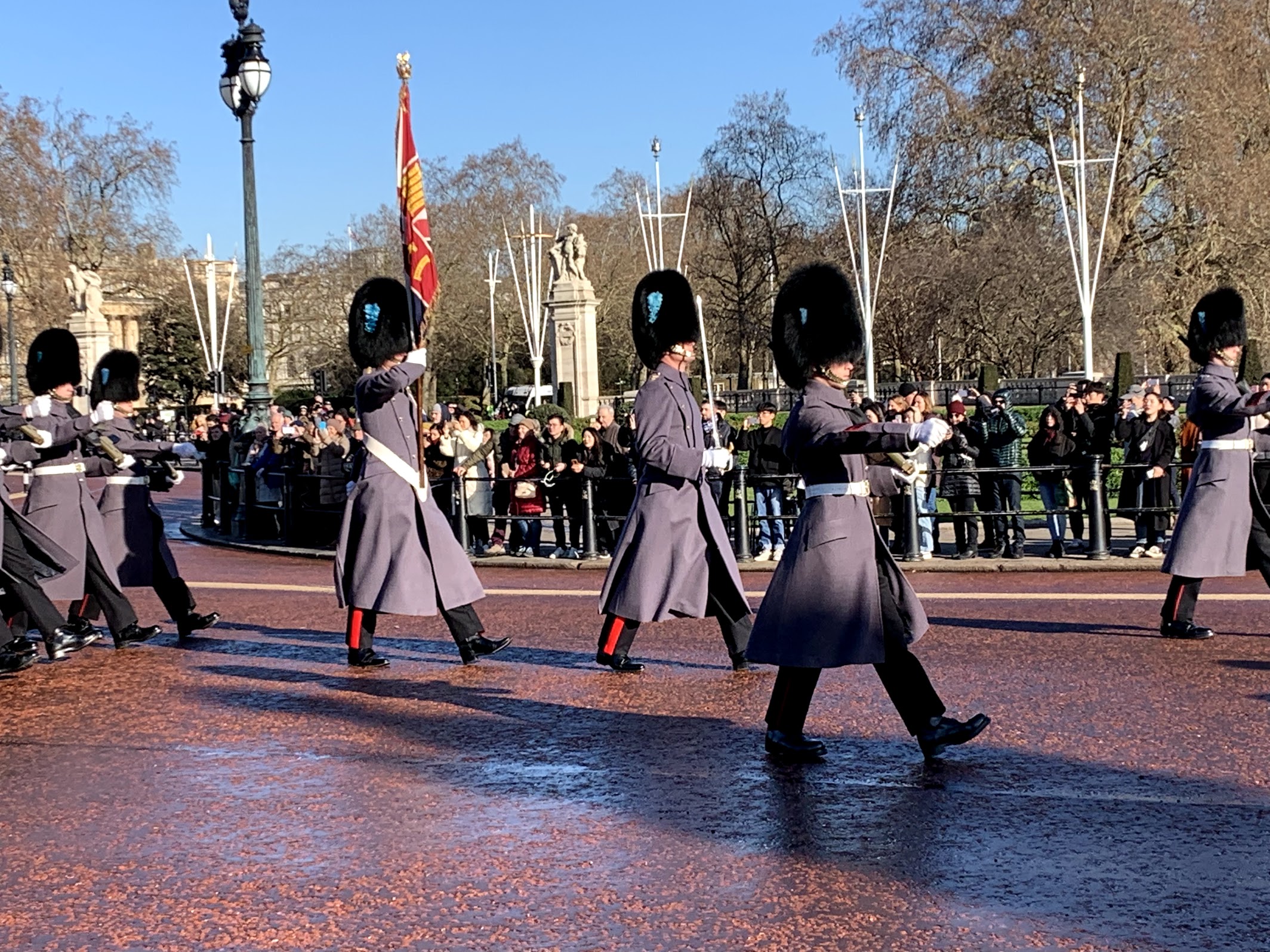
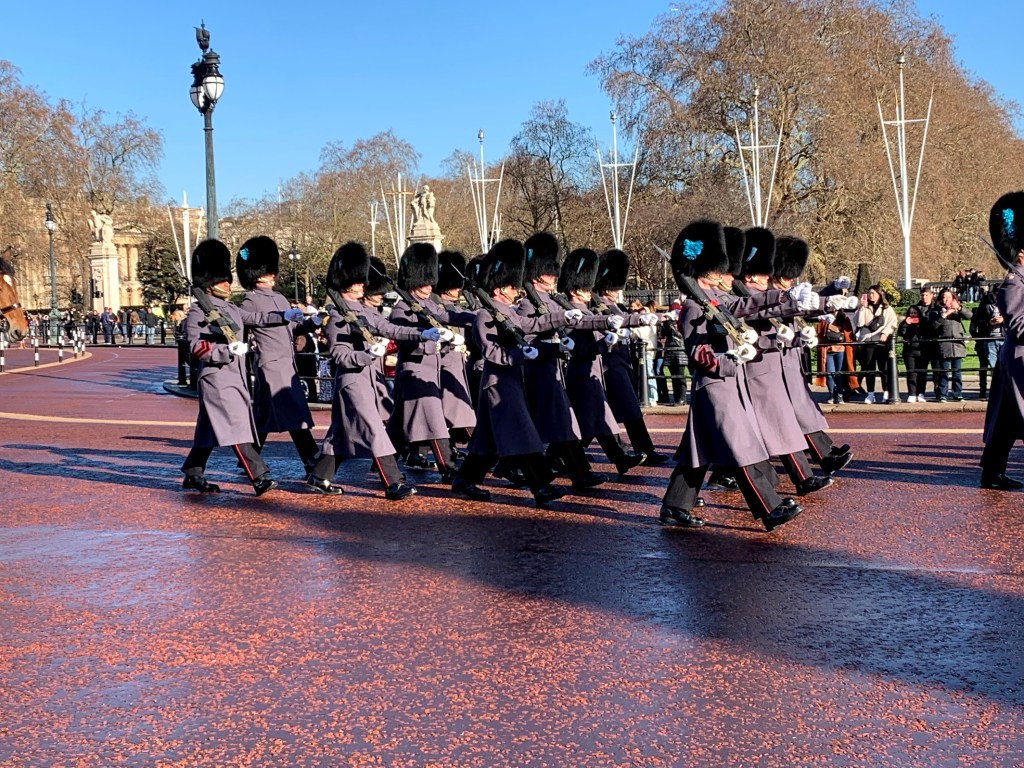
About two blocks further down St. James Park and we could see Buckingham Palace, the official residence of Queen Elizabeth II. However she was not in residence, because the royal standard was not being flown. The Changing of the Guard was about to begin. First to come down the street were the Queen’s Horse Guard followed by the 1st Battalion Irish Pipes and Drums. The 1st Battalion Irish Guards were the “old guard” being relieved of duty. Next to enter was the 1st Battalion of the Coldstream Guard followed by the Band of the Scots Guard who were the “new guard” coming on duty for the next 48 hours. It was truly British military pomp at the grandest level! The soldiers marched in perfection as the bands played, sergeants yelled out orders, and the pipes and traditional bands played beautifully!

1st Battalion Irish Guard Pipes and Drums
1st Battalion Irish Guard
1st Battalion Coldstream Guard
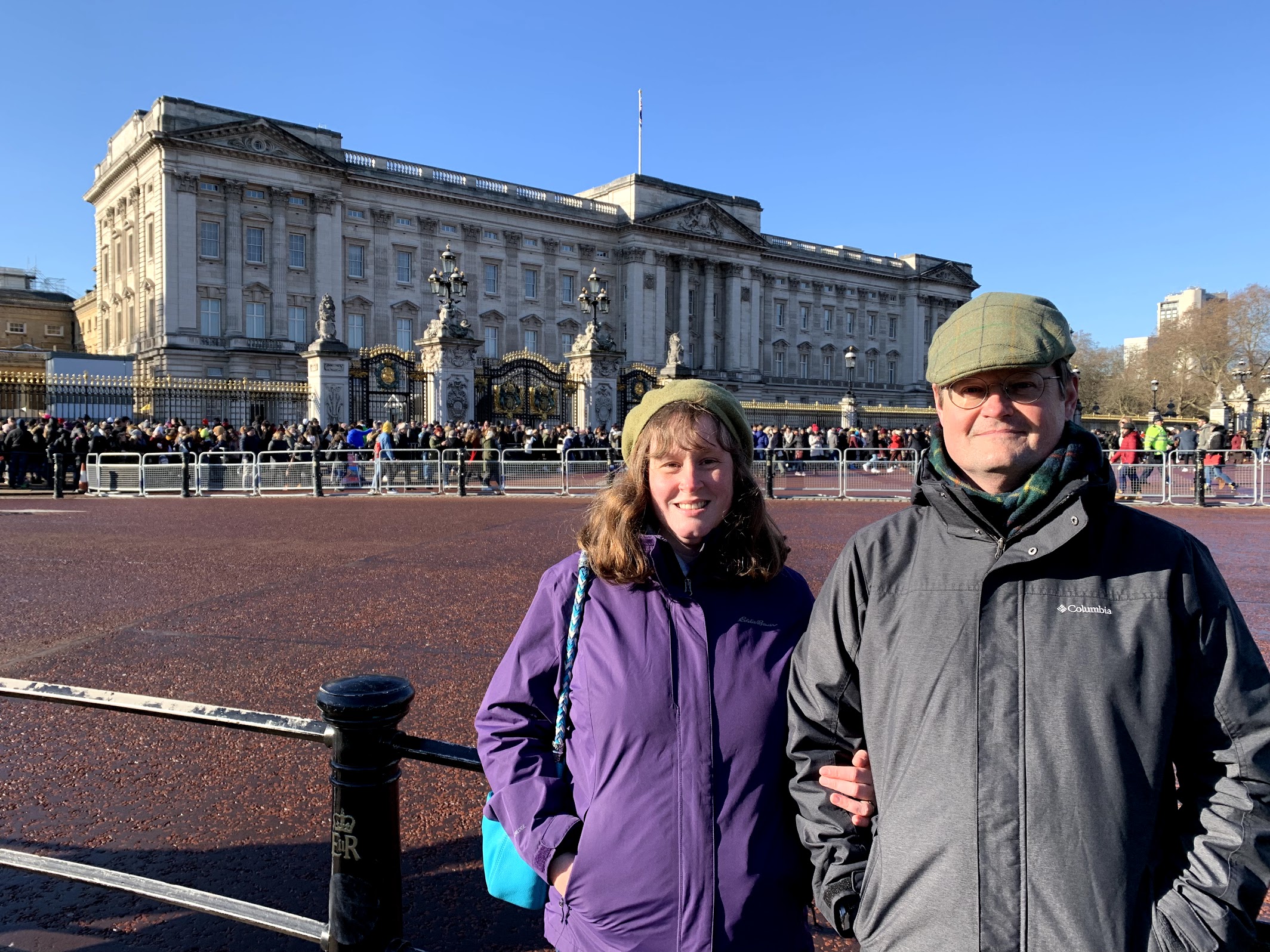
Robert and I in front of Buckingham Palace

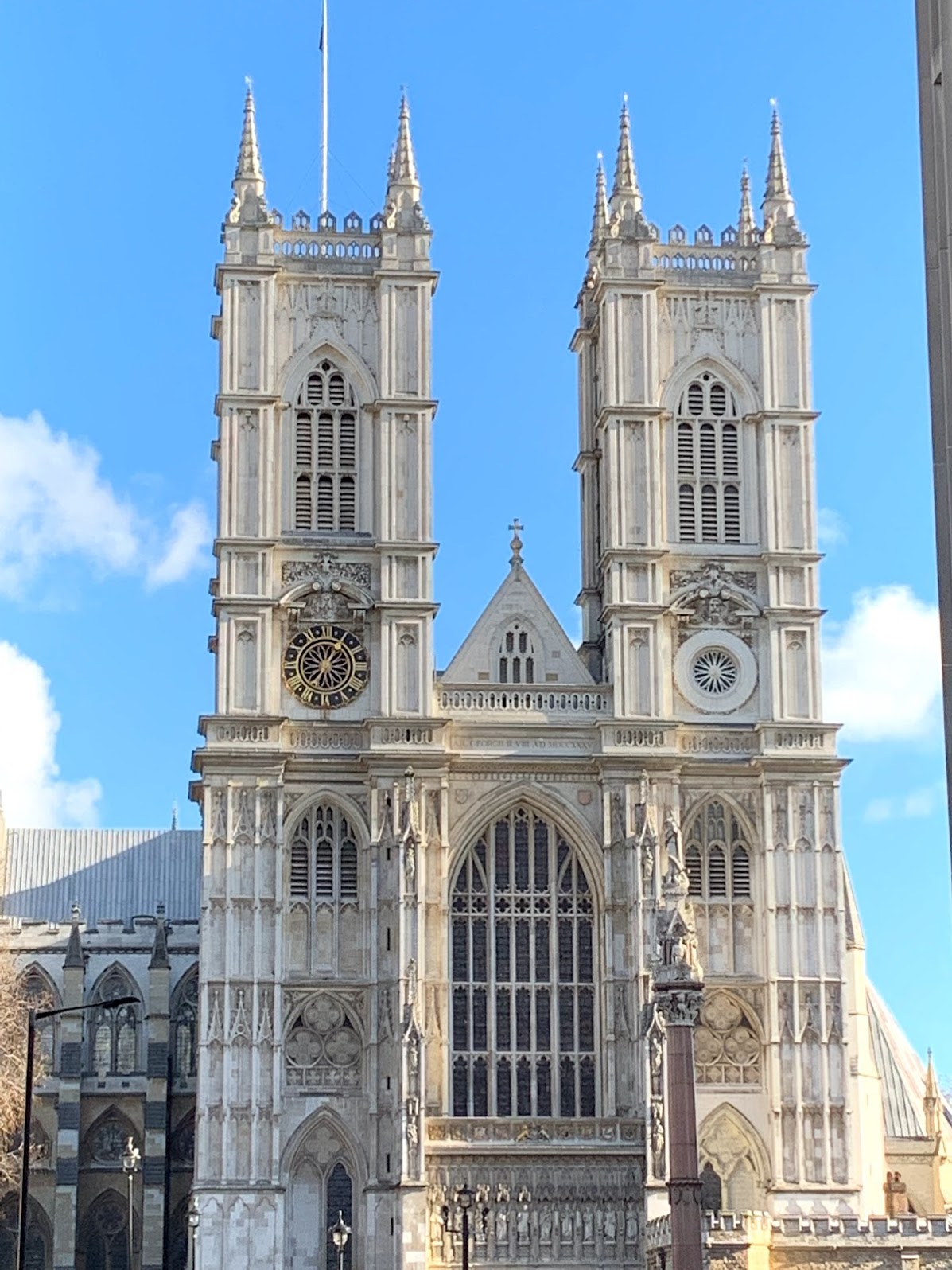
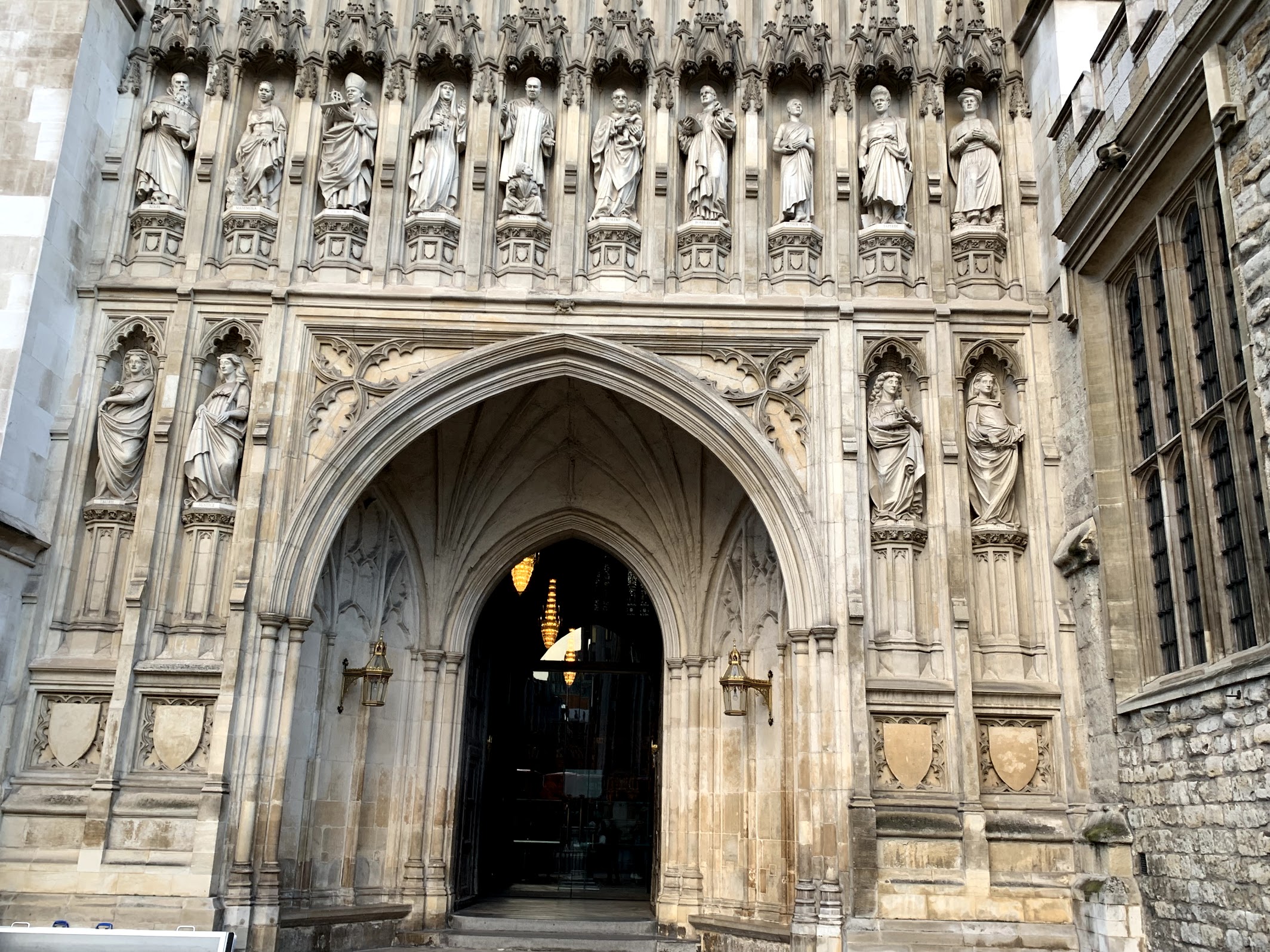
From the pomp of royal British military might to the humble religious grandeur of where great kings and queens have been crowed, married, and buried, we entered one of the world’s most famous churches…Westminster Abbey. The audio tour was very helpful as we meandered through burials of kings and queens, the Choir, the High Altar, Lady’s Chapel, and Poet’s corner. The Lady’s Chapel was built in the late 1400’s by Henry VII and is a very ornate late medieval structure. Called Lady’s Chapel in honor of the Virgin Mary, it is also the resting place of Henry VII and his wife Elizabeth of York, Queen Mary, Queen Elizabeth I, and Mary Queen of Scots.

Westminster Abbey: western front of the Abbey
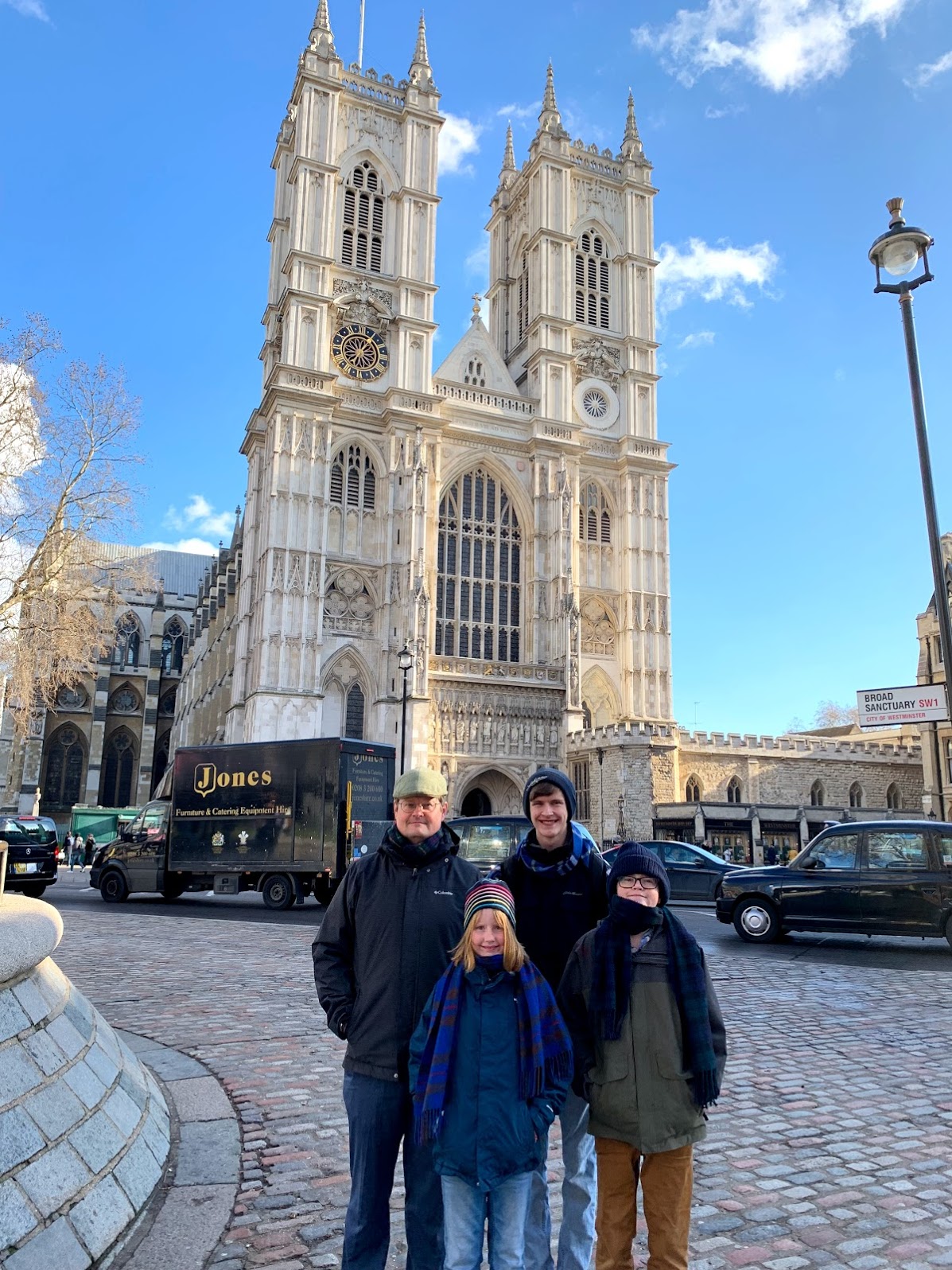
Another view of the Abbey

Westminster Abbey was founded in the 11th century by monks and blessed by Edward the Confessor who later became a Saint. His tomb lies behind the high altar. The current gothic cathedral took over 500 years to build and went through various phases until reaching it’s current outward appearance in the 18th century. One corner of the eastern end contains graves of famous poets, writers, and musicians in British history; C.S. Lewis, Charles Dickens, Rudyard Kipling, and the earliest grave belonged to Geoffrey Chaucer. Handel and Purcell are also buried in Westminster Abbey.

Many of the graves lie on the floor or are in the walls of the building and therefore are walked or leaned upon. There is one simple grave that is held in the highest regard even above that of kings and queens…the Tomb of the Unknown Warrior. This tomb lies in front of the main western doors and is always surrounded by flowers. No one it allowed to walk on it. The tomb contains the remains of an unknown soldier for WWI. The highest honor is given to a commoner. The tomb is extremely symbolic, because in the eyes of Christ we are all equal!

The last item you see in Westminster before exiting is the Chapel of St. Edward the Confessor and the wooden coronation throne upon which the kings and queens of the British Isles and Commonwealth have been crowned. The chair known as Edward the Confessor’s throne, dates to 1309. Sadly, there was no photography allowed in the sanctuary so I only have photos from outside.

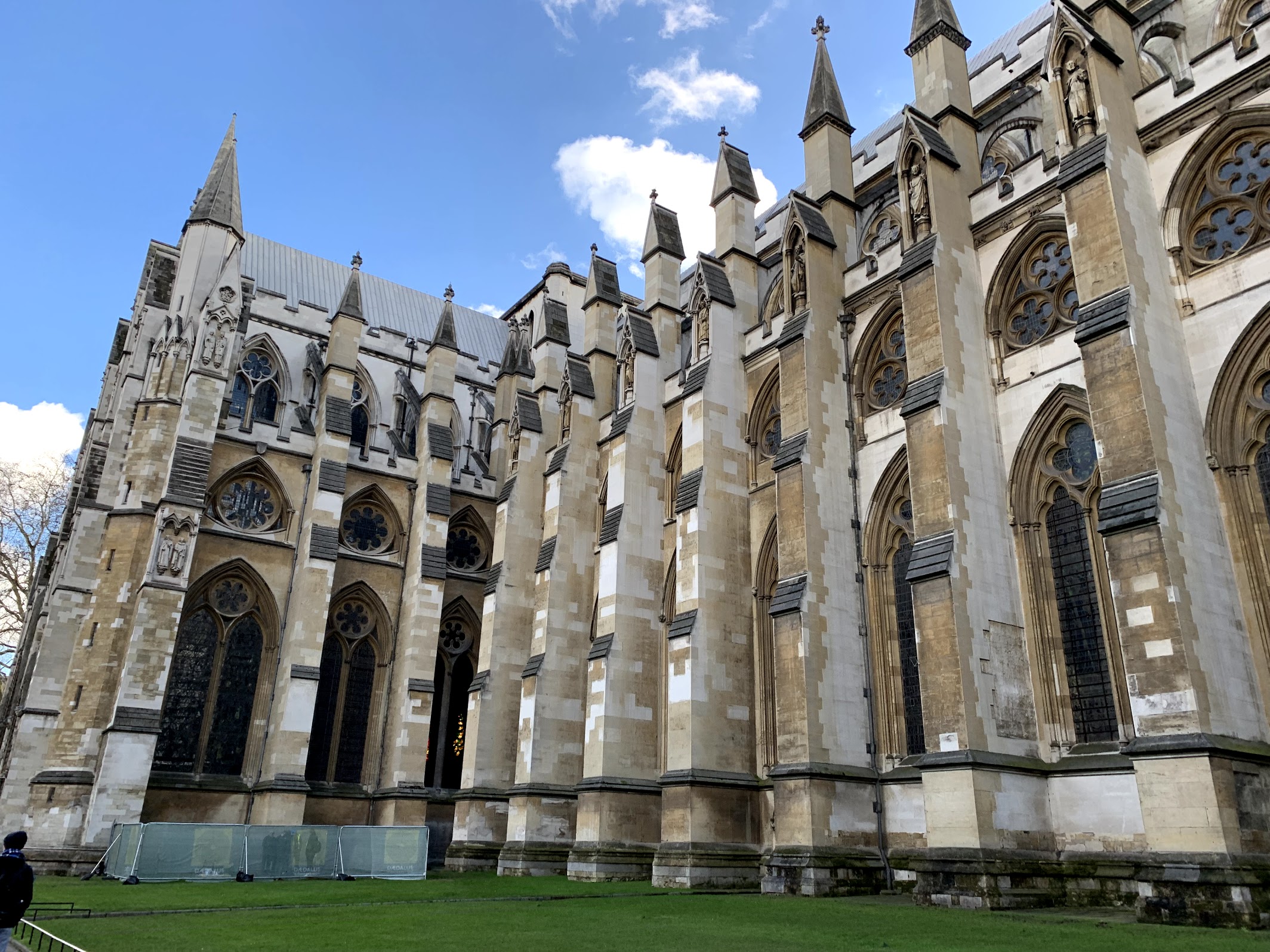
Side view of Westminster Abbey
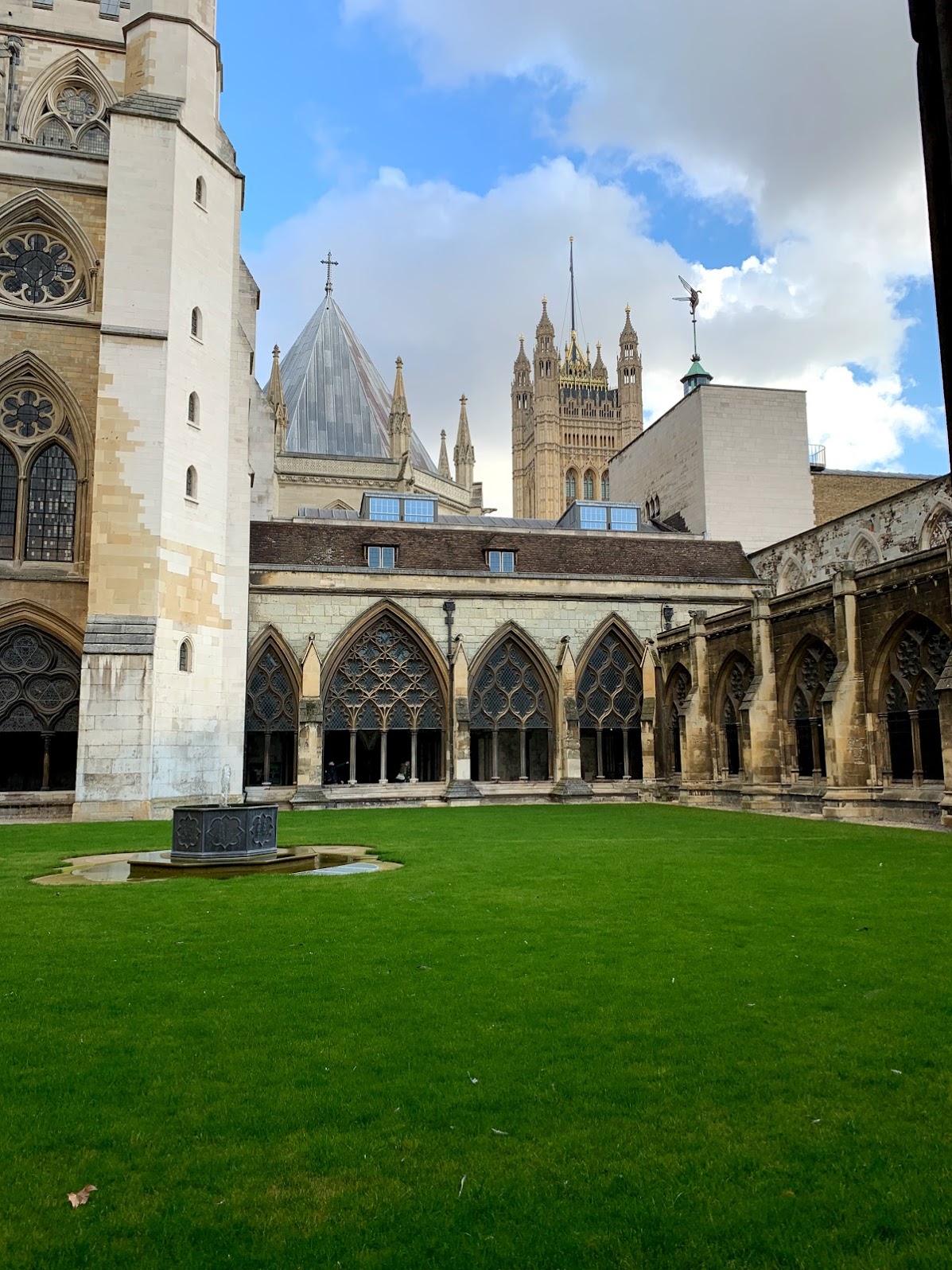
Old cloister inside the Abbey
Famous Western Doors of the Abbey

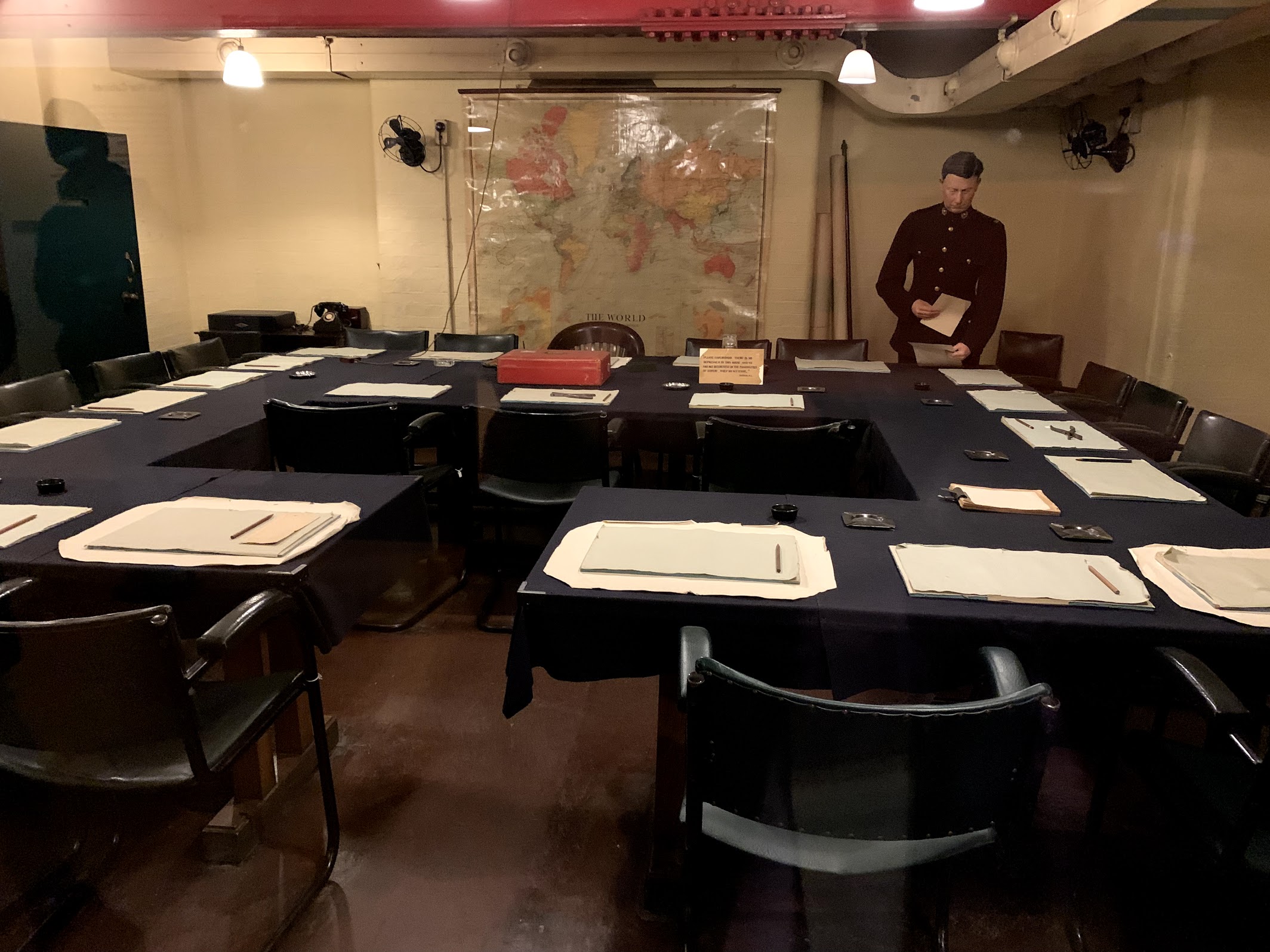
It was tea time when we left the Abbey so we meandered a couple of blocks until we found this cute little café called Pickles and had a nice tea with cakes and sandwiches. Kati-cornered from Pickles was the Royal Treasury, which holds a secret in it’s basement, The Churchill War Rooms. During WWII Winston Churchill and his government ran military operations and correspondence from this underground bunker that was original the vaults to the Treasury. The War Rooms were turned into a museum and opened in 2005.

Churchill’s War Cabinet Room

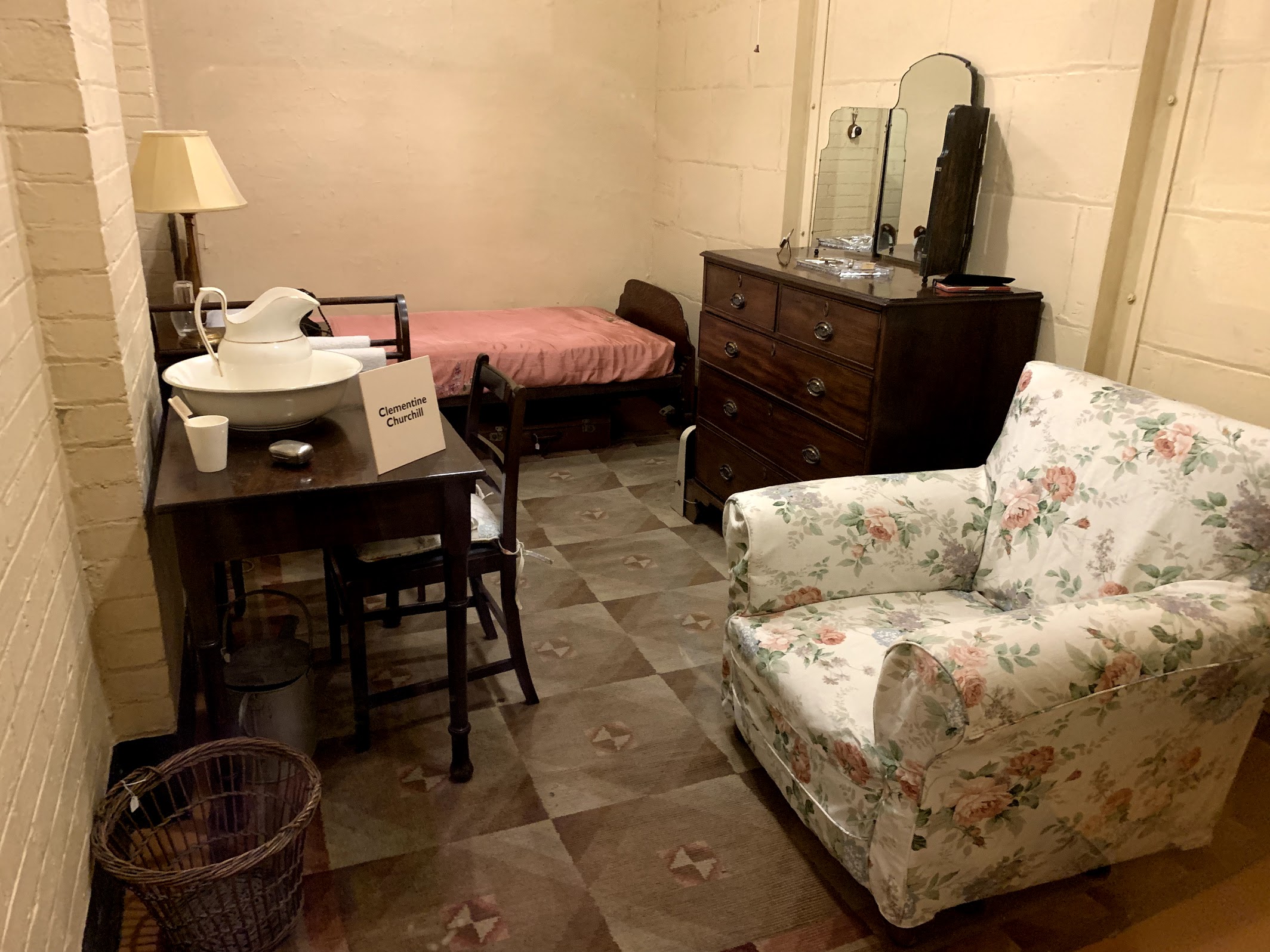
The labyrinth of rooms contained original artifacts and furniture from the time period of its operation, May 1940-Aug. 1945. There was also a Winston Churchill Museum within the bunker. I really enjoyed listening to the audio tour that gave vital information about each room and personal accounts from the men and women who worked in the bunker and with Prime Minister Churchill. The boys were engrossed and even Faywen really enjoyed the displays. She particularly liked Mrs. Churchill’s bunker room and seeing the room where the typists worked. Churchill even had his favorite cook Ms. Georgina come and prepare his meals while he was in the bunker.

Mrs. Churchill’s quarters
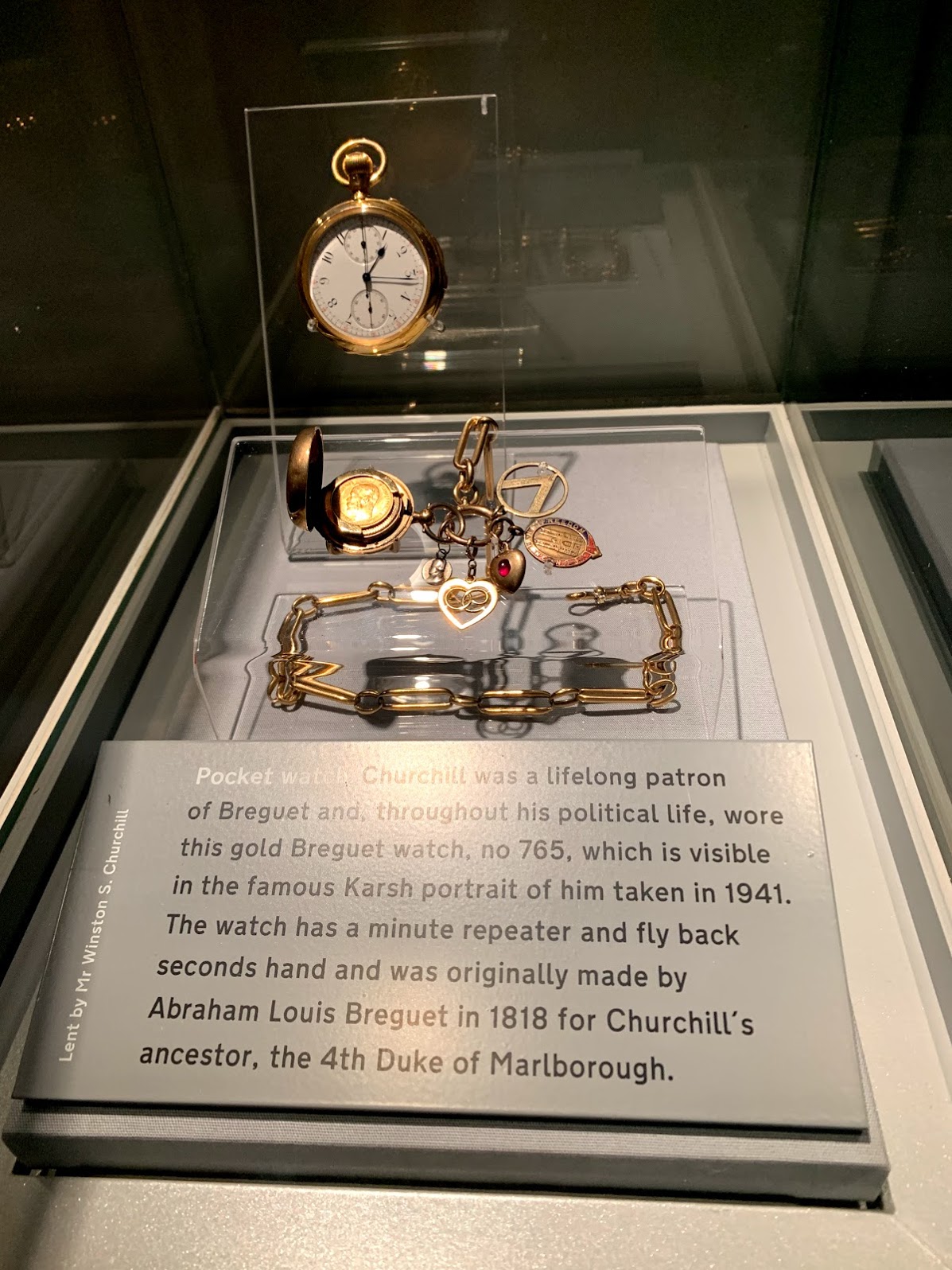
Winston Churchill’s famous pocket watch
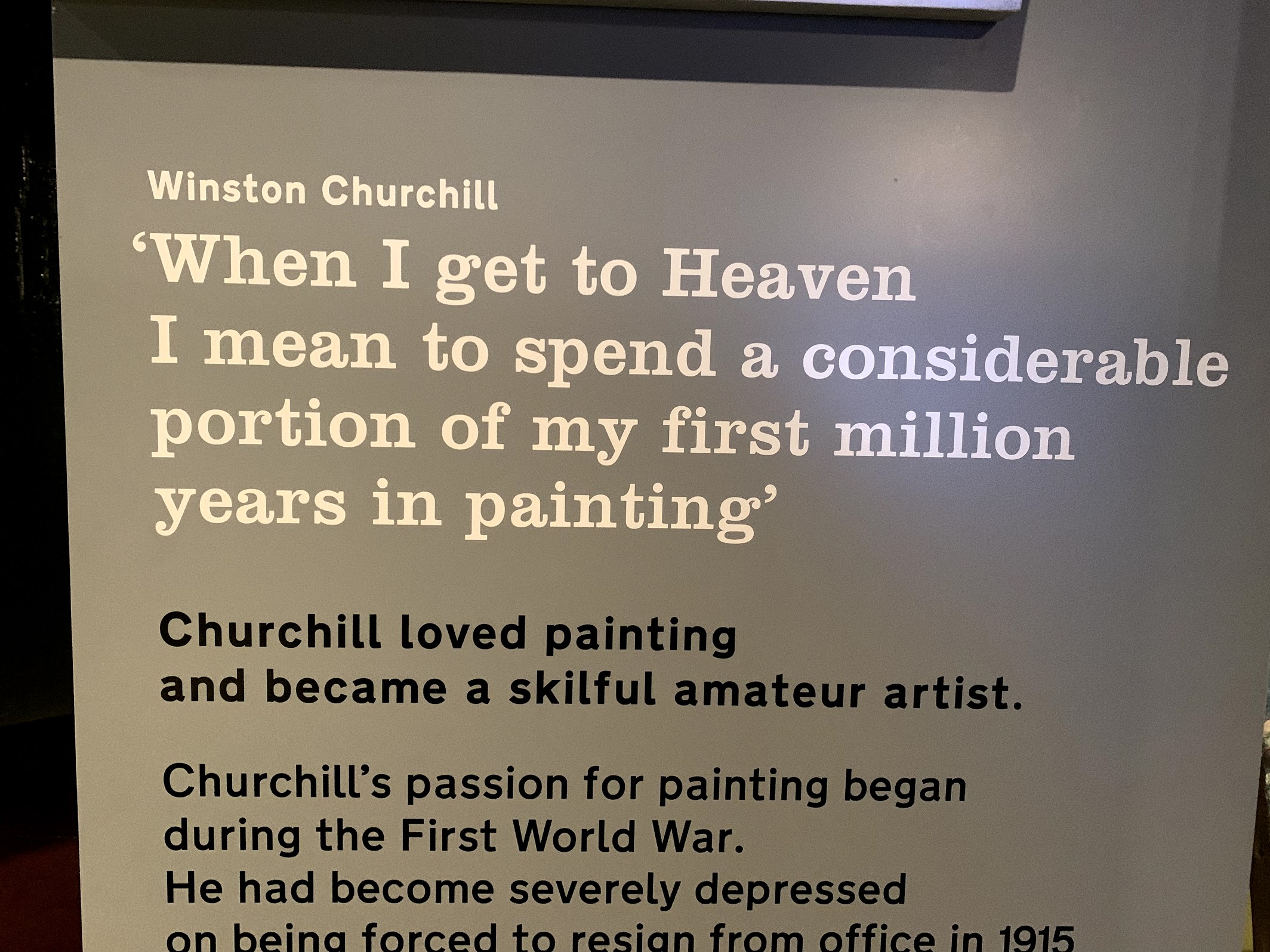
I just love this quote: He was a devout Christian and faithful husband and father.
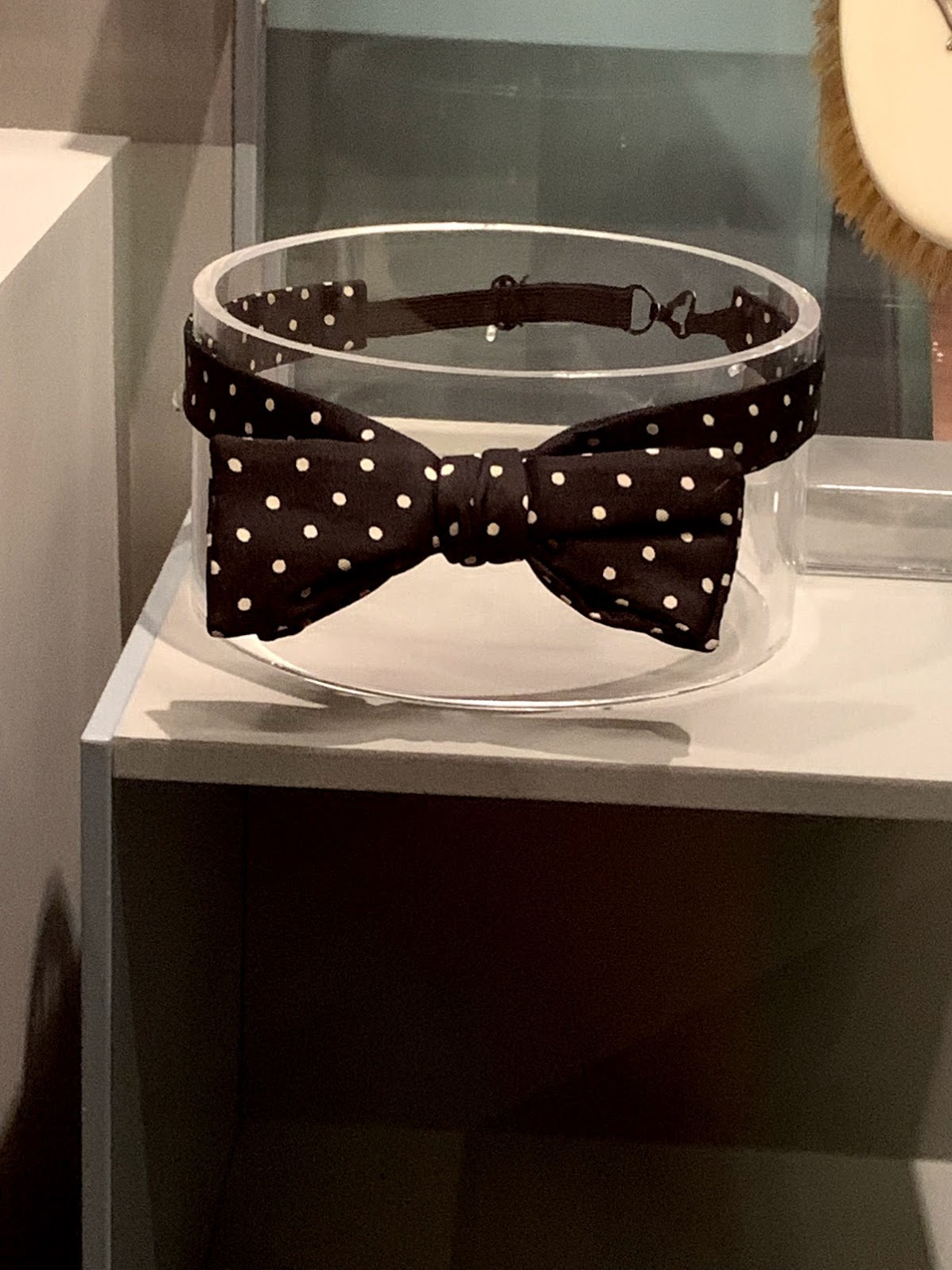
Churchill’s famous bowtie
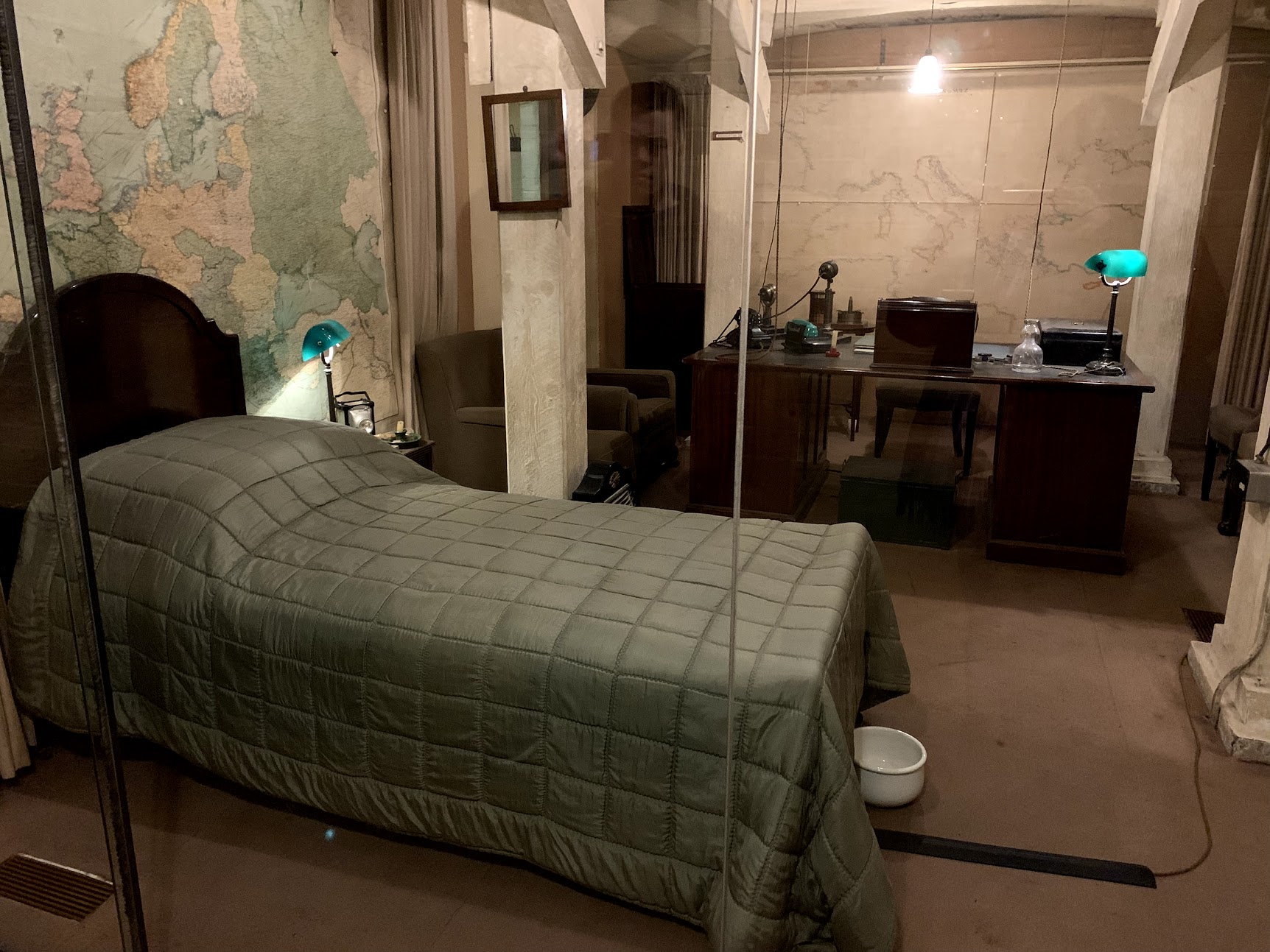
His private quarters: He gave several of his famous BBC radio speeches from that desk.

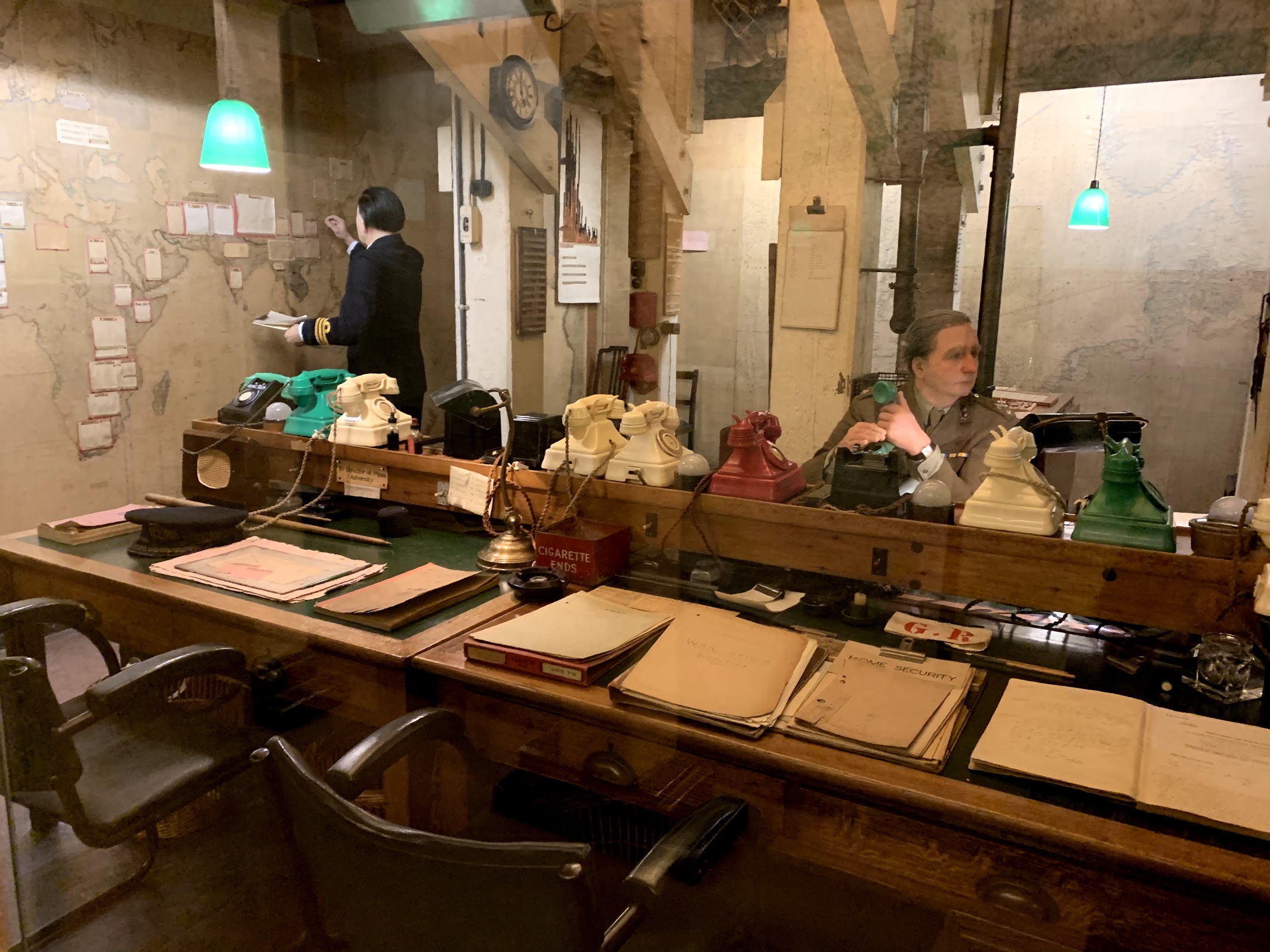
Robert and I liked the Glamour Boys room with the row of specialized colored telephones. The Glamour Boys were the intelligence officers who had access to every political ally, commander, and could find out what was going on in the war by choosing a phone that was color matched to a certain intelligence office around the world. All phone calls were scrambled before being sent out over the wire.

Glamour Boys Room with the iconic “Beauty-line” colorful phones

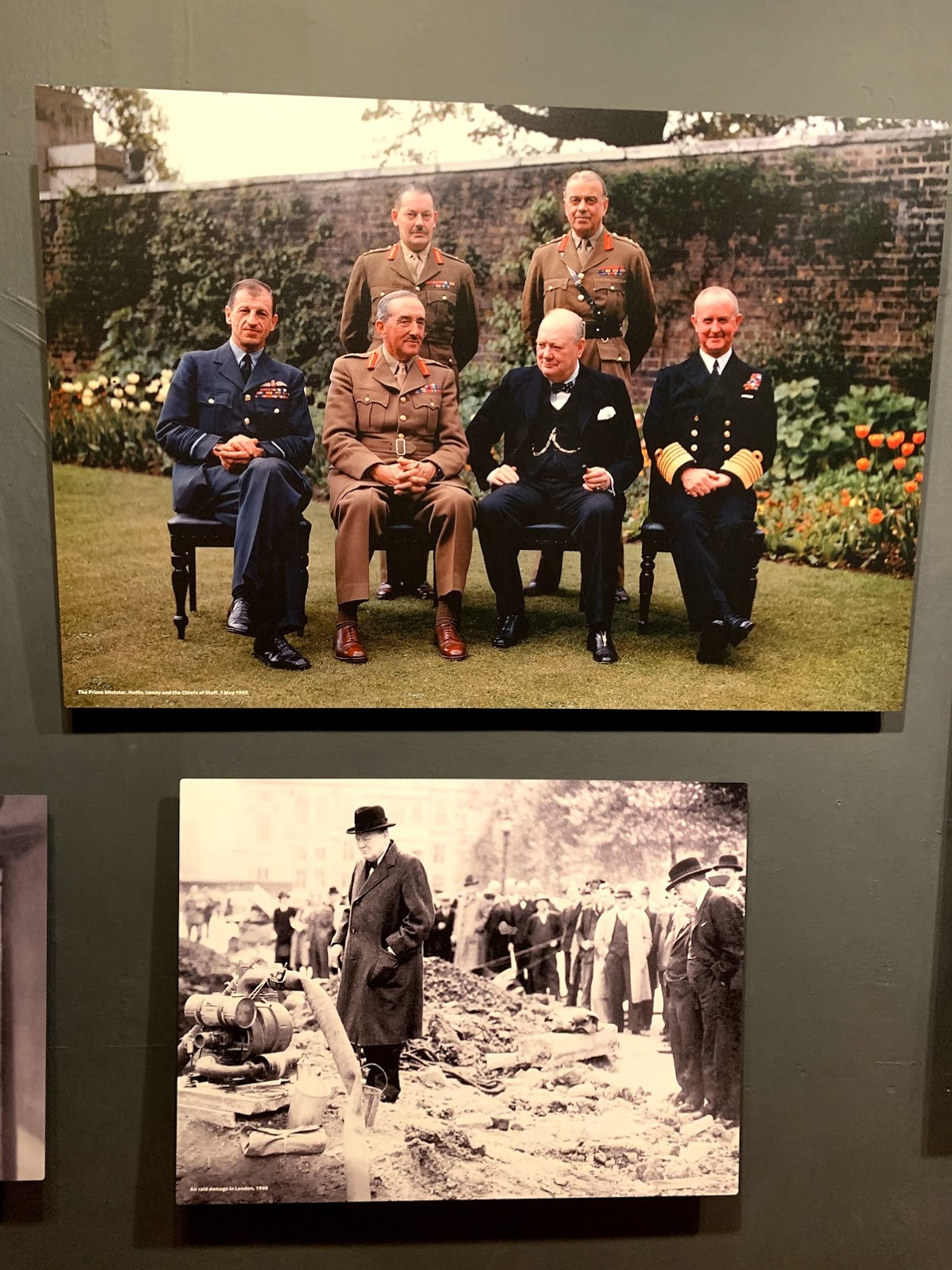
A set of photos hung in the main hall that really hit home the affect of the war on Britain. One photo shows Churchill inspecting rubble literally at the doorstep of the Treasury after a blitz bombing of London. The bomb landed meters away from the building and the bunker entrance. The other photo is Prime Minister Churchill sitting with 5 of his top war cabinet on 7 May 1945, V.E. Day (Victory in Europe).

Top photo is VE day
Bottom photo was taken in 1940 only meters away from the secret bunker. In the photo only he and his bodyguard know where the bunker was located.

The entire museum was laid out nicely and was very informative. In the quiet moments when the audio tour wasn’t playing you could almost hear the voices of the men and women who worked in the bunker, sometimes not emerging for weeks. It was a chilling yet calming reminder of the commitment of those behind the lines who made sure “Victory” was obtainable.

On our way home we had dinner at a local classic British fish and chips shop. A befitting end to a day learning about Britain’s history!

London Day 1: Exploring the City

We are staying in a Premier Inn right on the River Thames! Literally you can see the London Eye (a giant Ferris wheel) right outside our window! After a delicious breakfast we bundled up and headed out to explore London. It was partly to mostly cloudy all day and not too cold.

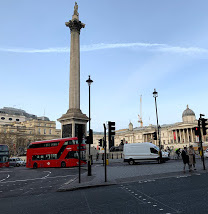
Trafalgar Square, London
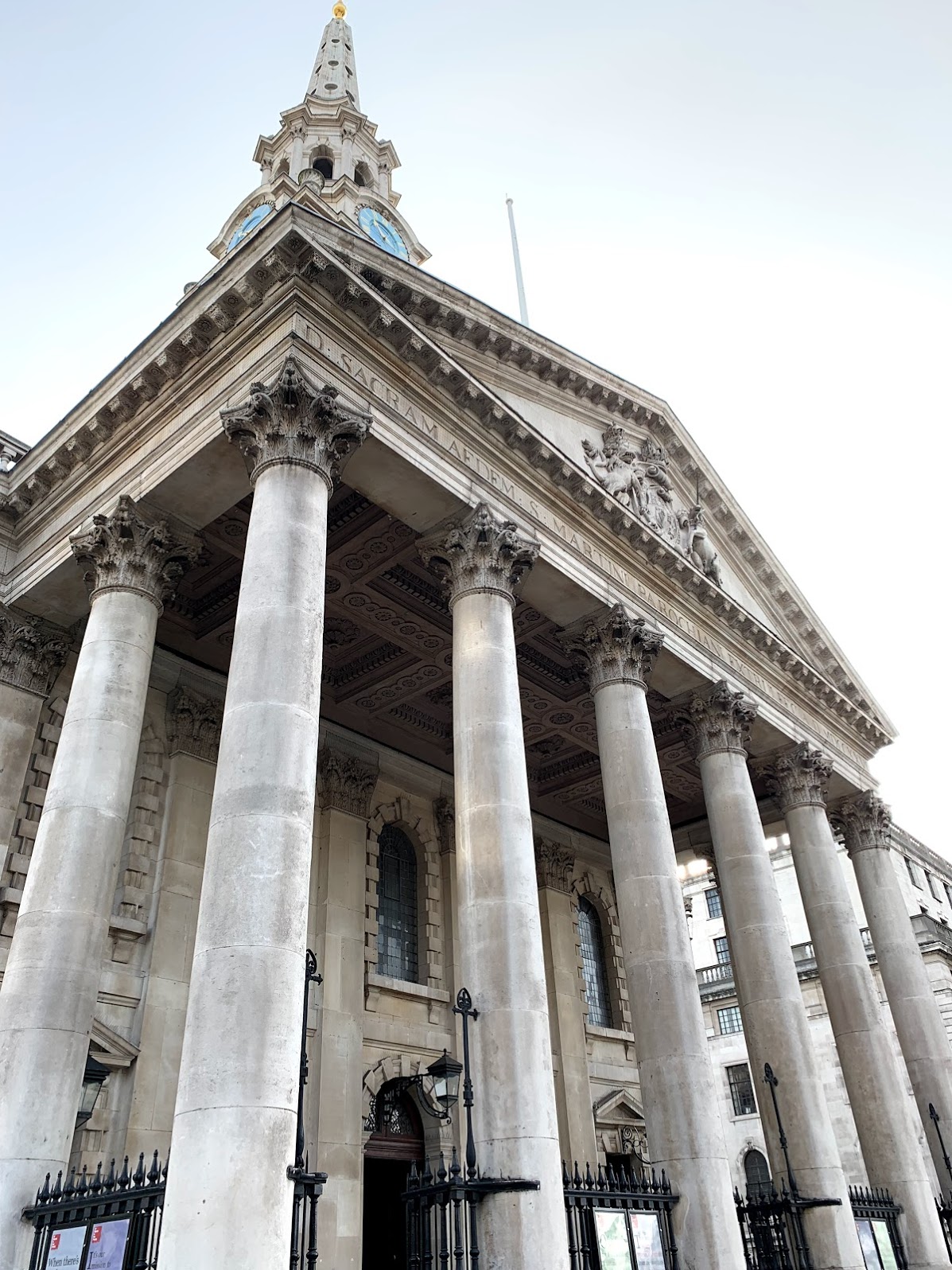
St. Martin in the Fields inTrafalgar Square
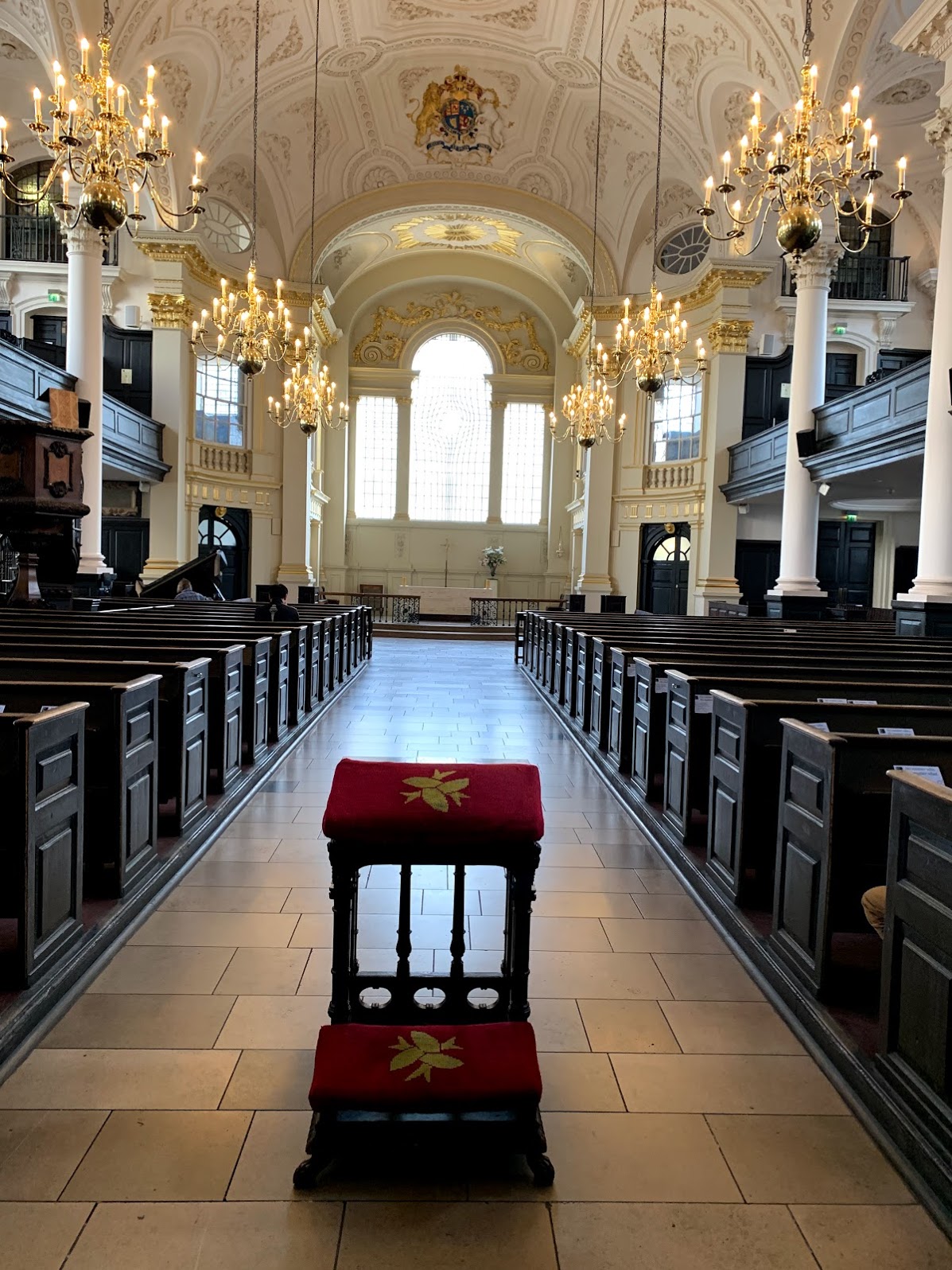
Inside St. Martin in the Fields

We walked along the Queen’s Walk and then across the Waterloo footbridge into the heart of London. A few blocks down the street we were in Trafalgar Square. The statue of Vice Admiral Lord Nelson was directly in front of us. Funny to think that just yesterday we were on his ship the HMS Victory! We briefly popped into Waterstones, which is the largest bookstore in Europe. It’s also a bookstore chain found throughout the UK. Across Trafalgar Square was the beautiful church, St. Martin in the Fields. There has been a church on the site since the Middle Ages, but the current building was completed in 1726. The church building is used not only for religious services, but also for classical music concerts. Many famous classical recordings have been made in the sanctuary. In fact, as we sat in the pews admiring the architecture, the grand piano was being tuned for a concert that evening.

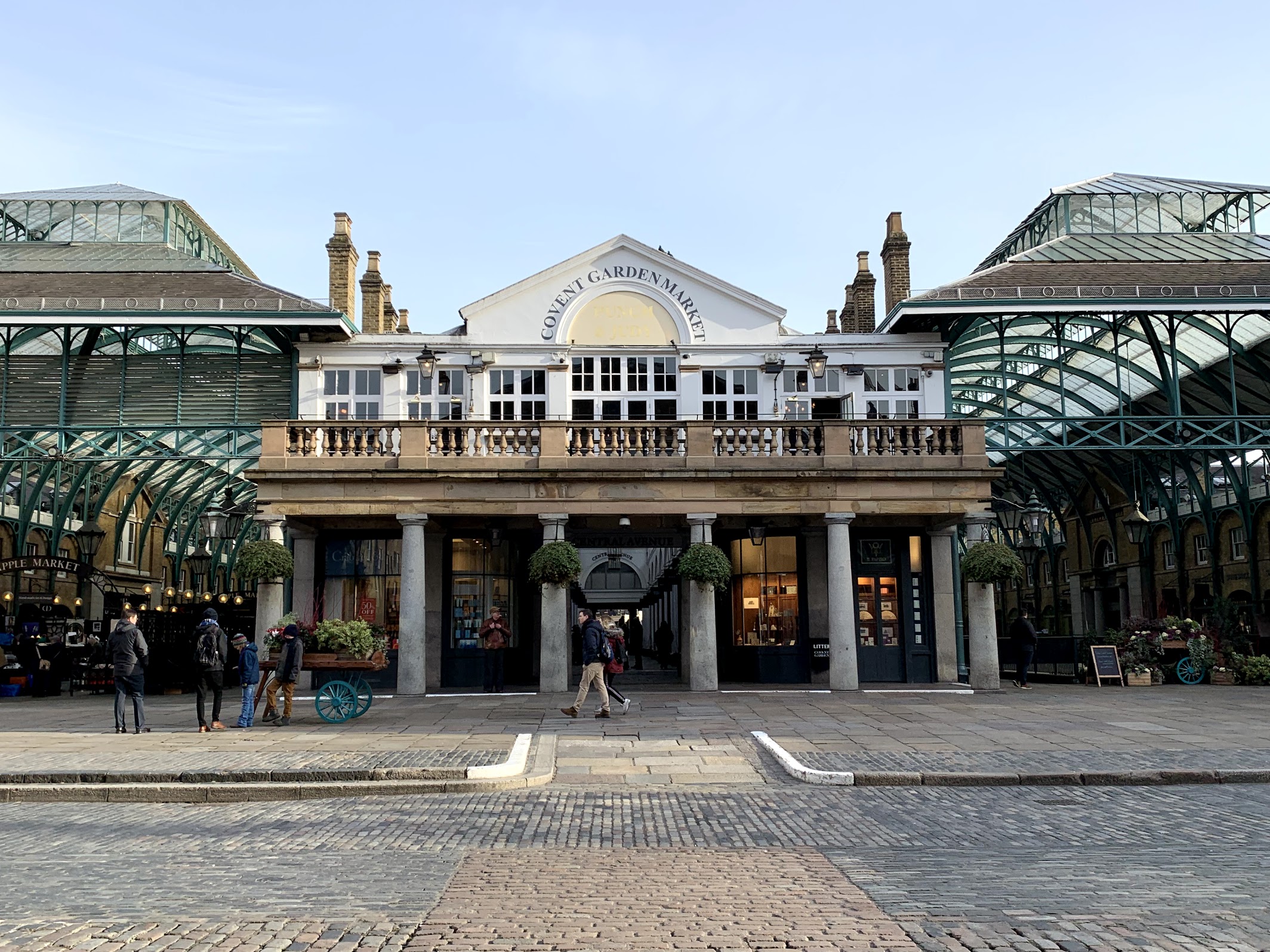
Rounding the corner we walked a further three blocks until coming upon a little engraving in the side of a building. The engraving said that in 1662 the first Punch and Judy Show took place on the spot. Across from the sign a pedestrian walkway took us to the entrance to Covent Garden. There were not only established stores in the old Victorian shopping arcade, but several shop stalls… however we didn’t see any ill-speaking flower girls or professors of speech!  😉

Covent Garden
The first Punch and Judy Show happened behind where I stood to take this photo.

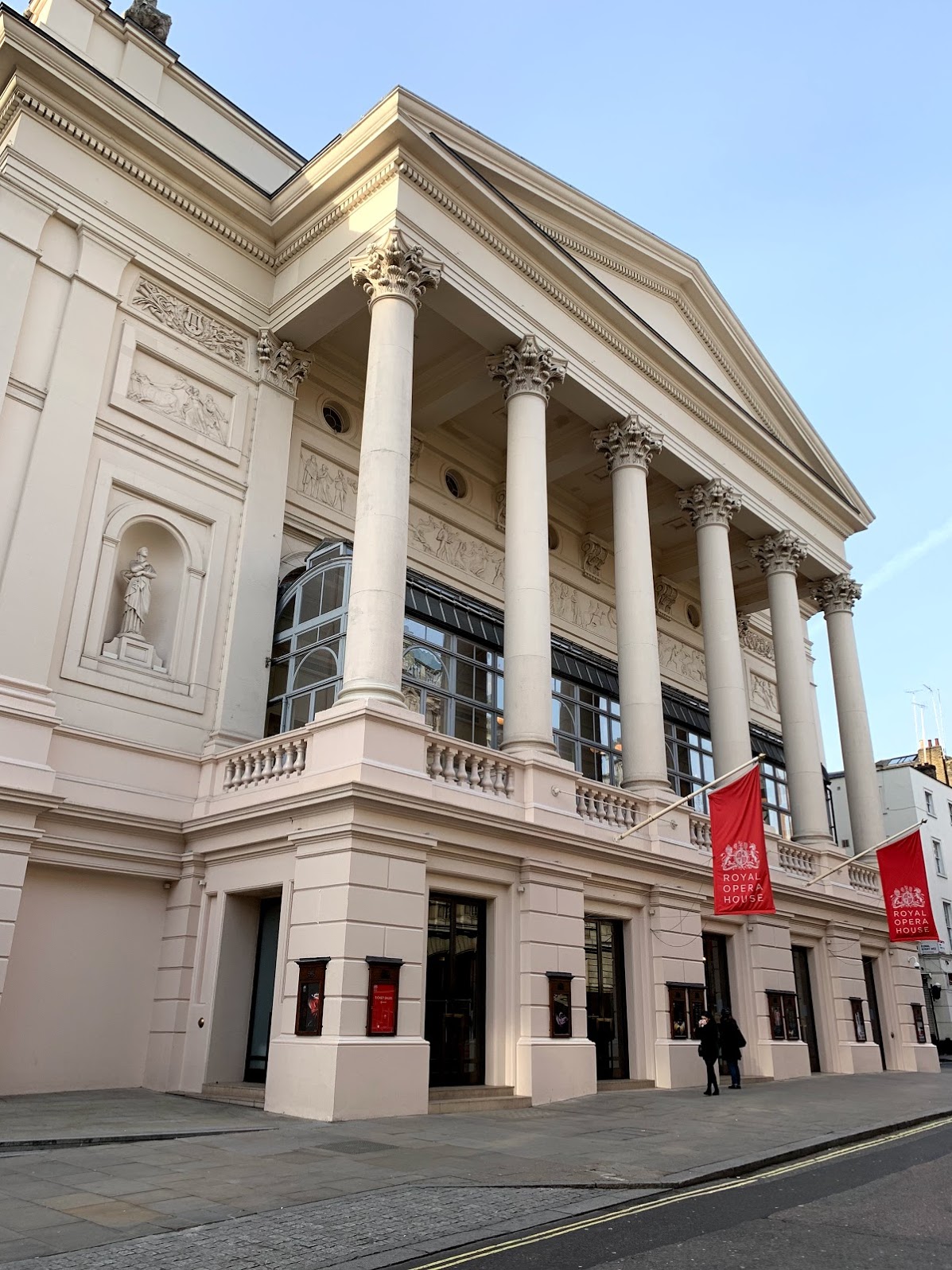
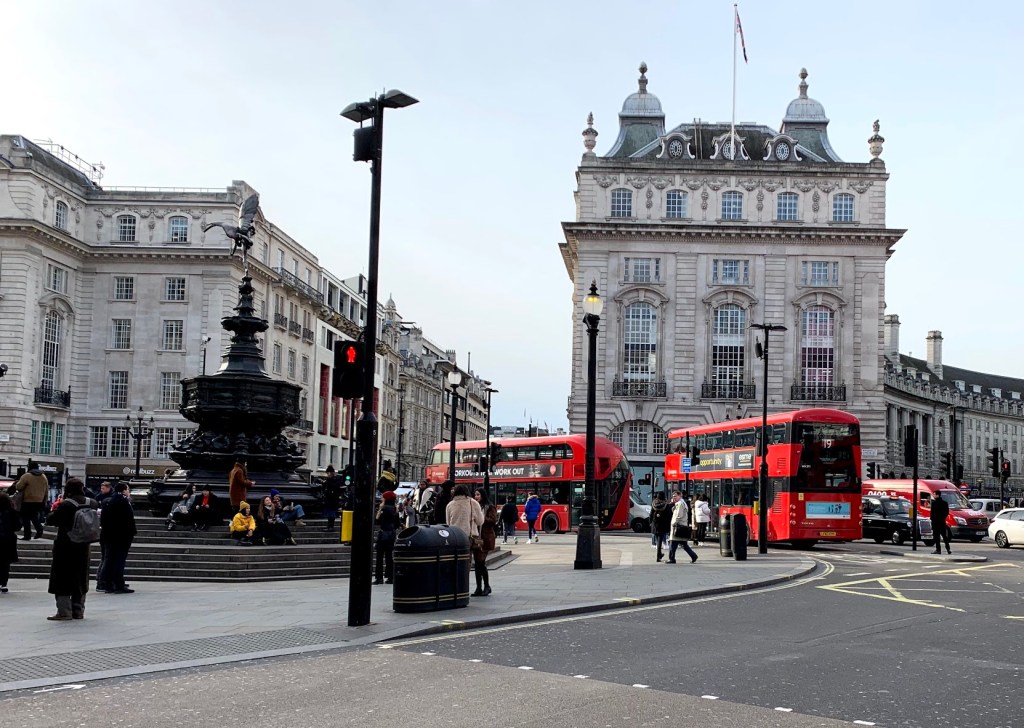
Not too far from Covent Gardens is the Royal Opera House. We were able to step into the lavish red carpeted, mahogany trimmed foyer and have a quick look around. Since I’m a trained opera singer, it was a delight to visit one of the world’s most famous opera houses. Unfortunately we weren’t allowed into the main performance hall. We left the opera house and walked past the Royal Ballet and right out into Leister Square and then a few blocks onto Piccadilly Circus, London’s Times Square!

Royal Opera House
Piccadilly Circus, London

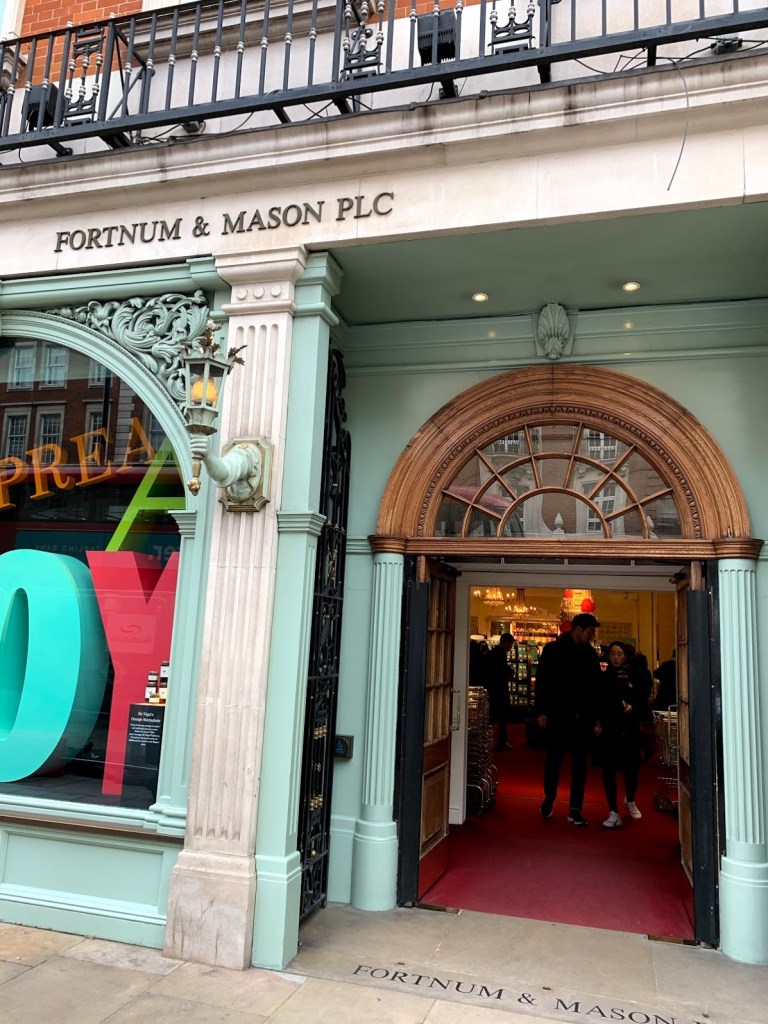
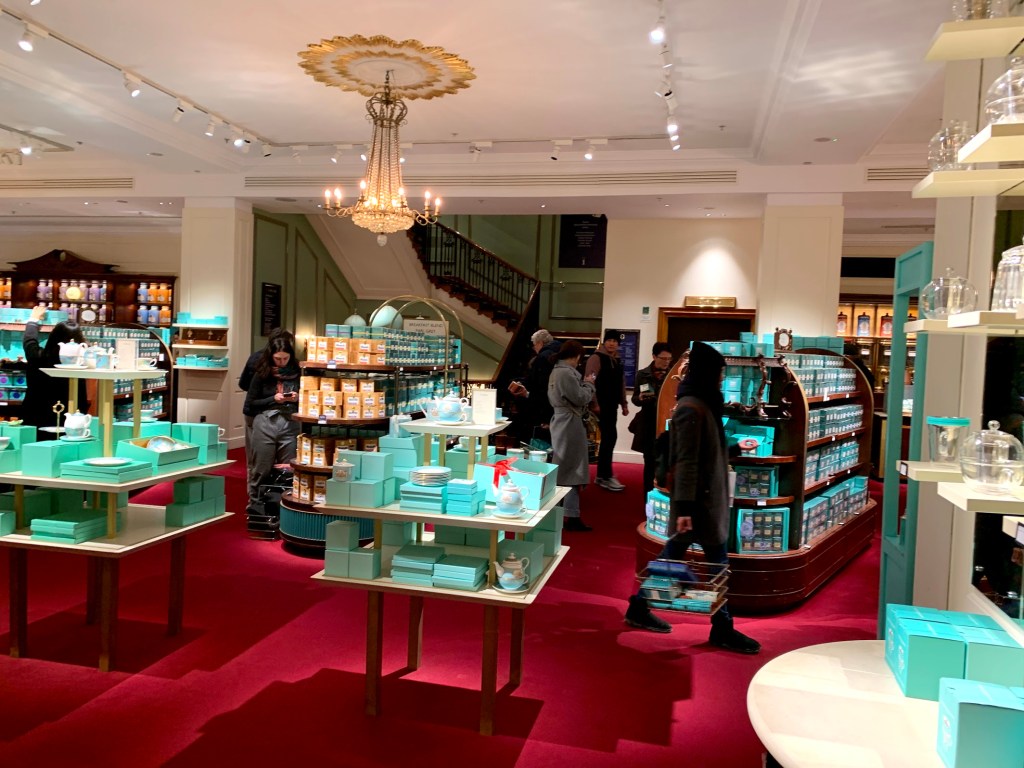
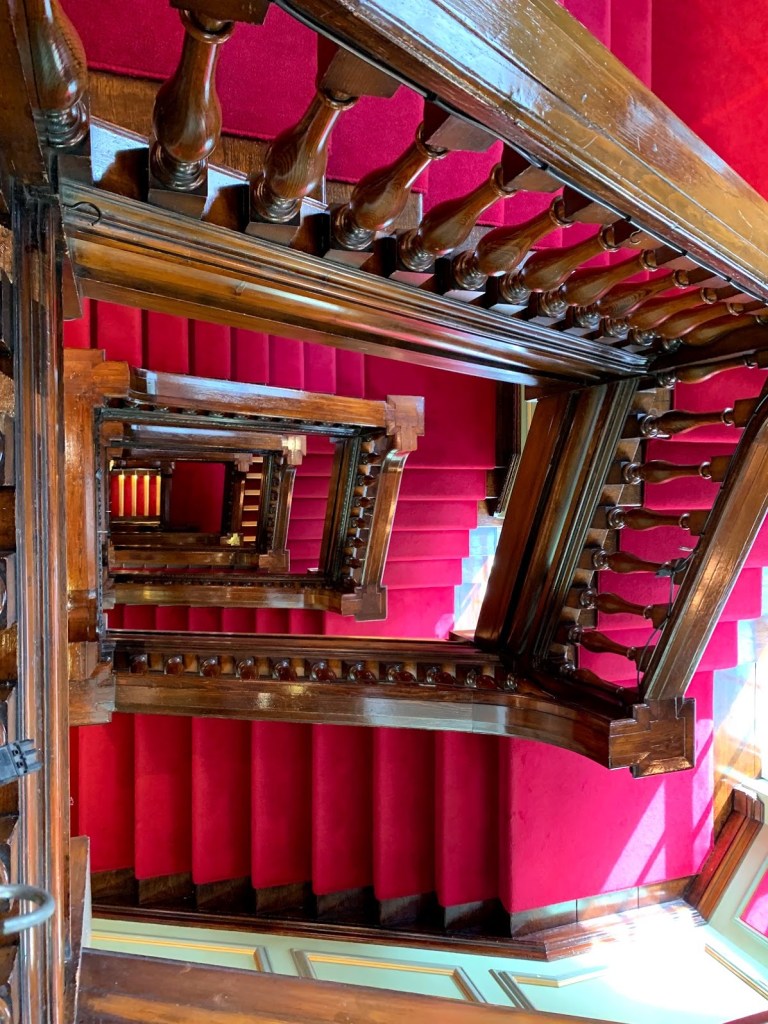
Along Piccadilly Road we came to Fortnum and Mason. This high-end grocery and shop has been in existence since 1707. It was a lovely 4-story shop beautifully decorated with white marble, chandeliers, and staircases with mahogany trim and red velvet carpets.

Fortnum and Masonin London
Tea floor
Main staircase built in 1707 at Fortnum and Mason

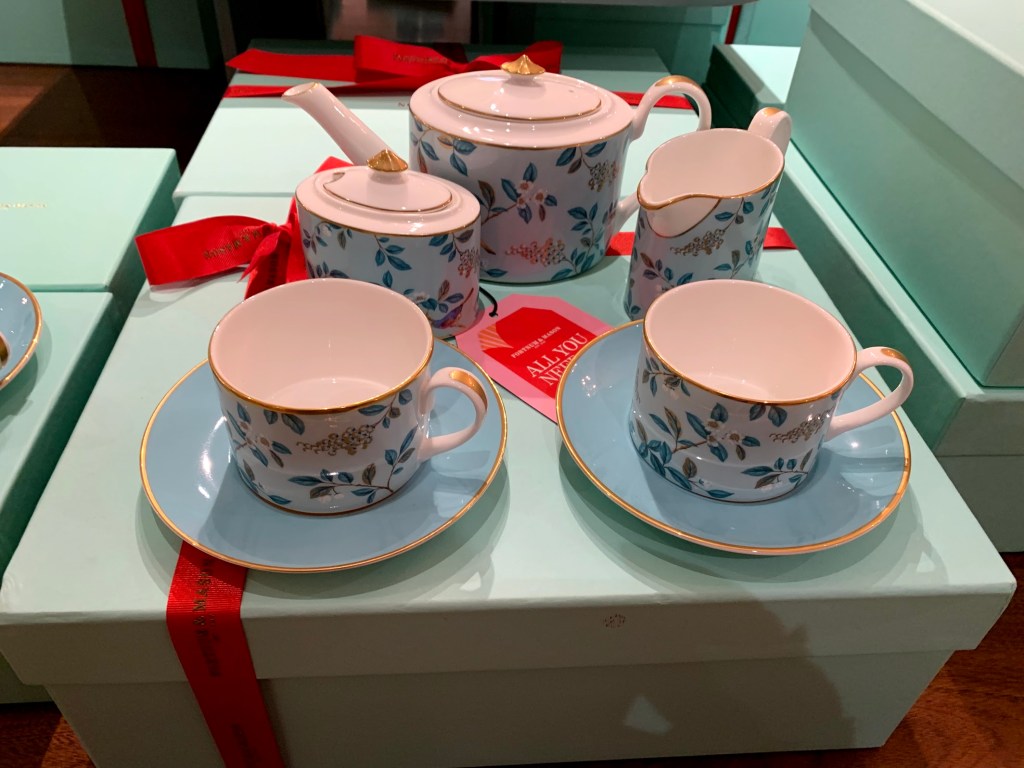
I was looking around at the tea accessories when Robert took me by the hand and said I needed to come see something that he WOULD be buying for me. Of course, I was quite intrigued at this point. We rounded the corner and he showed me the most beautiful turquoise tea set with little blue jays, delicate green twigs, and little white flowers. I gasped to see that the flowers were Camellias! It was a tea set designed especially for Fortnum and Mason that had little delicate Camellia Sinensis plants on the tea service. The Camellia Sinensis is the tea plant itself. The little delicate white Camellia flowers bloom just as the leaves begin to sprout. I’ve known about the plant and it’s connection to my name for years, but never have been able to find an actual tea service with a Camellia pattern. David, the clerk, was just as excited to meet someone by the name of Camellia and actually introduced me to some of his colleagues in the china department. Robert kept true to his word and purchased a box set of two cups/saucers, the teapot, creamer, and the sugar bowl in the pattern. I grabbed a couple of coordinating tea towels and a tea cozy. We had the lot shipped to America. I’ll have to wait 6 months, but that’s okay, I’m patient!!!

Fortnum and Mason’s signature tea service, Camellia Pattern

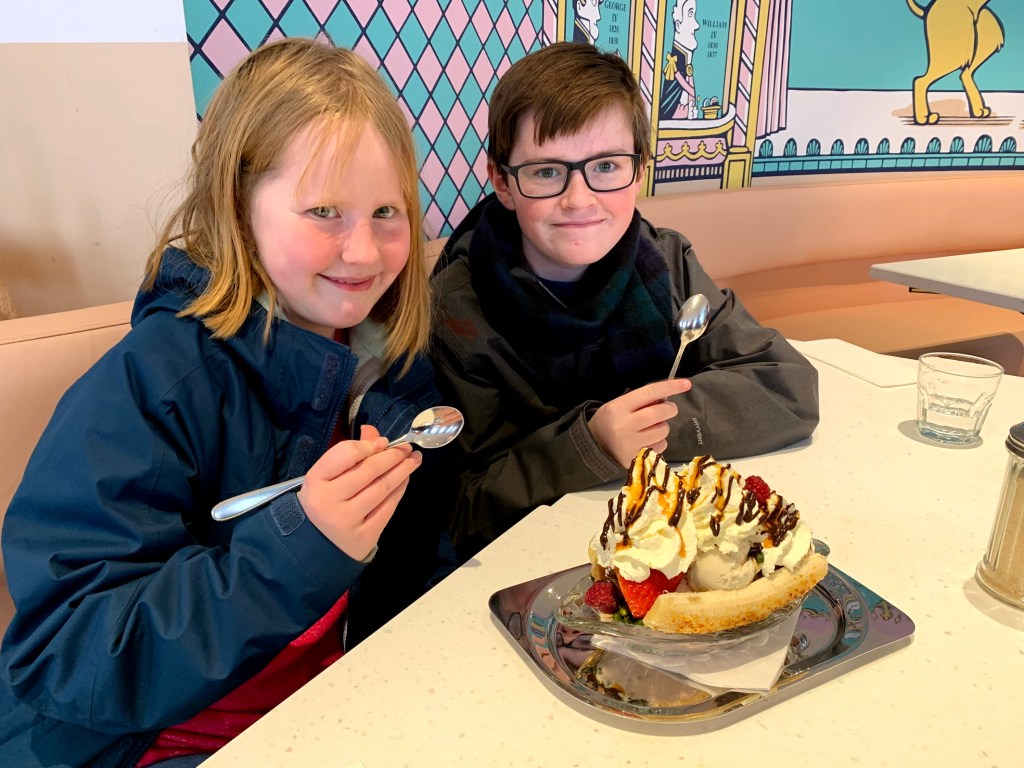
While at Fortnum and Mason Liam had a traditional shoeshine on his leather boots and we all had a light refreshment. Liam and Robert had coffee and scones, Seamus and Faywen shared a gigantic banana split, and once again Robert surprised me. This time he secretly told the waitress to bring me a real London Coronation Chicken on toast! I LOVE Coronation Chicken! He’s such a sweetie!

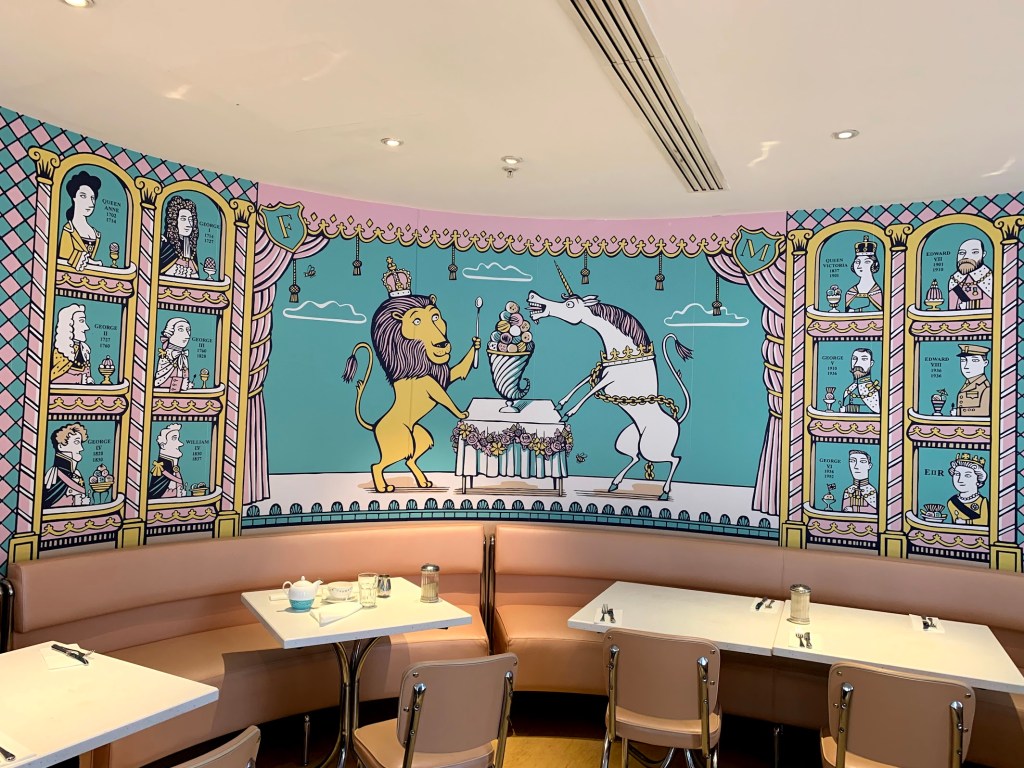
We all loved this whimsical painting in the tearoom at Fortnum and Mason. It shows the kings and queens that have ruled since the shop opened in the early 1700’s.
Eating ice cream at Fortnum and Mason

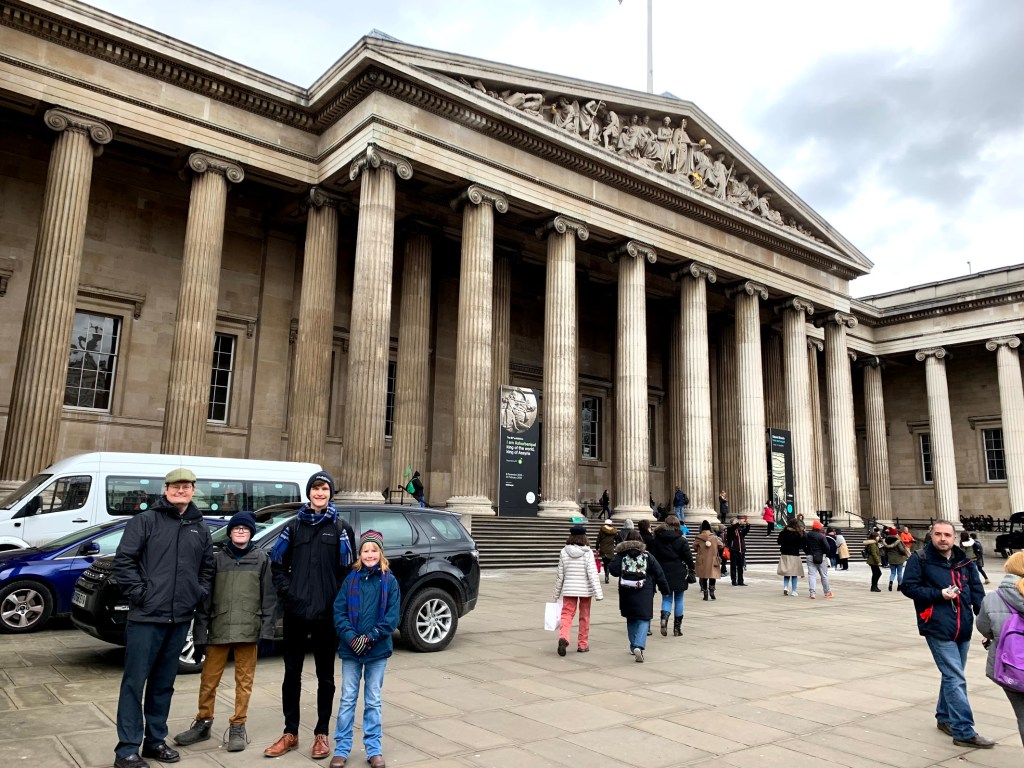
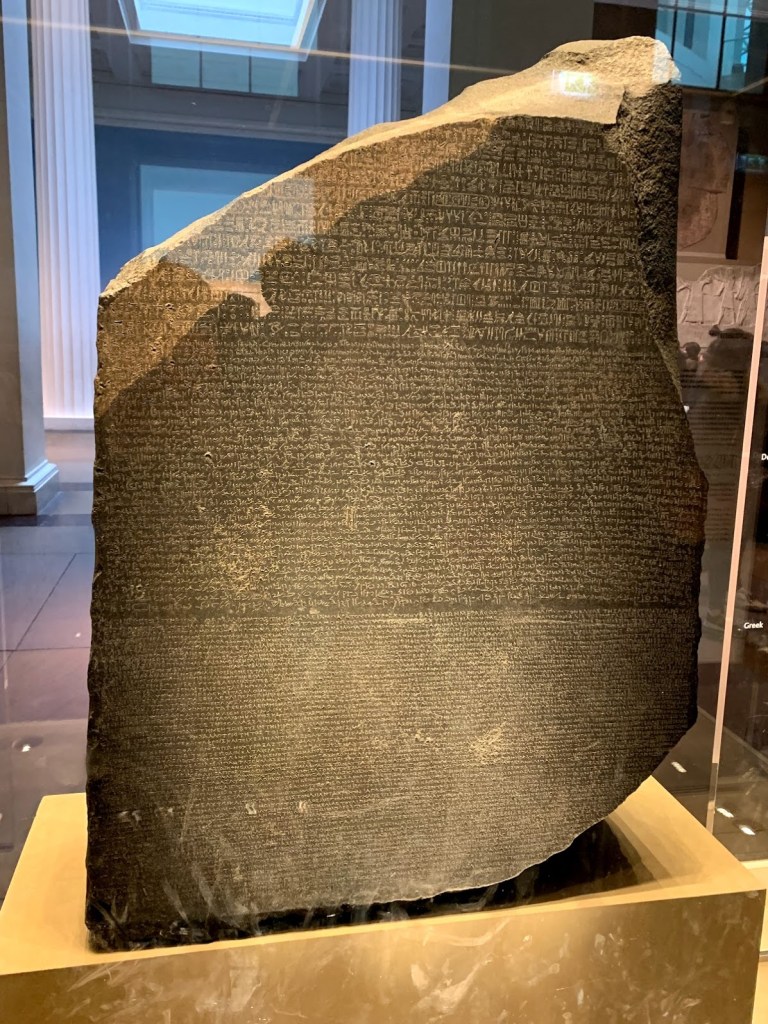
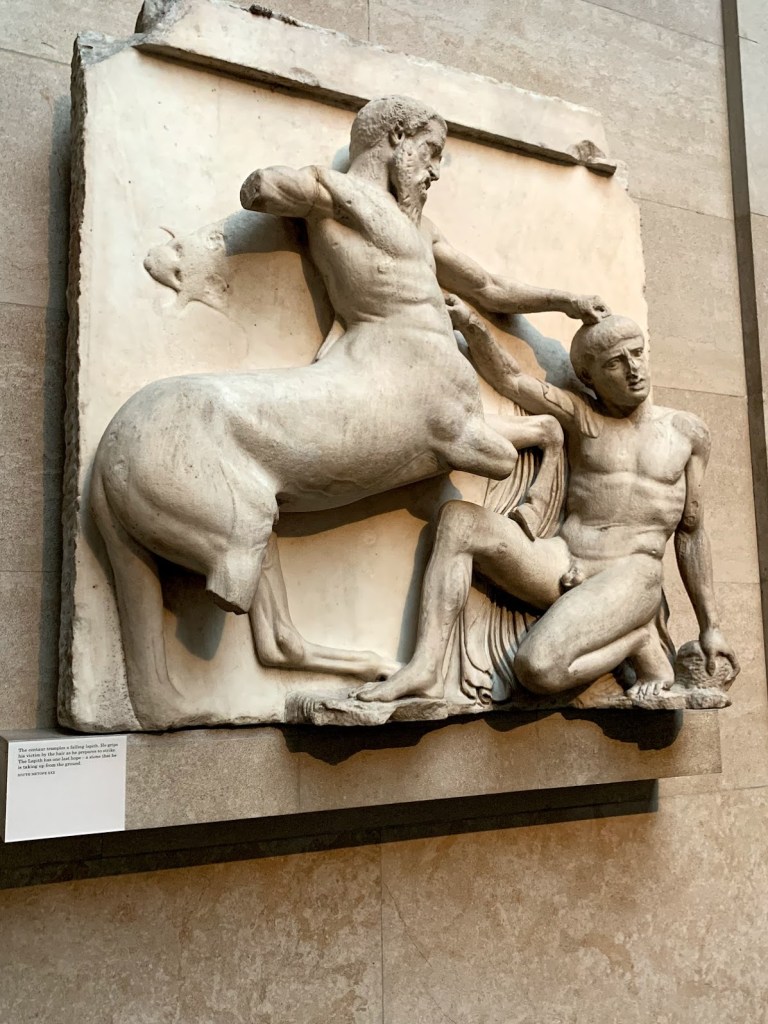
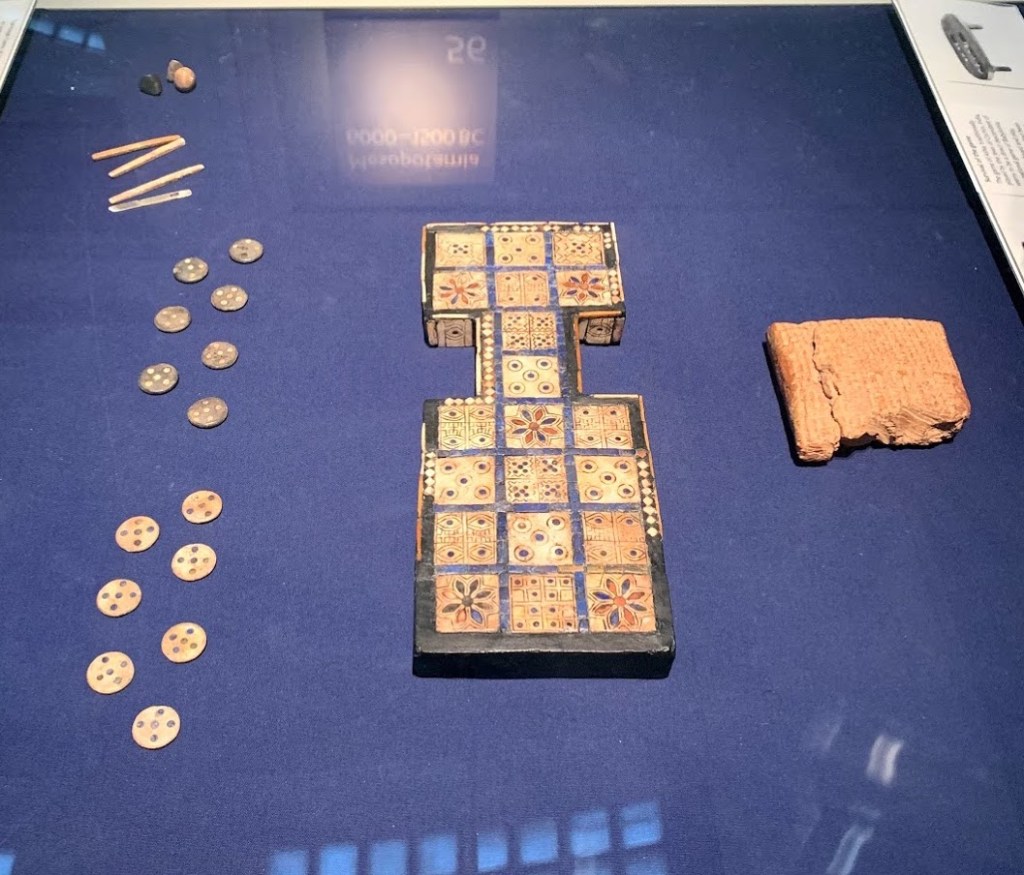
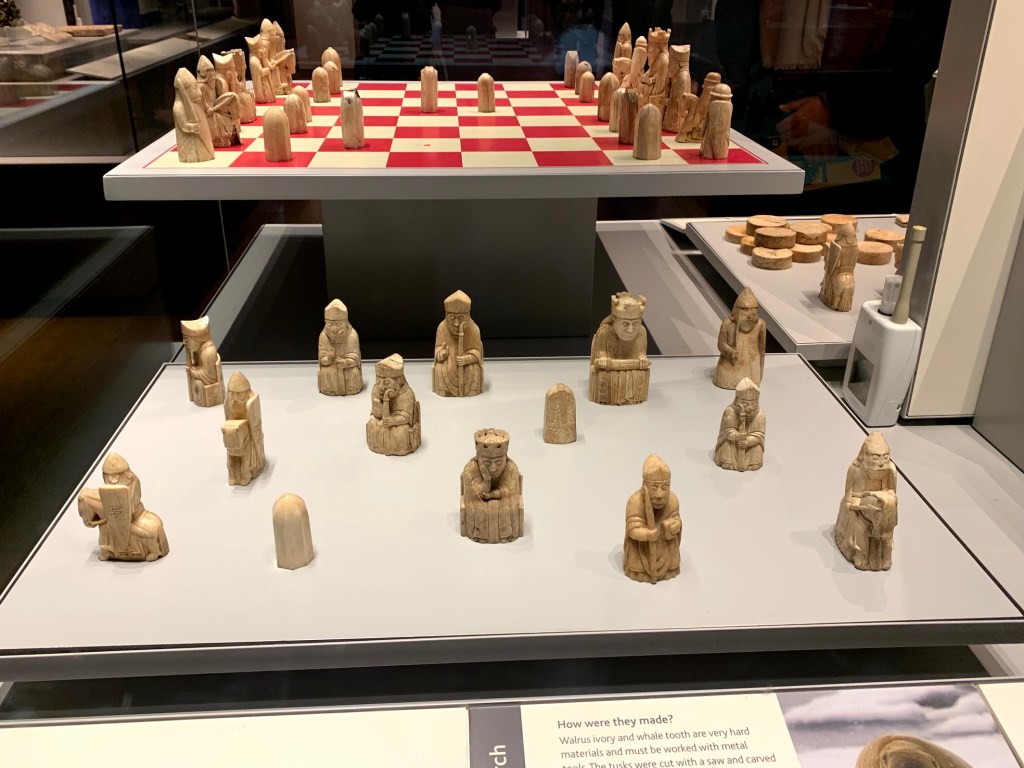
Meandering through the West End, London’s Broadway district, we came to the famous British Museum. Free to the public the museum houses some of the world’s greatest antiquities. These include artifacts from ancient Mesopotamia, Egypt, India, Rome, Japan, Greece, Babylon, and Europe. Some family favorites were Egyptian cats and mummies, temple stone statues from the Parthenon, the ancient Mesopotamian Royal Game of Ur (which we play at home on a version Robert made by hand, so seeing the original was a family treat), the Lewis Chessmen, the clock room, Easter Island Head, and the Rosetta Stone.

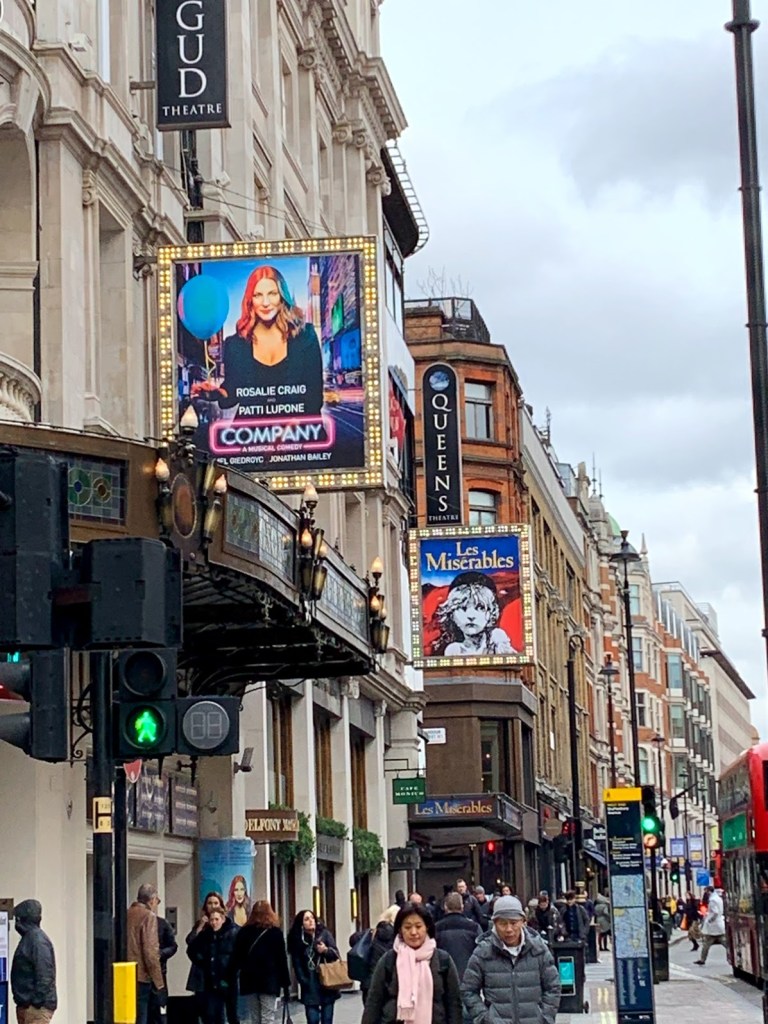
West End: London’s Broadway
British Museum:
It is free to the public.
Rosetta Stone
A Lapith fighting a Centaur: The Lapith were Greek Centaur hunters
From the Parthenon
Royal Game of Ur from Mesopotamia 2500 years old
Lewis Chessmen 13th century

After a long day of walking we had dinner and returned to the hotel for a nice cup of warming tea and some yummy local cookies and candies we bought along the way.

A Sailor’s Life for Me

It was a bit hard saying goodbye to Graham, Kathleen and their friend Jane at the B&B. They were all very kind and friendly. The night before Kathleen gave us free “year round tickets” to see two ships in Portsmouth Harbor, The Mary Rose and HMS Victory (we came to Portsmouth to see the HMS Victory). She only asked that we mail them back to her in the self-addressed envelope she gave us. This way she could give them to the next family that might come and stay at her B&B.

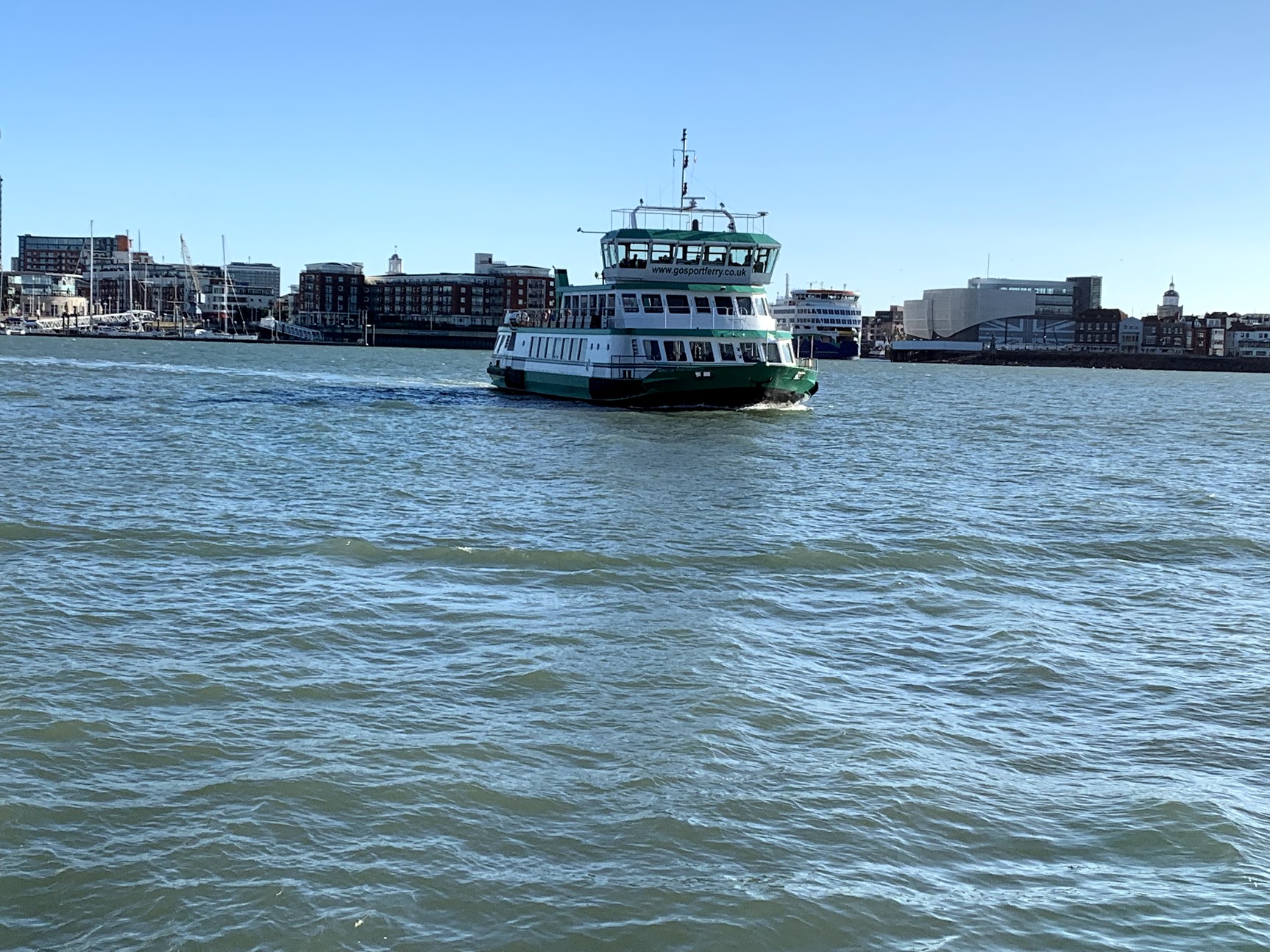
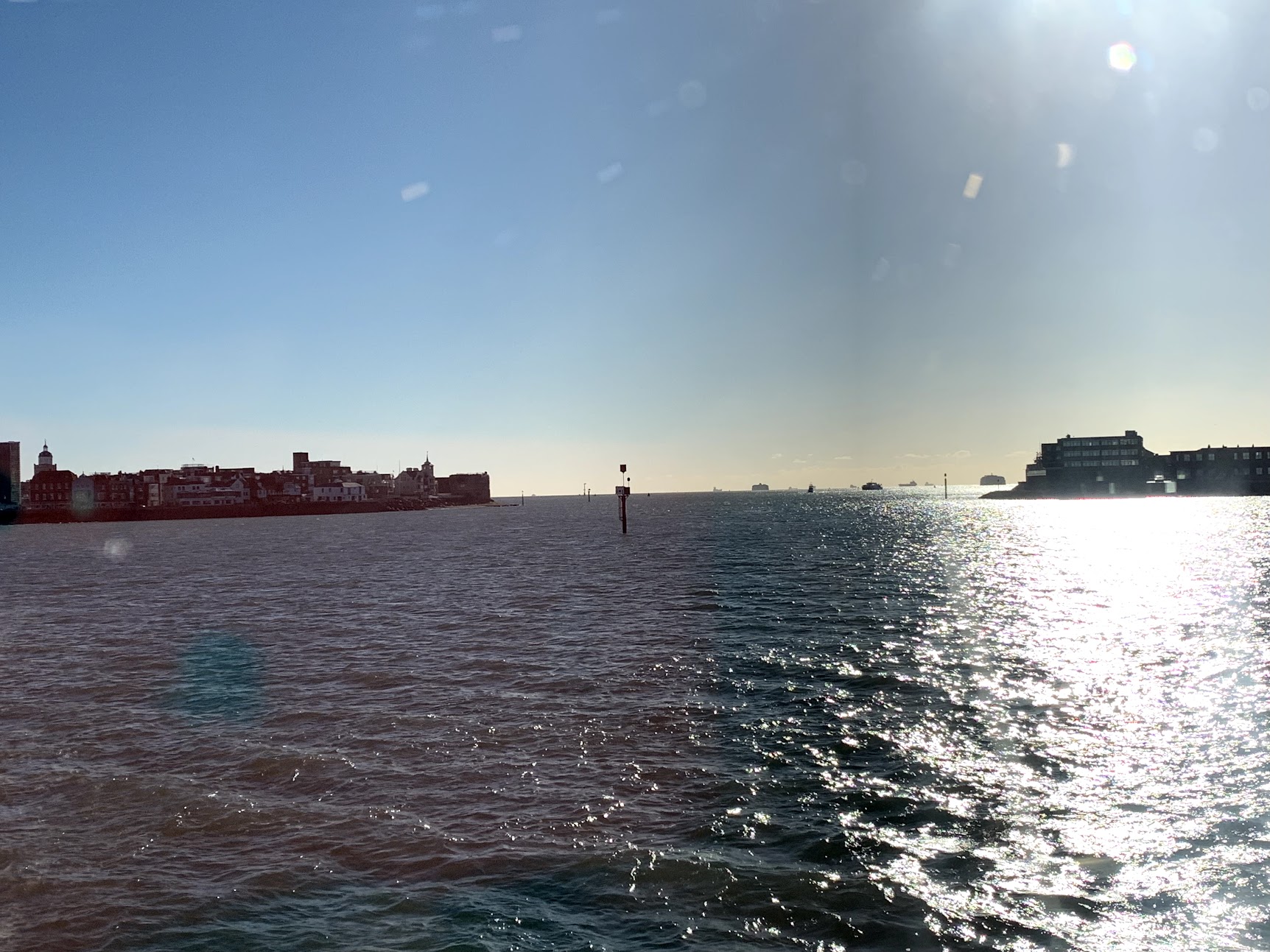
We said goodbye with warm hugs and drove 5 minutes down to the Gosport docks where we parked and rode the ferry across the harbor to the Portsmouth Royal Dockyard. Located in the dockyard were several historical Royal Navy ships ranging in age from The Mary Rose, flagship of Henry VIII, to HMS Queen Elizabeth II, a modern aircraft carrier. Our first stop was The Mary Rose.

The ferry we took across the harbor
Portsmouth Harbor

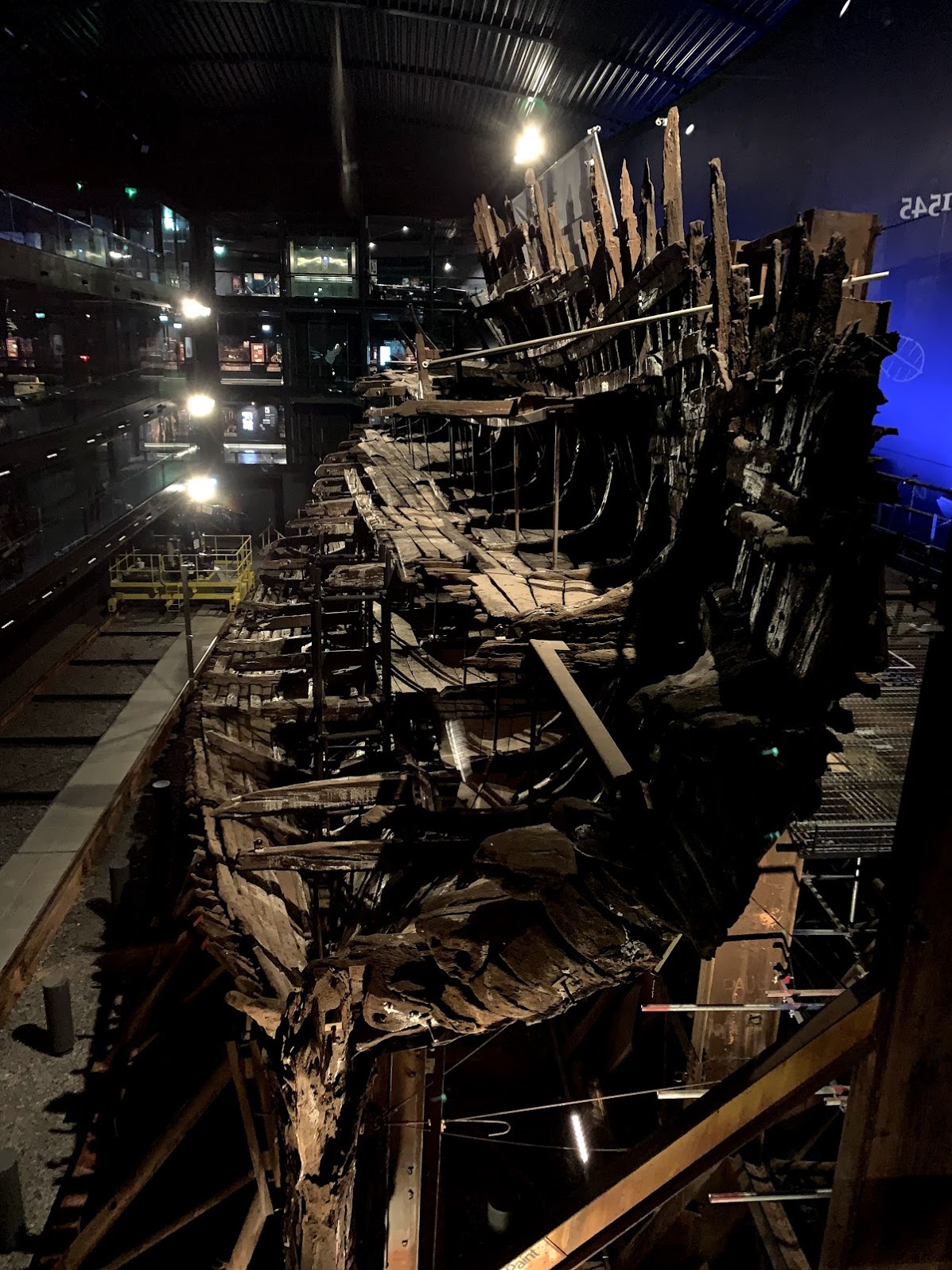
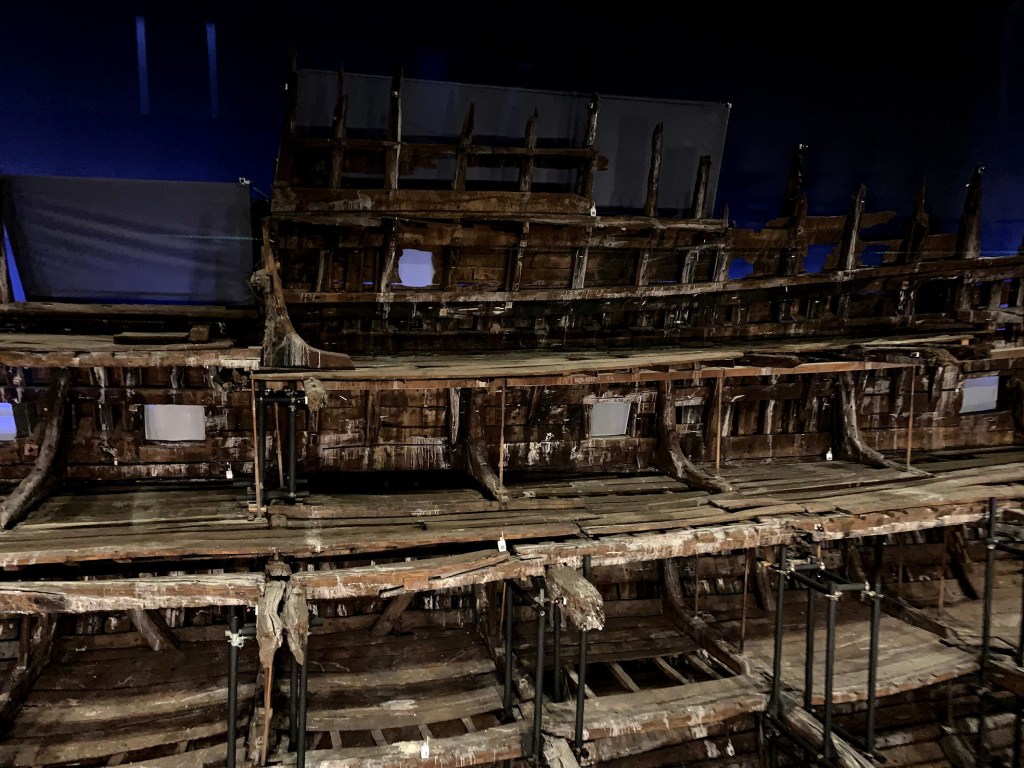
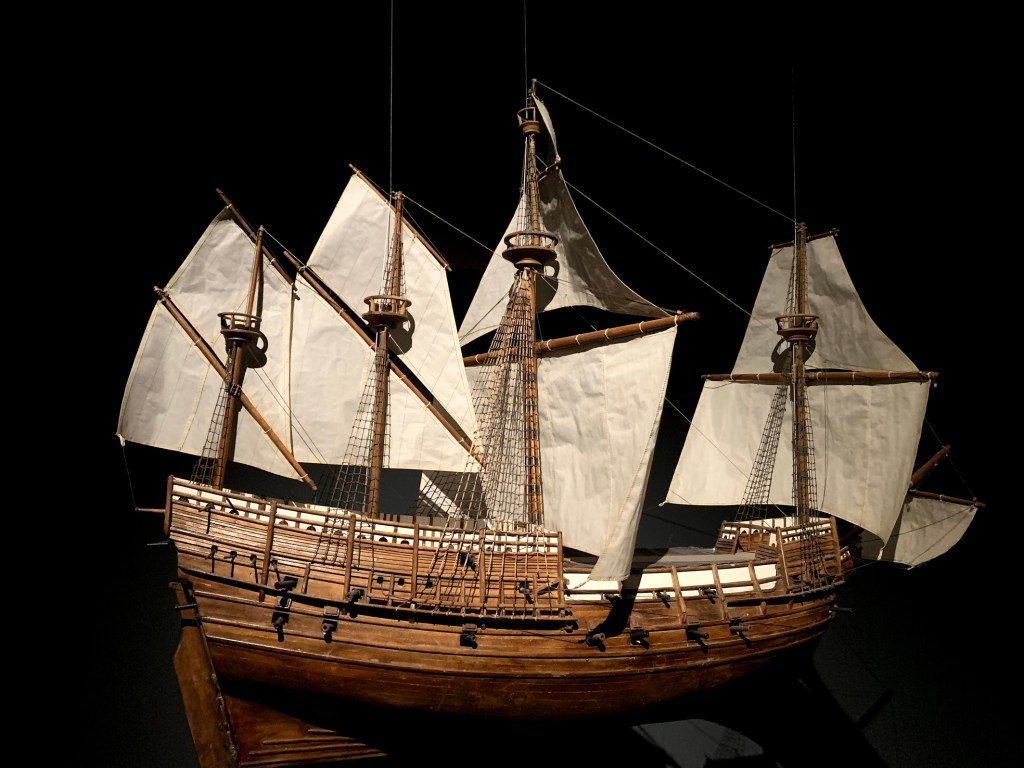
Built in 1510 when Henry VIII was a new king, The Mary Rose was his flagship and in service until it sank in the Battle of the Solent in Portsmouth Harbor, July 1545. The ship was named after Henry’s sister Mary and the Virgin Mary. Rose refers to the Tudor Rose. It could carry around 500 men and crew. Sadly the ship sank when they fired cannons on one side then went to fire on the other side, opened the hatches, and the wind caught the sails tipping the boat. Water rushed into the open gun hatches and she sank quickly…that combined with a few holes the French warship had made in The Mary Roses side. All hands, but 35 were lost at sea.

From the bow of the Mary Rose
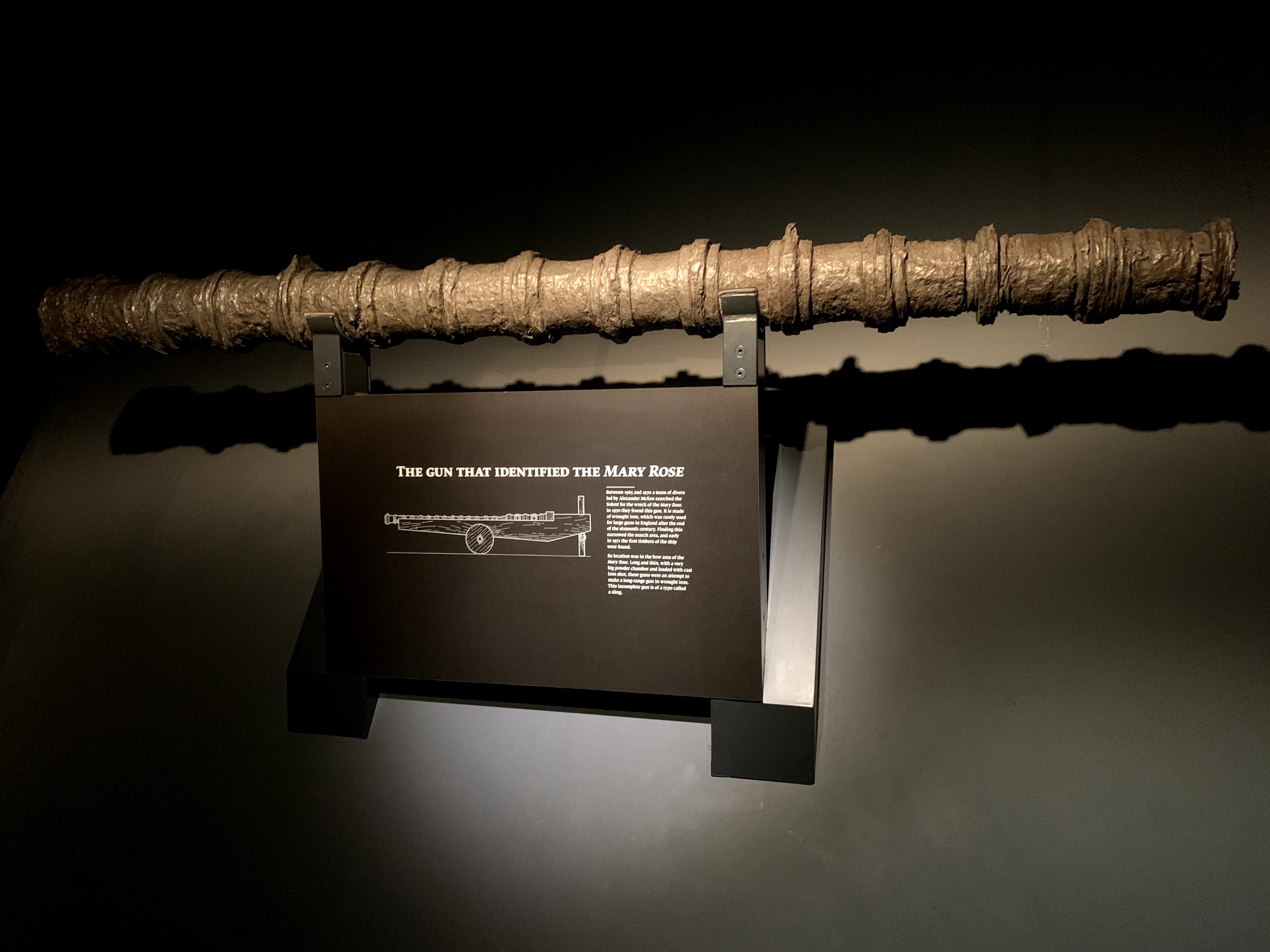
The caption reads that this gun was what divers first found helping them locate the ship
The Mary Rose

They tried to salvage her in 1545, but to no avail. In the 1800’s a few relics were un-watered, but it wasn’t until 1970 that divers un-watered a cannon that fit the description of the ship and recovery operations were begun. It has taken 40 years to salvage and preserve the ship and it’s 16,000+ artifacts. In 2016 the museum containing the preserved ship and relics was opened to the public.

Model of what The Mary Rose looked like
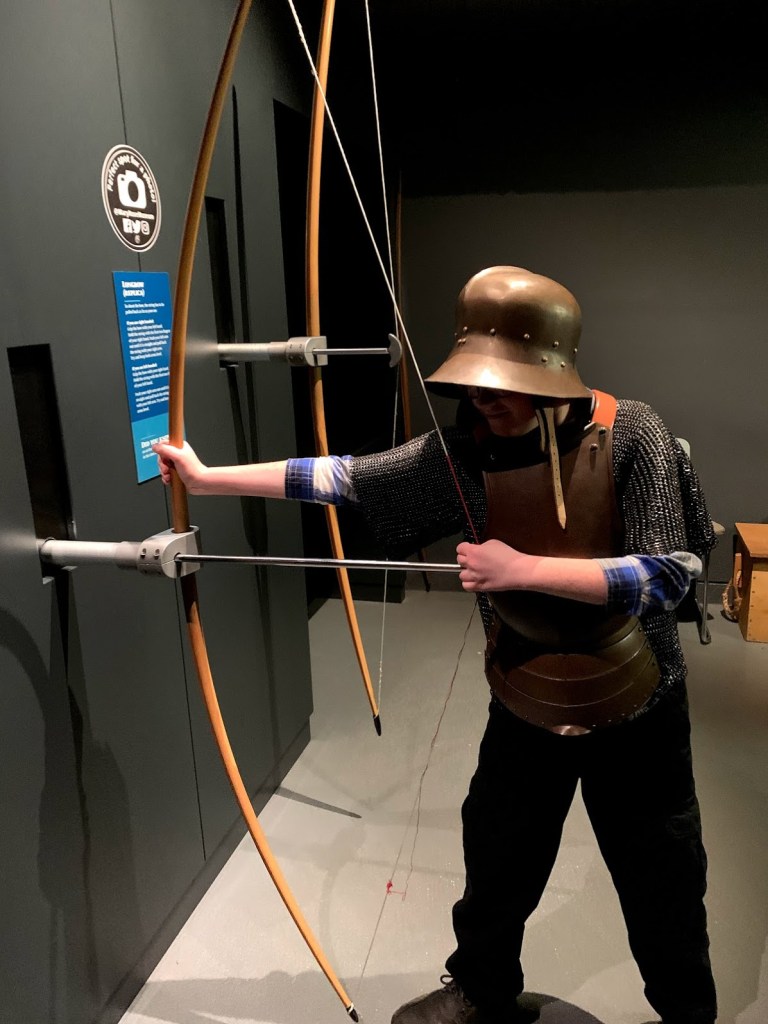
Practicing shooting a longbow

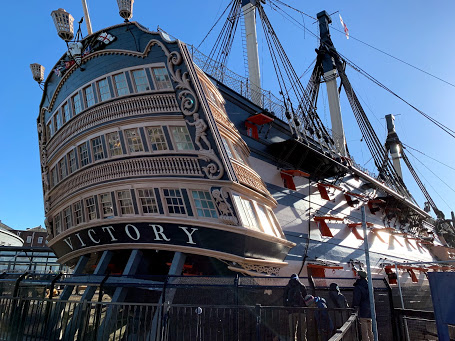
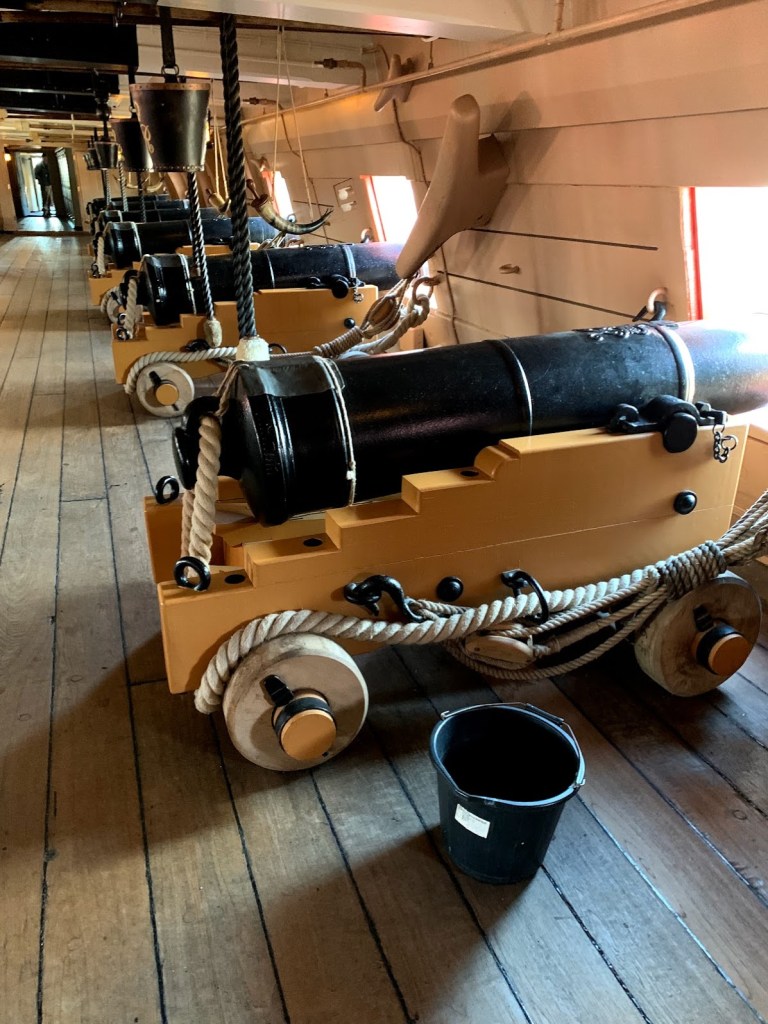
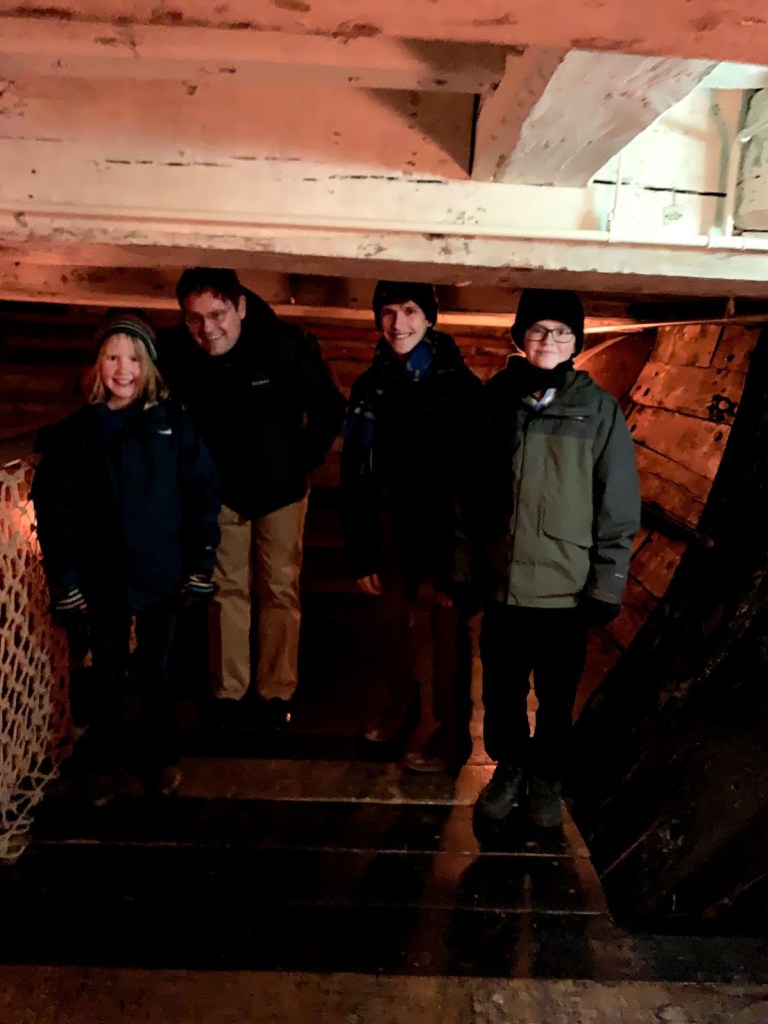
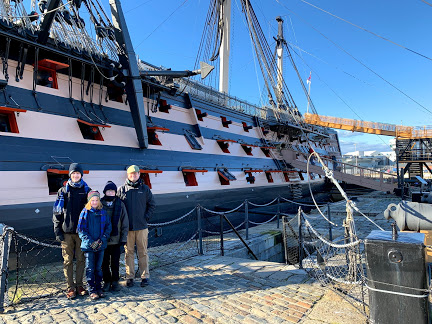
The HMS Victory was in the dry dock next to The Mary Rose Museum. This was the famous ship of Vice Admiral Horatio Nelson who won the Battle of Trafalgar in 1805, but sadly died aboard the ship of a gunshot. The 250+ year old ship still contains about ¼ of the original timbers from when the ship was refurbished in 1805 before setting out upon the seas. The HMS Victory was originally commissioned in 1765 by King George III and only 1/8 of those original parts remain. Most of the ship dates to it’s last refurbishment in 1814. It was amazing meandering through the various living quarters and gun decks. The further down you went into the belly of the ship the lower the ceilings. By the time we reached the hull Liam, Robert, and I could barely stand up! The Victory could carry upwards of 800 men and crew on a single voyage. It was truly a floating village.

HMS Victory
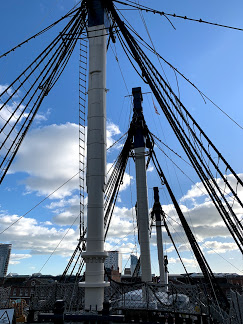
Masts and rigging
Gun decks
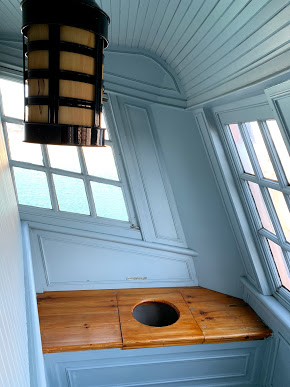
Vice Admiral Lord Nelson’s privy
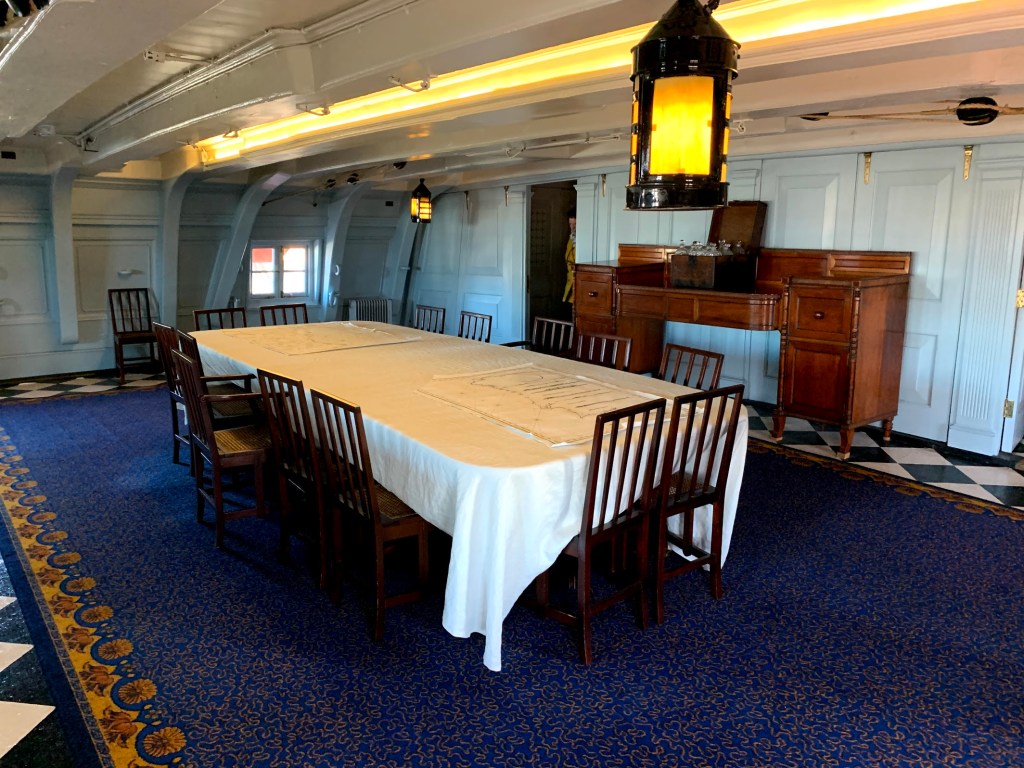
Vice Admiral’s quarters: The current Vice Admiral of the Royal Navy still holds dinner parties at this table!
Lower decks and low ceilings
HMS Victory

We made our way back across Portsmouth Harbor and began the 2 hour drive into central London. I have to say I am quite proud of Robert. It’s no easy task driving into the centre of one of the busiest cities in the world, but that is where the Enterprise carpark drop off was located! We unloaded our car listening to the rumble of trains leaving Waterloo Station just above our heads and walked about 10 minutes to our hotel. The Premier Inn London is located directly on the River Thames. The room even has a partial view of the river and the London Eye.

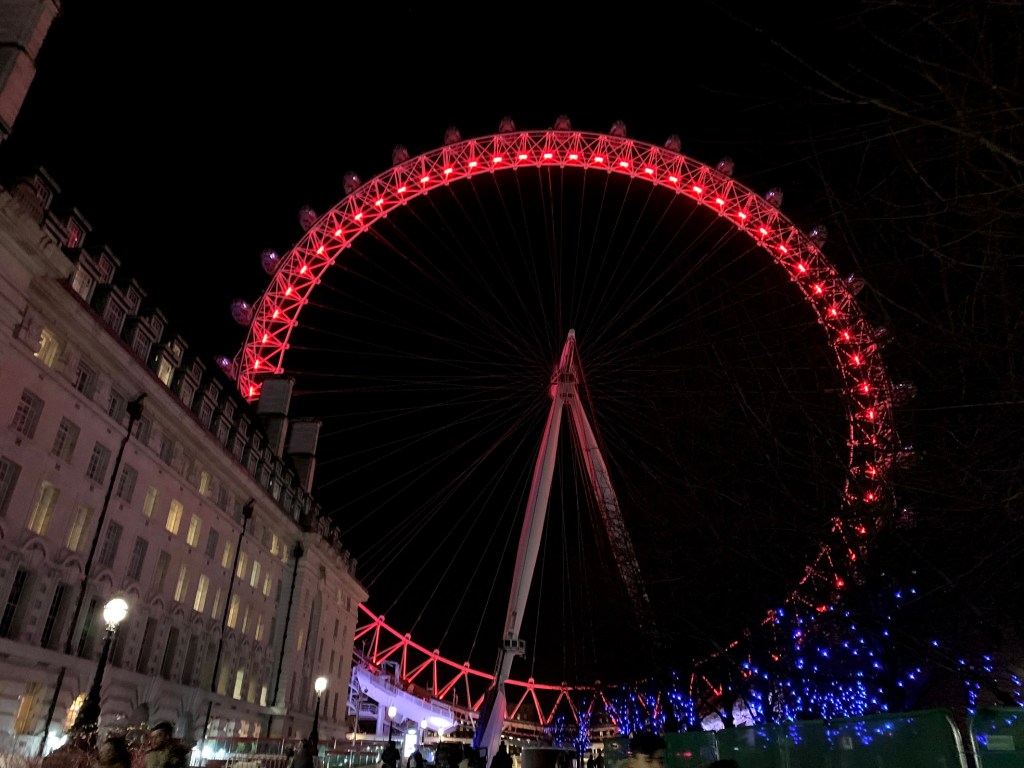
London Eye

Blow, Blow Thou Winter Wind

Yesterday we didn’t quite get to see all the sites associated with William Shakespeare so we drove about 5 minutes out of town to Shotterly Village where Anne Hathaway’s Cottage resides. She was Shakespeare’s wife. Anne was actually 8 yrs. older than William when they married. He was 18 and she 26. She was the daughter of a respectable local farmer and the two probably met at church or when their fathers’ gathered for town council meetings.

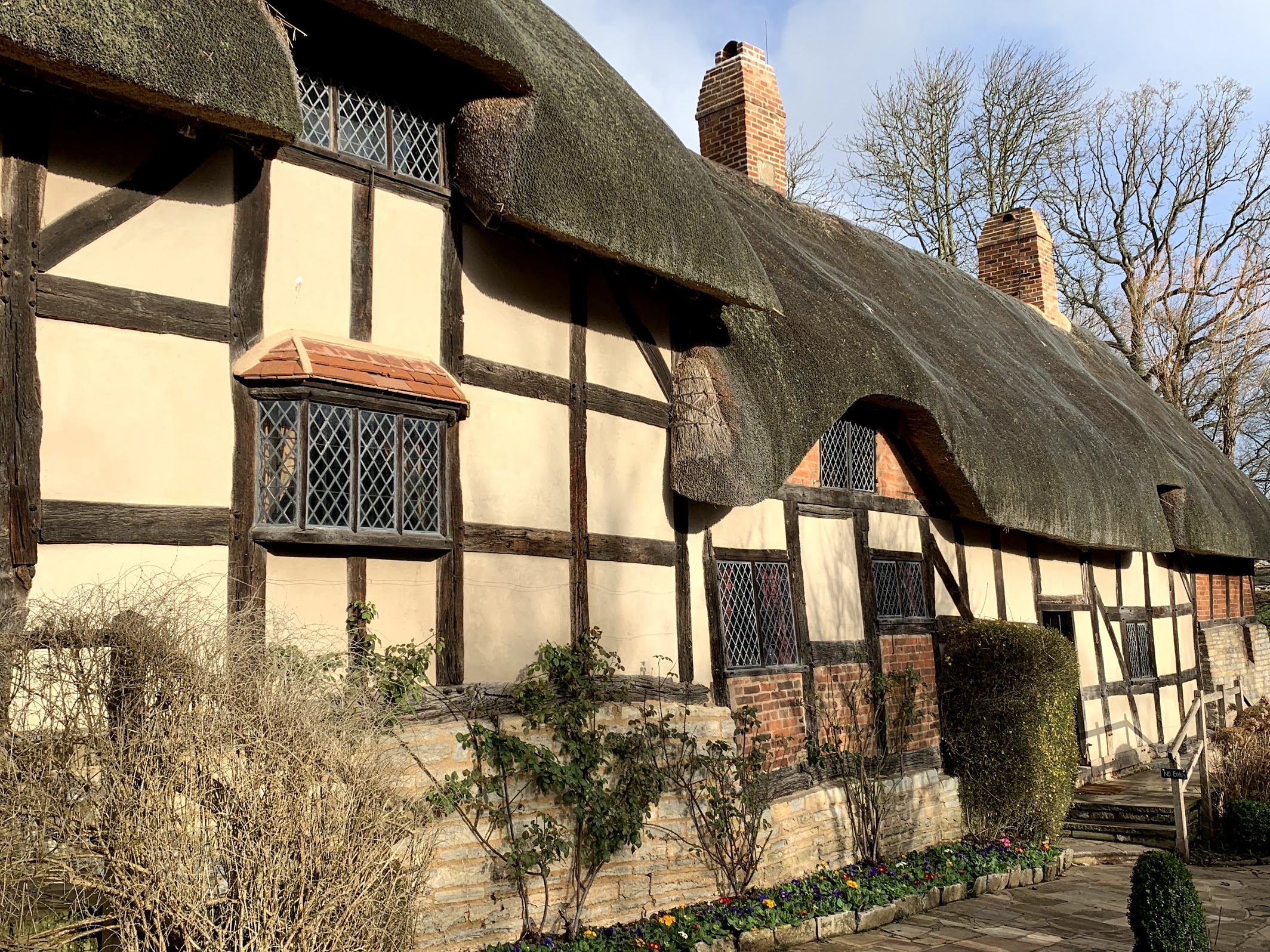
Anne Hathaway’s Cottage
Typical architecture of the era

The Hathaway’s Cottage stayed in the family until 1892 when Miss Baker, a spinster and the last remaining Hathaway heir, left the home to the Shakespeare Trust. The cottage was first built in 1463 and had major renovations in the mid 1500 to early 1600’s. Anne’s brother, Bartholomew tended and added rooms onto the property. He also legally bought the 90 acres the family had rented up until then, making him one of a few select freeman landowners in the area. Even though it is winter the gardens surrounding the house were still lovely to walk through, when one wasn’t being blown sideways by the powerful wind.

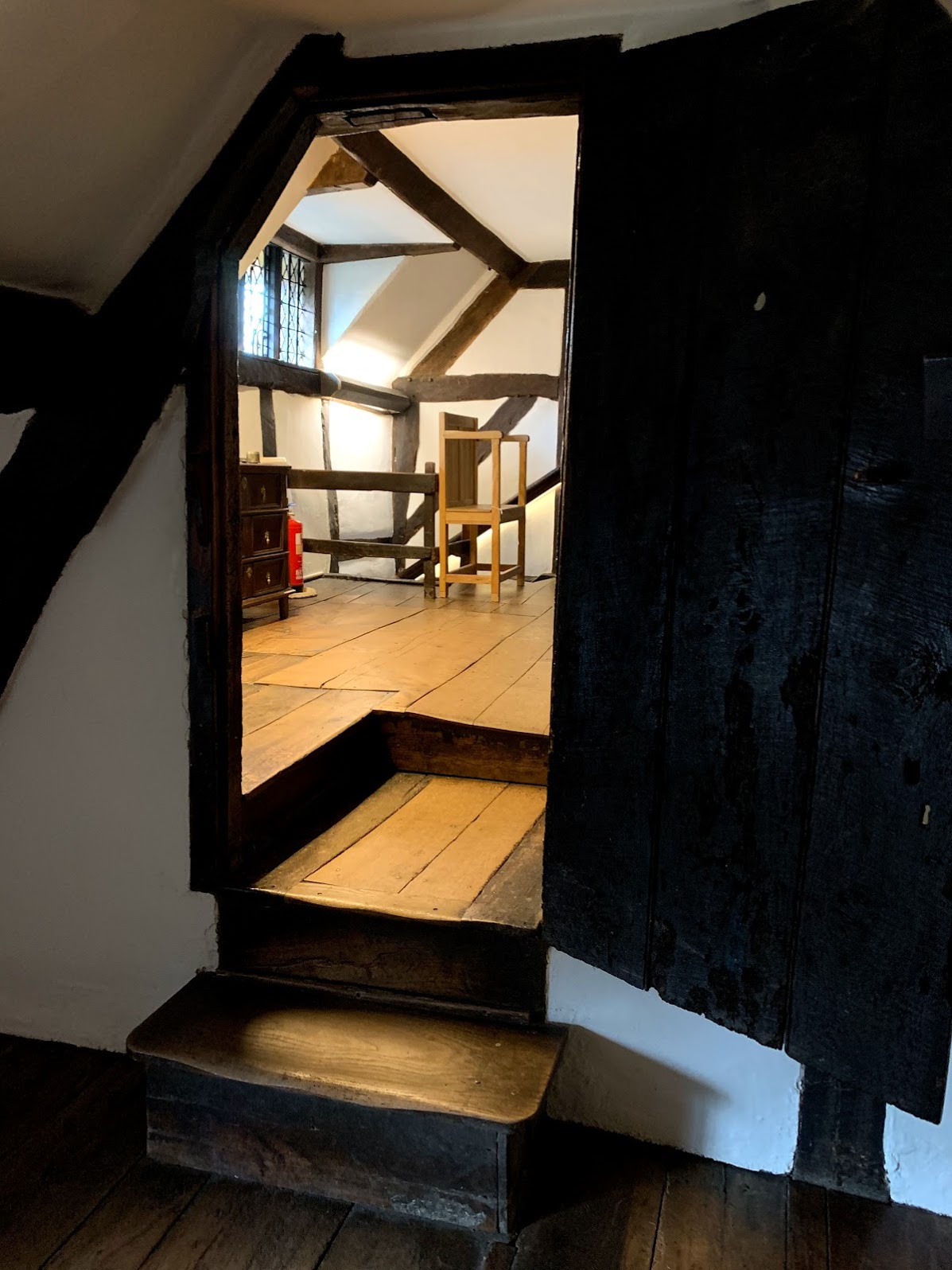
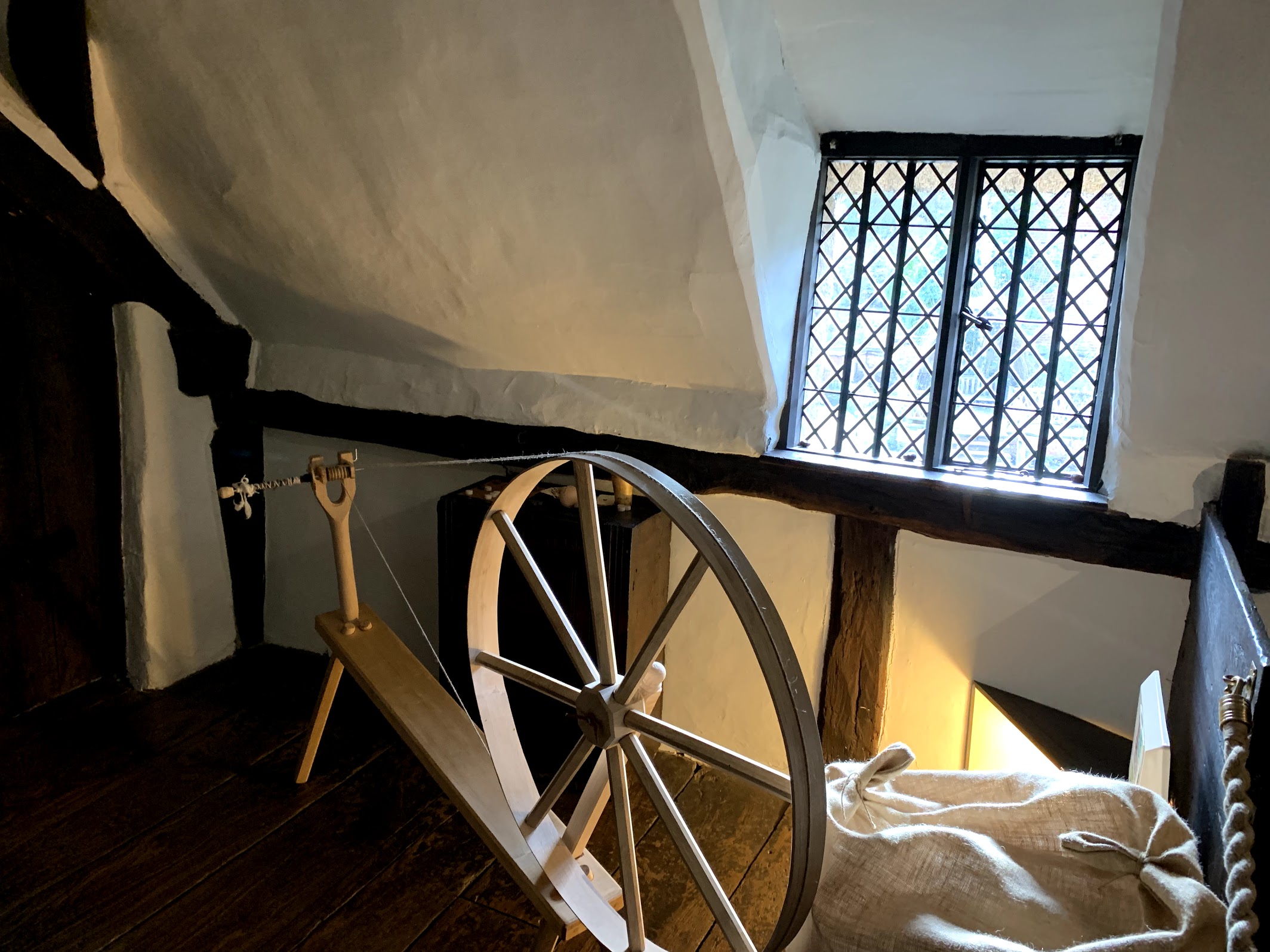
A lovely view by the window while spinning wool
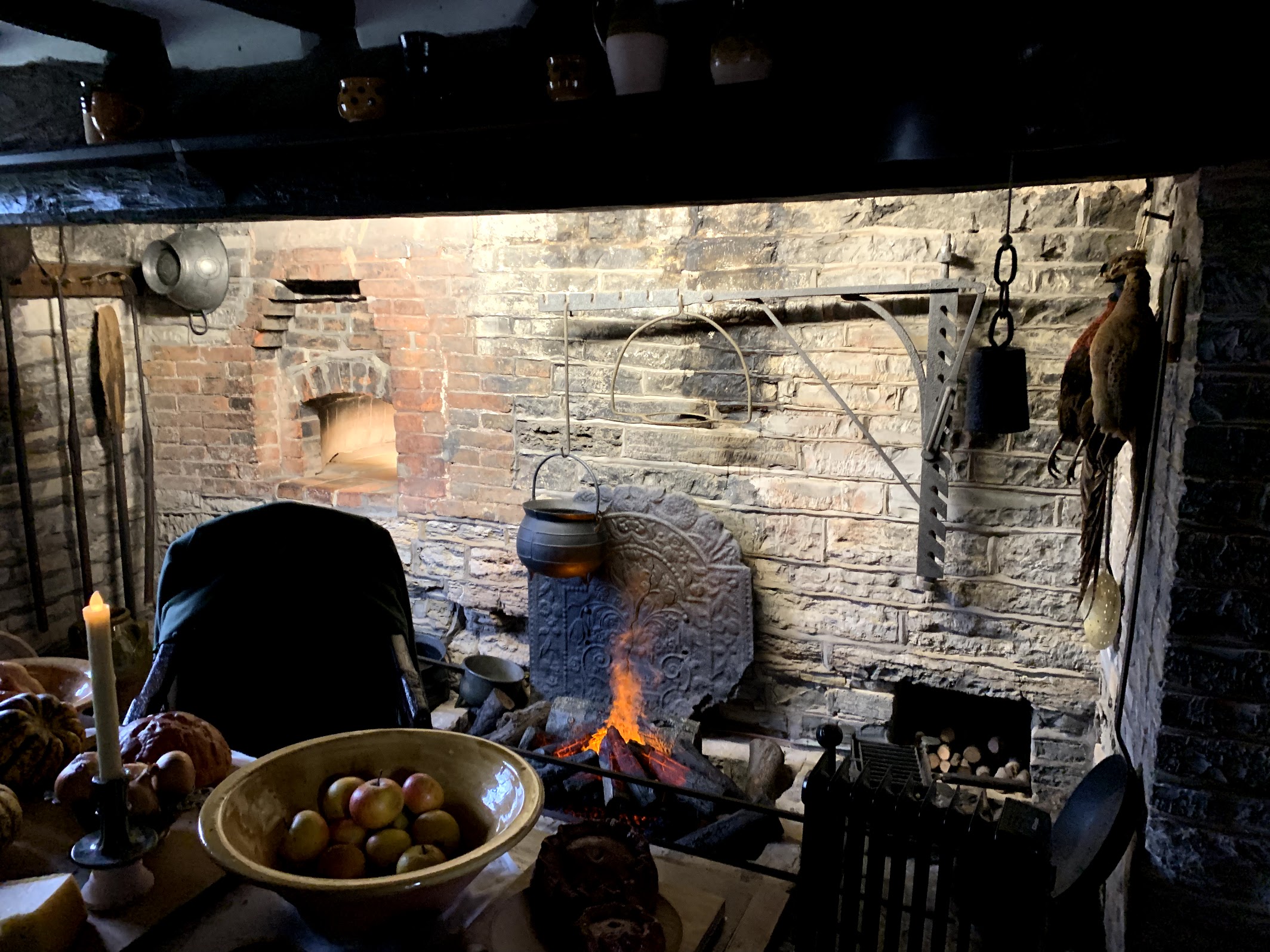
This fireplace was added in the late 1500’s. Originally the ceiling opened all the way to the thatch roof and there was a central ring pit fire. After the two chimneys were built they directed the fire smoke to one small center hall where the meat would be hung. You could still smell the smoke in the hallway!
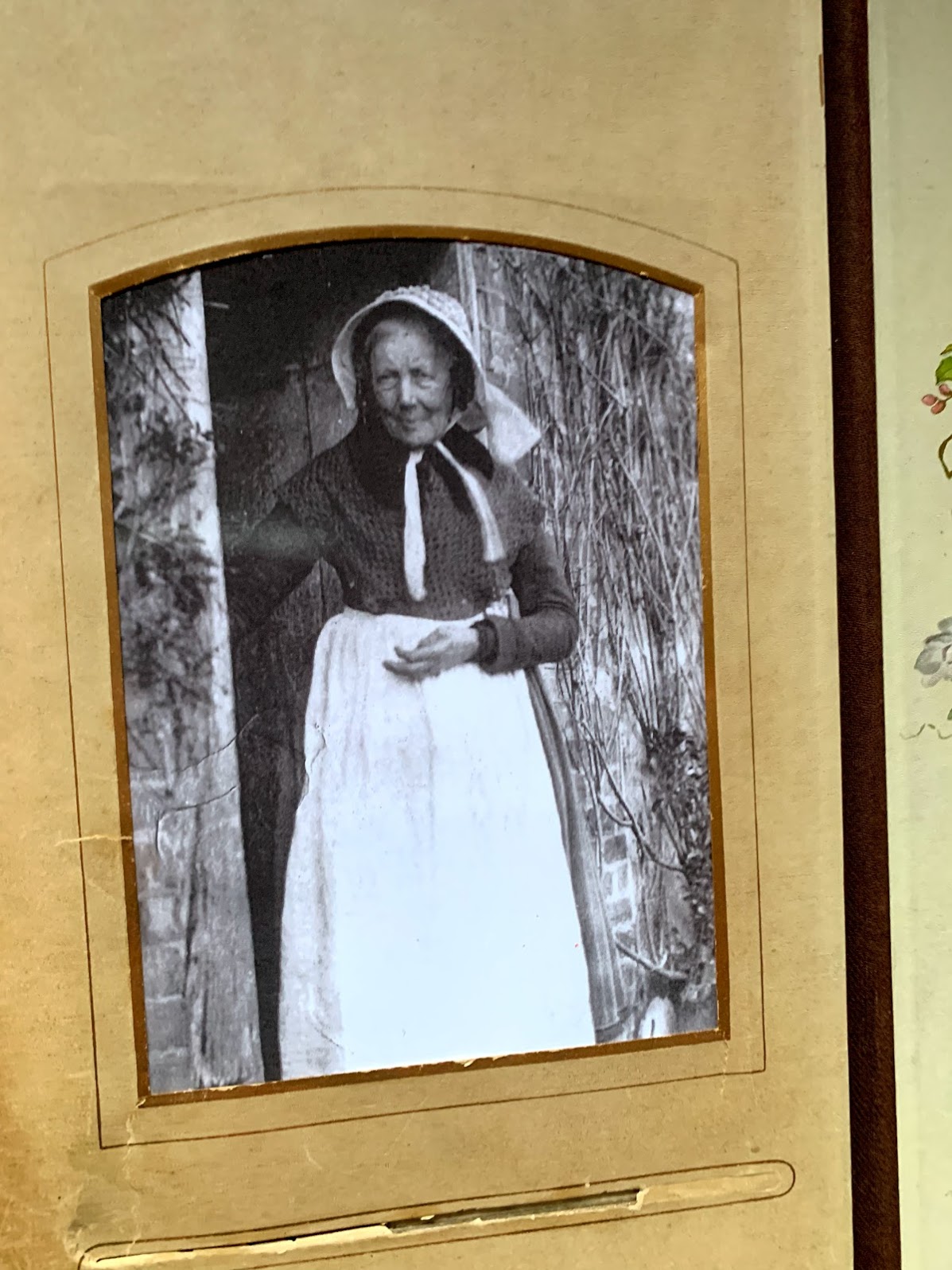
Miss Baker was the last Hathaway heir and lived in the cottage all her life

All day the wind blew fiercely! As we drove south through Oxford all the tree limbs and flags stood at attention. We expected to see Pooh Bear and Piglet fly by with a kite at any moment!

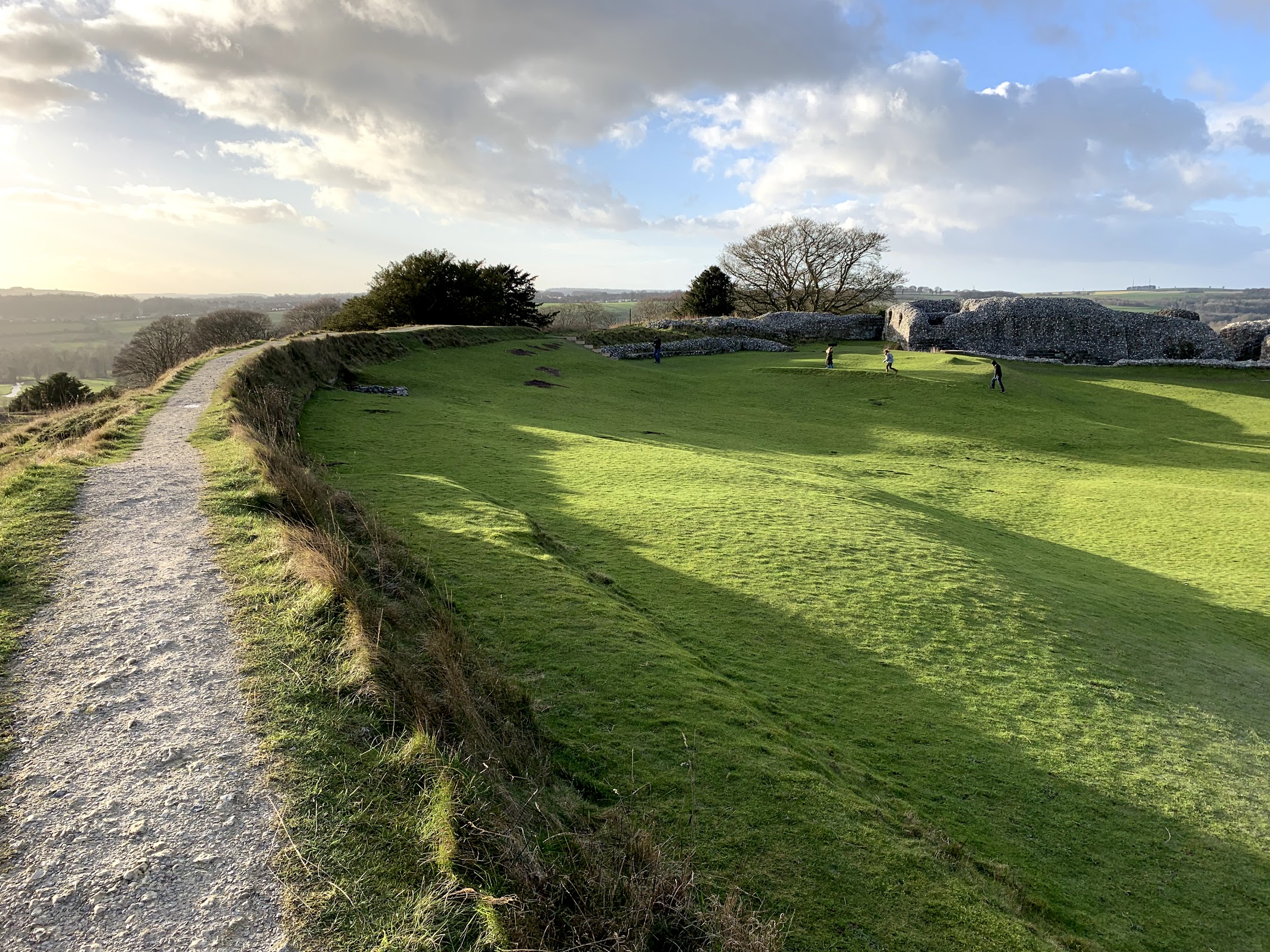
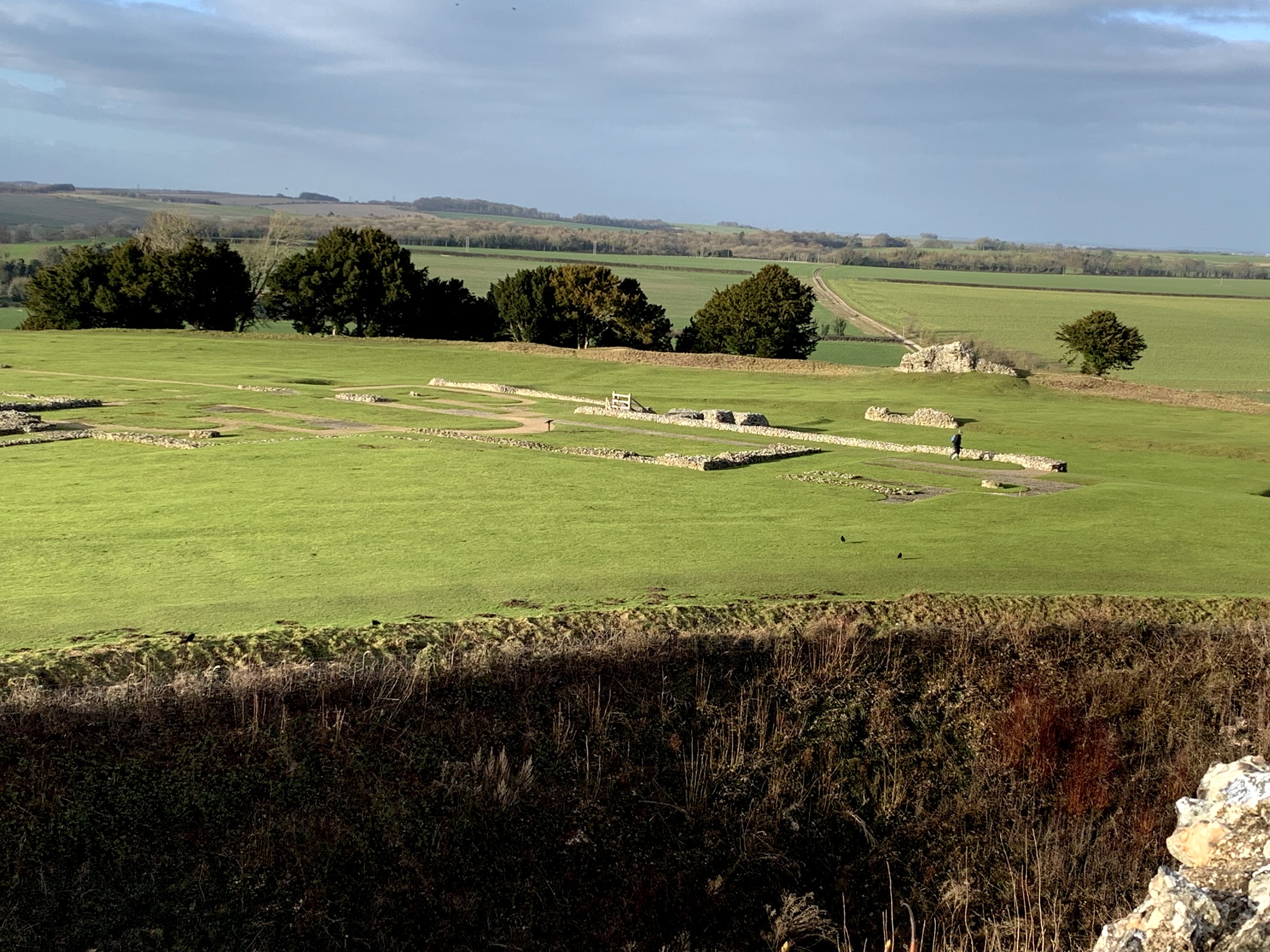
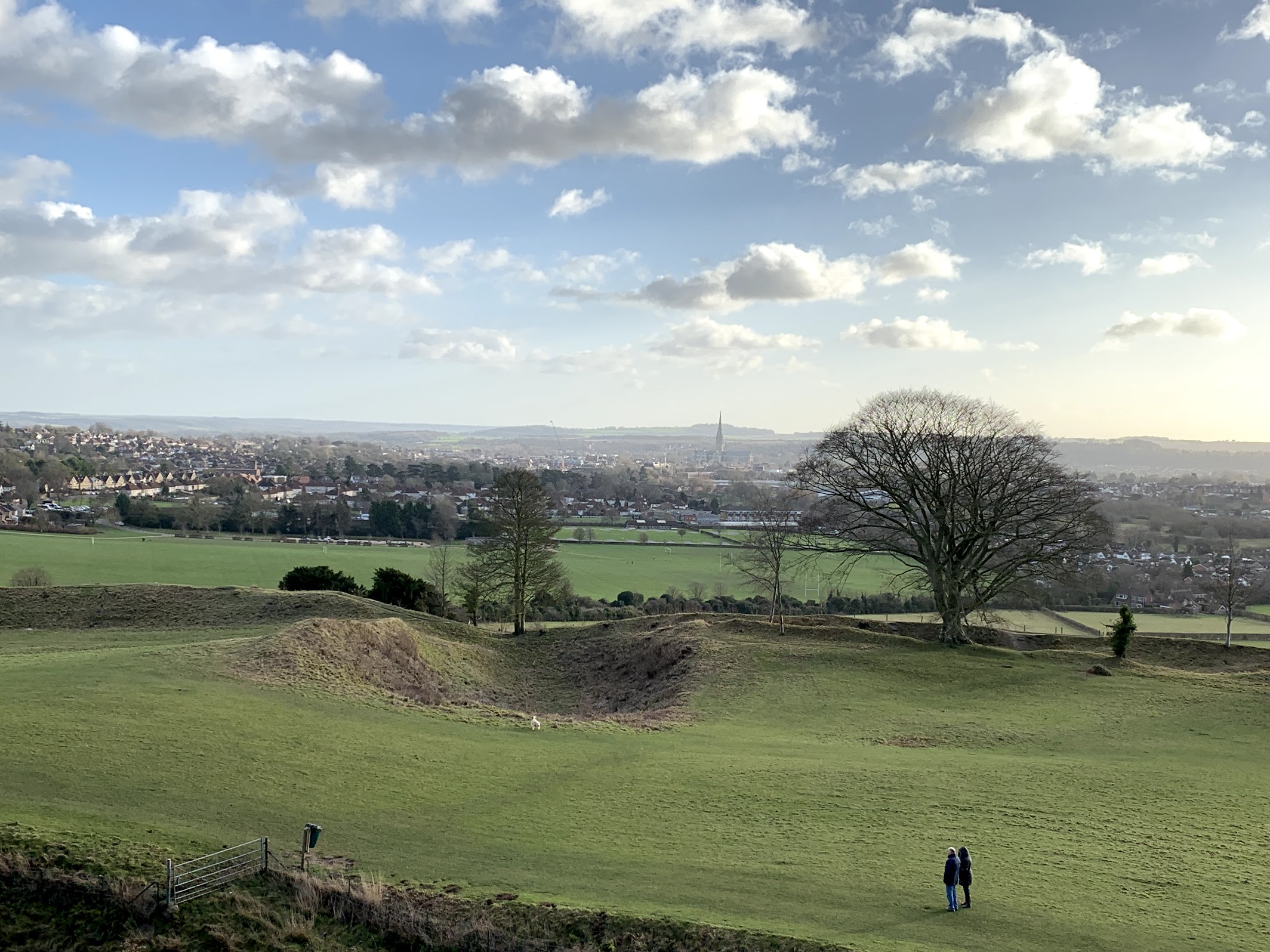
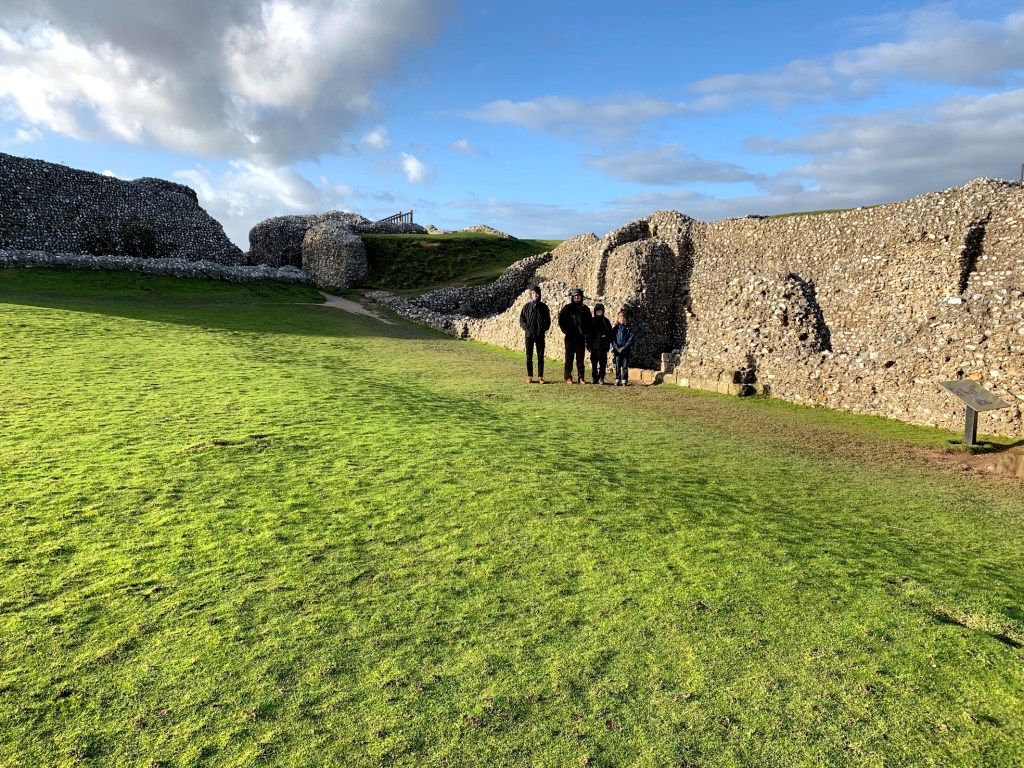
The wind pushed the clouds away and the intense brilliant winter sun shown forth in glory as we drove up to Old Sarum. A majestic ring of mounded earth rose up in front of us as we climbed the steep hill to the summit of this Iron Age Ring Fort. Of course Aeolus was still in a mood and about blew us from atop the earthen walls as we walked around. Old Srum was originally an Iron Age Ring Fort and then became a medieval fortress founded by William the Conqueror. It was a favorite southern castle and fortress for several English kings including Henry II. The original Salisbury Cathedral footprint can be seen in the fortress as well as the newer 16th century rebuild way off in the distance! Unfortunately Old Sarum fell into disrepair and ruin by the late 14th century.

Along the top earthen wall at Old Sarum. There were three such rings around the iron age fort.
Footprint of the 12th cent. Salisbury Cathedral
View of Salisbury and the Cathedral spire from the top of the fort
Inside the old castle at Old Sarum

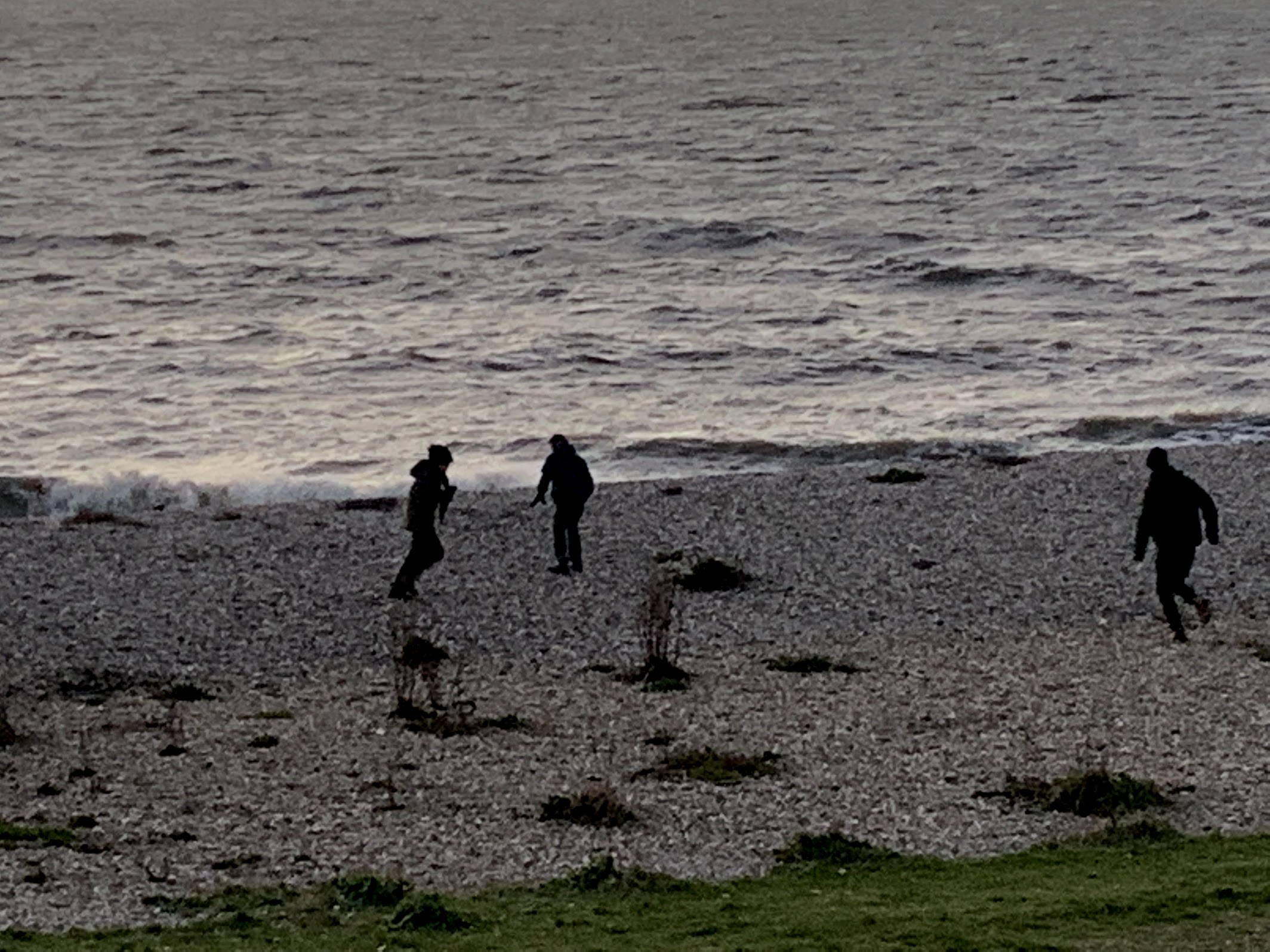
Our final encounter with the relentless winter winds was down along the seashore in Portsmouth. Our B&B is only about 3 blocks from the seashore. Before checking in, we took a few minutes to see the sun set over the Isle of Wight and the English Channel. The children explored the beach and found a few rocks and seashells. As the sun dipped below the horizon we found a nice warm pub/restaurant called “The Old Ship” and had a delicious WARM meal. As I write this, the wind is still whipping around the corners of the Leeward House B&B where we are spending the night.

Looking for seashells by the seashore
You can just see the Isle of Wight behind Seamus
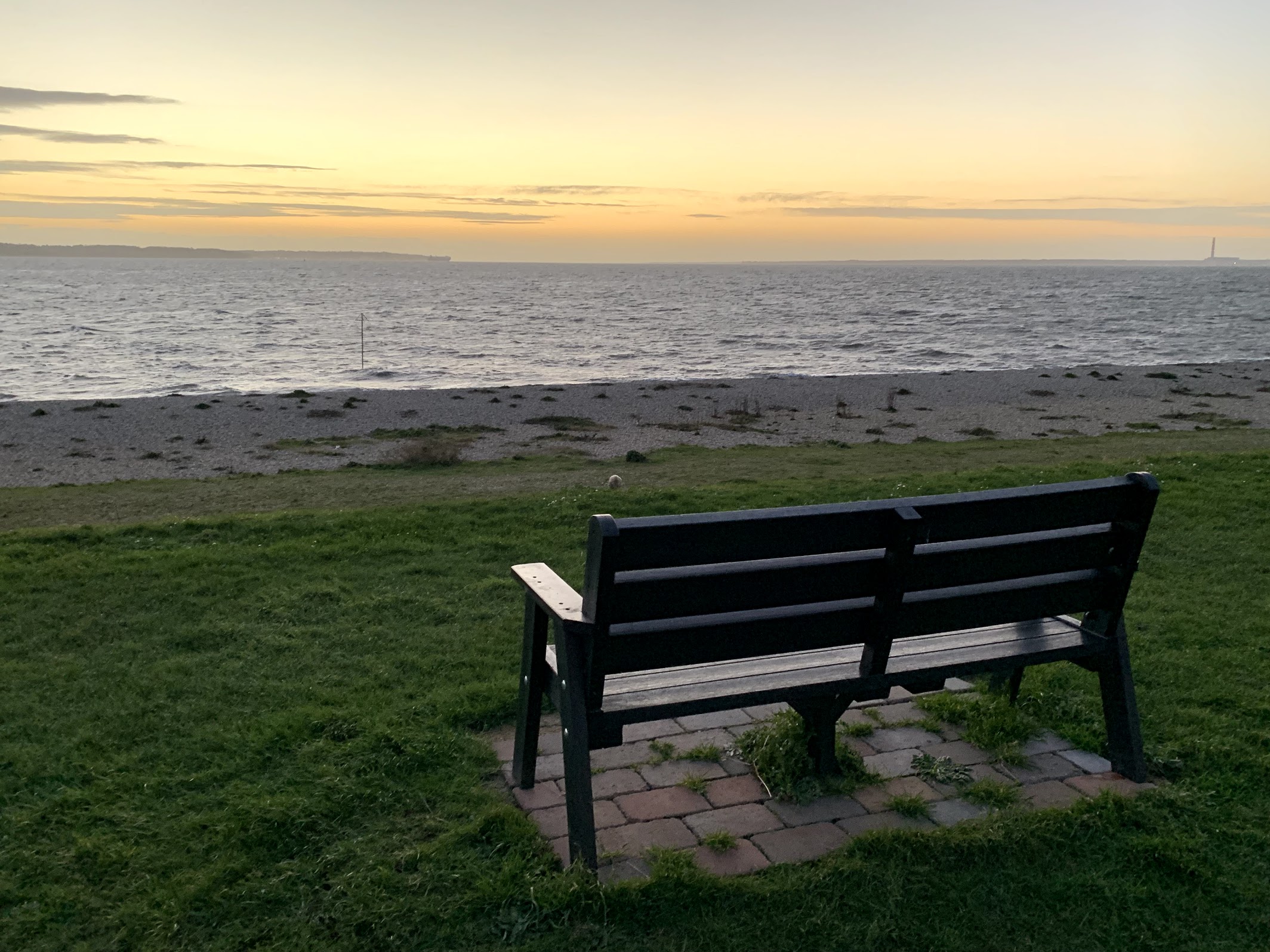
Sunset on the English Channel in Gosport a village near Portsmouth, England